
Google has officially updated its advertising policies to require clear disclosures for any ad content created or altered using generative AI that depicts realistic people or events. Effective immediately, the mandate forces advertisers using Google Ads to check a disclosure box when uploading synthetic media, a move designed to combat misinformation and maintain consumer trust as AI-generated creative becomes the industry standard.
Why it matters: This isn't just a Google problem. For social media marketing leads and agency strategists, this mandate serves as the first domino. Meta and TikTok are already testing similar labeling frameworks. If your creative workflow doesn't currently track which assets are 'synthetic,' you aren't just risking a Google ban—you're risking a total collapse of your cross-platform reporting and compliance when the rest of the industry follows suit.
TL;DR
- The Mandate: Google Ads now requires a disclosure for realistic AI-generated images, video, and audio.
- The Workflow Shift: Creative teams must implement 'Synthetic Media Logs' to track AI usage at the asset level before it hits the media buyer.
- Platform Parity: Expect Meta and TikTok to enforce identical standards by Q4 2026 to align with global regulatory shifts.
- Performance Risk: Early data suggests disclosure labels may impact initial CTR, requiring a shift toward 'AI-native' creative strategies.
The Google Mandate and the 'Realistic' Threshold
Google’s policy specifically targets content that could be mistaken for reality. If you use AI to remove a background or sharpen an image of a product, you’re likely in the clear. However, if you use Midjourney to generate a person holding that product, or ElevenLabs to clone a voice for a voiceover, the disclosure is mandatory. This distinction is critical because it moves the burden of proof from the platform's detection algorithms to the advertiser's upload process.
Ginny Marvin, Google’s Ads Liaison, recently clarified the platform's stance on AI search and qualified future conversions, emphasizing that transparency is foundational to how Google handles its evolving AI Search eligibility [S5]. While Marvin was speaking to search eligibility, the sentiment carries over to the creative side: Google wants to know what is real and what is generated to better qualify how users interact with that content.
For social buyers, this means the 'black box' of creative production must be opened. You can no longer accept a finished MP4 from a creator or an agency without a technical breakdown of how it was made. If a TikTok creator uses a 'Beauty Filter' that fundamentally alters their facial structure, does that count? Under Google's current definitions, probably not. But if they use a generative AI tool to swap the background to a realistic-looking beach in Bali, you are entering the disclosure zone.
Auditing the Creative Workflow from Brief to Buy
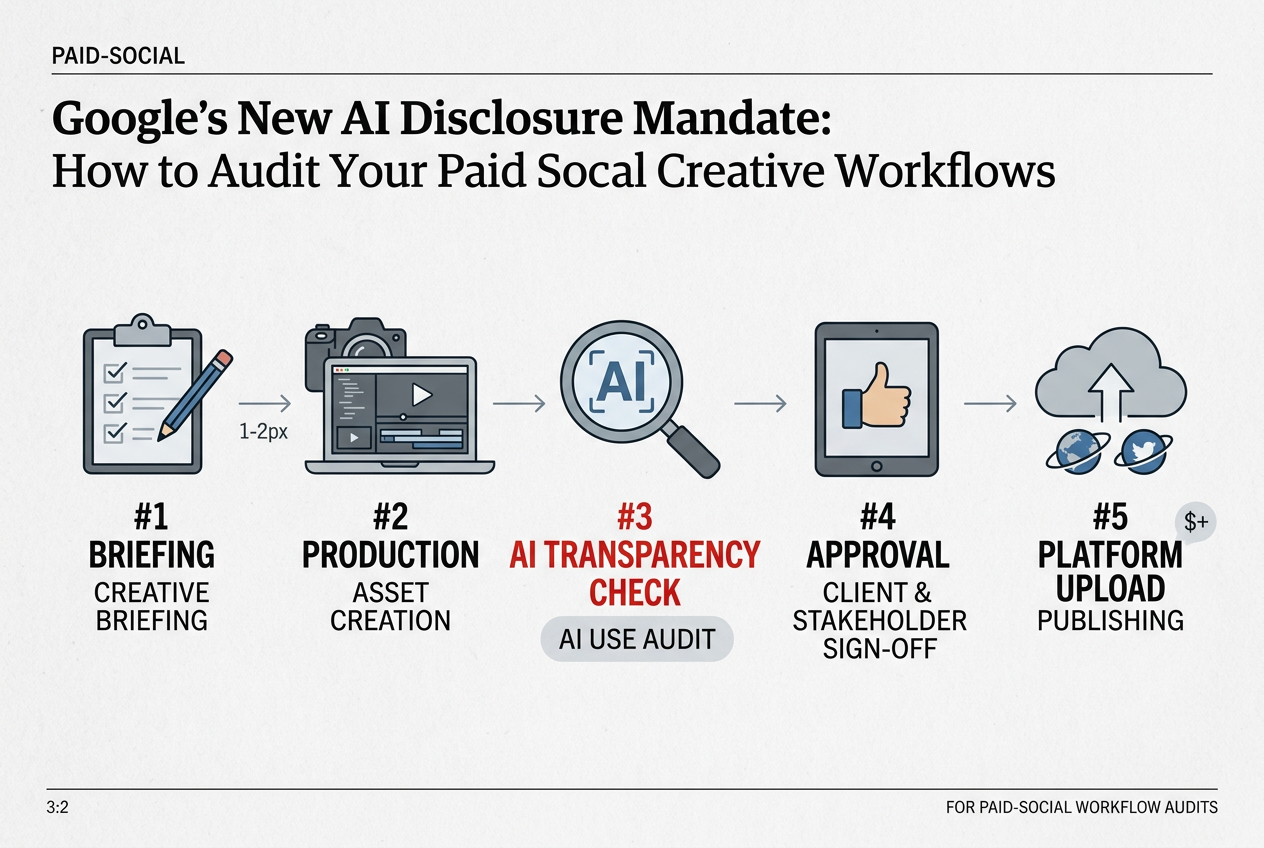
Most social media creative workflows are messy. A brief goes to an influencer or an in-house editor, a few versions are cut, and the final file is dropped into a Slack channel or a Frame.io project. This lack of documentation is now a liability. To audit your workflow, you must insert a 'Transparency Checkpoint' at the point of asset delivery.
Start by requiring a 'Metadata Declaration' for every asset. This isn't just about following the rules; it's about protecting your account standing. Agencies like those recognized as top TikTok marketing firms [S4] are already moving toward structured delivery folders that separate 'Clean' (non-AI) from 'Synthetic' (AI-enhanced) assets.
Consider this structure for your next audit:
- Origin Tracking: Did the creator use AI for the script, the visual, or the audio?
- Tool Documentation: Which specific tool was used? (e.g., Adobe Firefly, which includes Content Credentials, vs. tools that strip metadata).
- Disclosure Mapping: Does the asset require a permanent on-screen watermark, or just a platform-level toggle?
The Impending Shift on Meta and TikTok
While Google is the first to codify these rules into its primary ad policy, Meta and TikTok are not far behind. Meta has already begun labeling 'Imagined with AI' content across its organic surfaces. It is only a matter of time before the Meta Ads Manager (formerly Power Editor) includes a mandatory checkbox similar to the 'Special Ad Category' toggle for housing and credit ads.
TikTok is in an even more precarious position. Given its focus on 'authenticity' and the 'For You' page's reliance on human-centric content, the platform is highly sensitive to synthetic media that tricks users. TikTok’s current community guidelines already require creators to disclose AI, but the ad-side enforcement has been a 'soft launch' at best.
For the social buyer, this means your Google Ads AI disclosure strategy is actually your universal creative strategy. You should be building your 2026 budgets with the assumption that every platform will have a 'Synthetic' label. This impacts your creative testing. If you are running an A/B test between a real human and an AI-generated avatar, the AI version will soon have a label that the human version doesn't. That label is a variable you must account for in your performance analysis.
Impact on Performance Metrics and Consumer Trust
There is a prevailing fear among brand marketing leads that an 'AI-Generated' label will kill click-through rates (CTR). However, the reality is likely more nuanced. Much like the 'Sponsored' tag didn't kill social media marketing, the AI label will eventually become background noise. The immediate impact, however, will be on trust-sensitive verticals like healthcare, finance, and high-end beauty.
In these sectors, transparency is a feature, not a bug. If you are selling a skincare product using an AI-generated face, the lack of a label isn't just a policy violation—it's potentially fraudulent. Conversely, in entertainment or gaming, AI labels might actually signal innovation.
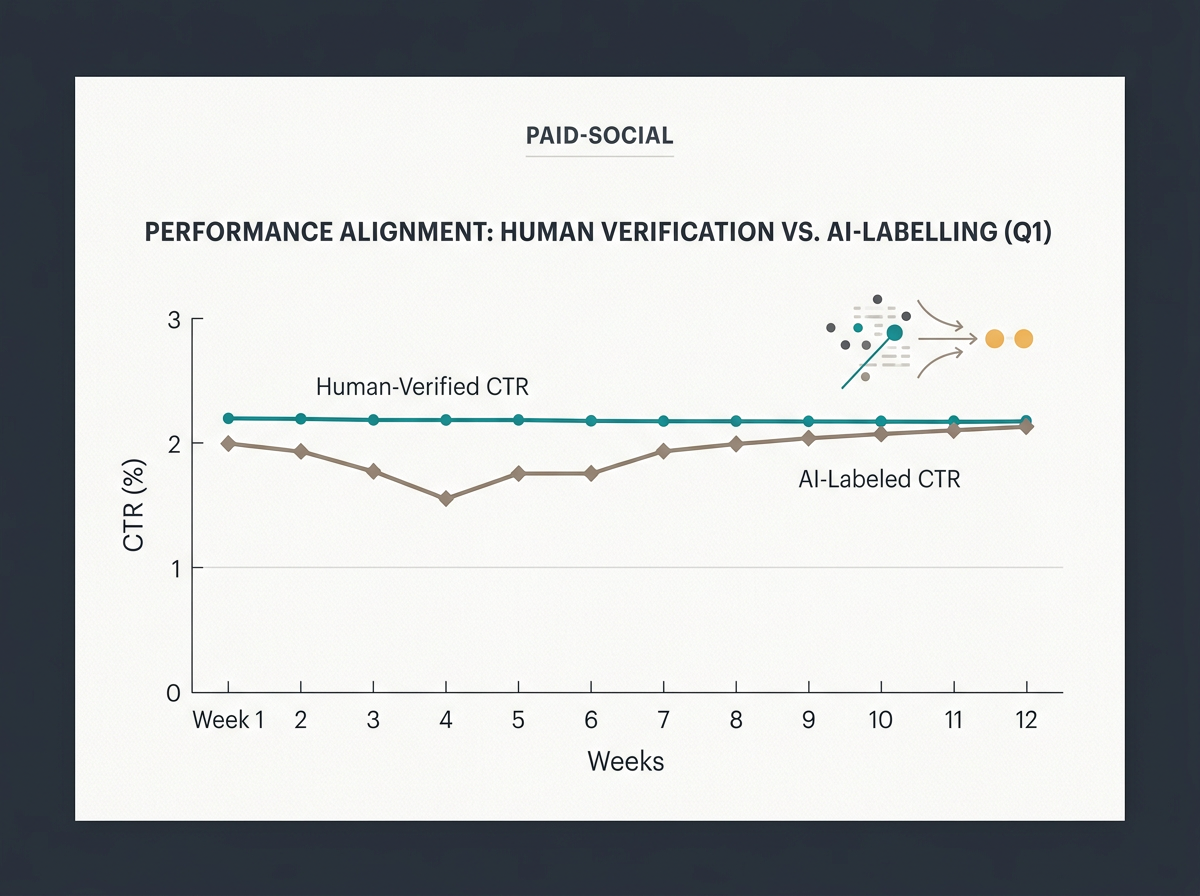
We are seeing a shift toward what some call 'GEO' or Generative Engine Optimization. While typically applied to search, the principles of justifying investment without perfect attribution [S1] apply here too. You may not be able to attribute a drop in CTR solely to the AI label, but you can track the 'Trust Delta'—the difference in conversion rate between labeled and unlabeled assets over a 90-day window.
Managing the Creator Relationship
As brands like MLS launch massive coordinated campaigns [S3], the complexity of managing hundreds of creator assets increases. If MLS CMO Radhika Duggal is overseeing the largest campaign in the league's history, you can bet that the legal and compliance teams are scrutinizing every frame for unauthorized AI usage.
When working with creators, you must update your contracts. The standard 'Work for Hire' clause is no longer sufficient. You need specific language regarding:
- Disclosure Indemnification: The creator must disclose if they used AI, or they are liable for any platform bans.
- Right to Edit: The brand must have the right to add disclosure labels without the creator’s further approval.
- Asset Provenance: Creators should be encouraged to use tools like Adobe's Content Authenticity Initiative to 'prove' the human element of their work.
This is particularly important on emerging platforms like Bluesky, where community-first networks and transparent feeds are the draw [S2]. On a platform where users have more control over what they see, being caught 'faking' content with undisclosed AI could lead to a brand being permanently blacklisted by the community.
Practical Steps for Tomorrow’s Campaign
Don't wait for a warning from your Google account rep. Start auditing today.
First, go back through your top-performing 20 assets. Identify which ones would require a disclosure under the new rules. If more than 30% of your top creative is AI-dependent, you have a high-risk profile.
Second, talk to your production partners. Ask them for their 'AI Transparency Policy.' If they don't have one, they aren't ready for the 2026 regulatory environment.
Third, begin 'Label Testing.' Manually add a small 'Created with AI' watermark to a few of your ads today. See how the audience reacts. If the performance remains stable, you’ve de-risked the upcoming mandatory labels. If performance craters, you have time to pivot back to high-quality human production before the platforms force your hand.

The Future of Synthetic Media in Paid Social
We are moving toward a bifurcated creative market. On one side, we will have 'Verified Human' content—likely commanding a premium price and higher trust scores. On the other, we will have 'Hyper-Optimized Synthetic' content—cheaper to produce, infinitely scalable, but clearly labeled as AI.
Success in this new era won't go to the brand with the best AI prompts, but to the brand with the most disciplined creative workflow. Transparency is no longer an ethical choice; it is a technical requirement for ad delivery. By auditing your social creative workflows now, you ensure that when Meta and TikTok inevitably follow Google’s lead, your campaigns won't skip a beat.
FAQ