
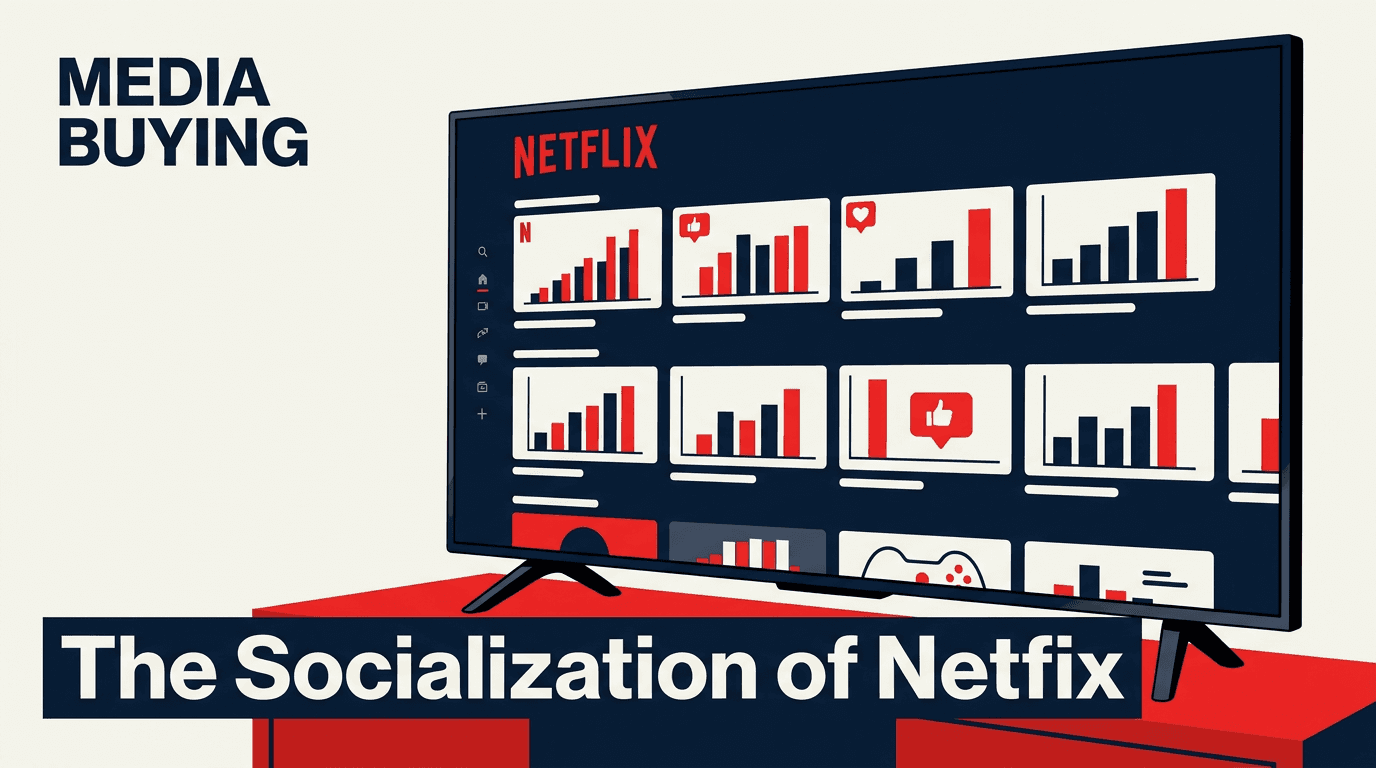
Is Netflix essentially becoming a very expensive, very exclusive social network without the comments? That is the question social media buyers are asking as we head into the 2026 upfront season. For years, the line between 'premium' streaming and 'social' video was defined by the quality of the content and the transparency of the data. One had the prestige; the other had the measurement. Now, those lines are blurring into a messy, high-stakes middle ground.
Why it matters: As Netflix moves toward private, direct-sold ad deals and simultaneously reduces the frequency of its viewership reporting, social buyers are being forced to re-evaluate where their next $1 million in video spend goes. If you can’t see the granular data, are you buying an audience or just a brand association?
TL;DR
- Pricing Parity: Netflix is aggressively positioning its CPMs to compete with YouTube Select, moving away from the $60+ launch pricing toward a more palatable $30-$40 range for bulk buys.
- Data Blackout: The platform is pivoting from bi-annual transparency reports to a 'trust us' model, mirroring the walled-garden approach of Meta and TikTok.
- Social Convergence: With the rise of short-form 'Netflix Moments' and social-style ad formats, the distinction between OTT and social video is becoming a matter of device, not intent.
The Netflix Pivot: From Transparency to Walled Garden
For the better part of three years, Netflix attempted to play by the rules of traditional television while boasting the tech-stack advantages of a Silicon Valley giant. They released bi-annual engagement reports—massive spreadsheets detailing exactly how many hours we spent watching Stranger Things or Bridgerton. It was a move toward transparency that social buyers, long frustrated by Meta’s shifting metrics, found refreshing.
That era is ending. According to reports from mid-July 2026, Netflix is in advanced talks to close major upfront deals while simultaneously signaling a pullback on these detailed viewership reports. They are moving toward a private-market model. In this setup, the 'public' doesn't get to see the scoreboard; only the advertisers paying the entry fee do.
This shift mimics the trajectory of TikTok. When TikTok first launched its ad platform, it was a wild west of experimental data. As it matured—evidenced by recent moves like Vendasta becoming a TikTok Channel Sales Partner in July 2026—the platform became more prescriptive about what data it shares and how it’s measured. Netflix is following the same playbook. They’ve realized that in the attention economy, scarcity of data can sometimes drive higher prices than an abundance of it.
Comparing the Math: Netflix vs. YouTube vs. Meta
If you are a social buyer used to the auction dynamics of Meta or the reserved inventory of YouTube Select, the Netflix upfront model feels like a throwback. But the numbers are starting to converge.
In 2024 and 2025, Netflix CPMs were the outlier, often hovering in the $50 to $65 range. For a social buyer used to $12 Reels CPMs or $25 YouTube Select placements, that was a tough pill to swallow. However, as we enter the 2026 cycle, Netflix has adjusted. By leaning into programmatic private marketplaces (PMPs), they are bringing effective CPMs down to the $30-$35 range for non-guaranteed inventory.
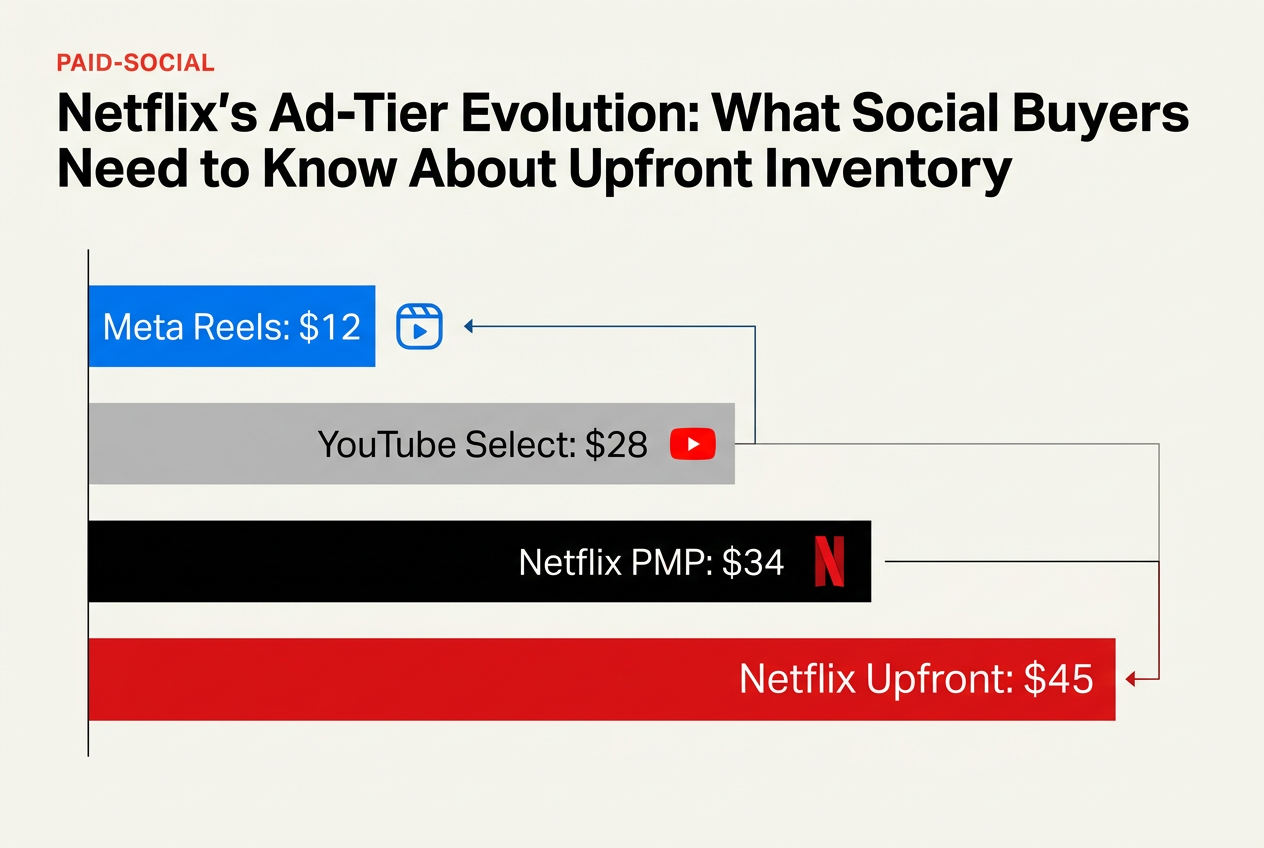
Let’s look at the hierarchy of intent and pricing:
- Meta Reels (High Intent/Low Cost): You’re paying for the algorithm's ability to find a buyer. CPMs are low ($10-$18), but the 'rub-off' effect of the content is minimal. You might appear next to a cat video or a DIY fail.
- YouTube Select (Mid-Tier): This is the closest competitor to Netflix. You’re buying the top 5% of content on the platform. CPMs sit at $25-$35. You get the 'big screen' experience via CTV, but with the granular targeting of Google data.
- Netflix Ad-Tier (Premium/High Cost): You are buying the cultural zeitgeist. CPMs are $35-$45. The trade-off is the lack of 'clickability.' This is a pure awareness and association play, much like the sports marketing strategies discussed at the July 2026 Adweek Sports Summit, where brands are learning to be 'spontaneously' present in cultural moments.
The 'Socialization' of OTT Ad Formats
Netflix isn't just changing how they sell; they are changing what they sell. We are seeing the introduction of 'Pause Ads' and 'Binge Ads' that feel remarkably like social story sequences. A 'Binge Ad'—where a user sees a custom brand message after watching three consecutive episodes—is essentially a sequenced social campaign delivered in a lean-back environment.
Social buyers are uniquely qualified to manage these. Why? Because social buyers understand frequency capping and creative fatigue better than traditional TV buyers. In the social world, we know that showing the same 15-second spot to a user four times in an hour is a recipe for brand resentment. Traditional TV buyers are used to 'tonnage.' Netflix’s new ad-supported tier requires a social-first mindset: high-quality creative that changes based on the user's journey through a series.
[INTERNAL: How to optimize creative for high-frequency social environments -> social-ad-creative-fatigue-guide]
Furthermore, the tech stack is catching up. Netflix has been building its own ad-tech platform to move away from its initial reliance on Microsoft. This allows for the kind of 'spontaneous' brand integration that social platforms excel at. If a show like Squid Game suddenly trends, social buyers are used to pivoting budget in 24 hours. Netflix is finally building the infrastructure to allow that same agility in the streaming space.
The Data Vacuum: How to Measure Without the Spreadsheets
With Netflix scaling back its bi-annual reports, how do social buyers justify the spend? The answer lies in third-party verification and 'Social Lift' metrics.
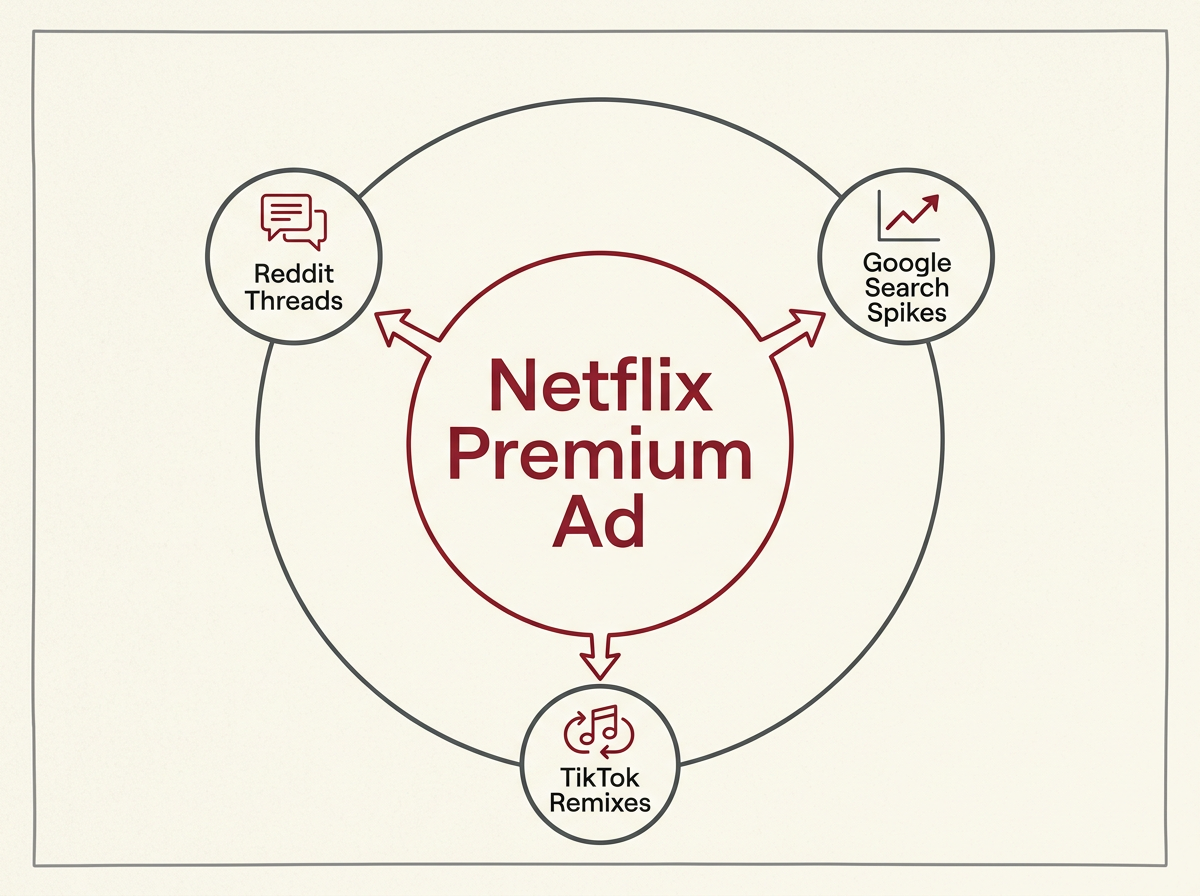
When a brand runs a significant campaign on Netflix, we don't just look at the Netflix dashboard. We look at the search volume on Google and the sentiment shifts on Reddit. As noted in recent analysis of multi-location visibility, AI search tools like Google's Gemini (even with its internal delays) are increasingly citing Reddit as a primary source of 'truth' for brand reputation.
If your Netflix ad is working, people will talk about it on social. The 'Netflix Effect'—where a product featured in a show sells out instantly—is the ultimate attribution model. For social buyers, the strategy is to buy Netflix inventory as the 'fire' and use social spend as the 'oxygen.' You run the high-CPM ad on Netflix to build the prestige, then immediately retarget those same lookalike audiences on Meta and TikTok to drive the conversion.
What This Means for Your 2026 Strategy
If you are managing a social budget, you can no longer ignore the upfronts. But you shouldn't approach them like a traditional media buyer. Here is how to apply this shift to your 2026 planning:
1. Treat Netflix as Your 'Top of Funnel' Social
Don't look at Netflix as a TV buy. Look at it as a way to buy the 'prestige' that social platforms often lack. Use it to launch a brand narrative, then use the data from those campaigns to inform your creative hooks on Reels and TikTok. If a specific creative angle performs well on the big screen, it will likely resonate in a 9:16 format.
2. Demand Programmatic Access
Avoid the 'handshake' deals of the traditional upfronts unless you are a global brand like Coca-Cola or Nike. For most agency-level social buyers, the value is in the PMP (Private Marketplace). This gives you the flexibility to turn spend on and off based on performance—a core competency of any social manager.
3. Focus on 'Cultural Moments' Over Hours Watched
Since Netflix is pulling back on viewership hours, shift your KPIs. Focus on 'Share of Voice' during premiere weeks. Use tools like Brandwatch or Talkwalker to measure the social resonance of the shows you are appearing in. If the show is trending on X (formerly Twitter) or TikTok, your ad is gaining 'earned' impressions that Netflix doesn't charge you for.
Measuring the impact of earned media in social campaigns
4. Prepare for the 'Spontaneity' Gap
As discussed in [S3], the future belongs to brands that can react. If Netflix allows for more real-time ad insertion in its live events (like the upcoming sports broadcasts), your social team needs to be the one running those ads, not the traditional TV team. The social desk is already built for 'real-time'; the TV desk is built for 'six months out.'
The Bottom Line
Netflix’s evolution into a less transparent, more social-like ad platform is a signal that the 'Streaming Wars' have moved into a new phase. It’s no longer about who has the most subscribers; it’s about who has the most valuable ad inventory. For the social media buyer, this is an opportunity to move 'upstream.' By applying the rigorous testing and attribution models of social to the premium environment of Netflix, you can capture a level of brand authority that a standard Facebook ad simply can't provide.
The data may be getting darker, but the strategic path is getting clearer: buy the prestige, then socialise the results.
FAQ