
How do you measure success when the search result is a single paragraph instead of a list of ten links? This is the question currently keeping SEO leads and brand strategists awake. For two decades, we’ve relied on 'Position 1' as the ultimate trophy. But in a world where Perplexity, Gemini, and SearchGPT synthesize answers into a cohesive narrative, being first doesn't mean what it used to. If your brand is mentioned in the text but your link is buried in a footnote, did you win or lose?
This shift marks the transition from Search Engine Optimization (SEO) to Answer Engine Optimization (AEO). In this new landscape, the metric that matters isn't ranking—it's Citation Share.
TL;DR
- Citation Share is the percentage of generative search responses for a specific topic that explicitly reference your brand or content as a source.
- Traditional rank tracking is failing because AI models often aggregate data from multiple sources to form one answer.
- AEO requires a shift toward 'structured authority'—ensuring your data is easily ingestible by LLMs while maintaining brand voice.
- New tools from HubSpot and others are finally making these metrics quantifiable for the average marketing team.
The fundamental shift from indexing to synthesis
To understand why we need a new dashboard, we have to understand the mechanical shift in how users find information. Traditional search engines are librarians; they point you to the shelf where the book lives. AI answer engines are researchers; they read all the books on the shelf and write you a summary.
When Google's classic algorithm ranks a page, it looks at signals like backlinks, page speed, and keyword density. When an LLM (Large Language Model) like Gemini or Claude processes a query, it isn't just looking for the most relevant page—it's looking for the most reliable fact. If your brand provides that fact, you become a citation. If you are just another blog post repeating the same generic advice, you are ignored.
We are seeing this play out in real-time across social commerce as well. According to [S3] glossy.co, TikTok’s comments section is driving the majority of first purchases right now because users trust the synthesized 'consensus' of the crowd over the brand's own claims. AI search operates on a similar principle of consensus. If multiple high-authority sources cite your data, the AI is more likely to include you in its final response.
Defining Citation Share: The new North Star
If traditional SEO is about 'Share of Voice' in a crowded room, Citation Share is about 'Share of Influence' in a private conversation. We define Citation Share as the frequency with which an AI engine identifies your brand as a primary source for a specific cluster of queries.
Imagine a user asks Perplexity: "What are the best LinkedIn marketing strategies for small businesses in 2026?" The AI might pull from Sprout Social's 2026 guide [S2] and a few industry case studies. If Sprout Social appears in the footnotes of 8 out of 10 similar queries, their Citation Share is 80%.
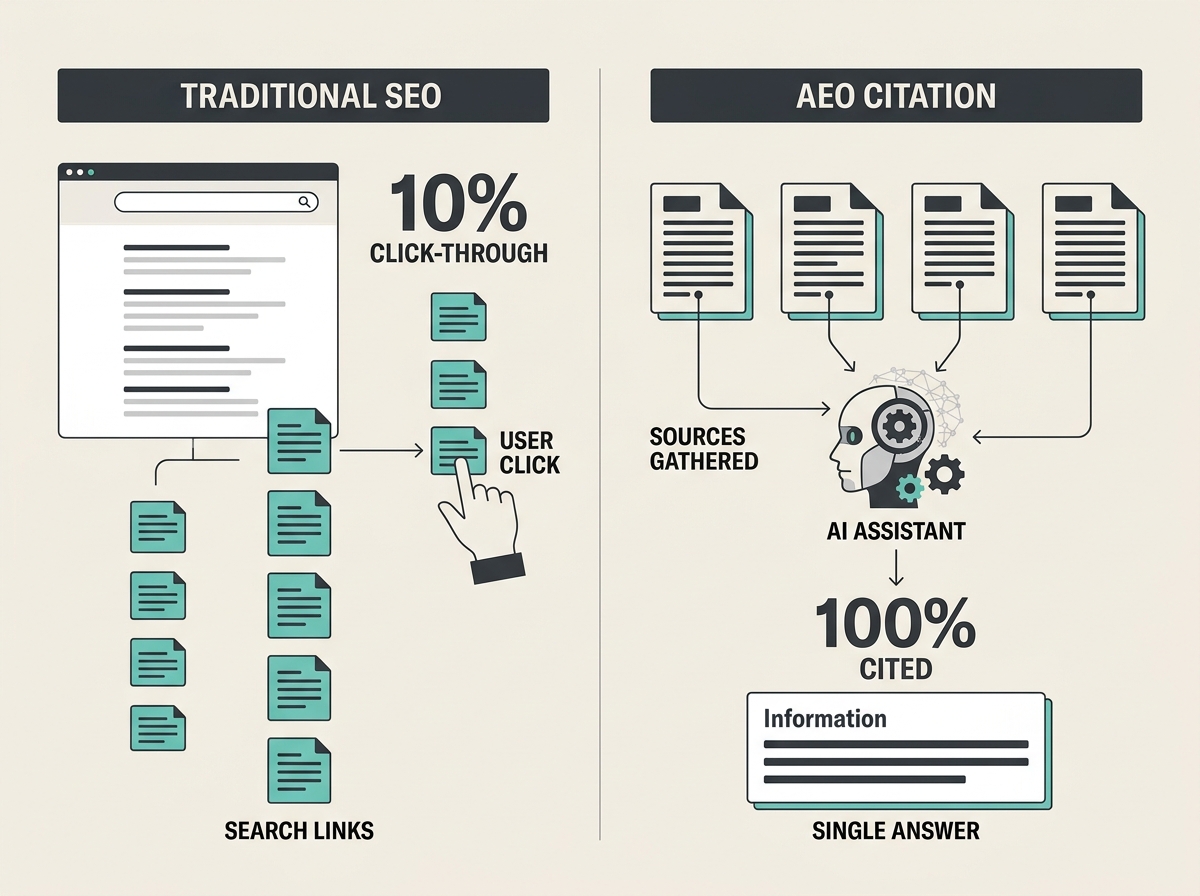
This is fundamentally different from a keyword ranking. You could rank #1 for the keyword "LinkedIn marketing" but have a 0% Citation Share if the AI decides your content is too gated, too thin, or too promotional to be used as a source for its generated summary. The AI model is effectively a gatekeeper that rewards clarity and factual density over 'dwell time' or 'click-through rate'.
Why traditional SERP tracking is lying to you
For years, we’ve used tools like Semrush or Ahrefs to tell us we are 'winning' because our blue link is at the top. But if 60% of users are getting their answer directly from the AI-generated box at the top of the page (Zero-Click Searches), your #1 ranking is essentially a ghost.
Furthermore, the 'Position 1' in an AI search result is often a hallucination-prone summary that might not even mention the top-ranked organic link. We are seeing a decoupling of organic rank and AI citation. A study of early SGE (Search Generative Experience) results showed that the sources cited in the AI overview only overlapped with the top 10 organic results about 45% of the time.
This means you could be doing everything right for the 2022 version of Google but failing the 2026 version. As noted by [S4] Maeil Business Newspaper regarding Instagram, algorithms are constantly changing; those who adapt their measurement frameworks are the ones who monetize. In the search world, that means moving your reporting from 'Rankings' to 'Attribution in the Answer'.
The AEO Tech Stack: How to measure what matters
How do you actually track this? You can't just log into Google Search Console and see a 'Citation Share' tab—not yet, anyway. However, the industry is catching up. HubSpot and other major CRM/Marketing platforms have begun rolling out AI citation tracking tools that scrape generative engines to see how often a brand is mentioned.
To build a manual dashboard today, you need to track three specific pillars:
- Direct Citation Frequency: How often does the AI explicitly name your brand in the text of the answer?
- Footnote Presence: How often does your URL appear in the 'Sources' or 'References' section of the AI output?
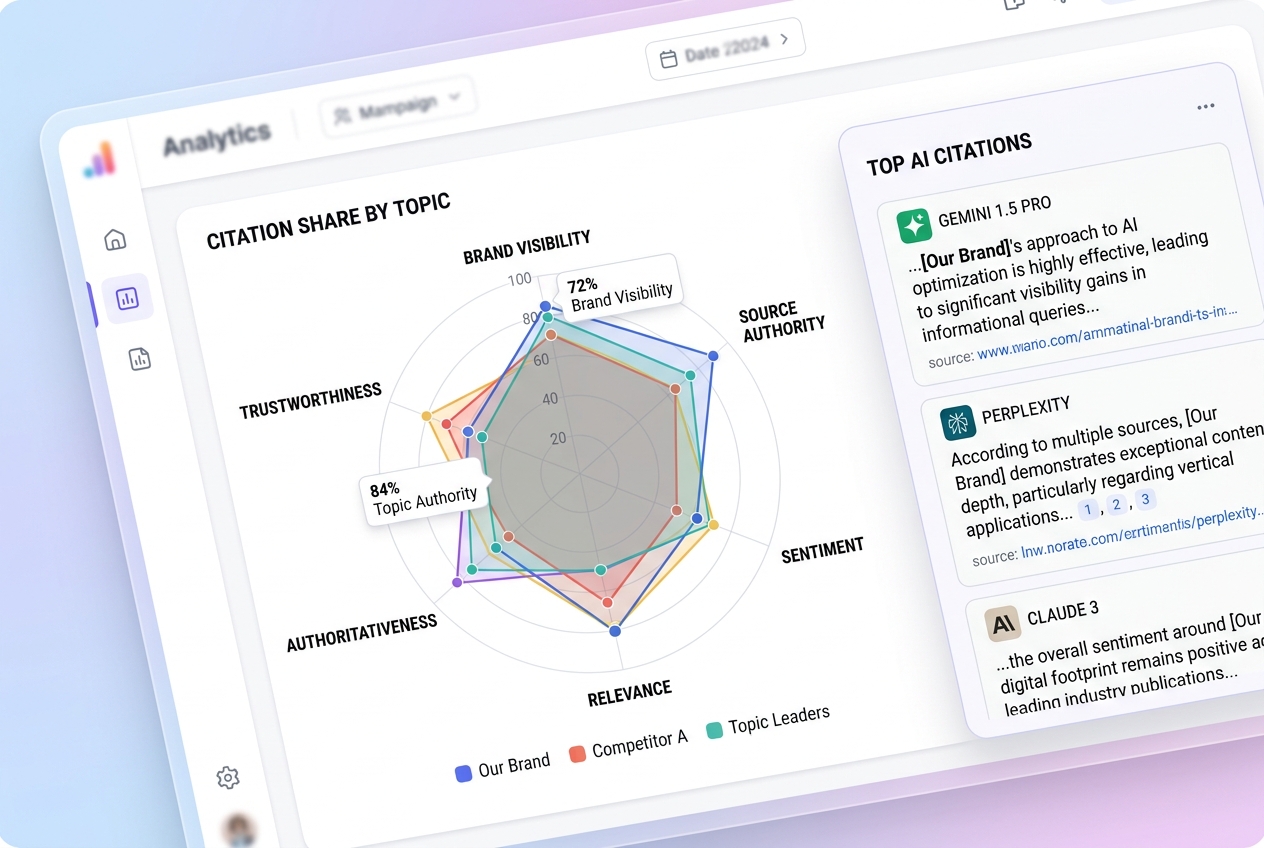
- Sentiment and Context: When the AI mentions you, is it as a 'leader', a 'competitor', or a 'cautionary tale'?
This requires a shift in how we use social listening and brand monitoring tools. Instead of just looking for mentions on Twitter or Reddit, we need to monitor the 'knowledge graphs' that feed LLMs. Platforms like Brandwatch or Sprinklr are beginning to offer 'LLM Visibility' reports that simulate thousands of queries to map out a brand's footprint in the AI landscape.
From 'Content is King' to 'Data is Queen'
If you want a high Citation Share, your content strategy must change. High-volume, low-value blog posts are the first victims of the AEO era. If an AI can summarize your 2,000-word post into two sentences without losing any nuance, your post didn't have enough original data to begin with.
To become a 'citational' brand, you must produce what we call 'Primary Intelligence'. This includes:
- Proprietary Data: Original surveys, internal benchmarks, or experimental results (e.g., the TikTok ad account testing mentioned in [S1]).
- Technical Specifications: Clearly defined processes, pricing, or frameworks that an AI can easily parse.
- Expert Counter-Narratives: Opinions that differ from the 'average' internet consensus. AI engines often look for 'pro and con' perspectives to provide a balanced answer.
Consider the success of Shoplazza, which recently won a TikTok Partner Innovation Award [S5]. They didn't just market their technology; they integrated it into the commerce ecosystem in a way that made them a necessary 'fact' in the discussion of TikTok commerce. When an AI explains how TikTok shops work, it has to mention the tech providers that make it possible. That is AEO at its finest.
Actionable Guidance: Your 90-Day AEO Roadmap
If you are a social media manager or a brand strategist, you don't need to be a data scientist to start optimizing for AEO. You do, however, need to change your production workflow.
Phase 1: The Audit (Days 1-30) Identify your top 50 'money' keywords. Manually run these through Perplexity, Gemini, and Claude. Record who is being cited. Is it you? Is it a competitor? Or is it a neutral third party like Wikipedia or a major news outlet? This becomes your baseline Citation Share.
Phase 2: Structured Data Overhaul (Days 31-60) Ensure your website is optimized for 'ingestibility'. This means using Schema markup aggressively. If you have a guide on LinkedIn marketing for small businesses [S2], ensure the key takeaways are in a format that an LLM can easily extract. Use bullet points, clear headers, and 'Entity-Based' writing—where you clearly define the relationships between your brand and the problems you solve.
Phase 3: The Citation Campaign (Days 61-90) Start building 'Citation Backlinks'. In the old world, any backlink was good. In the AEO world, you want links from sites that the AI already trusts. If you get mentioned in a trade publication that Gemini frequently uses as a source, your own 'trust score' in the eyes of the AI increases. [INTERNAL: How to build an AI-first PR strategy -> ai-pr-strategy]
What this means for your 2026 budget
We expect to see a massive reallocation of SEO budgets toward 'Answer Optimization' over the next 18 months. This isn't just a trend; it's a structural change in how the internet functions. If you continue to report on 'Keywords' while your competitors are reporting on 'Citation Share', you are measuring the wrong war.
Your dashboard should no longer be a list of keywords and their positions. It should be a map of 'Topic Clusters' and your brand's 'Dominance' within the AI's synthesized answers for those clusters. It’s a harder metric to move, but it’s the only one that will actually drive revenue in an AI-first world.
As the Instagram algorithm's constant evolution has taught us [S4], the winners are those who don't just follow the rules—they anticipate the new ones. The era of the blue link is ending. The era of the cited answer has begun.
FAQ