
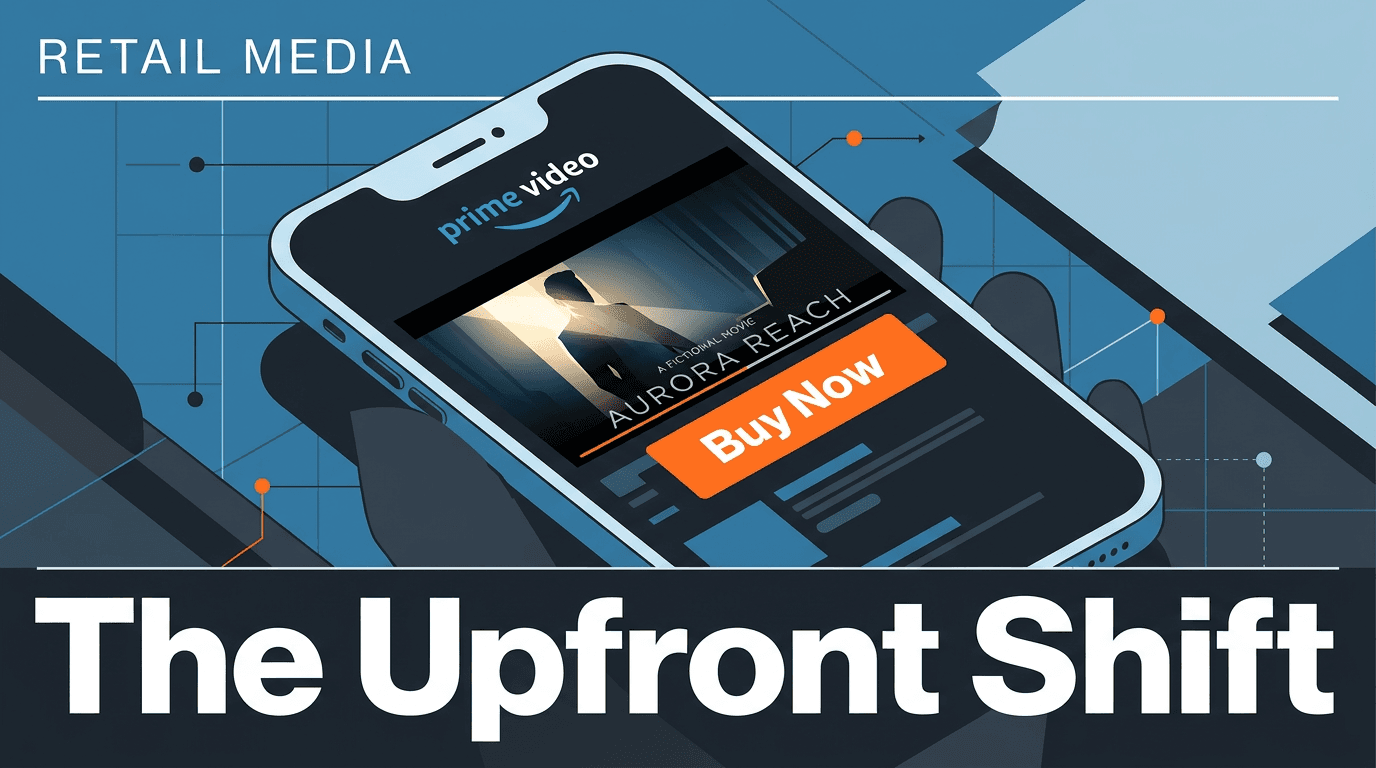
Amazon Ads has officially closed its latest upfront negotiations, exceeding its volume goals and securing significant year-over-year growth. Alan Moss, VP of Global Ad Sales at Amazon Ads, confirmed the performance following the company's inaugural presentation at the Pier 36 venue in New York. This surge in commitments highlights a massive pivot toward retail-integrated video content.
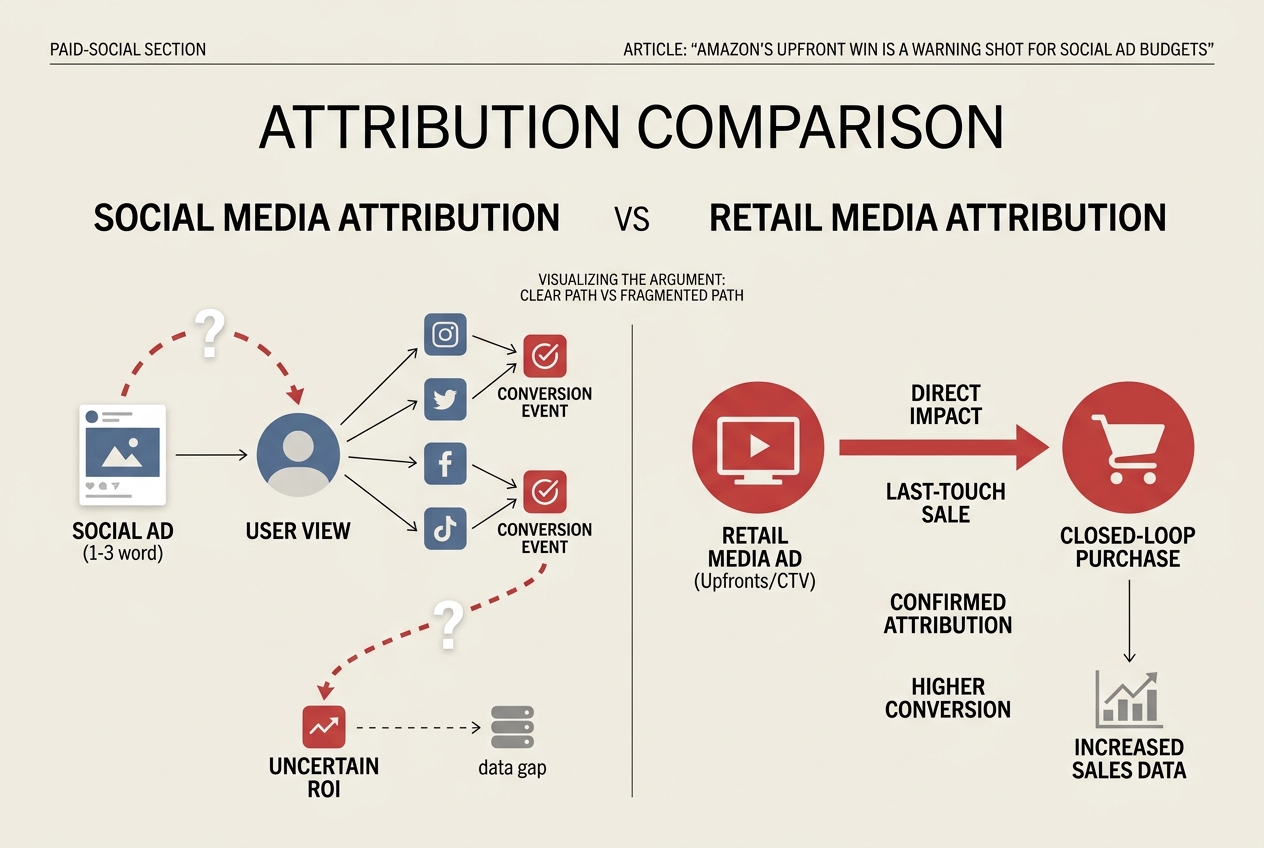
Why it matters: For social media marketers, this isn't just another streaming win. It represents a direct threat to the mid-to-upper funnel budgets traditionally reserved for Meta and TikTok. As Amazon scales Prime Video ads with the promise of closed-loop attribution—connecting a video view directly to a toothbrush purchase—the "vague" brand awareness metrics of social platforms are becoming harder to justify in tightening 2026 budgets.
The retail media network tidal wave
Amazon’s success in the upfronts isn't an isolated incident; it’s the culmination of the Retail Media Network (RMN) evolution. While social platforms have spent years trying to force social commerce into the user experience, Amazon started with the commerce and simply added the media. Per the latest reports from Adweek [S5], the company’s ability to exceed volume goals suggests that advertisers are no longer viewing Amazon as just a search-and-performance play at the bottom of the funnel. They are now treating it as a legitimate reach vehicle.
When you buy a spot on Prime Video, you aren't just buying eyeballs; you're buying access to the Amazon DSP (Demand Side Platform) data. This allows for a level of deterministic targeting that Meta has struggled to replicate since the deprecation of granular tracking on iOS. Social buyers are now finding themselves in a position where they must defend their CPMs against a platform that can prove a Return on Ad Spend (ROAS) without relying on modeled data or third-party cookies.
Why social buyers are losing the attribution war
For years, social media managers have relied on "blended ROAS" or platform-reported metrics that often felt like a black box. But as Amazon integrates its first-party purchase data into its video offerings, the gap between "engagement" and "sale" is shrinking. If you're running a TikTok campaign for a CPG brand, your measurement likely involves a mix of view-through conversions and perhaps a lift study. Amazon, meanwhile, can show that the person who watched 15 seconds of your ad bought the product three hours later on their mobile app.
This is why we're seeing a shift in how agencies structure their teams. Recent research from the ANA [S4] indicates that in-house agencies are no longer just cost-cutting measures; they are strategic plays designed to own first-party data. If your brand’s internal team is sitting on a mountain of Amazon purchase history, they are going to push budget toward the platform where that data is most actionable. Social media becomes the "support" act rather than the lead, a reversal of the hierarchy we saw in the late 2010s.
The TikTok and Meta counter-offensive
It’s not as if the social giants are sitting still. TikTok has been aggressively courting agencies with strategies that aim to drive "real business results" beyond simple virality [S3]. Strategies now involve deep integration with external APIs and a heavy focus on the "Search" intent within the app. However, the friction remains: users go to TikTok to be entertained, while they go to Amazon to spend.
Meta’s Advantage+ and TikTok’s Shop features are attempts to build the same closed-loop ecosystem Amazon already owns. But as Amazon expands its footprint into Out-of-Home (OOH) and cross-channel experiences—similar to how Skyscanner has recently integrated TikTok creative into physical terminal displays [S2]—the definition of a "social" ad is blurring. If an ad looks like a TikTok but runs on an Amazon-powered screen in a grocery store and tracks the purchase via a Prime account, is it still social media marketing?
The content quality trap: Information gain over length
As budgets migrate toward these high-intent environments, the pressure on creative has never been higher. Marketers often make the mistake of thinking more content or longer videos equate to better performance. However, recent insights into how major platforms (including Google and social algorithms) understand content suggest a different priority.
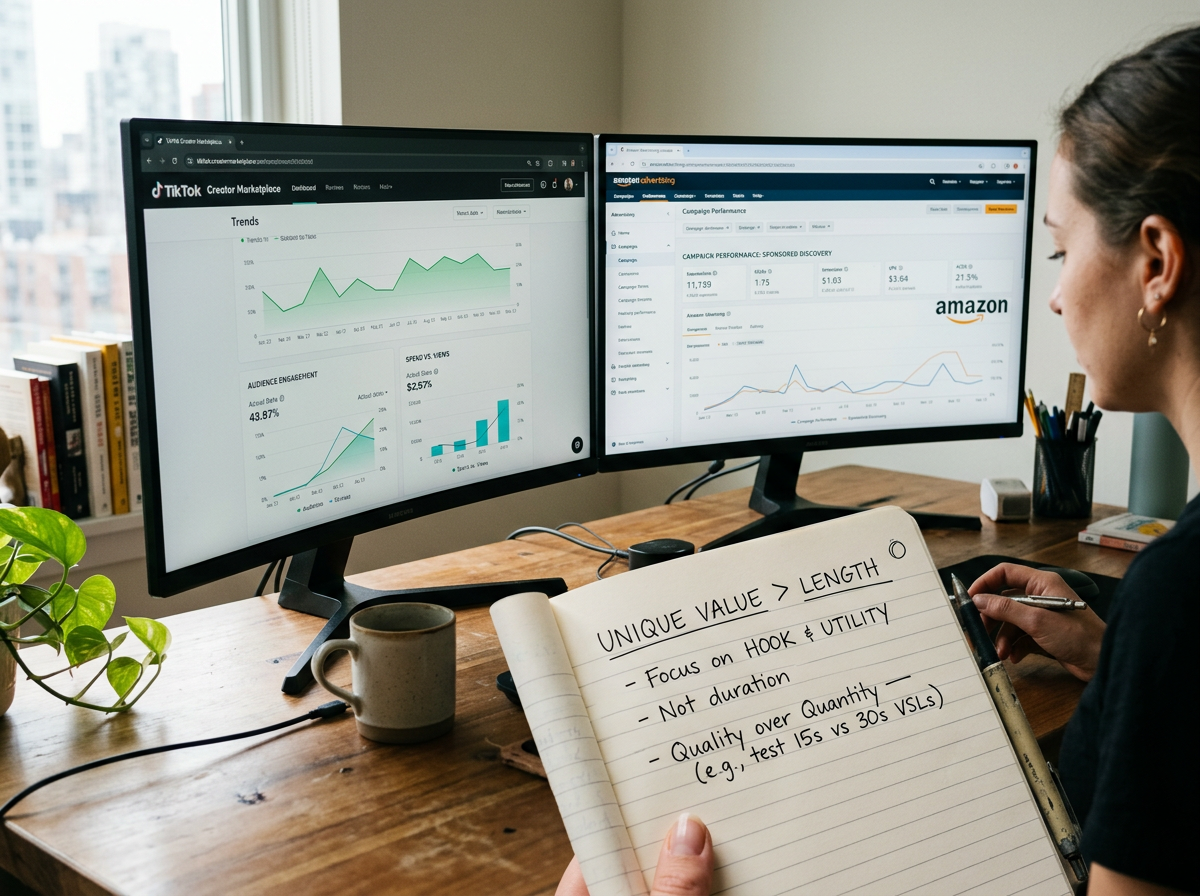
According to Search Engine Journal's analysis of information gain patents [S1], platforms are increasingly normalizing for length. They aren't looking for the longest video or the most exhaustive caption; they are looking for unique information that hasn't been seen elsewhere. For a social media manager, this means that a 10-second clip with a truly unique product usage case will outperform a 60-second high-production brand film. Amazon’s ad environment rewards this efficiency—if the creative doesn't immediately signal value, the user is only one click away from a competitor’s product page.
How to rebalance your 2026 social budget
You shouldn't abandon Meta or TikTok, but you do need to stop treating them as silos. The Amazon upfront win proves that the market values "shoppable reach." To compete, your social strategy must adopt a retail-first mindset.
- Audit your attribution models. If you are still relying on 7-day click/1-day view in Meta, you are going to lose the budget battle to the retail media team. Move toward Media Mix Modeling (MMM) that accounts for the halo effect of social on Amazon search volume.
- Leverage social for "Information Gain." Since we know platforms are looking for unique content [S1], use TikTok and Reels to test creative hooks that you then port over to your Amazon Sponsored Brands Video campaigns.
- Focus on the "In-House" advantage. If your organization is part of the trend toward strategic in-housing [S4], ensure the social team and the retail media team are sharing data weekly. The search terms performing on Amazon should be your next five TikTok video headlines.
What to watch next: The rise of the 'Full-Funnel' retailer
Keep a close eye on how Amazon integrates its newer ad formats, like those within the "Thursday Night Football" broadcasts or its growing OOH presence. The goal for Amazon is to make the entire world a shoppable interface. For social media professionals, the job description is shifting from "community builder" to "full-funnel strategist."
If you can't prove that your Instagram Story led to a conversion—either on your site or on a major retailer's—your budget is at risk. The upfronts have shown that the big money is betting on the platforms that own the checkout button. Your task is to prove that social is the most effective way to get people to that button in the first place.
The looming challenge of platform saturation
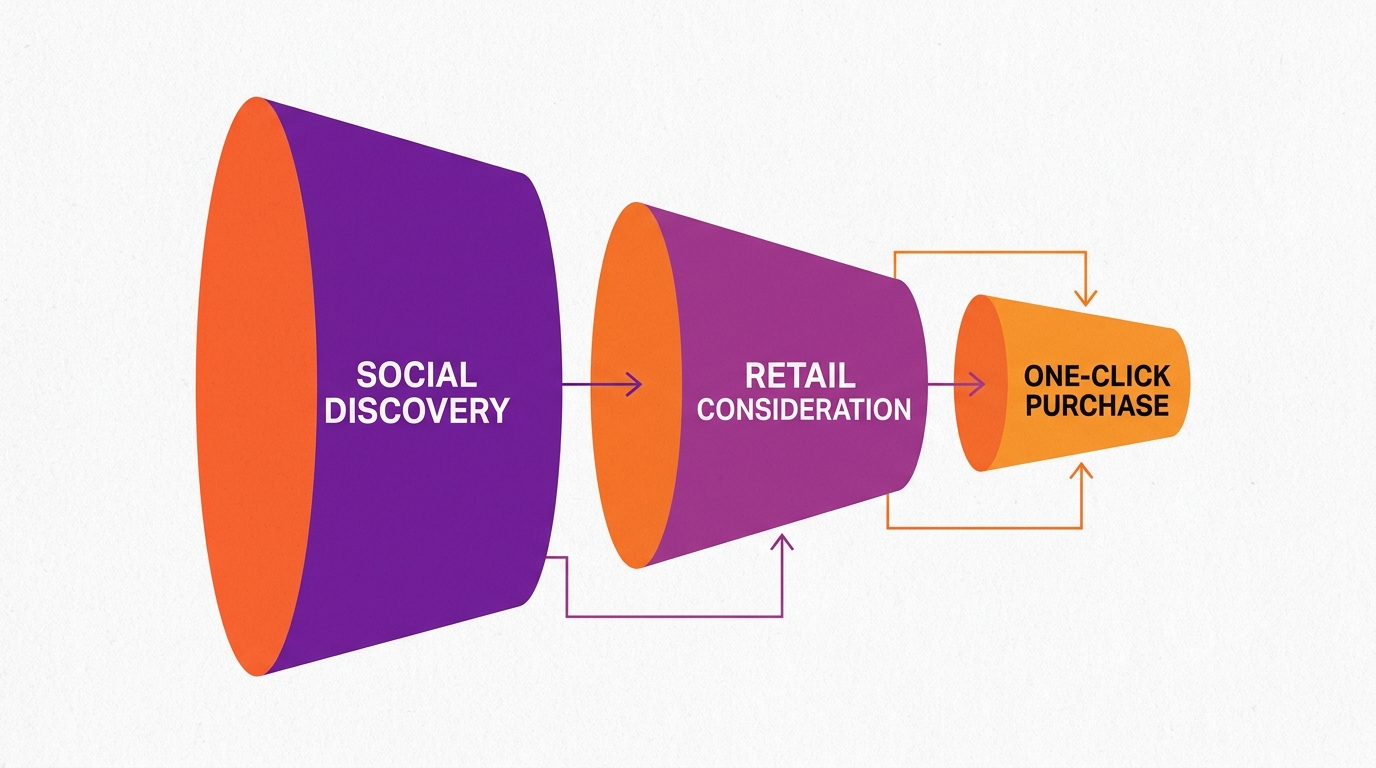
As more brands flock to Amazon Ads to capture that closed-loop data, we can expect a significant spike in CPCs and CPMs on the platform. This is where social media retains a tactical edge. Meta and TikTok still offer a lower barrier to entry for discovery. The smart play for the next 18 months isn't a total pivot, but a sophisticated bridge. Use the relatively lower cost of social to build the "brand equity" that makes your Amazon ads more efficient.
When a user sees your product on Prime Video, they shouldn't be seeing it for the first time. They should recognize it from the unique, high-information-gain content they saw on their social feed three days prior. That is how you survive the retail media takeover: by making your social presence the indispensable precursor to the Amazon purchase.
FAQ