
If you are currently optimizing your brand’s content by chasing the same keywords that worked in 2022, you aren't just behind—you're invisible to the new gatekeepers of the web. The rise of Perplexity, SearchGPT, and Google’s AI Overviews has bifurcated the search landscape into two distinct disciplines: Answer Engine Optimization (AEO) and Generative Engine Optimization (GEO).
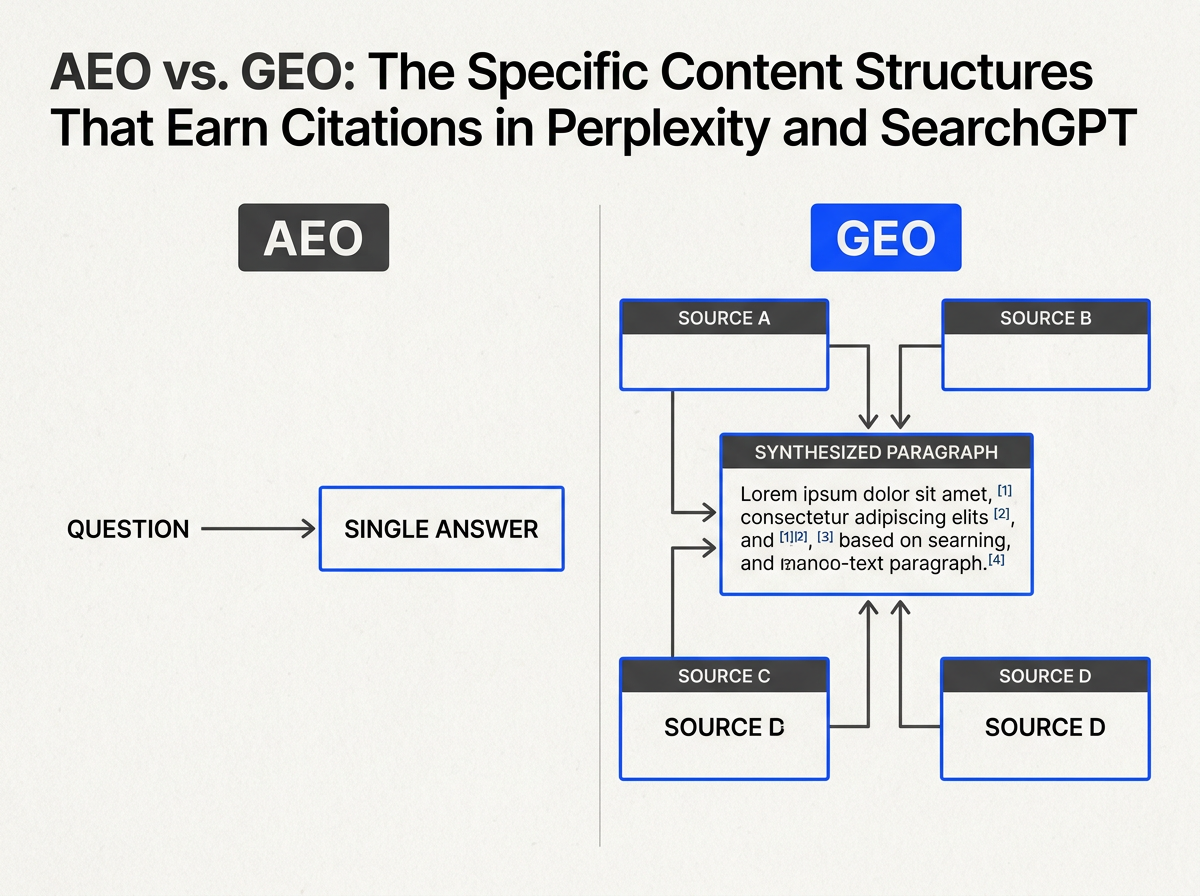
While they sound like semantic cousins, the technical requirements for each are vastly different. One is about being the 'voice' at the end of a smart speaker; the other is about being the cited source in a multi-paragraph research report generated by an LLM. If you want your brand to be more than just training data, you need to understand how to structure your HTML and schema to earn the blue link next to the answer.
Why it matters: As AI-driven search models move from experimental to mainstream—evidenced by the rapid adoption of SearchGPT and the sustained growth of Perplexity—traditional CTR is being replaced by 'citation share.' Brands that fail to adapt their technical architecture will lose the referral traffic that remains in an AI-first era.
TL;DR
- AEO (Answer Engine Optimization) focuses on concise, direct factual responses for voice assistants and quick-answer snippets.
- GEO (Generative Engine Optimization) requires authoritative, structured data and 'quotable' context that LLMs can synthesize into complex reports.
- Structured Data is no longer optional; Schema.org markup is the primary language these engines use to verify your brand's authority.
- Technical Nuance: AEO loves
<li>tags; GEO loves<cite>,<blockquote>, and deep technical whitepapers.
The fundamental shift from answers to synthesis
To understand the difference, think of a library. AEO is the index card that tells you exactly where the book is. GEO is the synthesis of three different books into a new thesis.
Answer Engine Optimization (AEO) was the first wave. It was built for Siri, Alexa, and the Google Featured Snippet. The goal was simple: provide the most direct answer to a 'Who,' 'What,' or 'Where' question. If a user asked, "What is the best SMM panel in 2026?", AEO logic dictated that you should have a clear H2 with that exact phrasing followed by a concise 40-word paragraph. According to data from Programming Insider in May 2026, the demand for these centralized social media management hubs has skyrocketed, making clear, direct answers essential for ranking in these legacy 'answer' slots how smm panels are evolving.
Generative Engine Optimization (GEO) is the second wave. It isn't just looking for an answer; it’s looking for evidence. When SearchGPT or Perplexity answers a query, it doesn't just parrot a single source. It crawls multiple pages, evaluates their credibility, and stitches together a narrative. To win here, your content cannot just be 'correct.' It must be 'citeable.' This means providing unique data, expert quotes, and structured evidence that an LLM can easily extract and attribute back to you.
Technical architecture: HTML tags that trigger citations
If you want an LLM to cite you, you have to make the citation easy for its parser to identify. Traditional SEO focused on <h1> through <h3> hierarchy for topical relevance. GEO focuses on semantic density and attribution markers.
The power of the <cite> and <blockquote> tags
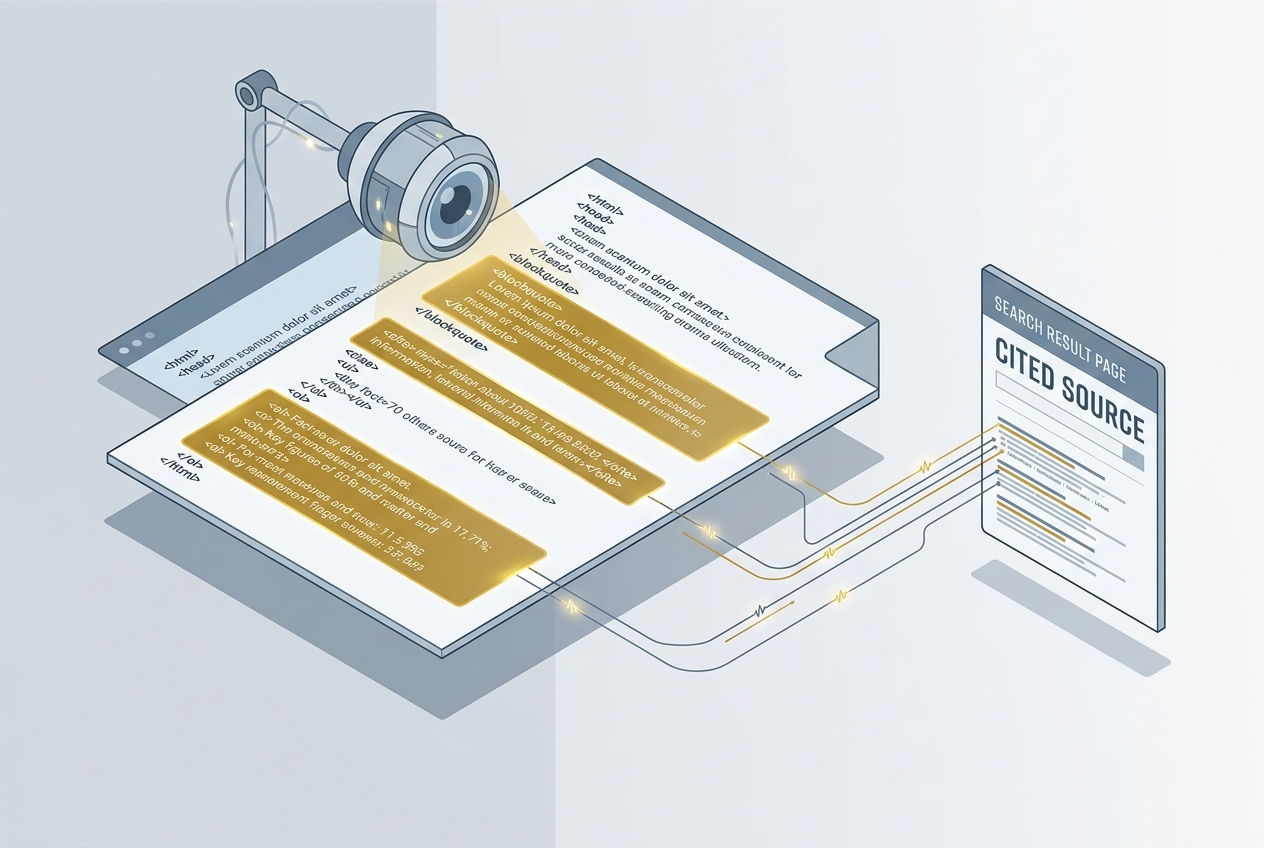
In the GEO era, these underutilized HTML tags are making a comeback. When an LLM scans a page, it looks for signals of authority. A blockquote wrapped in a <cite> tag tells the model: "This is a definitive statement from an expert." Models like SearchGPT are trained to prioritize named entities and expert opinions. If you are quoting a lead strategist on the benefits of Instagram for business in 2026, don't just use italics. Use the proper semantic markup.
List structures: <ul> vs <ol> for AEO and GEO
AEO thrives on ordered lists (<ol>). If you’re providing a 'How-To' guide, the numbered list is the gold standard for voice assistants. However, GEO prefers unordered lists (<ul>) that categorize features or benefits, as these are easier for a generative engine to reorganize into its own synthesized response. For example, if you're detailing the cheapest SMM panels in 2026, using a structured list with clear price-point labels allows the AI to compare your data against other sources more effectively.
Schema.org: The bridge between content and cognition
Schema markup has moved from a 'nice-to-have' for rich snippets to a 'must-have' for AI discovery. Without Schema, an LLM has to guess what your content is about. With Schema, you are handing it a map.
For GEO, the Article, TechArticle, and Review schemas are the most critical. But the real secret weapon is mentions and about properties. By explicitly stating what other entities your content relates to, you help the LLM place your brand within its knowledge graph. If your content is about helping local businesses grow their social media presence, as highlighted by Morning Sentinel in May 2026, your schema should explicitly link to the 'LocalBusiness' and 'SocialMediaMarketing' entities in the Schema.org vocabulary.
Implementing Speakable Schema for AEO
While GEO takes over the desktop and research-heavy search, AEO still dominates mobile and home devices. The speakable schema property allows you to identify sections of an article that are especially appropriate for text-to-speech (TTS). This is the direct line to Siri and Google Assistant. If you aren't using this, you're leaving the 'answer' market on the table.
Citation Marketing: Why 'Quotable' is the new 'Keyword'
In the world of GEO, keywords are secondary to 'quotable facts.' An LLM doesn't care if you've used the phrase "AI citation marketing" five times in your first 200 words. It cares if you have a unique statistic or a proprietary insight that it can't find elsewhere.
Consider the Vogue Business TikTok Trend Tracker. It succeeds in the GEO landscape because it provides specific, dated, and proprietary data points. When an AI search engine looks for "TikTok trends in May 2026," it cites Vogue not because of their SEO, but because they have the primary data.
To apply this to your strategy, you must move away from 'skyscraper' content that simply summarizes what everyone else is saying. You need to produce primary research, case studies, and contrarian viewpoints. The goal is to create 'citation magnets'—sentences so specific and well-supported that the AI feels compelled to include them to make its own answer credible.
The measurement gap: Tracking success without clicks
One of the hardest pills for marketers to swallow is that GEO success often leads to fewer clicks. If Perplexity gives the user a perfect answer based on your content, the user might never visit your site. This is 'zero-click' search on steroids.
So, how do you measure it? You have to move toward 'Share of Model' (SoM). This involves using tools like Brandwatch or specialized AI-tracking scripts to see how often your brand is mentioned in LLM-generated responses. You are no longer tracking your position on Page 1; you are tracking your presence in the 'Sources' list of a SearchGPT result.
Action plan: What to do tomorrow
- Audit your top 10 pages for 'Citation Readiness': Do they contain unique data points, or are they just summaries? Add a 'Key Findings' block at the top of every long-form piece.
- Upgrade your Schema: Ensure you are using
Articleschema withauthorandpublisherfields fully populated. This builds the E-E-A-T (Experience, Expertise, Authoritativeness, and Trustworthiness) that AI models use as a quality filter. - Optimize for 'Entity' relationships: Instead of just targeting the keyword 'SMM Panel,' target the relationship between 'SMM Panel' and 'Small Business Growth' or 'Creator Economy.'
- Use the
<cite>tag: Start semantically marking up your expert quotes and data sources. Give the AI a clear trail to follow.
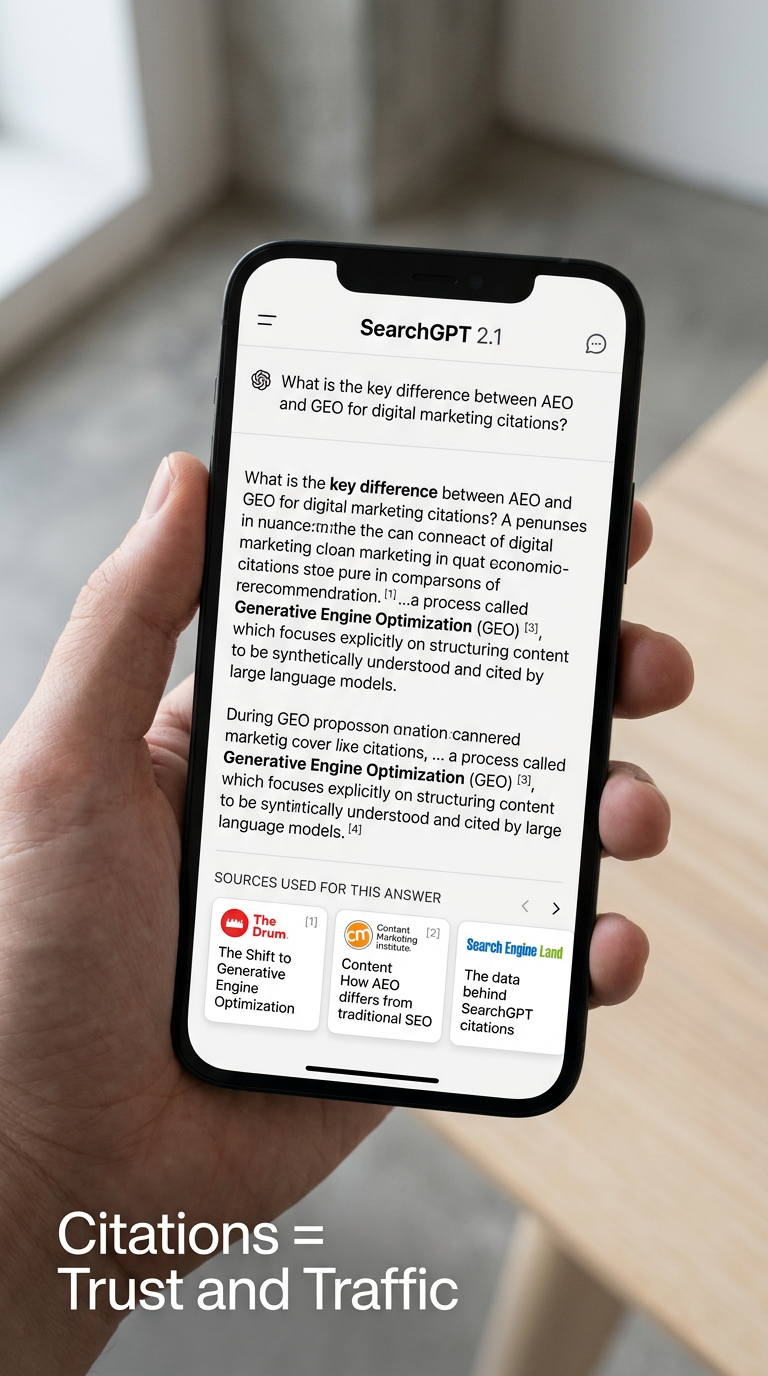
The transition from AEO to GEO is a transition from being a 'result' to being a 'source.' In the age of generative AI, being the source is the only way to remain relevant. Your content shouldn't just be readable by humans—it must be digestible, verifiable, and citeable by the machines that now summarize our world.
The role of E-E-A-T in the GEO landscape
Google’s emphasis on Experience, Expertise, Authoritativeness, and Trustworthiness (E-E-A-T) was a precursor to the GEO era. LLMs are trained to avoid 'hallucinations' and misinformation. They do this by weighting sources based on perceived authority. This is why a citation from a legacy publication like Vogue or a niche authority like Business.com carries more weight in a generative response than a generic blog post.
For smaller brands, this means you can't be an expert in everything. You must double down on a specific niche. If you are a local agency helping businesses with social media, your content should reflect deep, localized expertise that a general AI can't easily replicate from its training data. This 'hyper-specificity' is your shield against being replaced by a generic AI summary.
Future-proofing: Beyond the text
Finally, remember that GEO isn't limited to text. Multi-modal models (like GPT-4o or Gemini 1.5 Pro) are increasingly 'reading' images and 'watching' videos to generate answers. This means your image alt text and video transcripts need the same level of AEO/GEO optimization as your prose. A well-labeled diagram of a marketing funnel is more likely to be pulled into a SearchGPT 'Visual' answer than a generic stock photo. Optimize your assets with the same technical rigor you apply to your HTML, and you'll find your brand cited in places your competitors haven't even discovered yet.
FAQ