
Prompt engineering is a parlor trick that has reached its expiration date. If your social strategy relies on finding the 'magic words' to make Claude or GPT-4o behave, you're building on sand. The real shift—what Google’s Jeff Dean has signaled as the transition from model-centric to data-centric AI—is the move toward context engineering. For social teams, this means the value has shifted from writing clever instructions to architecting the brand data structures that AI models ingest to produce relevant, on-brand output.
Key Takeaways
- Prompts are ephemeral; context is permanent. A prompt is a one-off command; context is the persistent knowledge base (brand voice, SKU data, customer sentiment) that informs every output.
- Data structure is the new creative brief. Strategists must move from writing copy to managing the 'vector databases' and structured feeds that supply AI with its truth.
- The 'Model' matters less than the 'Memory'. As LLMs commoditize, the competitive advantage lies in the proprietary data you feed them, not the specific model you use.
- Measurement is catching up. Recent updates, like Google Ads' new customer acquisition reporting (August 2026), prove that platforms are prioritizing specific data signals over broad automation.
The Death of the 'Prompt Whisperer'
For the last two years, we've been told that 'prompt engineering' is the most important skill of the decade. We saw job postings for six-figure salaries just to talk to machines. But as models get smarter, they need fewer instructions. They don't need you to say "act as a world-class social media manager" anymore; they need to know what your brand sounded like during the 2024 holiday sale versus the 2026 product recall.
Context engineering is the practice of organizing your brand’s institutional knowledge—style guides, past performance data, customer personas, and real-time inventory—into a format that an AI can retrieve instantly. It’s the difference between asking a stranger to write a tweet for you (prompting) and giving a long-term employee a brief (context).
Jeff Dean, Chief Scientist at Google DeepMind, has long argued that the scale of the model isn't the final frontier; it’s the quality and structure of the information provided at the point of inference. In social media, this translates to how we feed our 'Brand Brain' into tools like Sprout Social or Sprinklr. If your data is messy, no amount of 'prompting' will save your 2,000-word long-form LinkedIn post from sounding like a generic robot.
Why Brand Data Structures Outperform Clever Hooks
When we look at the current state of platform automation, the trend is clear: the machines are taking over the 'how,' so humans must master the 'what.' Consider the August 2026 rollout of Google Ads' dedicated reporting for new customer acquisition [INTERNAL: google-ads-update-2026 -> google-ads-reporting]. This update allows marketers to isolate acquisition data without messing with the bidding algorithm.
This is a context play. By providing the model with a cleaner definition of what a 'new customer' looks like, the AI performs better. The same applies to social content. Instead of prompting an AI to "make this sound edgy," a context engineer builds a JSON library of 'edgy' vs. 'safe' brand examples. The AI then references this library to maintain consistency across 500 localized Facebook ads.
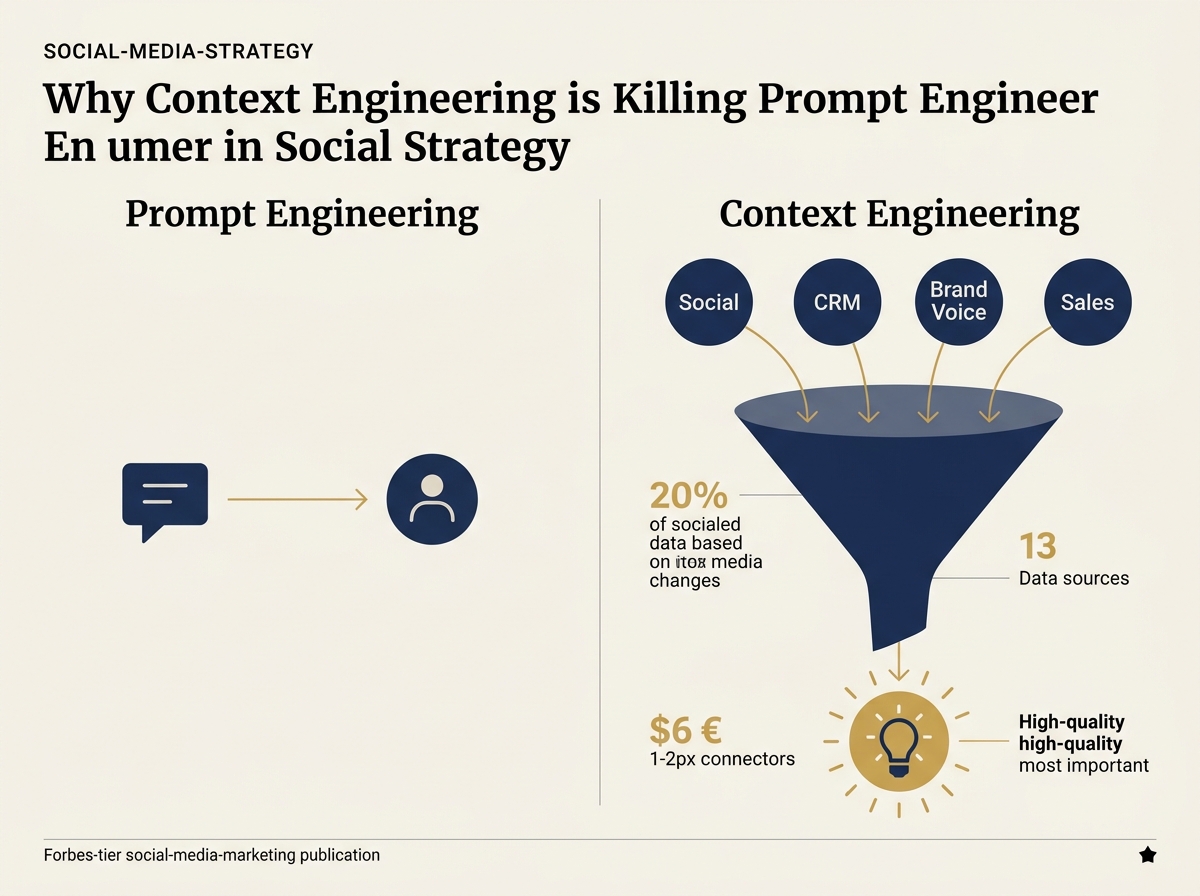
We are moving away from 'Zero-Shot' prompting (asking with no examples) toward 'Retrieval-Augmented Generation' (RAG). In a RAG workflow, your social media management tool doesn't just guess what to write. It queries your internal database—perhaps a Snowflake instance or a structured Notion board—to find the most successful creative from the last quarter before it generates a single word of copy.
The Platform Pivot: Real-Time Context in the Feed
It isn't just internal workflows changing; the platforms are forcing this shift. In June 2026, Instagram began testing 'Real Time' algorithm customization, allowing users to influence their feed signals in a more granular way. For brands, this means your content must fit into a highly specific, rapidly shifting context.
If you are still using static prompts created in Q1, you are missing the real-time cultural context that the Instagram algorithm is now prioritizing. Context engineering requires a live pipe of data. This might include:
- Sentiment Feeds: Real-time analysis of comments to adjust the tone of the next scheduled post.
- Product Availability: Automatically pausing ads when stock levels in a specific Shopify region drop below 10%.
- Competitor Movement: Using tools like Brandwatch to feed the 'competitive context' into your generative AI tools so your responses are always positioned against the current market leader.
Take the recent landscape of digital advertising. YouTube is currently testing image ads during horizontal mobile playback [INTERNAL: youtube-image-ads-2026 -> youtube-ad-placements]. This is a new surface area. A prompt engineer would write a prompt for a 'horizontal ad.' A context engineer builds a dynamic asset library where the AI knows which product images perform best in a 'lean-back' horizontal viewing mode versus a 'lean-forward' vertical Shorts mode. The data dictates the creative, not the user's manual input.
The Counterargument: Doesn't the Model Do the Thinking?
The most common pushback against context engineering is the belief that 'Agentic AI' will eventually figure it all out. Critics argue that if models become truly autonomous, they won't need us to structure data for them; they will just crawl our websites and social feeds and 'know' what to do.
This is a dangerous assumption for two reasons: Privacy and Provenance.
First, the death of the third-party cookie and the increasing walled gardens of Meta and TikTok mean that models cannot just crawl everything. You have to give them permission and access to your first-party data. Second, the 'hallucination' problem in AI is almost always a context problem. When an AI lies, it’s usually because it was forced to guess in the absence of a specific fact. Context engineering provides the 'Source of Truth.' Without it, you are essentially letting a highly confident intern run your brand’s global Twitter account without a handbook.
Even in the face of massive industry consolidation—like the Nielsen and DoubleVerify merger—the focus remains on transparency and measurement. You cannot measure what you haven't structured. If your brand data is a black box, your AI performance will be a black box too.

How to Transition Your Team to Context Engineering
If you want to stay relevant, you need to stop hiring 'AI Content Creators' and start hiring 'Content Architects.' The workflow for a modern social desk should look less like a writer’s room and more like a data refinery.
Step 1: Audit your 'Truth Sources' Where does your brand voice live? If it's a PDF buried in a Google Drive, it's useless. You need to convert your brand guidelines into a structured format (like a CSV or a set of tagged text blocks) that can be fed into an LLM's system message or a RAG database.
Step 2: Build a 'Negative Context' Library Most social teams focus on what they want the AI to do. Context engineering is equally about what the AI should never do. Build a database of failed posts, PR disasters, and banned phrases. Feed this to your AI as the 'guardrail context.'
Step 3: Connect the Pipes Use automation platforms like Zapier or Make to connect your social listening tools directly to your generative AI workspace. When a specific topic starts trending in your industry, that 'context' should automatically be prepended to any new content drafts the AI generates.
The 2027 Prediction: The Rise of the 'Brand Graph'
By mid-2027, the concept of 'prompting' will be seen as a legacy skill, much like knowing how to write raw HTML is for most web designers today. Instead, every major brand will maintain a Brand Graph—a dynamic, machine-readable map of their products, values, history, and customer interactions.
We will see the emergence of 'Chief Context Officers' who oversee how this graph is shared with various AI agents across Meta, Google, and Amazon. The brands that win won't be the ones with the best writers, but the ones whose data is the easiest for an AI to understand and execute upon.
If you're still debating which 'magic words' to put in your prompt, you've already lost the race. The machine is ready to work; it's just waiting for you to give it the right map.
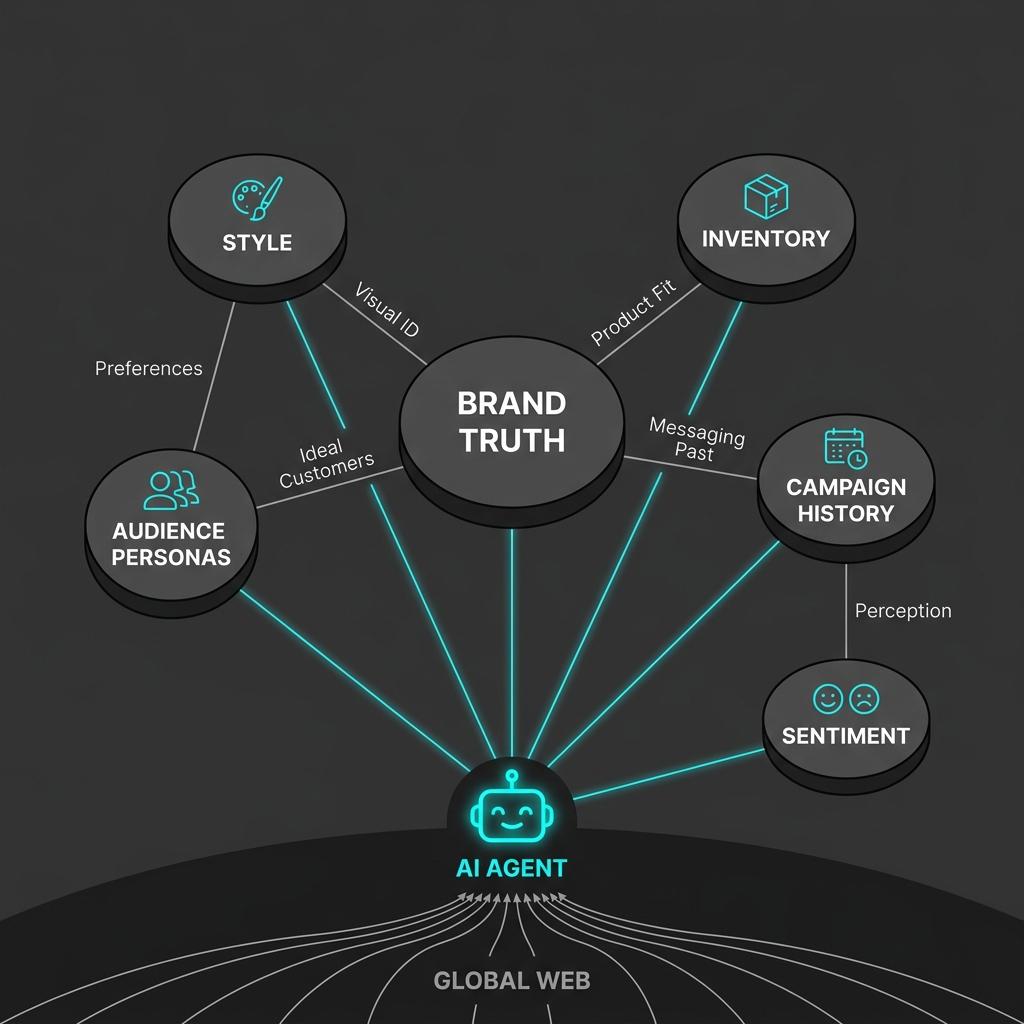
Final Strategic Checklist
- Move your brand voice from prose to parameters. Don't say "we are friendly"; define "friendly" with five specific examples of approved replies.
- Invest in first-party data hygiene. The August 2026 Google updates show that the platforms are hungry for your conversion data. Give it to them in a structured way.
- Stop chasing 'hacks'. There is no prompt that can replace a well-structured database of your last 1,000 top-performing social assets.
- Focus on 'Retrieval'. Before you generate, ask: "What information does the AI need to see to make this perfect?" and then build the system to provide that information automatically.
FAQ