
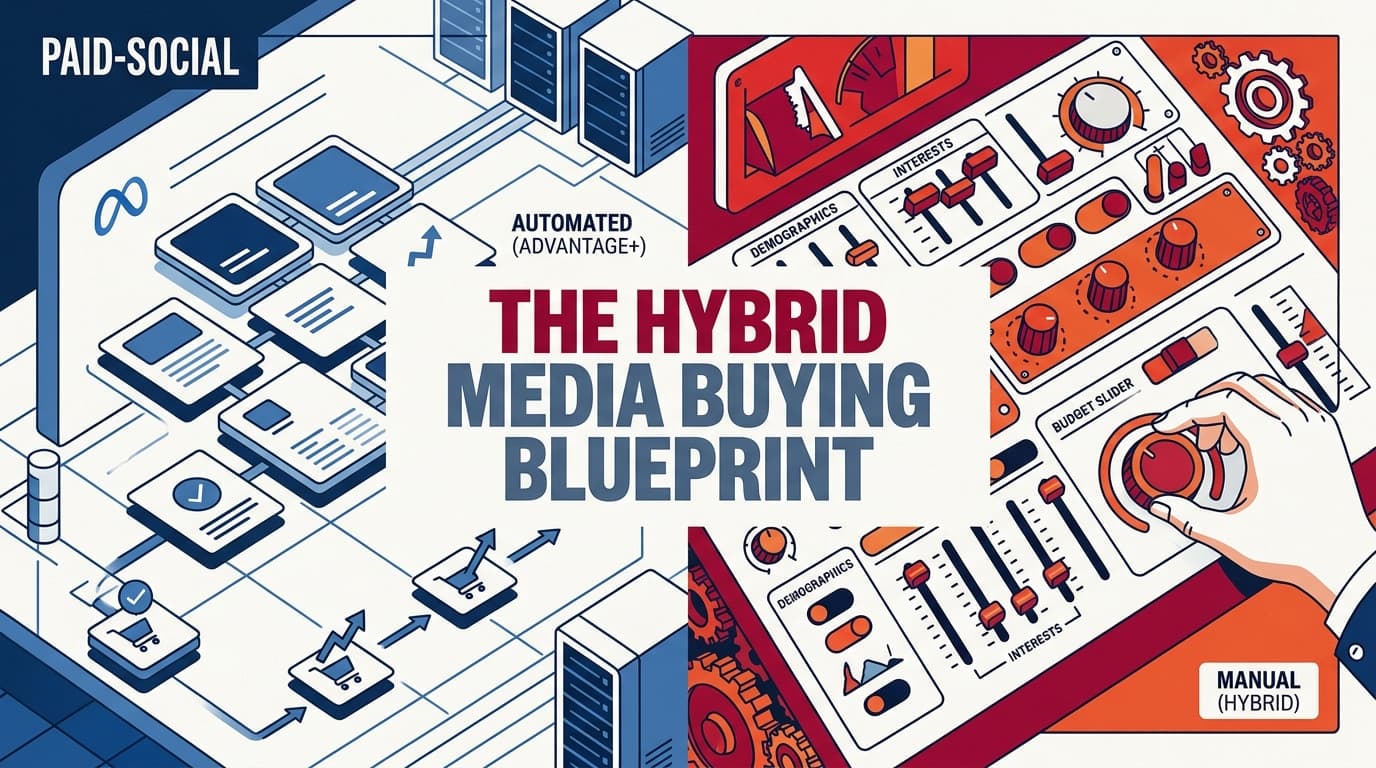
Relying entirely on Meta's Advantage+ Shopping Campaigns is a fast track to margin erosion; modern media buyers must transition to a 70/30 hybrid model that reserves 30% of spend for manual targeting to combat creative fatigue and algorithmic clustering. For brand marketing leads and paid-social buyers, this shift determines whether your customer acquisition cost remains sustainable or spikes as Meta's automated bidding strategy repeatedly serves the same creative to the same narrow, high-converting audience cluster.
Key takeaways
- Algorithmic Clustering is Real: Advantage+ Shopping Campaigns optimize for immediate conversions by targeting a tight, high-intent subset of users, leading to localized creative fatigue and skyrocketing frequency metrics.
- The 70/30 Allocation: Maintain 70% of budget in automated campaigns for broad efficiency, but route 30% into manual ad sets with interest and lookalike guardrails to force audience expansion.
- Creative Testing Integrity: Manual ad sets prevent automated bidding strategies from dumping 90% of budget into a single "winning" creative, keeping your testing pipeline clean and reliable.
The Illusion of 'Set-and-Forget' Media Buying
When Meta rolled out Advantage+ Shopping Campaigns, the promise was simple: feed the machine your creative assets, set a daily budget, and let the algorithm do the heavy lifting. For a year, it felt like magic. CPA dropped, ROAS climbed, and media buyers spent their newly freed-up hours designing complex creative matrices.
But that honeymoon has ended. In early 2026, media buyers across major direct-to-consumer (DTC) brands began reporting a familiar, frustrating pattern. A new ASC campaign launches with stellar metrics. Within three weeks, performance falls off a cliff. Frequency metrics within the campaign spike to 4.5 or higher, even when targeting a supposedly "broad" audience of millions. Blended Marketing Efficiency Ratio (MER) drops, and the platform's reported ROAS becomes increasingly divorced from Shopify backend revenue.
This is not a creative problem. It is a structural problem. By handing 100% of your account control to Meta's automated bidding strategy, you are allowing the algorithm to take the path of least resistance. The algorithm's primary mandate is to find the cheapest conversions possible within a specific attribution window. It does not care about long-term customer acquisition, brand discovery, or cohort health. It cares about hitting its immediate feedback loop. To do that, it builds tight, algorithmic audience clusters—and hammers them until they stop buying.
How Algorithmic Clustering Breeds Meta Ad Creative Fatigue
To understand why ASC campaigns fatigue so rapidly, you have to look under the hood of Meta's delivery system. When you launch a broad ASC campaign, Meta does not actually distribute your ads evenly across the entire target demographic. Instead, it identifies a small, highly active slice of that audience—often less than 5% of the total pool—that exhibits high-intent behavior like frequent clicking, adding to cart, or engaging with competitor ads.
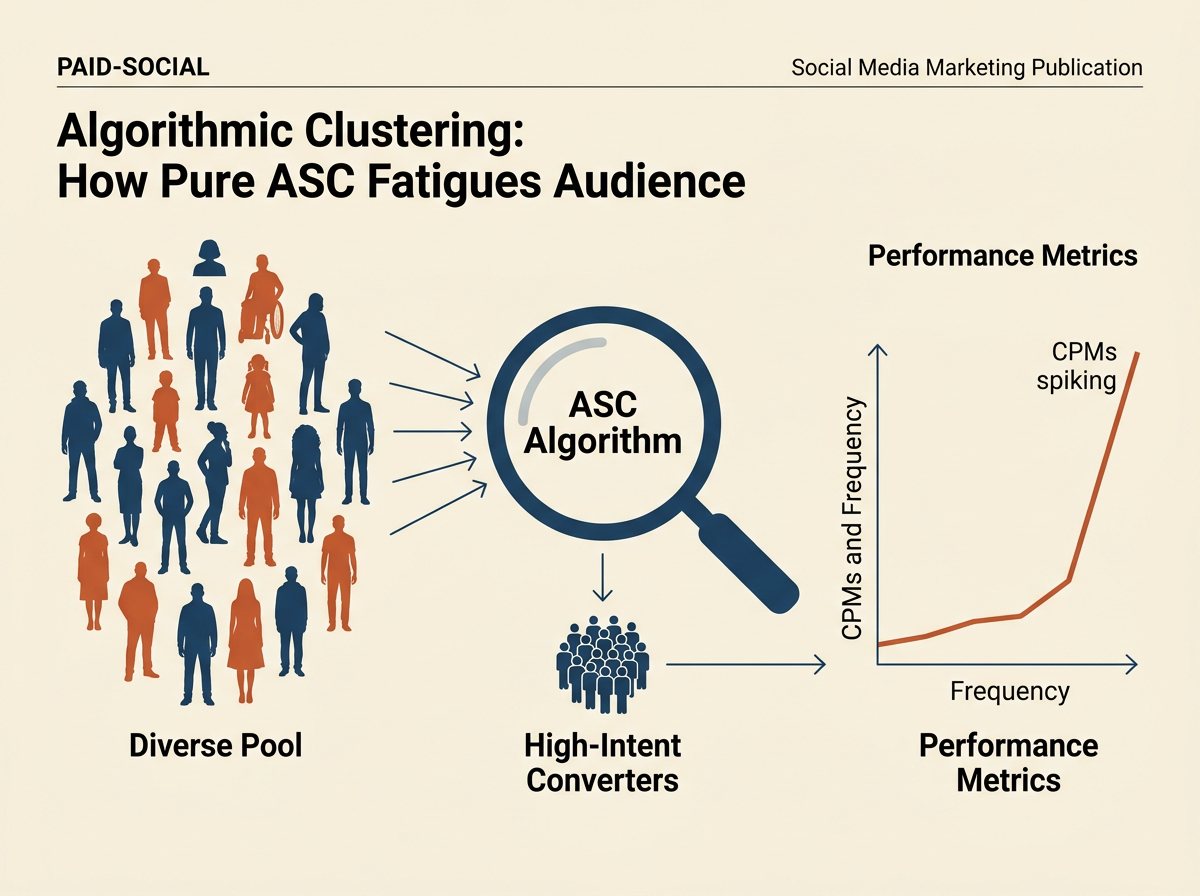
This is algorithmic clustering. Once Meta's machine-learning models identify this cluster, they direct nearly all your budget toward it. This produces excellent short-term conversion data, but it also triggers localized Meta ad creative fatigue at an unprecedented rate.
Consider the mathematics of a typical mid-market DTC brand spending $50,000 a month on Meta Ads Manager. Under a pure ASC setup, Meta might dedicate $45,000 of that budget to a single campaign targeting a broad US audience of 150 million people. On paper, the audience is massive. In reality, the algorithm focuses on a cluster of 500,000 users.
Within two weeks, those 500,000 users have seen your ad three, four, or five times. The click-through rate (CTR) drops from a healthy 2.1% to a dismal 0.8%. CPMs climb from $15 to $32 as you bid repeatedly against other brands targeting that exact same high-intent cluster. This is why your creative "dies" so quickly. The creative itself isn't necessarily bad; it has simply been over-indexed to a saturated micro-audience.
Furthermore, ASC has a bad habit of monopolizing your creative testing. If you upload five new creatives into an active ASC campaign, the algorithm will look at early engagement signals and funnel 90% of the impressions to one single asset, leaving the other four untested. You aren't actually testing creative; you are letting a biased algorithm choose a winner based on a tiny, statistically insignificant sample size.
The 70/30 Hybrid Blueprint: Reclaiming Control Without Fighting the Machine
We are not advocating for a complete return to the hyper-segmented, lookalike-heavy campaigns of 2018. The pixel is smart, and machine learning is a vital tool for scaling accounts. However, the modern media buyer must act as a governor on the machine. The optimal setup for 2026 is a hybrid campaign architecture: 70% of your budget allocated to automated ASC campaigns, and 30% reserved for manual ad sets.
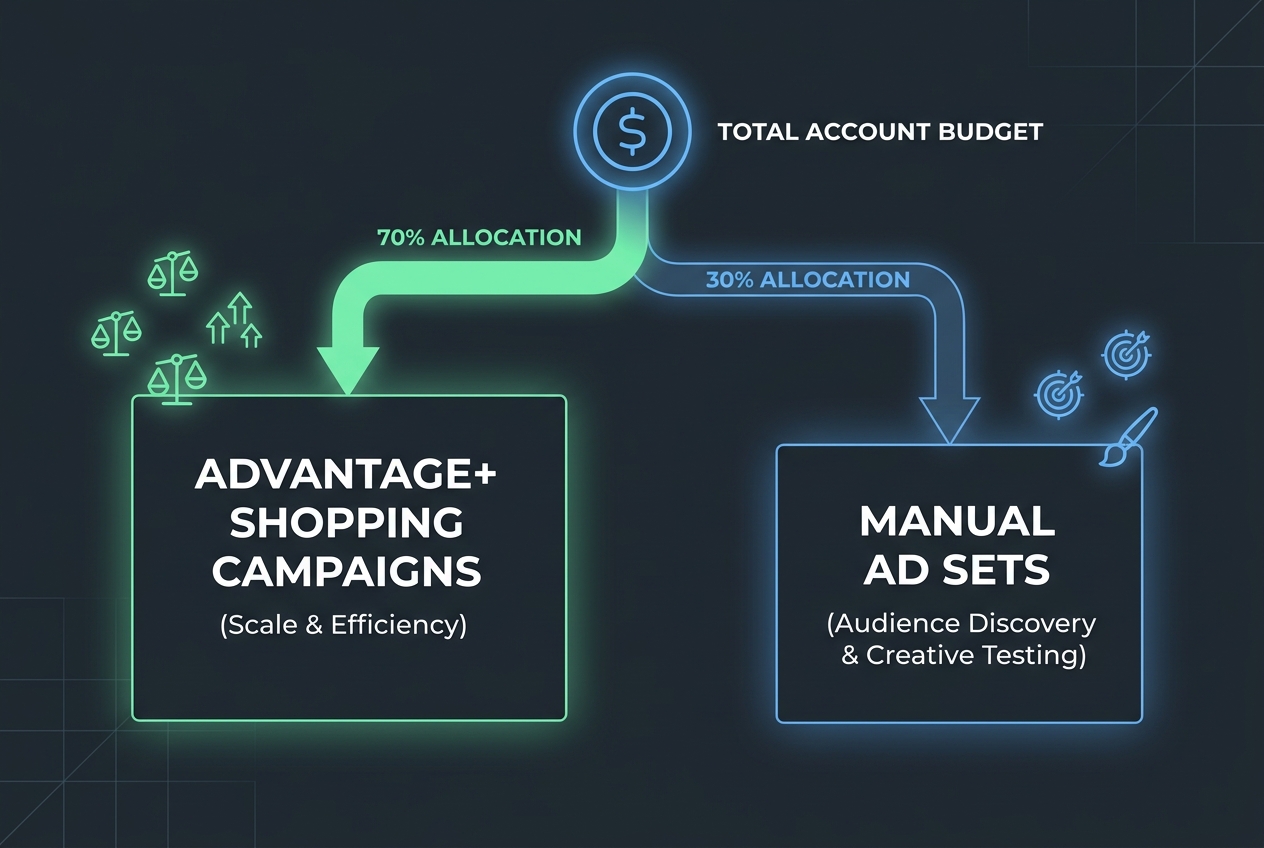
This 30% manual allocation is your strategic insurance policy. It serves three critical functions that ASC cannot perform on its own:
- Forced Audience Exploration: By using manual ad sets with specific interest groups, lookalikes, or custom exclusions, you force Meta to deliver impressions outside of its preferred ASC cluster. This feeds new, cold prospects into your funnel, broadening the pool of historical data that your ASC campaign can eventually retarget.
- Controlled Creative Testing: In a manual campaign, you can utilize dynamic creative options (DCT) or structured ad sets with even budget distribution to ensure every new asset receives a fair trial. You can test specific hooks, angles, and formats without the algorithm prematurely shutting down delivery.
- First-Party Data Protection: Manual ad sets allow you to explicitly exclude past purchasers, email subscribers, and warm social engagers. While ASC has custom audience exclusion settings, platform practitioners know they are notoriously leaky. Manual campaigns give you the hard guardrails needed to ensure your budget is actually driving incremental customer acquisition.
To implement this, structure your Meta Ads Manager with one primary ASC campaign capped at 70% of your total account budget. This campaign should contain your proven, evergreen creative assets. The remaining 30% of your budget should go into a manual campaign containing two to three ad sets: one dedicated to structured creative testing, one focused on high-affinity interest stacks, and one utilizing a clean 5% lookalike of your highest-value customers. Exclude all past 180-day buyers from the manual targeting ad sets to keep the focus entirely on prospecting.
Cross-Platform Automation: Lessons from Google Ask Advisor and TikTok Shop
This tension between full platform automation and manual control is not unique to Meta. Across the entire paid media ecosystem, platforms are pushing automated solutions that promise simplicity while quietly reducing advertiser control.
Take Google's recent rollout of Ask Advisor in May 2026, which consolidates campaign management, analytics, and optimization workflows through a Gemini-powered AI collaborator, as reported by Search Engine Land [S1]. While Ask Advisor streamlines workflow efficiency, it also nudges advertisers toward Performance Max (PMax) campaigns—Google’s equivalent of ASC. Media buyers who rely 100% on PMax face the same issues as those on ASC: rising brand-term cannibalization and a lack of transparency in placement data. The solution there, too, is a hybrid approach that keeps standard search campaigns running alongside automated assets.
Similarly, TikTok has aggressively expanded its commerce capabilities. With Pine-Sol testing social-first scents on TikTok Shop [S4] and Gen Z consumers shifting their purchasing habits toward platform-native checkouts [S5], the temptation is to let TikTok’s automated algorithms handle targeting entirely. Yet, as TikTok expands into broader categories like travel booking [S2], top-performing brands are finding that automated targeting alone fails to capture nuanced consumer intent.
Whether you are managing Meta, Google, or TikTok, the lesson is clear: automation is a powerful execution tool, but a terrible strategy. If you do not actively steer the algorithm with manual guardrails, it will default to the easiest, most expensive conversions it can find.
Dismantling the 'Trust the Pixel' Dogma
There is a vocal segment of the media buying community—often backed by Meta’s own agency representatives—that argues manual targeting is dead. They claim that any restriction placed on the pixel only increases costs and limits the algorithm's ability to optimize. "Trust the pixel," they say. "Broad is the only way to scale."
This argument is built on a fundamental misunderstanding of how Meta defines success. Meta’s algorithm is optimized to maximize platform-reported conversions within your chosen attribution window (usually 7-day click, 1-day view). It does not know your gross margins, your warehouse inventory levels, or your customer lifetime value (LTV).
When you run a 100% ASC account, the algorithm will inevitably begin bidding on low-value conversions. It will retarget people who were already planning to buy organically. It will serve ads to existing customers who would have purchased via an email newsletter. It will show ads to users who click repeatedly but have a high return rate.
Manual targeting ad sets act as a necessary counterweight. By restricting the algorithm's parameters, you force it to do the hard work of finding new customers. Yes, your platform-reported CPMs might be slightly higher in a manual ad set than in a broad ASC campaign. But your backend blended CAC will often improve because you are no longer paying Meta to retarget your own organic traffic.
Furthermore, relying entirely on ASC leaves your brand highly vulnerable to sudden algorithm updates. If Meta tweaks its optimization models—as it did during the performance disruptions of early 2024—accounts that are 100% automated experience massive volatility. Brands with a diversified hybrid structure have a buffer; their manual campaigns continue to deliver steady, predictable impressions while the automated campaigns recalibrate.
A Falsifiable Prediction for Paid Social Media Buying
As we look toward the future of paid social media buying, the current trajectory of total platform automation is unsustainable for mid-market brands operating on tight margins. The convenience of ASC is a trap that ultimately benefits Meta's top-line revenue more than your bottom-line profit.
Here is my falsifiable prediction: By Q4 2027, Meta will officially re-introduce explicit, granular audience-exclusion controls and frequency-capping features directly inside Advantage+ Shopping Campaigns.
They will not do this out of benevolence. They will do it because the rising tide of creative fatigue and escalating customer acquisition costs will force mid-market DTC brands to diversify their ad spend away from Meta and toward emerging channels like TikTok Shop and retail media networks. To retain those performance budgets, Meta will have to give media buyers the manual levers they are currently clawing back through hybrid account structures.
Until then, do not let the machine run your business. Build your hybrid campaigns, guard your creative testing pipeline, and treat Meta's automation as a partner to be managed—not a master to be followed.
FAQ