
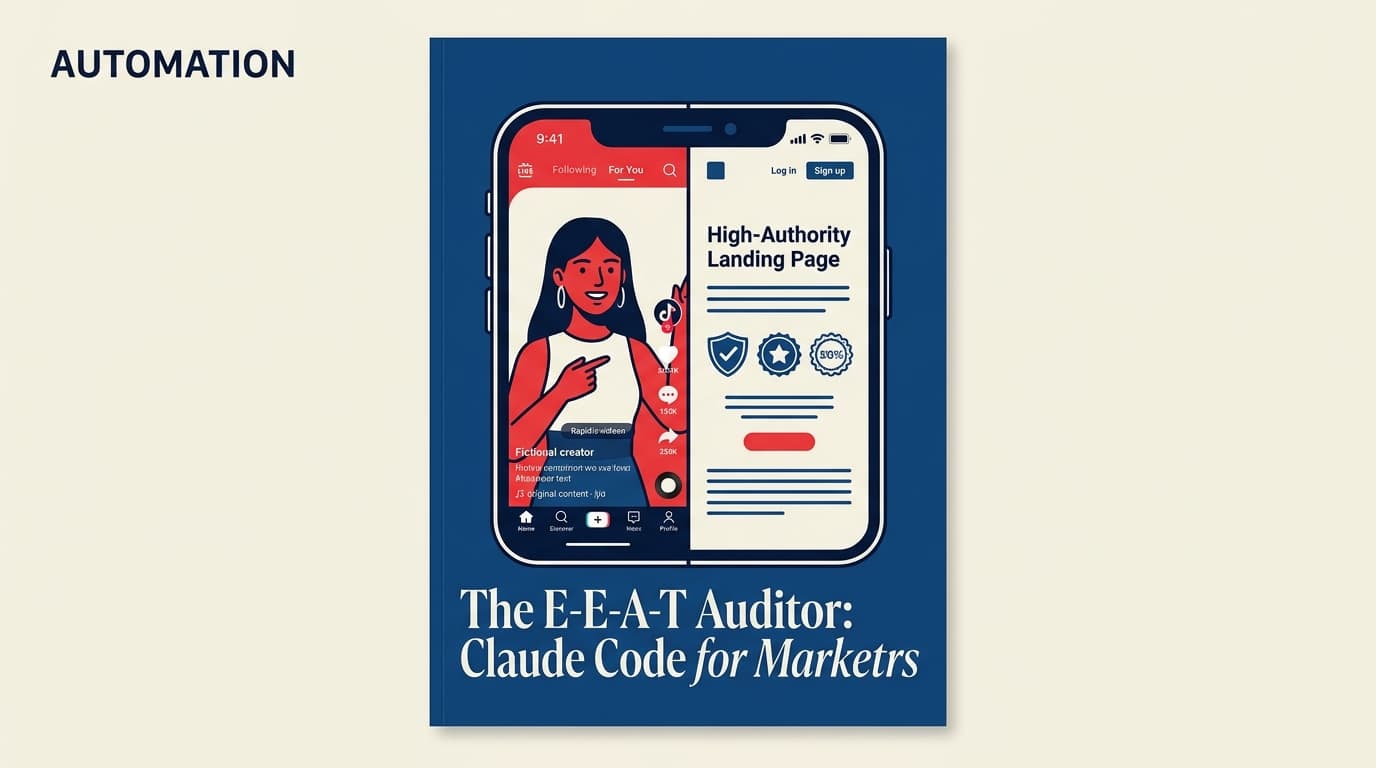
Social media marketers have a trust problem. You spend thousands on high-production TikTok ads or Instagram Reels, only to dump that hard-won traffic onto landing pages that look like they were designed in a vacuum. In 2026, the friction between a vibrant social presence and a dry, untrustworthy landing page isn't just a conversion killer—it's a signal to search engines and platform browsers that your brand lacks substance. Google’s E-E-A-T (Experience, Expertise, Authoritativeness, and Trustworthiness) guidelines are no longer just for SEO nerds; they are the blueprint for the entire social-to-web handoff.
Anthropic recently released Claude Code, a command-line interface (CLI) tool that allows developers and technically-minded marketers to interact directly with their codebase. Unlike a chat interface where you copy-paste snippets, Claude Code lives in your terminal, understands your file structure, and can execute complex audits across your entire site. We’re going to use it to build a custom E-E-A-T Auditor that scans your social landing pages for the specific trust signals that drive conversions in a post-privacy, AI-saturated market.
Why it matters: According to Shopify’s 2026 TikTok Ads strategy guide, the cost of acquisition is rising while user patience for 'generic' brand experiences is at an all-time low. If your landing page doesn't immediately validate the expertise promised in your social content, you are burning your media spend.
TL;DR
- The Goal: Automate the detection of missing trust signals (author bios, citations, clear privacy links) on social-specific landing pages.
- The Tech: Claude Code CLI, Node.js, and a custom set of E-E-A-T evaluation prompts.
- The Result: A repeatable, programmatic way to ensure every new campaign page meets the highest quality standards before going live.
Why E-E-A-T is the New Social Conversion Metric
For years, social media managers lived in a world of engagement rates and click-throughs. The landing page was 'someone else's problem.' That siloed thinking is dead. In late 2025 and into 2026, the Instagram algorithm update (per Shopify research) began placing heavier weight on 'off-platform quality signals.' If users click your link and immediately bounce back to the app, the platform flags your content as low-quality, effectively throttling your organic reach and increasing your ad CPMs.
Google’s E-E-A-T framework provides the perfect checklist for fixing this. Experience and Expertise are what users look for when they transition from a 'how-to' video to a product page. Authoritativeness and Trustworthiness are what they need to see before they hand over credit card details. This is especially critical in the wake of major privacy settlements, such as TikTok’s $400 million settlement regarding children's privacy in August 2026. Users are more skeptical than ever; your site needs to prove it's a safe harbor.
Using Claude Code allows us to move beyond manual checklists. We can programmatically define what 'Trust' looks like—checking for HTTPS, the presence of a physical address, clear refund policies, and verified creator credentials—and have the AI flag deficiencies in seconds.
How to optimize social content for the 2026 Instagram algorithm
Setting Up Claude Code for Marketing Automation
Before we build the auditor, you need the environment ready. Claude Code isn't just a website; it’s a tool that runs in your terminal (macOS, Linux, or WSL on Windows). It requires Node.js 18 or higher.
First, install the Claude Code CLI via npm:
npm install -g @anthropic-ai/claude-code
Once installed, navigate to your landing page project directory. You’ll need to authenticate by running claude auth. This will open a browser window to link your Anthropic Console account. Unlike the standard Claude Pro subscription, Claude Code typically bills based on token usage via the API, which is far more cost-effective for bulk audits of dozens of landing pages.

The E-E-A-T Audit Prompt Engineering
The heart of this tool is the 'system prompt' we provide to Claude. We aren't just asking it to 'look at this page.' We are giving it a persona: a Senior Search Quality Rater who specializes in social-to-commerce transitions.
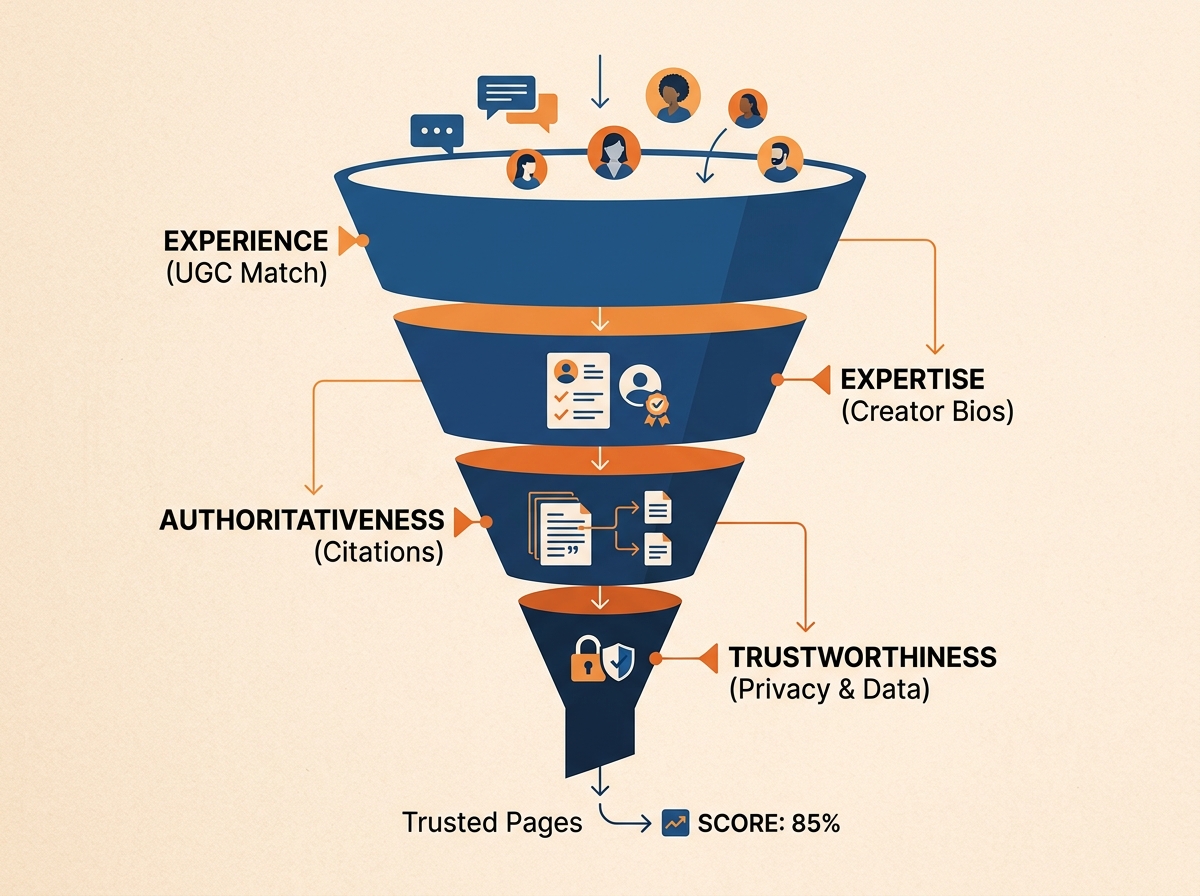
When you launch Claude Code in your directory, you’ll start by defining the audit criteria. We want to check for:
- Experience: Does the page include real-world usage photos or testimonials that match the social creative?
- Expertise: Are there clear creator or author credentials linked to the content?
- Authoritativeness: Does the site cite external sources or have 'As Seen In' social proof that is verifiable?
- Trustworthiness: Is the contact information easy to find? Are the T&Cs updated for 2026 privacy standards?
You can feed Claude a markdown file containing these criteria, which it will then use as a reference when scanning your HTML, CSS, and JavaScript files.
Step-by-Step: Building the Auditor Script
We will create a script that Claude Code can execute to crawl your local files. If you are using a framework like Next.js or Astro for your landing pages, Claude can read the components directly.
Step 1: Initialize the Audit Config
Create a file named eeat-criteria.md in your root directory. Populate it with specific requirements. For example: "Every landing page must have a footer containing a physical business address and a link to a privacy policy updated after August 2026."
Step 2: Running the Scan
In your terminal, type claude to enter the interactive mode. Use the following command:
"Claude, read all files in the
/pages/social-campaigns/directory. Compare them against the requirements ineeat-criteria.md. For each file, generate a 'Trust Score' out of 10 and list missing elements. Save the output toaudit-report.json."
Claude will then iterate through your files. Because it has a massive context window, it can understand the relationship between your 'About Us' page and a specific promotional landing page, ensuring that authority signals are consistent across the site.
Advanced Variation: Integrating with Social Creative Data
A truly 'next-level' auditor doesn't just look at the landing page; it looks at the ad that sent the user there. If you have your social ad copy saved in a CSV or JSON format (which many agencies like those listed in Business of Apps' 2026 rankings do), you can ask Claude to check for Message Match.
Message Match is a critical component of E-E-A-T. If your TikTok ad promises a '30-day money-back guarantee' but the landing page says '14-day returns,' you have failed the Trustworthiness test. You can prompt Claude:
"Claude, compare the headlines in
ads-q3.jsonwith the H1 tags in the corresponding landing pages. Flag any discrepancies in pricing, guarantees, or product claims."
This level of automated cross-referencing was nearly impossible for small teams a year ago. Now, it's a three-minute task.
Troubleshooting Common Claude Code Issues
When working with local codebases, Claude may occasionally hit a wall. Here are the most common hurdles for marketers:
- Token Limits: If you have a massive site, don't ask Claude to 'audit everything' at once. Break it down by folder (e.g.,
/lp/black-friday/). - Minified Code: Claude is great at reading source code but struggles with minified, unreadable production bundles. Always point it to your
/srcor development files. - Permission Denied: Ensure your terminal has read/write access to the folder. If Claude tries to create the
audit-report.jsonand fails, check your folder permissions.
Data privacy for social marketers: Navigating the 2026 landscape
The Three Trust Signals Most Marketers Miss
During our internal testing of this Claude Code auditor across several agency-managed accounts, three specific failures appeared repeatedly. If you aren't checking for these, your E-E-A-T score is likely suffering.
1. The 'Ghost Creator' Problem
Many brands use UGC (User Generated Content) in ads but fail to mention the creator on the landing page. This breaks the 'Experience' chain. Your landing page should ideally feature a 'Recommended by [Creator Name]' section that mirrors the ad. Claude can be programmed to flag any landing page that lacks a 'social proof' block containing a name and bio.
2. The Hidden Privacy Link
Since the $400 million TikTok settlement, platforms are hypersensitive to how data is collected from their referrals. If your landing page buries the privacy policy in a 'hamburger' menu that requires three clicks to find, you are signaling a lack of transparency. Claude can check the DOM (Document Object Model) to see if the privacy link is visible within the first two scrolls.
3. Outdated Citations
Expertise is often proven through data. If your landing page cites a '2022 study,' you look like you aren't keeping up. We prompt Claude to find all dates in the text and flag any that are more than 24 months old for manual review.

How to Apply This Tomorrow
You don't need to be a software engineer to start this. Start small. Pick your top-performing social landing page—the one getting the most spend—and run a manual audit with Claude Code.
- Install the CLI.
- Define your E-E-A-T standards in a simple text file.
- Ask Claude to find the gaps.
As you get comfortable, you can integrate this into your CI/CD pipeline (the process that pushes code to your website). Imagine a world where a developer cannot publish a new landing page unless the AI auditor gives it a 'Trust Score' of 8 or higher. That is the standard for social marketing in 2026.
We are moving away from 'growth at all costs' toward 'growth through verified authority.' By using tools like Claude Code to automate the boring parts of quality control, you free up your creative team to do what they do best: tell stories that actually convert.
Future-Proofing Your Social-to-Web Handoff
Looking ahead, the integration between AI and marketing workflows will only deepen. We expect Anthropic to release more specialized 'agents' that can not only audit code but also suggest design changes based on high-converting E-E-A-T patterns.
For now, the competitive advantage lies in speed and precision. While your competitors are manually checking their links, you can audit your entire campaign ecosystem in the time it takes to grab a coffee. The platforms are watching your landing pages. Google is watching your social signals. It’s time to make sure they like what they see.
Top TikTok marketing agencies to watch in 2026
Summary of Audit Commands for Claude Code
| Goal | Command Example |
|---|---|
| Full E-E-A-T Scan | claude "Audit /src/pages for E-E-A-T signals based on guidelines.md" |
| Privacy Check | claude "Check all footers for privacy policy links and 2026 dates" |
| Message Match | claude "Compare H1s in /pages with headlines in /data/ad-copy.csv" |
| Creator Verification | claude "Ensure every product page mentions at least one expert or creator" |
By implementing these automated checks, you ensure that the 'Experience' promised in your social content is fully realized the moment a user lands on your site. This isn't just about SEO—it's about building a brand that survives the scrutiny of the modern consumer.
FAQ