
If you still believe your social media agency is operating on a pure fee-for-service model, the recent WPP whistleblower suit is your cold shower. The allegations—specifically those involving claims of illegal media rebate fraud tied to Sony—suggest that the dark arts of the 2016 ANA transparency report haven't vanished; they've just migrated into the more opaque corners of programmatic social and retail media networks. This isn't just a WPP problem; it is a structural incentive problem that every brand lead must address immediately through aggressive contract renegotiation.
Key takeaways
- The 'Sony Rebate' Signal: Allegations suggest that rebates meant for clients were allegedly diverted or obscured through complex holding company structures.
- Social's Blind Spot: Programmatic social spend is particularly vulnerable to 'inventory markups' where agencies act as principals rather than agents.
- The Audit Gap: Standard 'right to audit' clauses often exclude the very subsidiaries where rebates are actually collected.
- Actionable Mandate: Brands must move to 'net-net' pricing and demand full disclosure of all AVBs (Agency Volume Bonuses).
The Anatomy of the WPP Whistleblower Allegations
The core of the suit involves claims that WPP entities allegedly mismanaged or failed to disclose rebates generated by Sony’s massive global media spend. While WPP has historically denied systemic wrongdoing, the specificity of these claims—detailing how volume-based discounts from platforms and publishers may have been retained by the agency rather than passed back to the client—strikes at the heart of the fiduciary duty an agency owes its brand partners.
For social media managers, this might feel like a high-level holding company drama, but the mechanics are local. When your agency buys millions in Meta or TikTok impressions, they aren't just buying for you. They are buying for their entire portfolio. If that volume triggers a 2% 'service fee' or 'data incentive' from the platform, who keeps that money? If the contract is vague, the agency does.
This isn't just about cash back; it's about the distortion of incentives. If an agency is incentivized to funnel spend toward a specific platform because of a backend rebate—rather than the platform's actual performance for your brand—your ROI is being sacrificed for their margin. We saw similar tensions rise during the Meta algorithm shift of 2024, where spend allocation became a point of contention between performance leads and procurement teams.
Why Social Media Spend is the New Frontier for Hidden Margins
In the old days of linear TV, rebates were easy to spot. You bought a block of time, and you got a credit back. In the world of social media marketing, the 'rebate' has evolved into more sophisticated forms: 'free' data segments, 'value-add' impressions, or 'technology credits' that never appear on a client invoice.
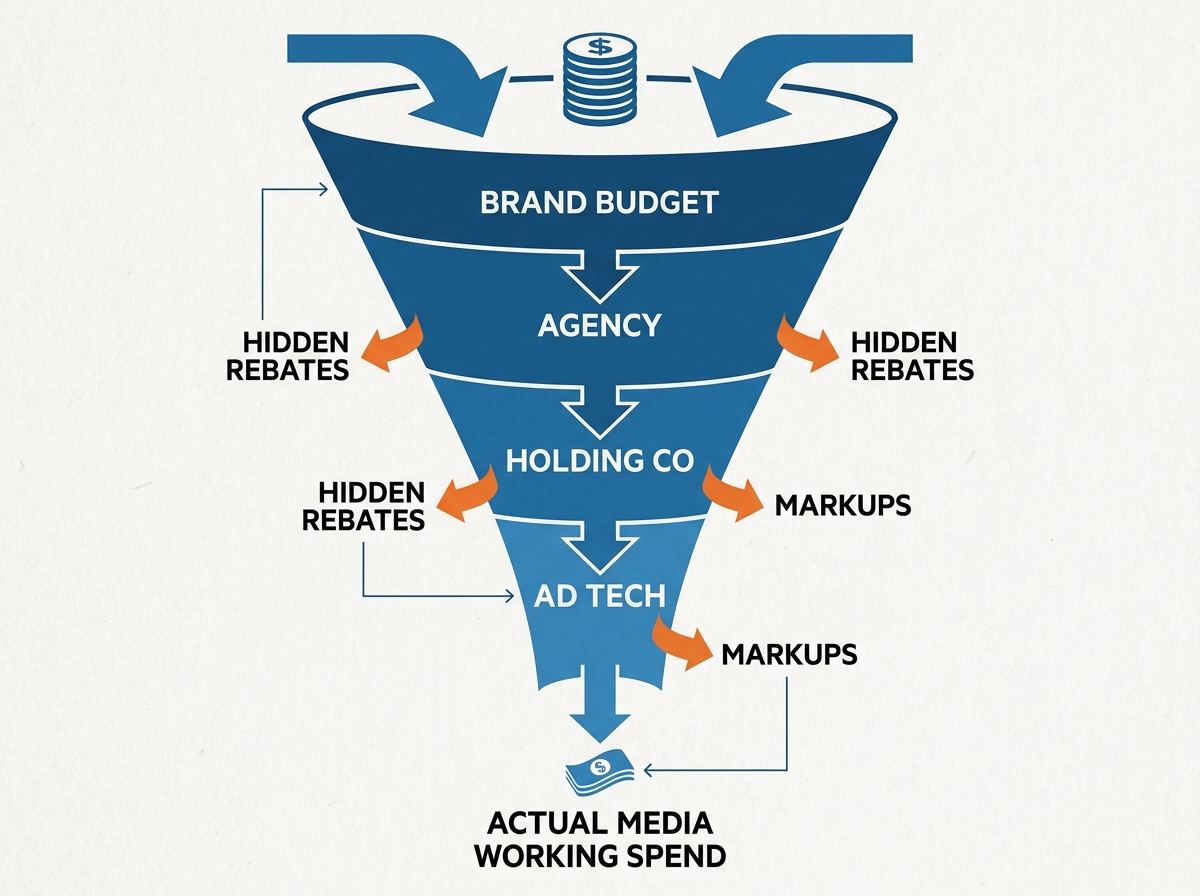
According to internal benchmarks from several mid-market auditing firms, nearly 15% of social media spend is currently 'unaccounted for' in terms of its final destination within the ad tech supply chain. Agencies often use 'Principal-Based Buying' (PBB). In this model, the agency buys the media themselves and then resells it to you at a markup. They claim they are taking the risk, so they deserve the reward. But if they are your agent, how can they also be your vendor?
This conflict of interest is exactly what the WPP suit brings to light. If the agency is acting as a principal, they have no obligation to show you the original price they paid. You see a $5.00 CPM on your report; they paid $3.80. That $1.20 difference is a hidden margin that bypasses your agency fee entirely.
The Three Red Flags in Your Social Agency Contract
You don't need a whistleblower to tell you if your spend is at risk. You just need to read your contract. Most brand leads are shocked to find that their 'transparency' clauses are riddled with loopholes large enough to drive a Sony-sized media budget through.
1. The 'Affiliate' Exclusion
Check your audit clause. Does it allow you to audit the agency, or the agency and all its affiliates and subsidiaries? Many holding companies house their rebate-collecting entities in separate legal structures—often offshore—that are explicitly excluded from client audit rights. If you can't see the books of the entity that actually signs the master agreement with the platform, you aren't auditing anything of substance.
2. The 'Opt-in' for Principal Buying
Look for language regarding 'proprietary media' or 'inventory products.' Agencies often bury a clause that says by signing the SOW, you agree to allow them to sell you media as a principal. This effectively waives your right to see the underlying cost. If you've opted into this, you've essentially given the agency permission to hide their margins.
3. Non-Cash Incentives
Rebates aren't always dollars. They are often 'credits' for the agency's own internal tools or research arms. If the agency gets a $500,000 credit for a social listening tool because of your spend, but they still charge you a 'technology fee' for that same tool, they are double-dipping. The WPP suit suggests that these non-cash benefits are a major part of the 'value' agencies are accused of withholding.

Refuting the 'Risk' Defense: Why Agencies are Wrong
The standard defense from holding companies—and likely the one WPP's counsel will lean on—is that they provide value through 'bulk purchasing power' and 'financial risk.' They argue that because they commit to spend millions upfront, they deserve the discounts that come with that risk.
This argument is fundamentally flawed for two reasons. First, the 'risk' is often illusory. Most agencies won't commit to spend unless they already have client IOs (Insertion Orders) covering that amount. Second, even if they were taking a risk, the lack of disclosure prevents the client from making an informed decision about whether that 'discounted' media is actually good for their brand.
If the agency is pushing you toward a specific retail media network or a niche social platform just to hit a volume tier for a rebate, they are no longer a strategic partner. They are a reseller. Brands need to decide: do you want a partner or a vendor? You cannot have both in the same contract.
How to Conduct a 'Post-Sony' Social Media Audit
If you are managing a social budget of $5M+ annually, a standard financial audit isn't enough. You need a forensic media audit. This goes beyond checking if the invoices match the placements; it involves tracing the money all the way to the platform.
How to vet social media auditing firms
Start by demanding a 'Net-Net' declaration. This is a signed document from the agency CFO stating that all discounts, rebates, AVBs, and credits—whether cash or non-cash—have been passed back to the client. If they refuse to sign it, you have your answer.
Next, look at your 'Value-Add' impressions. Agencies often boast about getting you 'bonus' reach. In reality, these are often the 'make-goods' for rebates the agency couldn't figure out how to keep. Instead of bonus impressions you didn't ask for, demand the cash equivalent or a reduction in your next month's media bill.
Finally, update your definitions. A 'rebate' in 2026 includes data access, API credits, and training vouchers. If it has value, it belongs to the person who paid for the media: you.
The Future of Agency Compensation: The Death of the Commission
The WPP whistleblower suit is likely the final nail in the coffin for the traditional media commission model. We are moving toward a 'radical transparency' era where agencies must be paid a fair, transparent fee for their talent, rather than a hidden percentage of the spend.
We've seen this shift in the creator economy already. When Creator CPMs hit record highs in Q3, brands demanded to see the exact split between the talent and the agency. Why should programmatic social be any different?
My prediction: Within the next 24 months, we will see at least three major Fortune 500 brands move their social media buying entirely in-house, not to save on fees, but to gain visibility into the $0.20 of every dollar that is currently disappearing into the 'rebate' black hole. If you aren't preparing for that level of scrutiny, you're already behind.
What to Watch Next
Keep a close eye on the discovery phase of the WPP suit. If internal emails are released showing a deliberate strategy to 'hide' Sony rebates, it will trigger a wave of audits across the industry. Brands like Unilever, P&G, and Coca-Cola—who have already been aggressive on this front—will likely lead the charge in demanding new, standardized contract templates that eliminate the 'Principal' loophole entirely.
For now, your move is simple: Call your agency lead. Ask for the 'Net-Net' declaration. Watch their face. That will tell you everything you need to know about where your money is actually going.
FAQ