

Nielsen’s $2 billion play for DoubleVerify isn't just another line item in the ongoing consolidation of ad tech; it is a fundamental threat to the 'independent' verification model that has propped up digital media's credibility for a decade. By absorbing the industry’s most prominent verification firm, Nielsen is effectively attempting to become both the judge and the jury of media quality. This deal risks creating a measurement monoculture that strips agencies of their primary leverage against platforms and leaves brand marketers wondering if the 'truth' is being sold to the highest bidder.
The Consolidation of the Arbiters of Truth
For years, the industry operated on a system of checks and balances. Nielsen measured the audience reach—the 'who' and 'how many'—while firms like DoubleVerify (DV) and Integral Ad Science (IAS) handled the 'where' and 'how well.' They were the safety net, ensuring that the billions of dollars flowing into programmatic and social channels weren't being swallowed by bot traffic or served to a muted player in a hidden browser tab.
With Nielsen’s acquisition of DV, that safety net is now part of the very infrastructure it was designed to audit. We are moving from a multi-vendor verification ecosystem to a centralized authority. According to reporting from Adweek in August 2026, this deal puts ad measurement independence to its ultimate test. If you are a media buyer at a holding company like WPP or Publicis, your ability to cross-reference data sources just took a massive hit.
When a single entity controls both the reach metrics and the fraud verification, the incentive to report 'perfect' campaigns increases exponentially. It’s the equivalent of a student grading their own homework, then asking the teacher to pay them for the privilege. While Nielsen argues this will 'streamline' the measurement process, practitioners know that 'streamlining' is often code for removing the friction that transparency requires.
Why Agency Bargaining Power is at Risk
In the current fragmented landscape, agencies use DV or IAS as a blunt instrument to demand make-goods from platforms like Meta or YouTube. If DV flagged a 15% discrepancy in viewability compared to the platform’s internal dashboard, the agency had the data to claw back spend.
By folding DV into Nielsen, that data becomes part of a larger, more opaque suite of products. Nielsen has long struggled with its own legacy issues—specifically the 2021 suspension of its MRC accreditation for national TV measurement. Although it has fought to regain its standing, the company’s track record with data accuracy is far from spotless.
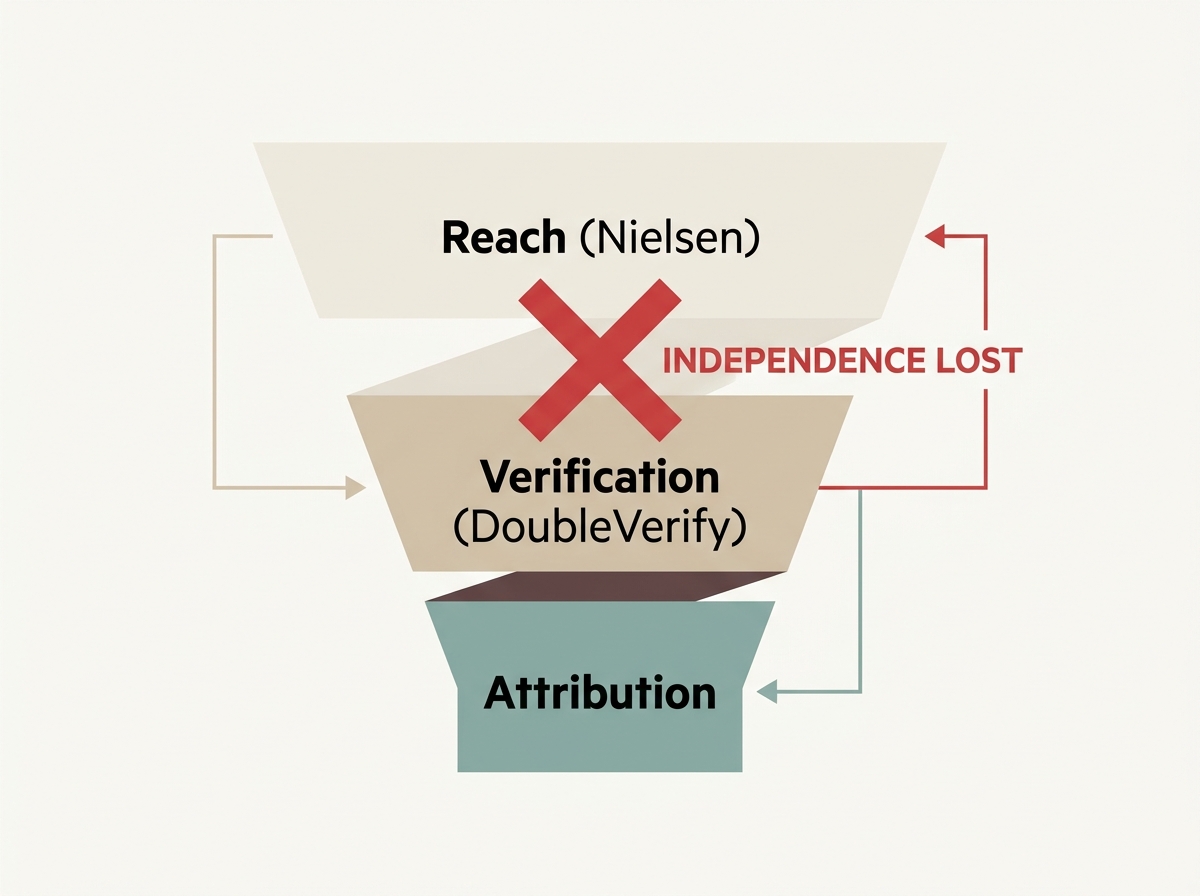
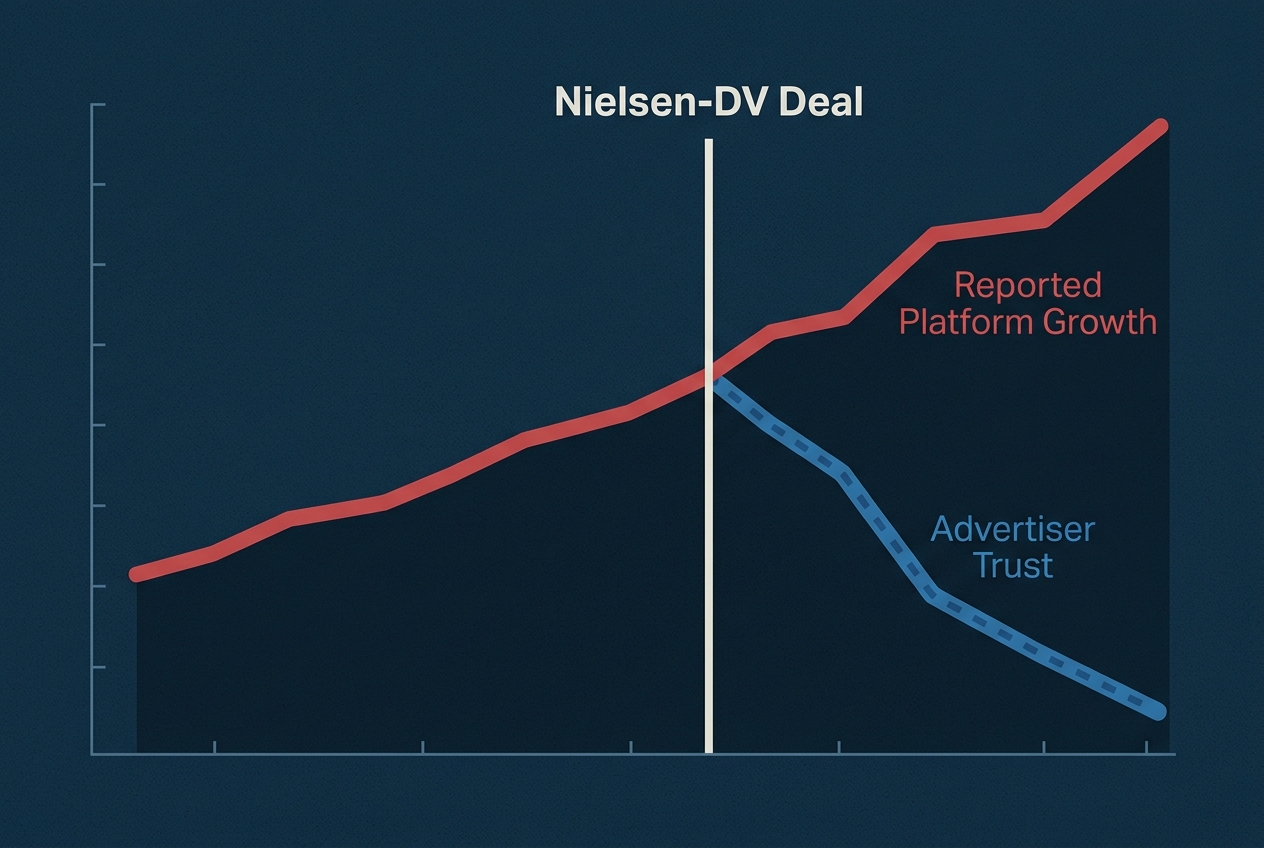
If you’re a social media manager or a paid-social buyer, you’ve likely felt the frustration described in recent Revista Merca2.0 reports: social media generates visibility, but demonstrating direct sales remains the 'holy grail' of the industry. Verification tools were the one thing that proved the 'visibility' was at least real. If those tools lose their perceived independence, the entire ROI calculation for social spend becomes a house of cards. Agencies will find it harder to justify premium CPMs to clients if the auditing firm is owned by the same company that provides the reach data the platforms themselves rely on for benchmarking.
The Counterargument: A Unified Currency for a Fragmented World
The strongest defense for this deal is that the industry is currently drowning in 'data fatigue.' Marketers are managing dozens of different measurement signals—DoubleVerify for fraud, Nielsen for reach, Brandwatch for sentiment, and internal platform metrics for engagement. Proponents of the merger argue that a unified 'Nielsen-DV' stack will finally provide a single source of truth that works across linear TV, CTV, and social.
In a world where Google Ads is pushing 'non-linear targeting' and complex AI-driven segments (as noted by Search Engine Journal in August 2026), having a measurement partner that can follow a user across every touchpoint is theoretically valuable. If Nielsen can truly integrate DV’s granular verification into its cross-platform 'Nielsen ONE' product, it might solve the attribution gap that has plagued the industry since Apple’s iOS 14.5 update.
However, this argument ignores the fundamental nature of auditing. An auditor's value is derived entirely from their distance from the transaction. A 'unified currency' is only valuable if the market trusts the mint. By removing the wall between reach and verification, Nielsen is trading long-term trust for short-term product integration.
The Ripple Effect on Social Media Stocks and Ad Tech
The market’s reaction to this consolidation has been telling. As MarketBeat noted in their August 10th analysis of social media stocks, investors are closely watching how measurement shifts impact platform valuations. If verification becomes more 'lenient' under a consolidated Nielsen, platform performance may appear to improve on paper, leading to a temporary boost in stock prices for the likes of Meta or Snap.
But this is a dangerous game. If brands lose faith in the verification data, they won't just move their money to a different platform—they’ll move it out of digital advertising altogether. We’ve already seen a shift toward 'retail media' (like Amazon or Walmart Connect) where the closed-loop attribution is easier to verify. If Nielsen-DV can't prove its independence, the exodus to these 'walled gardens' will only accelerate.
The Credibility Gap in the Post-Cookie Era
We are currently in a measurement vacuum. As third-party cookies disappear and privacy regulations like GDPR and CCPA tighten, the industry has turned to 'probabilistic' modeling. This is essentially educated guesswork. DoubleVerify’s strength was that it was less about 'who' the user was and more about 'what' the ad was doing—was it visible? Was it on a brand-safe site?
Nielsen’s business model is increasingly reliant on modeling. By acquiring DV, they are likely looking to ingest DV’s massive dataset to improve their own AI models. For a brand marketing lead, this is a red flag. You don’t want your verification data to be 'modeled'; you want it to be observed.
If Nielsen begins to use 'predictive viewability' based on DV’s historical data rather than real-time auditing, the door for ad fraud opens wide. We’ve seen this before with the 'SNDR' and 'Methbot' operations; fraudsters are experts at mimicking the patterns that measurement models look for. Without a truly independent, reactive auditor, the industry is flying blind.
What This Means for Your 2027 Planning
If you are currently negotiating annual contracts with verification partners, you need to look at the fine print. The 'Nielsen-DV' entity will likely push for bundled deals. While the discount might look attractive, you are essentially giving up your right to a second opinion.
- Diversify your verification stack. If you use DV for fraud, consider using a different partner like IAS or Moat for brand safety. Do not let one company own the entire audit trail.
- Demand 'Raw Data' access. Don't settle for the executive summaries in the Nielsen dashboard. Demand the log-level data so your internal data science teams can run their own audits.
- Watch the MRC closely. If the Media Rating Council flags concerns about this merger, take them seriously. The MRC is the last line of defense for measurement standards.
The Falsifiable Prediction
Here is the stake in the ground: Within 18 months of this deal closing, we will see a major ad fraud scandal—totaling at least $50 million in misattributed spend—that DoubleVerify fails to catch because of 'integration delays' or 'model discrepancies' within the Nielsen ecosystem. This failure will trigger a secondary wave of smaller, truly independent measurement startups that promise 'Zero-Nielsen' auditing. The 'unified currency' will fail because the market will always prioritize a check on power over a convenient dashboard.
Independence isn't just a buzzword in ad tech; it's the product. Nielsen just bought the product, but in doing so, they may have destroyed the very thing that made it valuable.

The Strategic Shift for Brand Leads
For the brand marketing lead, this acquisition necessitates a shift in how you report to the C-suite. You can no longer point to a single 'Green' checkmark in a DV report as proof of efficiency. You must begin building 'triangulation' models—using a mix of platform-native data, independent verification, and third-party attribution tools like Northbeam or Rockerbox.
Transparency isn't something that is given to you by a vendor; it is something you have to enforce through your own technical architecture. Nielsen’s $2B bet is that you’ll be too busy to notice the difference. Don't prove them right.
FAQ