
Why is every major brand suddenly obsessed with building an in-house agency? If you asked a CMO in 2018, the answer was simple: cost. By cutting out the 15% agency markup and the bloated overhead of a Madison Avenue billing structure, brands could squeeze more out of their working media budgets. But today, the math has changed. According to new research from the ANA (Association of National Advertisers), the primary driver for in-housing has shifted from fiscal efficiency to operational velocity.
We are witnessing the death of the 'monthly content calendar' and the rise of the 'real-time response desk.' In a landscape dominated by interest-based algorithms—where a single trend on TikTok can peak and vanish within 72 hours—the traditional agency approval workflow is no longer just slow; it's a liability. When you have to wait four days for an account manager to relay a creative brief to a junior designer, the cultural moment has already passed you by.
Key takeaways
- Speed is the new ROI: Brands are prioritizing the ability to move from 'idea' to 'live post' in under four hours, a feat rarely possible with external partners.
- Algorithm Alignment: Interest-based feeds (TikTok, Reels) reward volume and cultural relevance over high-production polish.
- First-Party Data Integration: In-house teams have direct access to CRM and sales data, allowing for tighter feedback loops in paid social performance.
- Institutional Knowledge: Internal teams live the brand 24/7, reducing the friction of 'brand voice' corrections that plague external agency relationships.
The Velocity Gap: Why Traditional Agencies Struggle with Interest-Based Feeds
To understand why the in-house agency is winning, we have to look at how the platforms themselves have changed. We've moved from a social graph (who you follow) to a content graph (what you like). In the social graph era, you could plan a campaign three months out because your audience was a captive one. You owned your followers.
Today, you own nothing. Every piece of content starts at zero views. Whether it reaches ten people or ten million depends on its immediate resonance within the first few minutes of publication. This shift has created what we call the 'Velocity Gap.'
How the TikTok algorithm weights early engagement
Consider the workflow of a standard external agency. A trend emerges on Tuesday morning. The social listening tool flags it. The agency strategist writes a brief by Wednesday. The creative team mocks up three options by Thursday. The brand manager reviews them on Friday, asks for a tweak to the logo placement, and by the time the post goes live on Monday afternoon, the trend is effectively dead. The brand looks like a 'fellow kids' meme, and the algorithm buries the post because the audience has moved on to the next obsession.
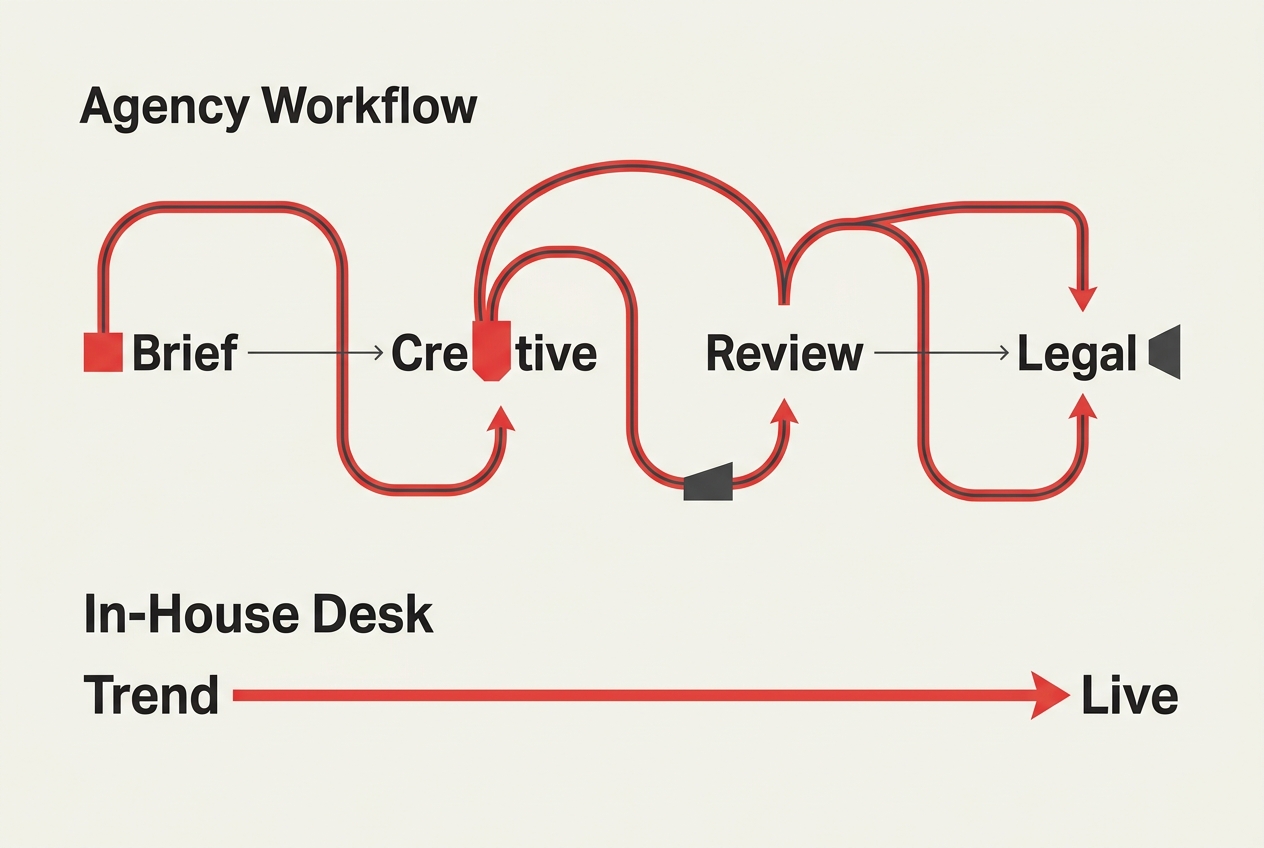
In-house teams eliminate the middleman. When the social lead sits three desks away from the legal counsel and the brand director, the approval chain shrinks from days to minutes. This isn't just about being 'first' for the sake of ego; it's about hitting the algorithmic window where engagement is cheapest and reach is most organic.
The ANA Findings: Institutionalizing the Creative Edge
The July 2026 ANA report highlights that while 78% of brands cited 'cost savings' as their top motivator five years ago, that number has dropped significantly. Now, 'speed to market' and 'creative control' are the dominant drivers. Brands like Skyscanner are leading this charge, integrating their social-first creative into broader OOH (Out-of-Home) campaigns with a level of agility that external partners struggle to replicate.
As reported by eMarketer, Skyscanner's recent shift toward 'TikTok to Terminal' campaigns proves that social isn't a silo; it's the testing ground for the entire marketing mix. By in-housing, they can identify which creator-led hooks are performing in the app and immediately port those visuals to digital billboards in airports.
This level of cross-channel synergy requires a deep understanding of the brand's internal data. As Amazon Ads VP Alan Moss recently noted during the close of Upfront talks, the integration of retail media and social content is becoming seamless. If you are an Amazon seller, your social content needs to react to real-time inventory levels. An external agency, no matter how talented, rarely has the API access or the internal clearance to see your warehouse stock in real-time. The in-house desk does.
The 'Polish Trap' and the Rise of Lo-Fi Creative
For decades, agencies justified their fees through production value. The 'Big Idea' was accompanied by a big shoot, a big crew, and a big color grade. But the current social environment—specifically on platforms like TikTok and Instagram—has democratized attention. In many cases, high production value actually signals 'AD' to a user, prompting an immediate scroll-past.
[INTERNAL: Why lo-fi creative is outperforming high-gloss ads -> creative-strategy-trends]
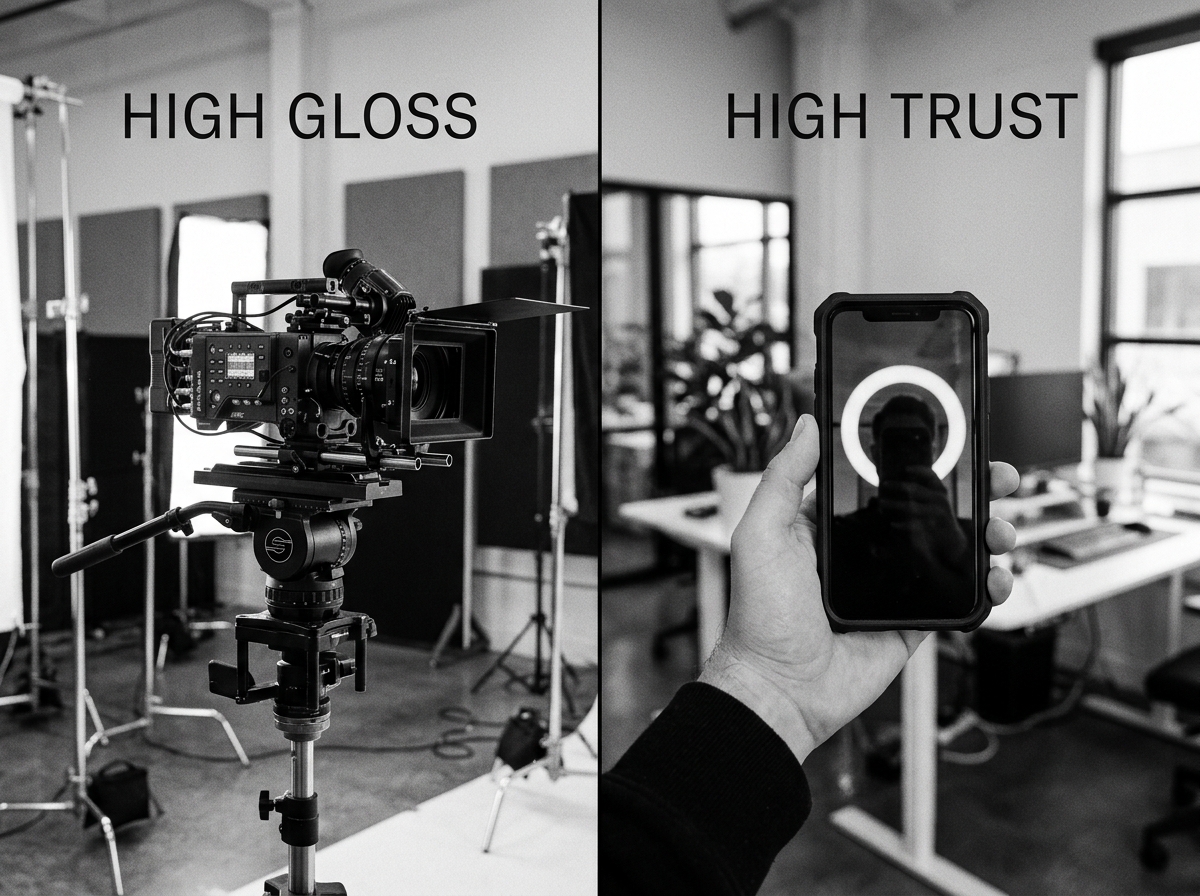
In-house teams are better positioned to embrace the 'lo-fi' aesthetic. They aren't trying to win a Cannes Lion for cinematography; they are trying to stop the thumb. This requires a different kind of talent—the 'preditor' (producer/editor). These are creators who can shoot on an iPhone, edit in CapCut, and understand the nuances of trending audio without a 20-page brand guidelines document holding them back.
Agencies often struggle to bill for this. How do you charge a client for a video that took 15 minutes to film in a parking lot? The agency business model is built on billable hours and specialized roles. The in-house model is built on outcomes. When the goal is 'generate 500 leads this week,' the method matters less than the result.
Building the Hybrid Model: Where Agencies Still Fit
Does this mean the agency is dead? Not quite. But their role is being forced to evolve. The most successful brands are moving toward a hybrid model. They keep the 'always-on' social desk in-house to handle the daily churn, community management, and trend-jacking. They then hire external agencies for specialized, high-impact needs:
- Big Rock Campaigns: The Super Bowl spots or major product launches that require 3D animation, celebrity talent, and massive scale.
- Strategic Audits: Internal teams can become echo chambers. An external agency provides the 'outsider's perspective' to challenge the status-quo.
- Experimental Tech: Whether it's building custom AR filters or navigating the complexities of AI-generated content, agencies can amortize the cost of expensive R&D across multiple clients.
As noted in recent Times Square Chronicles coverage of TikTok agency strategies, the agencies that are surviving are those that act as consultants rather than execution arms. They teach the in-house team how to fish rather than selling them the fish one by one.
The Information Gain Factor: Why Unique Content Wins
There is a technical SEO and algorithmic component to this shift that often goes unmentioned. Google's 'Information Gain' patent suggests that the search engine (and increasingly, social algorithms) prioritizes content that adds something new to the conversation rather than just rehashing what already exists.
[S1] When a brand uses a generic agency that handles five other competitors in the same vertical, the content tends to regress to the mean. It looks the same, sounds the same, and uses the same stock assets. In-house teams, by virtue of being embedded in the product development and customer service loops, have access to 'unique information' that an external partner simply doesn't.
They know the weird questions customers are asking on support calls. They know the specific way the product team intended a feature to be used. They can create content that provides genuine information gain, which platforms like Google and TikTok increasingly use as a ranking signal to determine what is 'high quality.'
How to Transition Your Social Desk In-House
If you're a brand marketing lead looking to make this move, don't try to flip the switch overnight. The graveyard of marketing is full of brands that fired their agency, hired three juniors, and realized they didn't have the infrastructure to manage them.
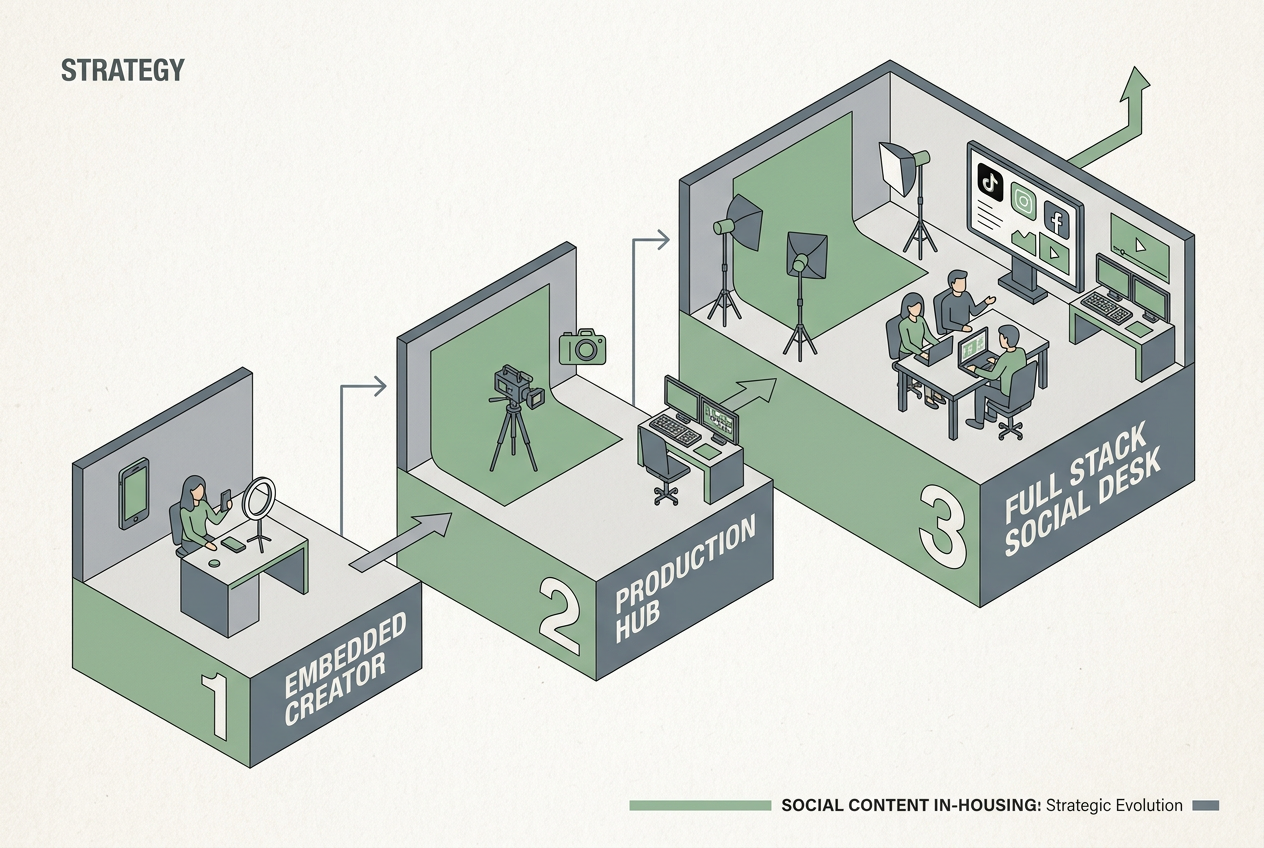
Phase 1: The Embedded Creator Hire one full-time creator whose only job is to live on camera and in the comments. Let them sit with the agency team. This person is your bridge. They bring the 'voice' in-house while the agency handles the media buying and reporting.
Phase 2: The Production Hub Bring your video editing and design in-house. This is where the most significant time-savings occur. Use tools like Frame.io or Sprout Social to manage the workflow, but ensure the hands on the keyboards are employees, not contractors.
Phase 3: The Full Stack Desk Once your creative loop is tight, bring the media buying in-house. With the rise of Advantage+ on Meta and TikTok's Smart Creative, the 'technical' side of media buying is becoming automated. The real work is now the creative testing—and that’s best done by the people who made the ads.
What This Means for Your Strategy Tomorrow
If you are still operating on a 'submit to agency, wait for feedback' loop, you are losing ground to competitors who are publishing three times a day. The ANA research isn't just a trend report; it's a warning.
Stop looking for an agency that can 'do social' for you. Look for an agency that can help you build the internal capability to do it yourself. The creative edge in 2026 isn't found in a polished 30-second spot; it's found in the brand that can see a trend at 9:00 AM and have a branded response in the feed by lunch. That isn't a cost-saving tactic. It's a competitive necessity.
FAQ