
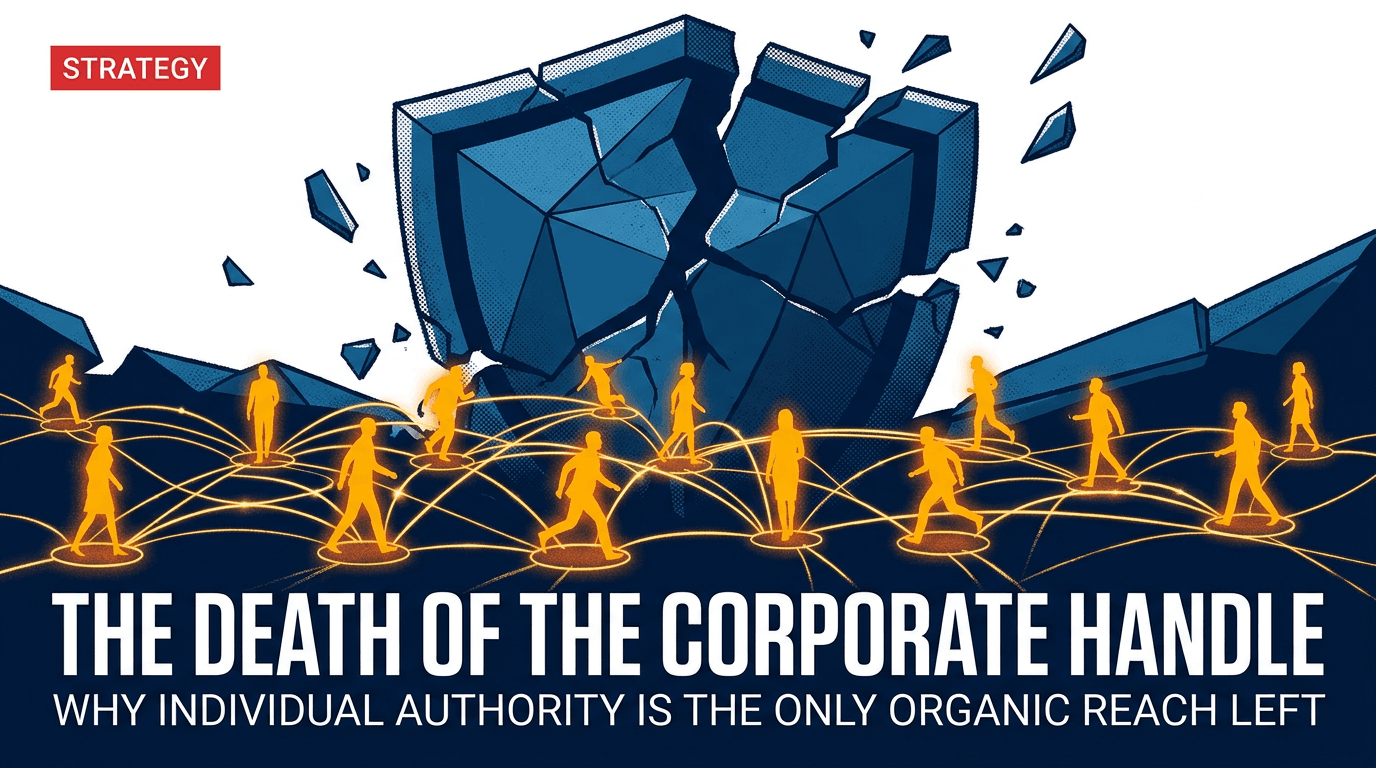
The corporate social media handle is becoming a digital ghost town. If your 2026 strategy still relies on a logo-branded account to drive organic growth, you're effectively shouting into a vacuum. The thesis is simple: In an era of AI-generated noise and algorithmic skepticism, individual authority has permanently replaced institutional trust as the primary currency of reach.
We've watched this slow-motion train wreck for years. Meta's pivot to Reels, TikTok's dominance, and LinkedIn's recent algorithm updates all point toward the same conclusion: platforms prioritize people, not entities. When a brand posts, it's an ad; when an executive or an employee posts, it's a conversation. For social leads, the job is no longer managing a calendar for the @Brand account—it's architecting a decentralized network of human voices.
The Algorithmic Bias Against Logos
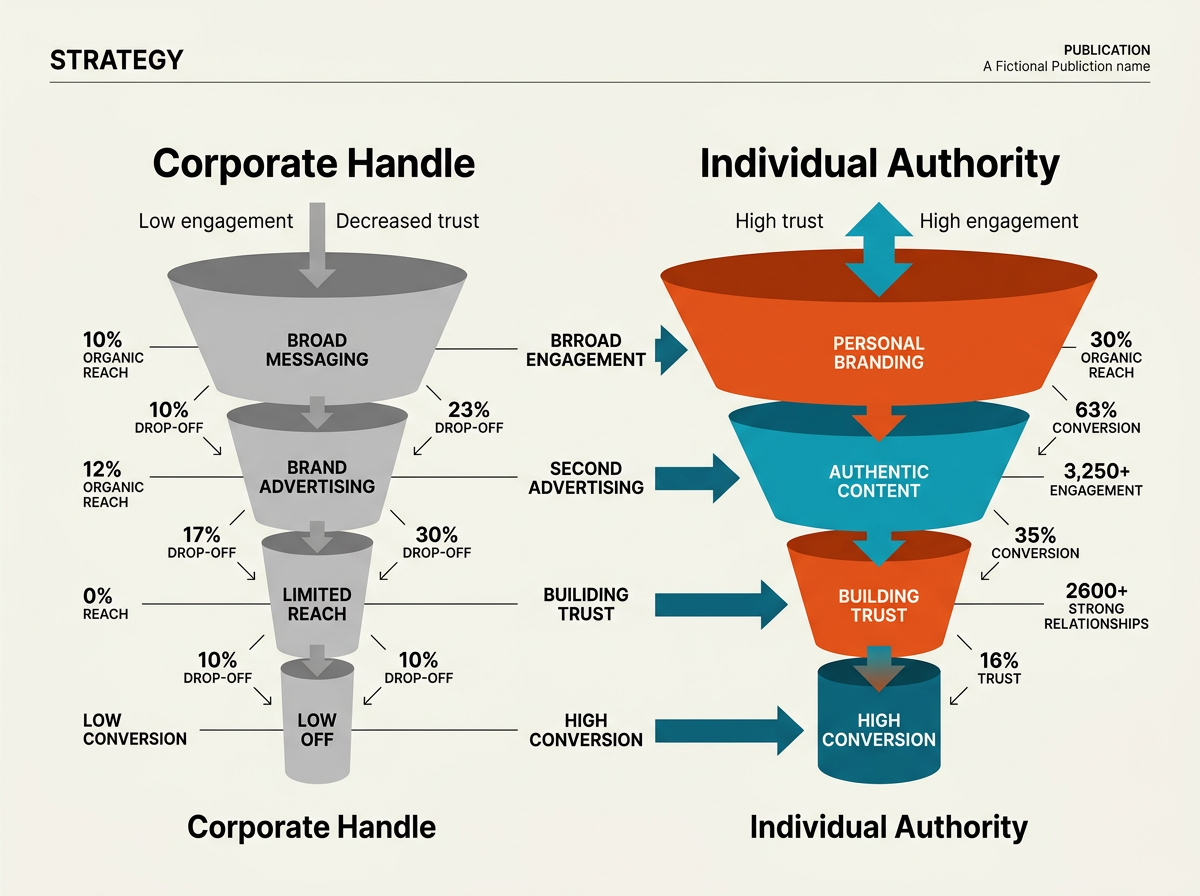
Recent data from Sprout Social suggests that users on emerging platforms like Bluesky are seeking 'user-controlled feeds' that favor transparency over polished corporate messaging. This isn't just a trend on niche networks; it's the new standard. Since Meta deprecated CrowdTangle in August 2024, our ability to track the specific decay of brand reach has become harder, but the anecdotal evidence from agency strategists is unanimous: organic reach for brand pages is hovering in the low single digits, while 'creator-style' posts from individual employees often see 10x to 50x the engagement.
Why? Because platforms like LinkedIn and X (formerly Twitter) have recalibrated their recommendation engines to favor 'original insight.' A corporate press release shared by a brand account is categorized as promotional. That same insight, reframed by a Chief Product Officer as a 'lesson learned,' is categorized as educational content.
How to justify GEO investment without perfect attribution
Consider the recent 'Qualified Future Conversions' discussion at Google. Per Search Engine Journal's reporting on Ginny Marvin’s recent clarifications, the focus is shifting toward qualified interactions and creator partnerships. Google is essentially signaling that the path to conversion now runs through trusted intermediaries—people—rather than just direct-to-site brand traffic. If the largest search engine in the world is prioritizing individual creator signals in its AI Overviews, why are you still pouring 80% of your social budget into a brand handle that the algorithm is actively suppressing?
Decentralizing the Brand: The MLS Case Study
Look at how Major League Soccer (MLS) is approaching its growth ahead of the World Cup. As reported by Adweek, MLS CMO Radhika Duggal is launching the largest coordinated marketing campaign in the league's history. But the secret sauce isn't just a massive TV buy; it's the mobilization of individual player brands and localized voices. They aren't just selling 'The League'; they are selling the individuals within it.
This is the blueprint for corporate social strategy in 2026. Instead of one megaphone, you need a thousand whispers. When a brand like Salesforce or Adobe empowers its engineering leads to post about their daily challenges, they aren't just 'doing social'—they are building a moat of human credibility that no AI-generated brand campaign can replicate.
The 'Evergreen' Trap and the Rise of Ephemeral Authority
For years, the gold standard was 'evergreen' content—posts that could live forever and drive steady traffic. Search Engine Journal recently suggested this era is over. In a Generative AI world, 'evergreen' information is commoditized. You can ask ChatGPT for a 'how-to' guide on B2B lead gen. You don't need a brand's blog post for that anymore.
What you can't get from an LLM is the specific, messy, time-bound perspective of a practitioner who just spent eight hours in a boardroom. This is 'ephemeral authority.' It’s the insight that matters now, delivered by a person who is actually doing the work.
To operationalize this, social leads must move away from the 'Social Media Manager as Content Creator' model and toward the 'Social Media Manager as Editor and Coach' model. Your job is to identify the internal subject matter experts (SMEs), ghostwrite their initial frameworks, and train them on how to engage with their specific niches.
Refuting the 'Risk' Argument
The most common pushback against employee advocacy and personal branding for business is the risk of the 'rogue employee.' Legal and HR departments fear that by building an individual's platform, the company is creating a liability or, worse, helping a top performer build their exit ramp.
This fear is outdated. In 2026, the risk of irrelevance far outweighs the risk of a PR gaffe. If your best people have no presence, your brand has no presence. Furthermore, the 'exit ramp' argument is a fallacy; top talent will leave regardless, but while they are with you, their reach is an asset you can't buy on the open market. A LinkedIn post from a Senior VP with 50,000 followers is worth more in earned media value than a $10,000 sponsored post from the corporate page.
10 Best TikTok Marketing Agencies for Brand Growth
How to Operationalize Individual Authority Tomorrow
If you want to survive the decline of organic social reach, you must reallocate your resources. Stop spending 40 hours a week on the brand Instagram grid. Start doing the following:
- Identify your 'Vanguard Five': Select five leaders across different departments (Product, Sales, HR, Engineering, C-Suite).
- Audit their 'Digital Footprint': Use tools like Sprout Social or Brandwatch to see where their expertise overlaps with trending industry topics.
- Create a 'Content Concierge' Service: The biggest barrier for executives is time. Provide them with weekly 'angles' based on internal wins or industry news. Don't write the posts for them in a vacuum—interview them for 15 minutes and transcribe their voice.
- Measure 'Network Reach': Stop reporting on the brand account's followers. Start reporting on the aggregate reach of your key employees. This is the metric that actually moves the needle on Brand Lift and GEO (Generative Experience Optimization).

The 2027 Prediction: The 'Ghost Brand' Era
By this time next year, the most successful B2B and B2C brands will have 'ghost' corporate accounts—handles that exist only for customer service and to host paid ads. The entirety of their organic 'storytelling' will happen through a decentralized network of creators, employees, and executives.
We are moving toward a world where 'The Brand' is simply the infrastructure that supports a community of individuals. If you aren't building those individual platforms now, you are building on a foundation of sand. The algorithm has made its choice: it wants the person, not the institution. It's time you made yours.
FAQ