

The Interactive Advertising Bureau (IAB) released its updated AI Content Disclosure Framework this week, establishing a new global benchmark for how brands must signal the use of generative tools in advertising. The guidelines move beyond simple binary 'AI-made' labels, focusing instead on whether the AI intervention materially alters a consumer’s perception of reality or product performance.
For social media marketers, this isn't just a matter of ethics—it’s a matter of deliverability. With Meta, TikTok, and YouTube already deploying automated detection for unlabelled synthetic media, the IAB’s new definitions provide the first clear roadmap for avoiding the 'shadowban' that often follows miscategorized creative. You've likely seen the 'Made with AI' tags appearing on Instagram Reels; this standard dictates exactly when you need to trigger them and when you can safely omit them.
Key takeaways
- Materiality is the new North Star: Disclosures are required only when AI creates a 'materially deceptive' representation of a person, place, or product.
- Utility vs. Generative: Standard tools like Generative Fill for background extensions do not require labels, provided the product remains untouched.
- The 'Human-in-the-Loop' Exemption: Creative heavily edited by humans after AI generation may bypass certain disclosure triggers if the final output is deemed 'artistic' rather than 'synthetic.'
- Platform Alignment: The IAB expects major social platforms to adopt these definitions by Q4 2026 to standardize the user experience.
The shift from technical origin to consumer impact
For the last 24 months, the industry has obsessed over how content was made. If a pixel was generated by a diffusion model, the knee-jerk reaction from regulators was to label it. The IAB’s August 2026 update rejects this technical-first approach. Instead, it adopts a 'perceptual impact' model.
If you use a tool like Adobe Firefly to expand the canvas of a lifestyle shot—adding more sky or extending a wooden table—you are performing what the IAB calls 'Functional AI Enhancement.' This is categorized alongside traditional Photoshop retouching. According to the new framework, these edits do not require a disclosure tag because they do not mislead the consumer about the product's benefits or the authenticity of a spokesperson.
However, the moment you use AI to swap a model’s face or generate a synthetic 'customer' giving a testimonial, you cross the line into 'Substantive Synthetic Media.' This requires a clear, prominent disclosure. The IAB suggests that for social video, this disclosure must appear within the first two seconds of the creative and remain visible for at least three seconds.
How Meta's new Reels ranking changes paid budget pacing
Navigating the 'Grey Zone' of Generative Retouching
One of the most contentious parts of the new standard involves product photography. Social media managers frequently use AI to clean up reflections or adjust lighting on product shots. Under the new IAB rules, if the AI changes the physical attributes of the product—making a diamond look clearer than it is or a fabric look smoother—it must be labeled.
This creates a significant workflow hurdle for creative teams. High-volume agencies are currently using AI to generate thousands of localized variants of a single ad. If every variant requires a different disclosure strategy, the 'efficiency gain' of AI begins to erode. The IAB recommends a 'Baseline Disclosure' for any ad where the central subject is synthetic, regardless of how 'real' it looks.
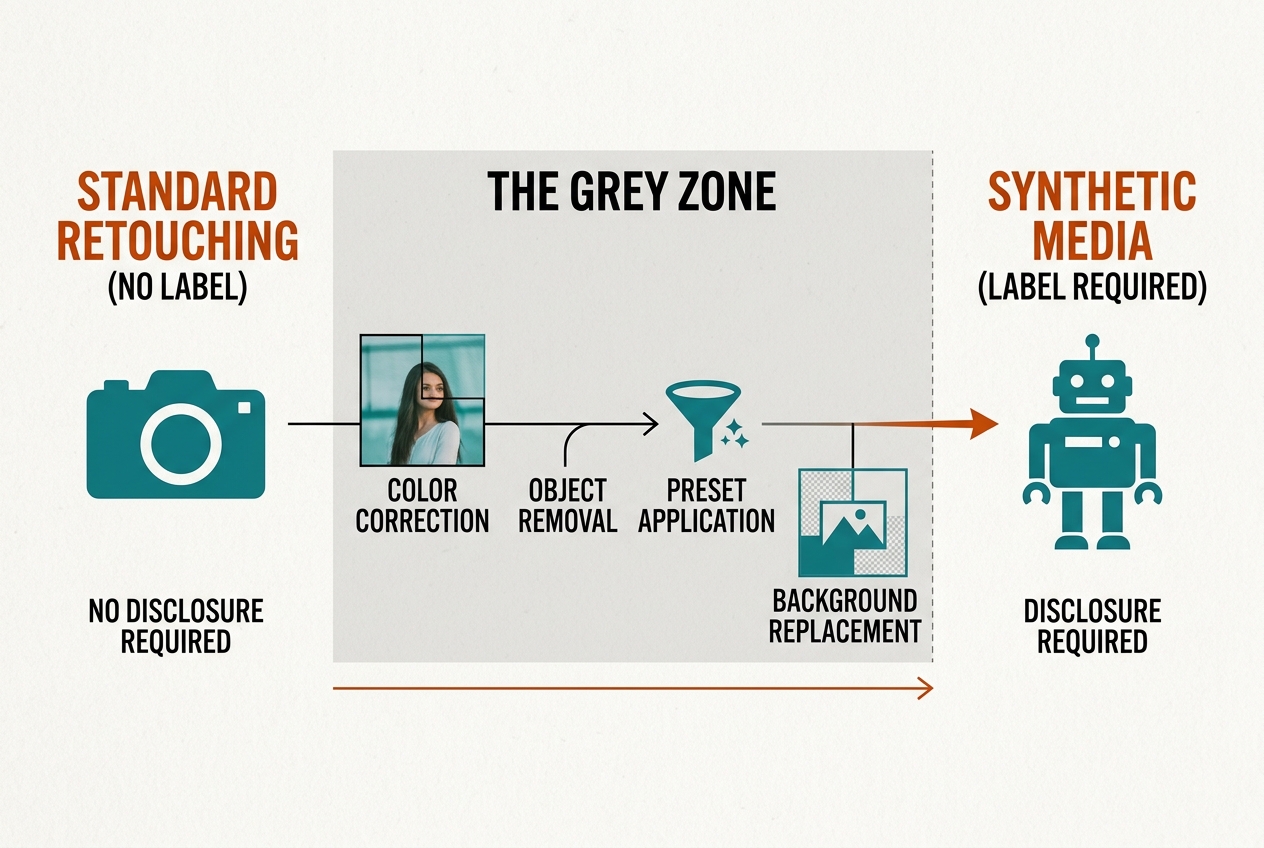
As noted in recent industry analysis, AI tools for social media are helping teams publish more with less (per Hootsuite’s August 2026 report). But that volume comes with a risk. If your team is using AI to swap products into different lifestyle settings—a practice known as 'Virtual Set Placement'—the IAB suggests a 'non-intrusive' disclosure, such as a small watermark or a line in the caption. This differs from the 'High-Intensity' labels required for deepfakes or political messaging.
Why 'Authenticity' is the new legal shield
We are seeing a bifurcated market. On one hand, brands are leaning into high-tech synthetic production. On the other, there is a massive surge in 'hyper-authentic' content. A recent partnership between Travis Kelce, Publicis Sports, and 3 Arts Sports highlights this trend, focusing on landing 'authentic' NIL deals that rely on real-world human connection (per Adweek, August 2026).
For social creative teams, the IAB standards provide a legal and operational shield. By following the 'Materiality' test, you can defend your choice not to label content that uses AI for mundane tasks. This is crucial because, according to internal agency benchmarks, ads with 'Made with AI' labels currently see a 12-15% lower click-through rate (CTR) on platforms like TikTok, as users often perceive them as 'low effort' or 'spammy.'
If you can prove that your AI usage was purely functional—upscaling resolution, removing a stray power line, or adjusting the color grade to match a brand palette—you can avoid the 'AI' tag and the associated performance penalty. The IAB defines this as 'Non-Material AI Assistance.'
The platform enforcement gap: Meta vs. TikTok vs. Google
While the IAB sets the standard, the platforms build the fences. Currently, there is a massive discrepancy in how AI content is detected. Meta’s 'AI Info' tag is largely triggered by C2PA metadata—invisible digital watermarks embedded by tools like OpenAI’s DALL-E or Google’s Gemini. If your creative team strips this metadata during the export process, you might bypass the automated tag, but you risk a permanent ban if a manual review flags the content as deceptive.
Google, meanwhile, is focusing on AI search integration. As Search Engine Journal noted in their recent study of 15 million data points, AI assistants are now turning contextual prompts into multiple queries, changing how buyers decide (per Ahrefs/SEJ, August 2026). This shift in search behavior means that your social creative isn't just being judged by humans; it's being indexed by AI that can recognize synthetic patterns better than any person could.
9 AI Search Myths, Debunked by 15 Million Data Points
To stay compliant, your creative operations (Creative Ops) team should implement a 'Metadata Integrity' policy. Instead of trying to hide AI usage, use the C2PA standards to specify what was changed. The IAB is pushing for 'manifests'—digital logs that show a human shot the photo but an AI extended the background. This granular transparency is the only way to satisfy both the algorithm and the regulator.
Practical steps for social media managers
How do you apply this to your Q4 2026 planning?
First, audit your toolset. If you are using any of the '13 expert picks' for AI social tools (per Hootsuite), identify which ones generate pixels versus which ones merely analyze data. Design tools like Canva’s Magic Studio or Midjourney require a different disclosure tier than listening tools like Brandwatch or Sprout Social.
Second, update your brand guidelines. You need a clear internal definition of 'Material Change.' If your brand sells skincare, using AI to smooth skin is a material change and a legal liability. If you sell software, using an AI-generated character to demonstrate the UI is a creative choice that requires a 'Synthetic Persona' label.
Finally, prepare for 'Label Fatigue.' As more brands comply with the IAB standards, social feeds will be littered with disclosures. The winners will be those who find creative ways to incorporate the disclosure into the brand voice—perhaps making the 'AI-ness' part of the joke or the aesthetic, rather than a hidden shame.

What to watch next: The rise of the 'Certified Human' badge
As generative AI becomes the default for mid-tier creative, we expect a counter-movement. Much like 'Organic' or 'Fair Trade' labels in the grocery aisle, we are seeing the early stages of 'Human-Only' certifications for high-end social production.
For now, the IAB’s move provides much-needed clarity. It stops the 'witch hunt' for any AI-touched pixel and focuses the industry's attention where it belongs: on the relationship between the brand and the consumer. If you aren't lying to your audience about what you're selling, the AI is just another brush in the kit. But if the AI is the one doing the selling, you’d better say so—loudly and clearly.
Why Search Volume Is Screening Out Your Best Content Opportunities
By aligning with these standards now, social creative teams can avoid the frantic 'compliance pivots' that usually follow a platform's sudden algorithm update. The goal isn't just to stay out of 'ad jail'—it's to maintain the trust that takes years to build and only one unlabelled deepfake to destroy.
FAQ