

Instagram has begun rolling out a global feature allowing users to hard-reset their content recommendations across Reels, Explore, and the Feed. This update, dubbed 'Your Algorithm' controls, effectively lets users wipe their behavioral data clean and start their interest graph from scratch, forcing the platform to relearn their preferences in real-time.
For social media marketers, this isn't just a user-experience tweak; it's a structural threat to long-term reach. When a user hits the reset button, your brand's historical 'earned' affinity vanishes. You are no longer appearing because of a follow or a like from three months ago. You are competing for a spot in a vacuum where only high-retention, immediate-value content survives the re-curation phase. This shift moves brand safety from a passive 'avoiding bad adjacencies' task to an active audit of whether your content is worth keeping in a sanitized feed.
The mechanics of the algorithmic purge
Under the new settings, users can select a 'Reset Suggested Content' option. This doesn't just shuffle the deck; it clears the cache of signal-based weighting that Instagram uses to predict what a user wants to see. If you’ve spent the last year optimizing for a specific niche, you may find your content suddenly excluded from the feeds of your most loyal non-following viewers.
Meta’s move follows a broader industry trend toward user-centric data control, but the timing is critical. As platforms move toward more aggressive AI-driven recommendations, the 'black box' has become too cluttered for many users. By offering a 'nuclear option,' Instagram is betting that a clean slate will increase long-term time spent on the app, even if it causes short-term volatility for creators and advertisers.
From a technical standpoint, this reset likely clears the weights assigned to specific accounts and hashtags in a user's 'interest vector.' If your brand was a '9/10' match for a user yesterday, you are a '0/10' today until they re-engage. This places a massive premium on what we call 'First Contact' content—the kind of high-impact, broad-appeal creative that wins over a skeptical, newly-reset algorithm.
Why brand voice is your only defense
In an environment where users can delete their history with you in two taps, your brand voice must be unmistakable. As noted in recent industry frameworks on building a strong brand voice in 2026, consistency isn't just about color palettes; it's about a recognizable editorial perspective that survives a feed reset.
If a user resets their feed and your content appears again, will they recognize you? Or were you just a ghost in their machine, appearing only because the algorithm forced you there? Brands that rely on 'hacks' or trending audio without a core identity will be the first to be purged.
We are seeing a shift toward what Adobe calls 'Brand Visibility' in the age of AI. Per recent reports on Adobe's GEO (Generative Engine Optimization) tools Adobe Brand Visibility and GEO, the goal is now to optimize for visibility across LLMs and recommendation engines alike. On Instagram, this means your content must be so clearly categorized and high-quality that the new, 'clean' algorithm immediately identifies you as a top-tier recommendation for your specific vertical.

The manual content audit: Surviving the curation phase
When a user resets their algorithm, they often enter a period of 'active curation.' They are more likely to hit 'Not Interested' on content that doesn't immediately fit their new desired digital vibe. This makes the manual content audit a weekly necessity for social teams. You are no longer auditing for what worked last month; you are auditing for what survives a 'vibe check' from a user who just cleared their history.
To survive this phase, marketers should focus on three specific metrics:
- Retention Rate at 3 Seconds: If you don't stop the scroll in a reset feed, you won't get a second chance to build that affinity back.
- Share-to-Save Ratio: Shares signal to a fresh algorithm that your content is high-value enough to exit the platform's ecosystem.
- Comment Sentiment Depth: Using AI social listening in 2026, brands must track not just volume, but the specific intent behind comments. Are people asking questions, or just dropping emojis? The former signals the kind of deep engagement that survives a reset.
Paid social and the 'Reset' ripple effect
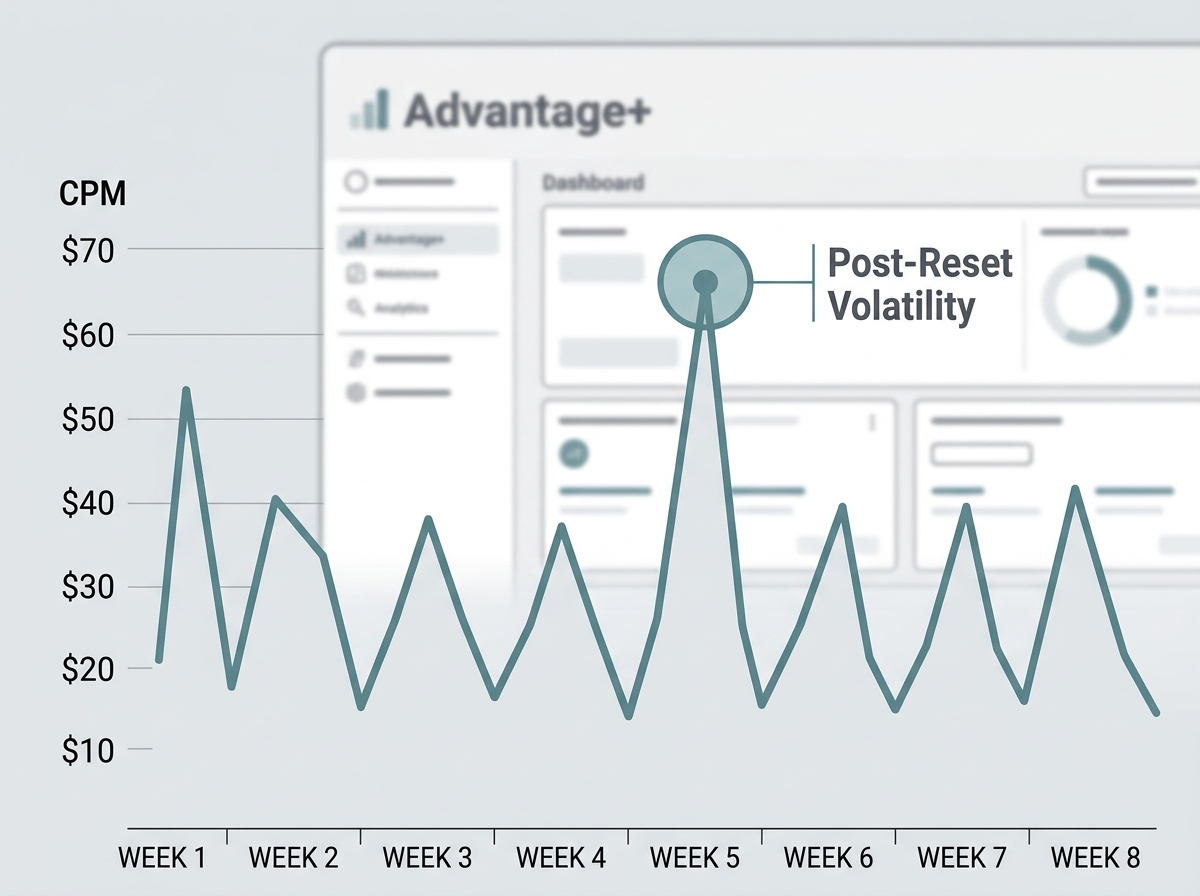
While the 'Your Algorithm' reset primarily targets organic recommendations, the ripple effects for paid social buyers are significant. Instagram’s ad delivery system relies heavily on the same interest graphs that power the organic feed. If a significant percentage of a target audience resets their preferences, the 'Advantage+' audiences and lookalikes will see a temporary spike in CPMs as the system struggles to re-categorize those users.
Media buyers should prepare for higher volatility in frequency and reach. If you are running a retargeting campaign based on 'engaged with Instagram profile,' those users might still be in your bucket, but their organic feed will no longer be priming them for your message. This creates a disconnect between the 'warmed-up' audience you think you have and the 'cold' experience they are actually having on the app.
We recommend diversifying creative more aggressively. As suggested in TikTok marketing strategies for 2026, the 'platform-native' look is no longer enough; you need 'interest-native' creative. This means making ads that look like the specific niche a user is trying to build after their reset—whether that's 'minimalist productivity,' 'maximalist DIY,' or 'quiet luxury.'
The integrated search approach to social visibility
With the algorithm reset, social media is behaving more like a search engine. Users are 'searching' for a new identity by interacting with specific types of content. This aligns with the 'Integrated Search Brief' concept popularized by Corey Morris in Search Engine Journal The Integrated Search Brief for AI Search, which advocates for aligning SEO, PPC, and content teams.
On Instagram, this means your captions and on-screen text are more important than ever. The 'Your Algorithm' tool likely uses NLP (Natural Language Processing) to categorize the content it shows to a 'reset' user. If your captions are vague or purely aesthetic, the algorithm won't know where to put you. You need to treat your Instagram captions with the same keyword discipline you use for Google or TikTok search.
Ask yourself: If a user tells Instagram they are interested in 'sustainable gardening,' does my content have the semantic markers to show up in their first hour of browsing? If the answer is no, you are essentially invisible until you start paying for the privilege.
What to watch: The rise of 'Intentional Consumption'
This update marks the end of the 'Passive Feed' era. We are entering an era of 'Intentional Consumption,' where users take an active hand in training their AI-driven feeds. For brands, this is a double-edged sword. It’s harder to get in, but once you are in a user’s 'curated' feed, your conversion rates are likely to be significantly higher because you have been 'vetted' by the user themselves.
In the coming months, keep a close eye on your 'Follower vs. Non-Follower' reach ratio in Instagram Insights. A sharp drop in non-follower reach may indicate that your target demographic is heavily utilizing the reset feature, and your current content isn't making the cut for their 'New Algorithm.'
Don't wait for the data to tell you you've been purged. Start the audit now. Simplify your messaging, sharpen your brand voice, and ensure every piece of content provides enough value to survive a user's manual curation. The algorithm isn't just a machine anymore—it's a reflection of user intent, and intent is a moving target.
FAQ