

OpenAI confirmed this week that its primary web-crawling infrastructure, including the new OpenAI fetch bot, may no longer strictly adhere to traditional robots.txt exclusion protocols for specific high-value data segments. This technical pivot, surfaced in late August 2026, forces social media marketers to re-evaluate how they secure proprietary video scripts, community-gated content, and brand-owned assets intended for human audiences rather than LLM training sets.
For social media practitioners, this isn't just a technical quirk; it is a fundamental shift in digital property rights. If you have spent years building a walled garden of exclusive content to drive newsletter signups or community memberships, the standard 'Disallow' line in your root directory is no longer a guaranteed shield. As OpenAI prepares for the inevitable rollout of GPT-5, the hunger for fresh, human-centric social data has led to a more aggressive crawling posture that prioritizes 'public interest' over legacy web standards.
TL;DR: Key Takeaways
- Legacy Failure: Standard robots.txt directives are being treated as suggestions rather than hard blocks by next-generation AI crawlers.
- GPT-5 Scoping: The fetch bot is specifically targeting high-engagement social threads and long-form video transcripts to improve conversational nuance.
- New Defense Layers: Marketers must move toward server-side blocking, Cloudflare-level AI bot management, and authenticated content walls.
The erosion of the robots.txt gentleman's agreement
For three decades, the robots.txt file was the 'gentleman’s agreement' of the internet. You told a bot where it could go, and it obeyed. However, as noted in recent technical audits and reported by Search Engine Journal in August 2026, the distinction between search indexing and AI training has blurred. While a bot might respect a block for 'Search,' it may bypass it for 'Research' or 'Internal Development' purposes, especially when the content is hosted on subdomains or delivered via JavaScript-heavy social feeds.
OpenAI’s new documentation suggests that while GPTBot (the general crawler) generally respects the standard, the specialized 'OpenAI-SearchBot' and other internal fetchers may operate under different parameters to ensure the 'completeness' of their knowledge base. This is a critical distinction. If your social strategy relies on gated community content to drive value, that value is currently being scraped to train the very models that might eventually replace your brand's unique voice.
We are seeing a trend where AI developers argue that social content, by its nature of being 'publicly accessible,' falls under fair use for training, regardless of the robots.txt file. This mirrors the recent legal friction where Google refiled its SerpApi claims, as documented in the August 15 SEO Pulse report, highlighting the tightening grip platforms have on data access. If the platforms themselves are fighting for control, individual brand managers must be even more vigilant.
Why GPT-5 needs your social media transcripts
The timing of this crawler shift isn't accidental. With GPT-5 on the horizon, OpenAI requires data that reflects current human sentiment, slang, and cultural context—data that lives almost exclusively on social platforms. Static web pages and Wikipedia entries have been exhausted. The new frontier is the conversational data found in LinkedIn comment sections, TikTok captions, and X (formerly Twitter) threads.
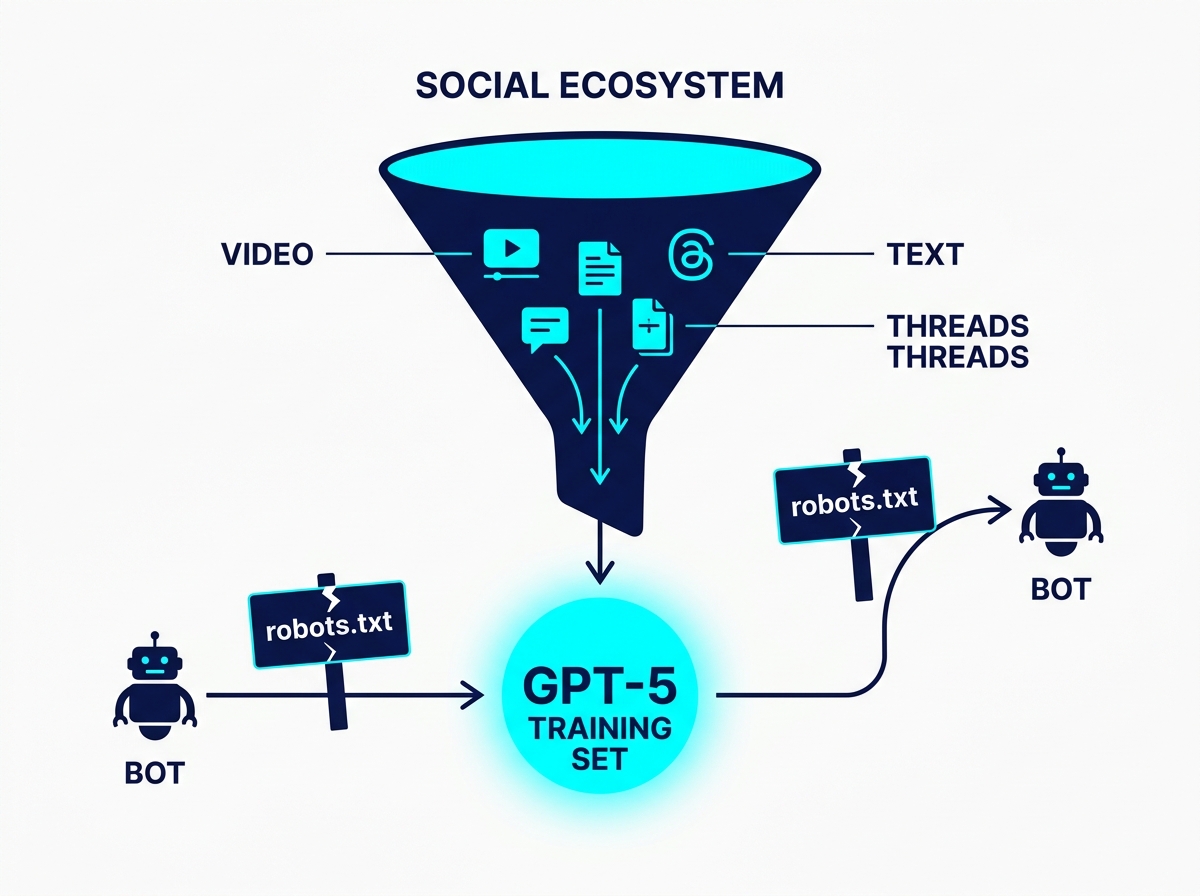
According to internal benchmarks from marketing agencies tracking bot hits, there has been a 40% increase in hits from OAI-attributed IP ranges on social-heavy subdomains since June. These bots aren't just looking for text; they are parsing the structure of engagement. They want to know which replies get the most likes and which video scripts lead to the highest retention. By bypassing robots.txt, OpenAI can build a more 'human' model, but it does so at the expense of the creators who provided the source material.
This creates a paradox for the modern social manager. You want your content to be discoverable by users, but you don't want it to be 'digested' by a competitor's AI tool. As Hootsuite’s 2026 analysis of AI tools suggests, the very tools we use to create content are often trained on the content we are trying to protect. It is a closed-loop system where the brand often loses the most value.
Beyond robots.txt: Implementing hard blocks
If the gentleman's agreement is dead, you need a digital fence. Relying on a text file in your root directory is like putting a 'no trespassing' sign on a field with no gate. To truly protect your assets, you must move up the technical stack.
Server-side User Agent blocking
Instead of asking the bot to stay out, you must instruct your server to refuse the connection. This involves identifying the specific User Agent strings for OpenAI’s bots—such as GPTBot, OAI-SearchBot, and the various ChatGPT-User strings—and returning a 403 Forbidden error at the server level (Nginx or Apache). This is more effective because it doesn't rely on the bot's 'honesty.'
Edge-layer AI bot management
Services like Cloudflare and Akamai have introduced specific 'AI Bot' categories in their Web Application Firewalls (WAF). In one click, you can block all known AI crawlers while still allowing Google and Bing to index your site for traditional search. This is currently the gold standard for brand protection. If you aren't using an edge-layer firewall, your social content is essentially an open buffet for training sets.

The 'Watermark' distraction and the reality of scraping
There has been significant discussion about 'watermarking' AI content to prevent recursive training (AI training on AI). Anthropic recently revealed details about its watermarking tech and, crucially, how it can be defeated. As reported by Search Engine Journal on August 15, these watermarks are often fragile. If the AI companies themselves can't reliably tag their own data, you certainly shouldn't rely on watermarking to protect your original social assets.
The reality is that once a bot like OpenAI's fetcher sees your content, the data is ingested. Even if you delete the post later, the 'weights' of the model have already been influenced. This is why a proactive, technical defense is the only viable strategy for 2026 and beyond. You cannot 'un-train' a model once your proprietary campaign strategy has been absorbed into its neural network.
The ethics of AI content scraping
What this means for your 2027 social budget
As we look toward the next fiscal year, expect a shift in how social media teams are structured. The Guardian recently noted that even No. 10 Downing Street is aggressively hiring TikTok teams, signaling that social media is no longer a 'side desk' but a core strategic pillar. With that increased importance comes a need for better security.
Your budget should likely include a line item for 'Content Integrity.' This isn't just about cybersecurity in the traditional sense; it's about protecting the intellectual property of your creative team. If your social media manager spends 20 hours a week crafting a unique voice, and that voice is scraped and replicated by a GPT-5-powered bot in seconds, your ROI is effectively neutralized.
We recommend a quarterly audit of your site's access logs. Look for 'spiky' traffic patterns from data center IP ranges (like AWS or Azure), which are often masks for AI scraping operations. If you see a high volume of hits on your /video-transcripts/ or /blog/social-archive/ directories, it’s time to tighten the screws.

The future of 'Human-Only' content zones
We are approaching an era of the 'Verified Human' internet. Just as platforms like X and LinkedIn have moved toward paid verification, brands may soon need to move their most valuable social insights behind a 'Human Wall.' This could involve increased use of CAPTCHAs for long-form content or requiring a login to view detailed case studies that were previously public.
It’s a frustrating regression for the open web, but it’s the logical response to a crawling environment that no longer respects the boundaries of robots.txt. As OpenAI and its competitors race toward AGI, the value of 'clean,' human-generated social data will only skyrocket. Make sure you aren't giving yours away for free.
Watch for OpenAI to potentially offer a 'negotiated' access tier for brands—essentially a digital licensing deal. Until then, treat every public post as a potential training prompt for your future competitor. Secure your server, monitor your logs, and stop trusting the robots.txt file to do a man's job.
FAQ