
By the end of this guide, you will have a repeatable framework for restructuring your social video and caption workflows to capture 'Answer Engine' traffic. You'll move from creating entertainment-first content to 'utility-first' assets that rank. Before starting, you need your last 30 days of search term data from TikTok Studio or Instagram Insights and a baseline understanding of your brand's core 'How-to' pillars.
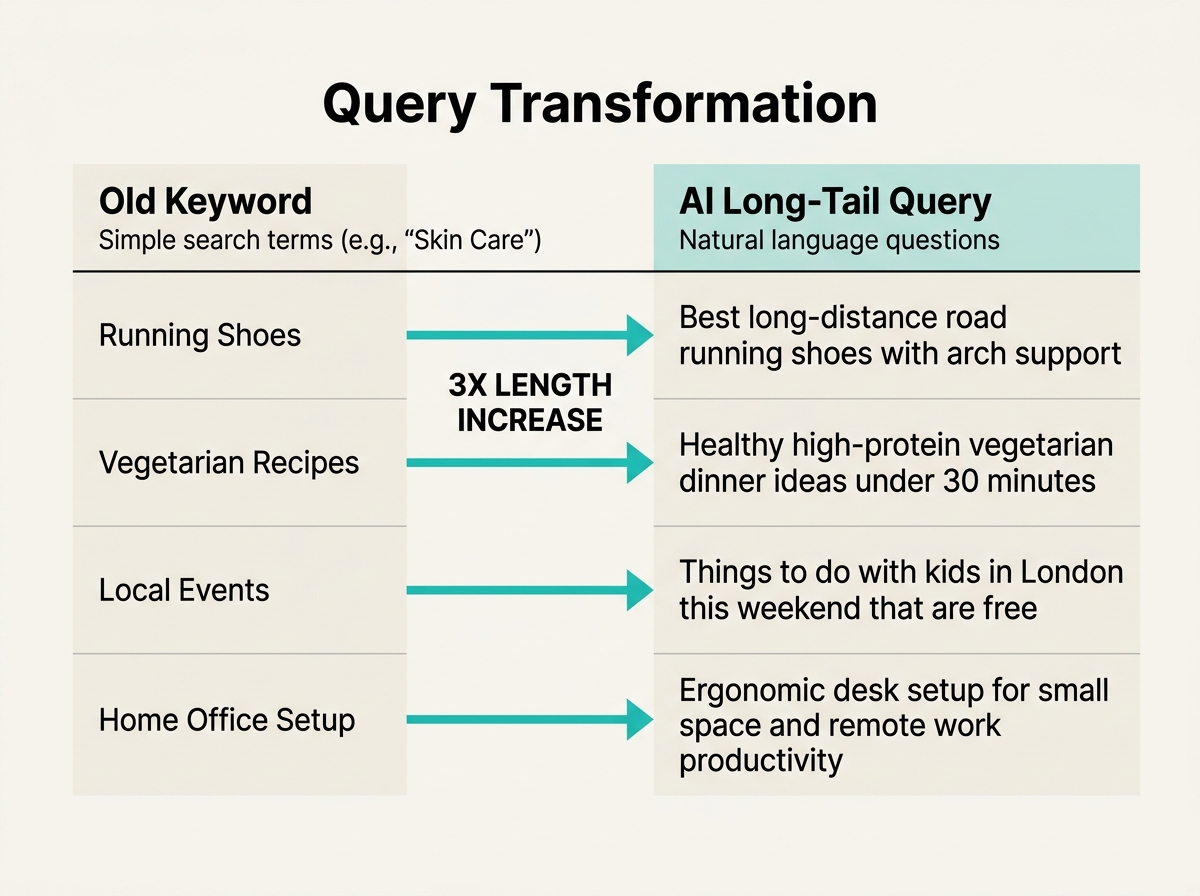
The era of the slow-burn narrative is over. According to recent Search Engine Journal AI data, the average search query in 'AI Mode'—the conversational interfaces now standard on TikTok and Instagram—is 3.2x longer than traditional keyword-based searches. Users aren't typing 'best moisturizer'; they're asking, 'What is the best moisturizer for sensitive skin that won't pill under silicone-based foundation?'
If your video starts with a 'Hey guys' or a scenic b-roll shot, you've already lost the attribution window. Platforms are now indexing the first three seconds of audio and on-screen text as the primary metadata for AI-driven discovery. To survive the shift in social media discovery, you must adopt an 'Answer First' posture.
Step 1: Map the 'Long-Tail Intent' of Your Core Pillars
Traditional keyword research focused on volume. AI Search Optimization focuses on intent. Because users are talking to their search bars like a friend, your content needs to mirror the complexity of their questions. You aren't just selling a product; you're answering a specific, multi-layered problem.
Start by exporting your search terms. Look for phrases with five or more words. These are your AI targets. Per Shopify's 2026 TikTok Ads analysis, campaigns targeting specific long-tail conversational queries saw a 22% higher conversion rate than broad-interest targeting. This is because the AI engine is better at matching highly specific content to highly specific needs.
What to do: Create a spreadsheet with three columns: 'Broad Topic', 'Conversational Query', and 'The Specific Answer'. For every broad topic like 'Email Marketing', find 10 conversational queries using tools like AnswerThePublic or by looking at the 'Others searched for' section on TikTok.
Why it matters: AI models prioritize 'completeness'. If your video title and first sentence directly match the syntax of a long-tail query, the platform's LLM-based indexer (the technology powering the 2026 Instagram Algorithm) will flag your content as a high-relevance match.
Common pitfall: Don't try to answer five questions in one video. The AI needs a clear, singular 'Answer Signal'. If you pivot mid-video, the indexing engine gets confused, and you'll rank for nothing.
Step 2: Implement 'Front-Loaded' Scripting with the 3-Second Rule
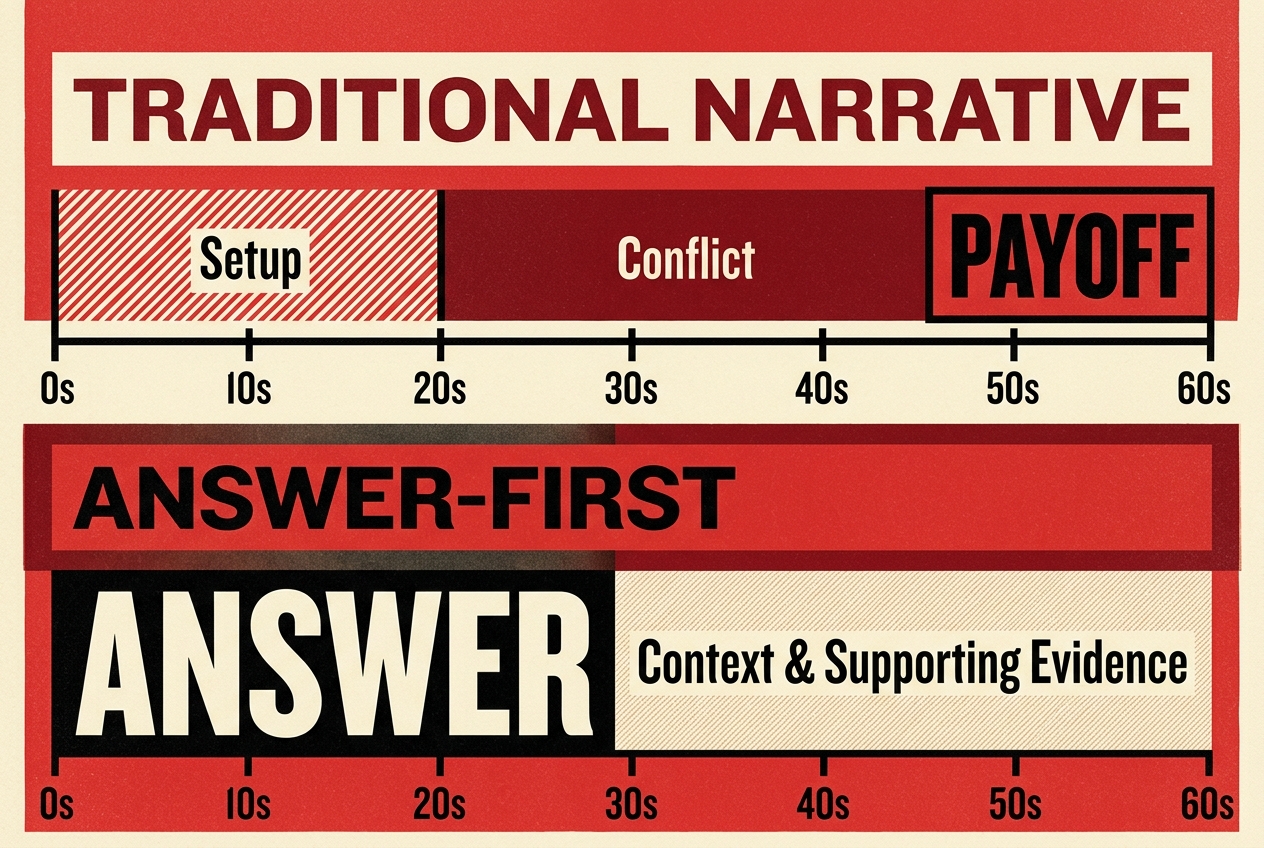
In the old world, we built tension. In the AI Search world, we lead with the resolution. You have roughly 45 frames to prove to the algorithm that you have the answer. This requires a radical shift in how you write your hooks.
Instead of: 'You won't believe how I fixed my dry skin...' Use: 'To fix dry skin caused by central heating, you need a urea-based cream applied to damp skin.'
You've given the answer away immediately. You might worry this kills watch time. It doesn't. It builds immediate authority. Once the user knows you have the answer, they stay to see the demonstration. Based on internal benchmarks from top TikTok marketing agencies in 2026, 'direct-answer' hooks see a 14% higher retention rate at the 30-second mark compared to 'mystery' hooks.
What to do: Rewrite your next five scripts using the 'Answer-Process-Proof' model.
- Answer: Give the solution in the first 3 seconds.
- Process: Show the steps or the product in action for the next 15 seconds.
- Proof: Show the result or a testimonial for the final 5 seconds.
Why it matters: Platforms like TikTok are under increasing scrutiny regarding data and privacy (as seen in the $400 million settlement in August 2026). Consequently, they are leaning harder into 'Utility' and 'Educational' signals to prove the platform's value beyond mindless scrolling. Content that provides immediate answers fits this 'High Value' category.
Common pitfall: Avoid using generic 'SEO-speak' in your audio. Use natural, conversational language. The AI is trained on how people actually talk, not how marketers write metadata.
Step 3: Optimize On-Screen Text for Machine Vision
It isn't just about what you say; it's about what the OCR (Optical Character Recognition) sees. AI discovery engines 'read' your video frame-by-frame. If your key answer is only spoken and not written, you're halving your discovery potential.
According to insights from former TikTok employees, the platform's internal 'Content Graph' weights on-screen text significantly higher for search indexing than the caption itself. This is because text-on-screen is a stronger signal of what the video is actually about in real-time.
What to do: Place your 'Answer' in high-contrast text in the 'Safe Zone' (the middle-top third of the screen) during the first 3 seconds. Use the exact phrasing from your long-tail query research in Step 1. If the query is 'how to style baggy jeans for a pear shape,' that exact phrase should appear on screen immediately.
Why it matters: As social media discovery becomes more fragmented, your video needs to be 'silent-searchable'. Many users browse in AI-mode with sound off, relying on the generated summaries. Clear on-screen text helps the AI generate a more accurate summary of your content for the search results page.
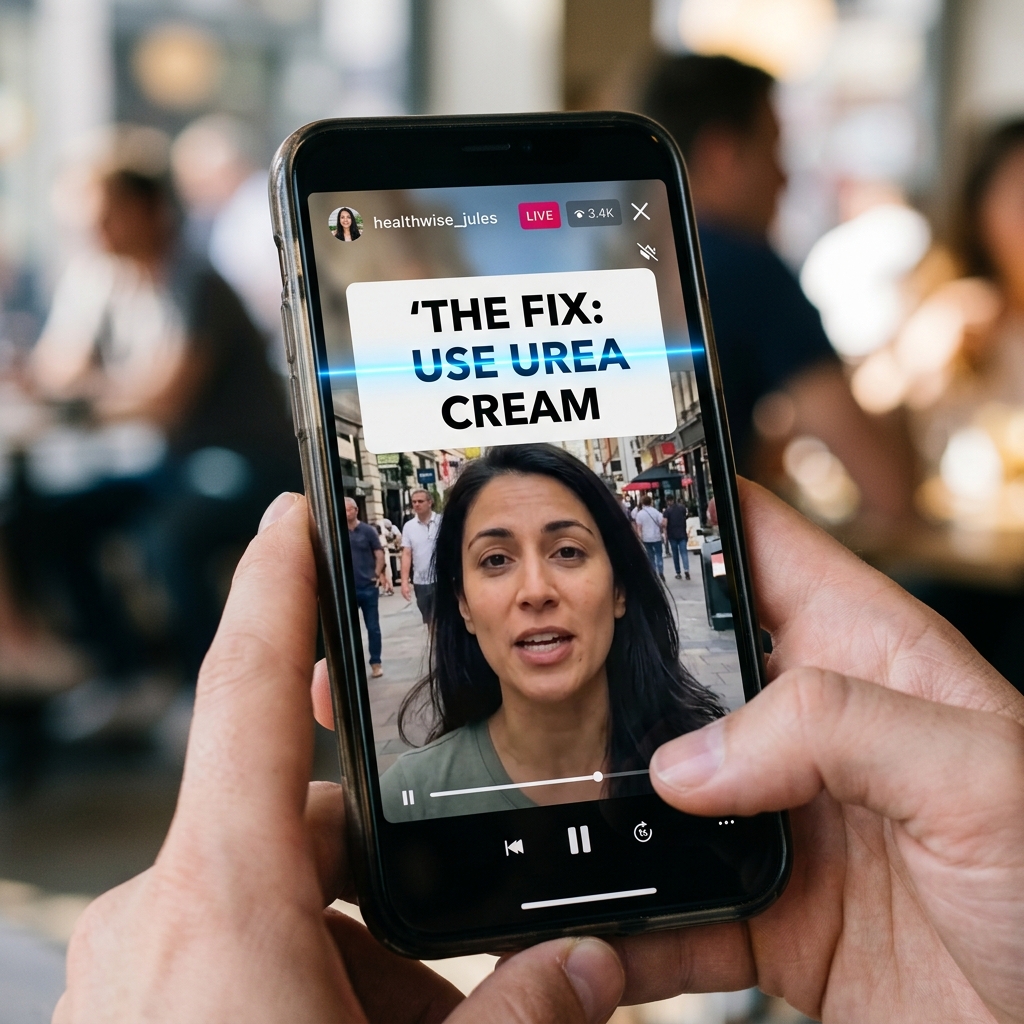
Common pitfall: Don't use 'aesthetic' fonts that are hard to read. Script or thin sans-serif fonts often fail OCR checks. Stick to bold, clean fonts with a background 'sticker' or shadow for maximum legibility.
Step 4: Use 'Semantic Captions' to Contextualize the Answer
Captions are no longer for 'engagement bait' like 'Tag a friend who needs this'. In 2026, captions are technical documentation. They provide the semantic context that helps the AI understand the intent behind your answer.
Learn more about the shift to semantic social SEO
What to do: Structure your caption like a mini-blog post. Start with the 'Answer' (again), followed by a bulleted list of details, and end with 3-5 highly specific hashtags. Avoid broad tags like #marketing; use #B2BEmailStrategy2026 instead.
Why it matters: The Instagram Algorithm in 2026 uses 'semantic clusters' to group content. If your caption uses related terms (e.g., if your video is about 'moisturizer,' your caption should include 'hydration,' 'barrier repair,' and 'ceramides'), the AI identifies you as a topical authority, increasing your chances of appearing in the 'Recommended for You' search carousels.
Common pitfall: Writing too little. While you don't need a novel, a 20-word caption isn't enough for an AI to cluster your content effectively. Aim for 60-100 words of value-dense text.
Step 5: Verify Your 'Answer-First' Ranking
You cannot manage what you do not measure. After 72 hours, you need to verify if the AI engine has correctly categorized your 'Answer'.
What to do:
- Open a 'Burner' account or use an incognito-style browser on the platform.
- Type your target long-tail query into the search bar.
- Check the 'AI Summary' or 'Search Highlights' at the top. Does your video appear?
- More importantly, look at the 'Find related content' bar at the bottom of your video's comments. If the keywords there match your intent, you've succeeded. If they say something generic like 'funny video,' your 'Answer Signal' was too weak.
Why it matters: This feedback loop allows you to adjust your 'Lead-First' scripts in real-time. If you find you aren't ranking, it usually means your first 3 seconds were too 'fluffy' or your on-screen text didn't match the query syntax closely enough.
Three Related Tactics to Scale Your AI Discovery
Once you have mastered the Answer-First script, try these advanced variations to broaden your footprint:
- The 'VS' Comparison Strategy: AI queries often involve 'X vs Y' comparisons. Create dedicated videos answering 'Brand A vs Brand B' for your niche. These are high-intent discovery magnets.
- The 'Cost/Price' Transparency Play: One of the most common long-tail queries is 'How much does X cost?'. Being the brand that answers this directly in the first 3 seconds can win you the 'Featured Snippet' equivalent on social search.
- The 'Common Mistake' Correction: Flip the answer. Start with: 'The reason your [Process] is failing is [Mistake]. Here is the fix.' This leverages the 'Answer First' logic by identifying the problem and solution instantly.
How to use TikTok Search Ads to bolster organic discovery
By moving away from narrative-heavy content and toward an 'Answer First' social strategy, you aren't just chasing views—you're building a library of discoverable assets that will continue to work as long as users have questions. The 2026 landscape rewards the helpful, not just the loud. Focus on the query, front-load the value, and let the AI do the distribution for you.
FAQ