

Google’s recently released guide to generative AI search features confirms what seasoned strategists have suspected: Answer Engine Optimization (AEO) is a marketing phantom. Despite the flurry of LinkedIn thought-leadership posts claiming we need a new playbook for 'answer engines,' Google’s technical documentation reveals that the path to winning AI Overviews is paved with the same bricks we’ve been laying for a decade: structured data, clear hierarchy, and authoritative sourcing. If you’re waiting for a secret 'AI-only' tag to save your traffic, you’re missing the point.
Why it matters: Marketers are currently wasting thousands of dollars on 'AEO audits' and 'LLM-chunking' services that offer no marginal benefit over standard technical SEO. By doubling down on established signals—particularly the emerging WebMCP standards—you can capture AI real estate without chasing hypothetical algorithms.
TL;DR
- AEO is a subset, not a successor. Google’s guide emphasizes that AI Overviews pull from the same index and ranking signals as standard search.
- WebMCP is the real shift. While AEO is hype, the Web Model Context Protocol is the technical bridge for AI agents you actually need to watch.
- Product Packs are the new battlefield. May 2026 data shows that merchant center integration now outweighs 'conversational' content for e-commerce visibility.
- Ignore 'chunking' for SEO. Google’s systems are already designed to parse semantic sections; manual content fragmenting is largely redundant.
The Myth of the Answer Engine Optimization Specialist
For the past eighteen months, the industry has tried to manifest 'AEO' as a distinct discipline. The argument was that because LLMs process information differently than traditional crawlers, we needed to write in 'blocks' or 'fragments' optimized for machine consumption. Google’s new guide effectively douses this fire with a cold bucket of reality. The documentation explicitly links visibility in generative features to the Core Web Vitals and E-E-A-T (Experience, Expertise, Authoritativeness, and Trustworthiness) frameworks that have governed the desk for years.
When we look at the mechanics, 'Answer Engine Optimization' is just SEO with a narrower focus on the featured snippet. We aren't optimizing for a different engine; we are optimizing for a different interface. The underlying index is identical. If your site is technically sound and provides high-utility answers, you are already doing AEO. The danger lies in the 'AEO-first' agencies currently pitching strategies that suggest stripping away the context and nuance that actually builds brand trust—all to satisfy a hypothetical machine preference that Google says doesn't exist.
We’ve seen this cycle before. When Voice Search was the 'next big thing' in 2017, we were told to optimize for 'natural language' at the expense of everything else. It turned out that the best way to win voice search was to have high-ranking mobile pages with structured data. History is repeating itself. The 'Generative Engine Optimization' (GEO) tactics being touted today—like adding 'authoritative citations' or 'statistical density'—are simply descriptors of high-quality journalism and research. Calling it a new field is a branding exercise, not a strategic one.
The Real Technical Frontier: WebMCP and AI Agents
While we can safely ignore the AEO label, we cannot ignore the shift toward AI agents. This is where the Google guide gets interesting. As noted in recent analysis of the Web Model Context Protocol (WebMCP) why now is the time to prepare for WebMCP, the industry is moving toward a world where agents don't just read your site—they use it.
WebMCP is becoming the schema markup that allows an AI to understand the 'capabilities' of a page, not just the text. Think of it as the difference between an agent reading a menu and an agent being able to place an order. Google’s guide hints at this by emphasizing the integration of 'Action Blocks' within generative responses. For a social media manager or a brand lead, this means your technical focus shouldn't be on 'writing for LLMs,' but on ensuring your site’s API-like structure is exposed via proper schema.
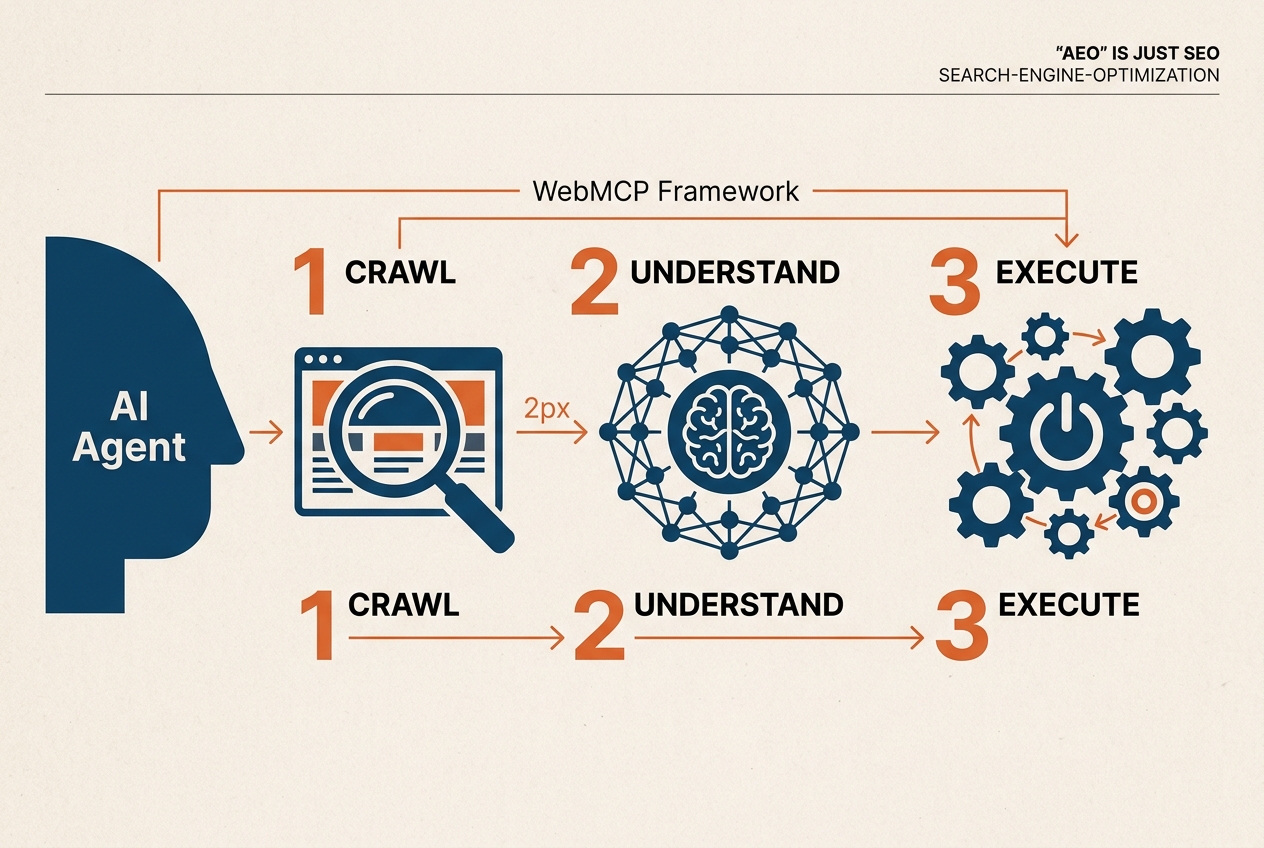
If you want to be 'discoverable' in the 2026 landscape, you need to look at how AI agents like those described by Ahrefs [S5] interact with data. These agents are looking for structured endpoints. They want to know the price, the availability, the shipping time, and the return policy in a format they can ingest instantly. This isn't 'answer' optimization; it's data-integrity optimization. The companies winning right now aren't the ones with the most 'conversational' blog posts; they are the ones with the cleanest Merchant Center feeds and the most robust JSON-LD implementations.
Product Packs and the Death of the Informational Click
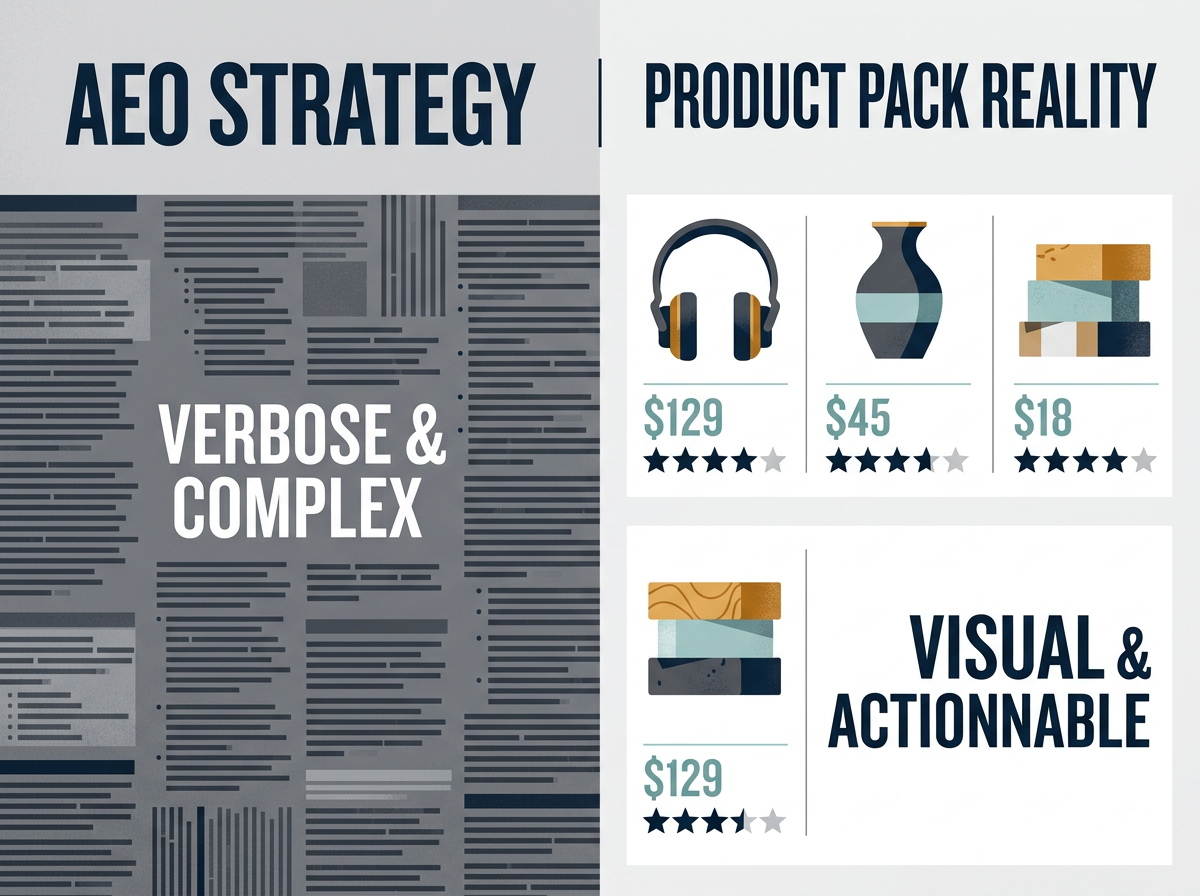
One of the most sobering sections of the new Google guide concerns 'Product Packs.' Data from Search Engine Land in May 2026 [S1] shows that for e-commerce queries, AI Overviews are increasingly being replaced or supplemented by highly visual product carousels that bypass the traditional 'article' layer entirely.
Among 63,000 merchants analyzed, those who saw the highest visibility weren't the ones writing 2,000-word guides on 'How to choose a blender.' They were the ones whose product data was so granular that Google could confidently place them in a comparison grid. This is a direct challenge to the 'content is king' mantra that has dominated the social and search desks for decades. In the generative era, data is king, and content is just the wrapper.
For brand marketing leads, this requires a pivot in budget allocation. If your goal is top-of-funnel discovery, an investment in a cleaner Google Manufacturer Center feed will likely yield a higher ROI than another five 'AEO-optimized' blog posts. We are seeing a compression of the funnel where the 'discovery' and 'evaluation' phases happen entirely within the Google UI. If you aren't in the Product Pack, you don't exist, regardless of how many 'answers' your blog provides.
The Counterargument: Is 'Conversational Authority' Real?
The strongest argument for AEO as a distinct discipline is the idea of 'Conversational Authority.' Proponents argue that as users move from keyword searches ('best running shoes') to complex, multi-step prompts ('find me a waterproof running shoe for flat feet under $150 that is available in Seattle'), the way we structure content must change to match that specificity.
They aren't entirely wrong. Specificity does matter. However, the flaw in the AEO argument is the belief that this requires a new type of writing. In reality, this is just the long-tail search strategy we’ve used since 2010, amplified by the LLM’s ability to parse complex queries. Google’s guide confirms that their 'helpful content' systems are already biased toward this kind of specificity. You don't need a new strategy; you need to stop writing generic, high-level fluff that was designed to rank for broad keywords and start writing for the specific use cases your customers actually have.
Furthermore, the idea that we should 'chunk' content for AI consumption—breaking articles into tiny, disconnected fragments—actually hurts your E-E-A-T. Google’s systems need context to verify the reliability of a claim. If you strip away the surrounding evidence to create an 'AI-ready' answer, you risk being flagged as low-quality or AI-generated yourself. The machine is smarter than the 'AEO' gurus give it credit for; it can find the answer within a well-structured, comprehensive article just fine.
Practical Guidance: What to Do Tomorrow
If you are a social media manager or agency strategist, how do you actually use this guide? First, stop using the term 'AEO' in your client reporting. It signals that you are chasing trends rather than results. Instead, focus on 'Generative Visibility' and tie it back to established technical milestones.
- Audit your Schema, not your 'Answers': Use the Rich Results Test and ensure every product, review, and FAQ on your site is marked up. If you aren't using the new WebMCP-adjacent schema types for 2026, start there.
- Optimize for the Product Pack: If you sell physical goods, your Merchant Center health is now your primary SEO metric. Check for 'Product Snippet' errors daily.
- Leverage Social Signals for Search: As seen with TikTok’s integration into Media Mix Modeling via NIQ [S3], the lines between social discovery and search attribution are blurring. Google’s AI features often pull 'social proof'—what people are saying on Reddit, TikTok, and specialized forums—into the generative response. Your 'SEO' strategy should include a community management component that ensures your brand is being discussed positively in the places AI models scrape for sentiment.
- Fix your Targeting: As Hootsuite’s 2026 guide [S4] suggests for Facebook, the ultimate measure is conversion. The same applies here. Don't chase AI Overview impressions that don't lead to clicks or sales. If an AI Overview provides the full answer and the user never visits your site, that 'win' is actually a loss for your bottom line. Focus your content on 'complex' topics where the user must click through to get the full value.

The 2027 Prediction: The Consolidation of Search and Action
I’ll put a marker in the sand: By the end of 2027, the distinction between 'Search' and 'E-commerce' will have functionally vanished for 80% of consumer queries. Google’s generative AI features are not designed to help users find websites; they are designed to help users complete tasks.
The 'AEO' crowd is focused on the wrong part of the equation. They are trying to optimize the input (the answer), while Google is busy optimizing the output (the transaction). If your strategy is based on being the 'answer,' you are building on sand. If your strategy is based on being the 'solution'—integrated via WebMCP, Product Packs, and robust data feeds—you will survive the transition.
Stop writing for the machine. Start structuring for the agent. The 'Answer Engine' is just the old search engine with a new coat of paint and a much shorter patience for bad data. Treat it accordingly.
FAQ