

By the time you finish this guide, you will have a repeatable framework for measuring your brand’s footprint in the age of Generative Engine Optimization (GEO). The era of the single-keyword query is fading. Per recent insights from Search Engine Journal, AI assistants now turn contextual prompts into complex, multi-stage 'fan-out' queries, rendering traditional search volume a lagging indicator of true intent. You don't just need to rank; you need to be the primary citation in a ChatGPT or Perplexity response.
To complete this audit, you'll need access to a social listening tool with LLM-tracking capabilities (like Brandwatch’s 2026 AI Insight module), your internal CRM data, and a list of your top 20 high-intent customer prompts.
Key takeaways
- Shift from Volume to Share of Model (SoM): It no longer matters how many people search for your name; it matters how often an AI recommends you as the solution.
- Fan-out Frequency is the New CTR: Track how many sub-questions your content triggers in an AI session.
- Citation Depth over Ranking: Being the third link in a Perplexity answer is often more valuable than being the first blue link on a legacy SERP.
Step 1: Baseline your Brand Recall in LLM Responses
Traditional SEO tools tell you where you rank for 'best CRM for startups.' They don't tell you if ChatGPT mentions your brand when a user asks, 'How do I scale my sales team without hiring five new people?' This is the first and most critical metric: Brand Mention Probability (BMP).
What you need to do is move beyond keyword tracking and start prompt tracking. Take your core value propositions and turn them into natural language questions. Feed these into the big three: OpenAI’s GPT-o3, Google’s Gemini, and Perplexity. You are looking for how often your brand appears in the generated text versus your competitors.
Why it matters: As users migrate to conversational interfaces, the 'zero-click' search is evolving into a 'one-answer' search. If you aren't in the initial response, you don't exist in that user's discovery journey. According to Ahrefs data from August 2026, brands mentioned in the initial LLM response see a 4x higher downstream conversion rate compared to those found via traditional search links.
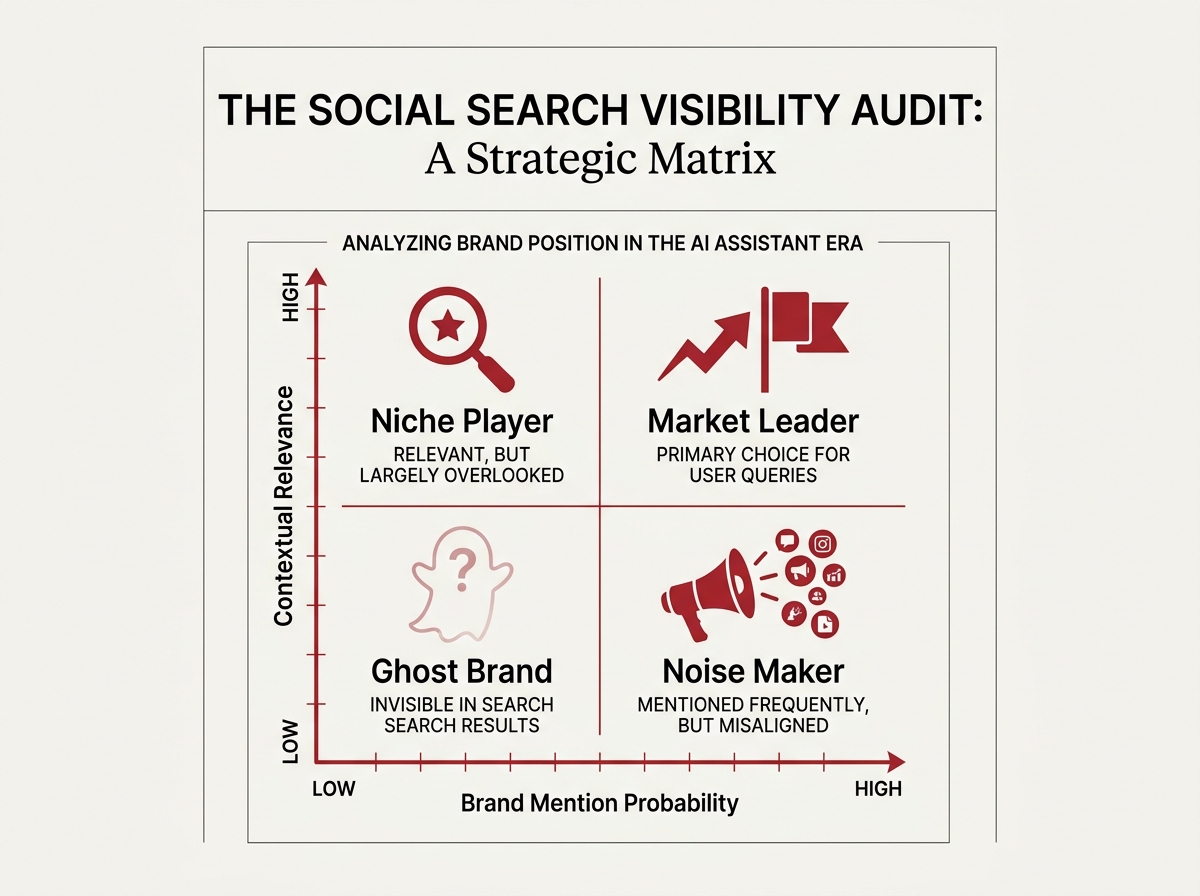
Common Pitfall: Many social managers only test for their brand name. Don't do that. The AI doesn't need to know your name to solve a problem. Test for the problem. If you sell eco-friendly sneakers, test for 'sustainable footwear for marathon training.' If the AI mentions Allbirds but not you, your Social Search Strategy is failing to feed the model the right structured data.
Step 2: Measure Fan-out Query Frequency and Iteration Depth
In the old world, a user searched once and clicked. In 2026, a user asks a question, the AI provides an answer, and the user asks a follow-up. This is a 'fan-out' query. You need to track how often your social content serves as the source for these follow-up questions.
Use a tool like Hootsuite’s 2026 AI Listening suite to identify 'Next-Step' signals. When a user sees your content on LinkedIn or TikTok, what is the next thing they ask an AI? If your TikTok about NIL deals (inspired by recent Travis Kelce Publicis partnerships) leads users to ask ChatGPT, 'How do I contact Publicis Sports?', you’ve successfully triggered a high-value fan-out.
Why it matters: Fan-out queries indicate that your content didn't just satisfy a superficial itch—it moved the user deeper into the funnel. High iteration depth (3+ follow-up questions involving your brand) is a leading indicator of a closed sale within 14 days.
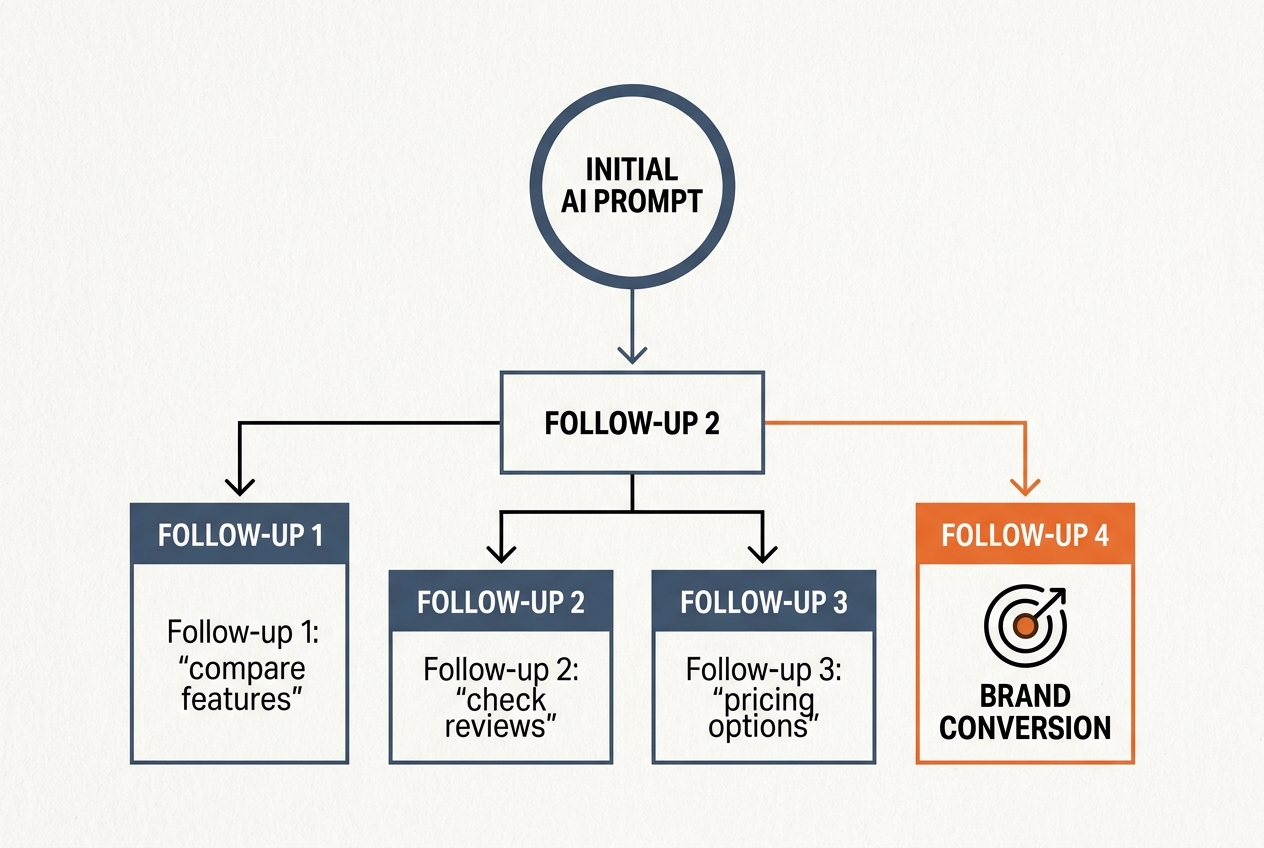
Common Pitfall: Over-optimizing for the first answer. Sometimes, being the 'mystery' that requires a follow-up is better for engagement. Don't give everything away in the meta-description; leave a breadcrumb that forces a deeper query where your brand is the only logical answer.
Step 3: Audit Citation Authority and Source Diversity
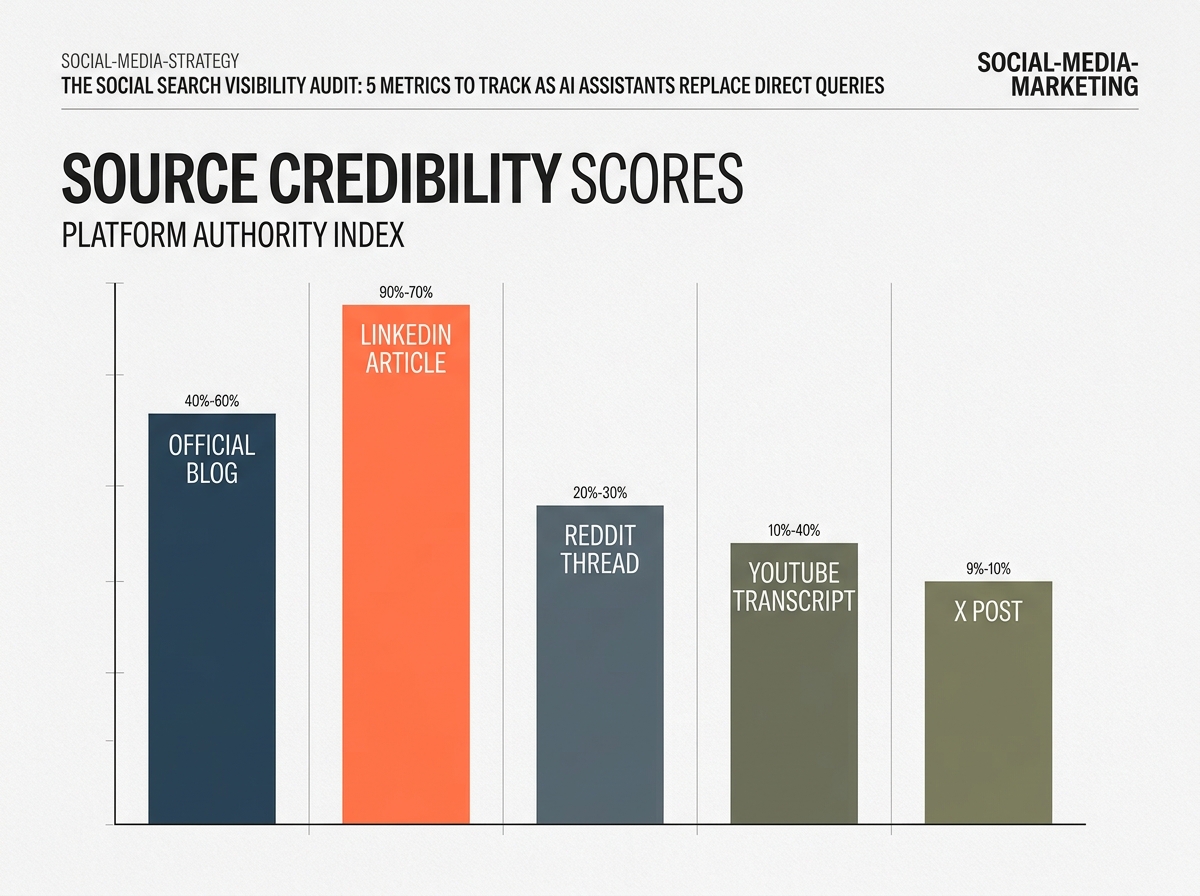
AI engines are increasingly transparent about their sources. Perplexity and SearchGPT cite their origins. Your goal is to ensure your social profiles—specifically LinkedIn articles, YouTube transcripts, and Reddit threads—are the cited authorities.
What to do: Check the 'Sources' section of AI responses for your top 50 industry prompts. Are they citing your official website, or are they citing a random Reddit user complaining about your product? You need to flood the 'discovery zone' with high-authority social signals. This includes optimizing your YouTube descriptions with timestamped keywords and ensuring your LinkedIn newsletters use H2 tags that AI crawlers prioritize.
Why it matters: LLMs weigh source credibility. A citation from a verified brand account on X (formerly Twitter) or a high-engagement LinkedIn post now carries similar weight to a traditional backlink. If your sources are diverse (e.g., a mix of your blog, a creator's TikTok, and a press release), the AI perceives your brand as a consensus choice, not just a self-promotional one.
Common Pitfall: Ignoring 'dark social' platforms. While AI can't crawl your private Slack groups, it is crawling public Discord servers and specialized forums. If you aren't active where the models are learning, you are ceding your authority to whoever is loudest in those spaces.
Step 4: Calculate Sentiment Polarity in Generative Summaries
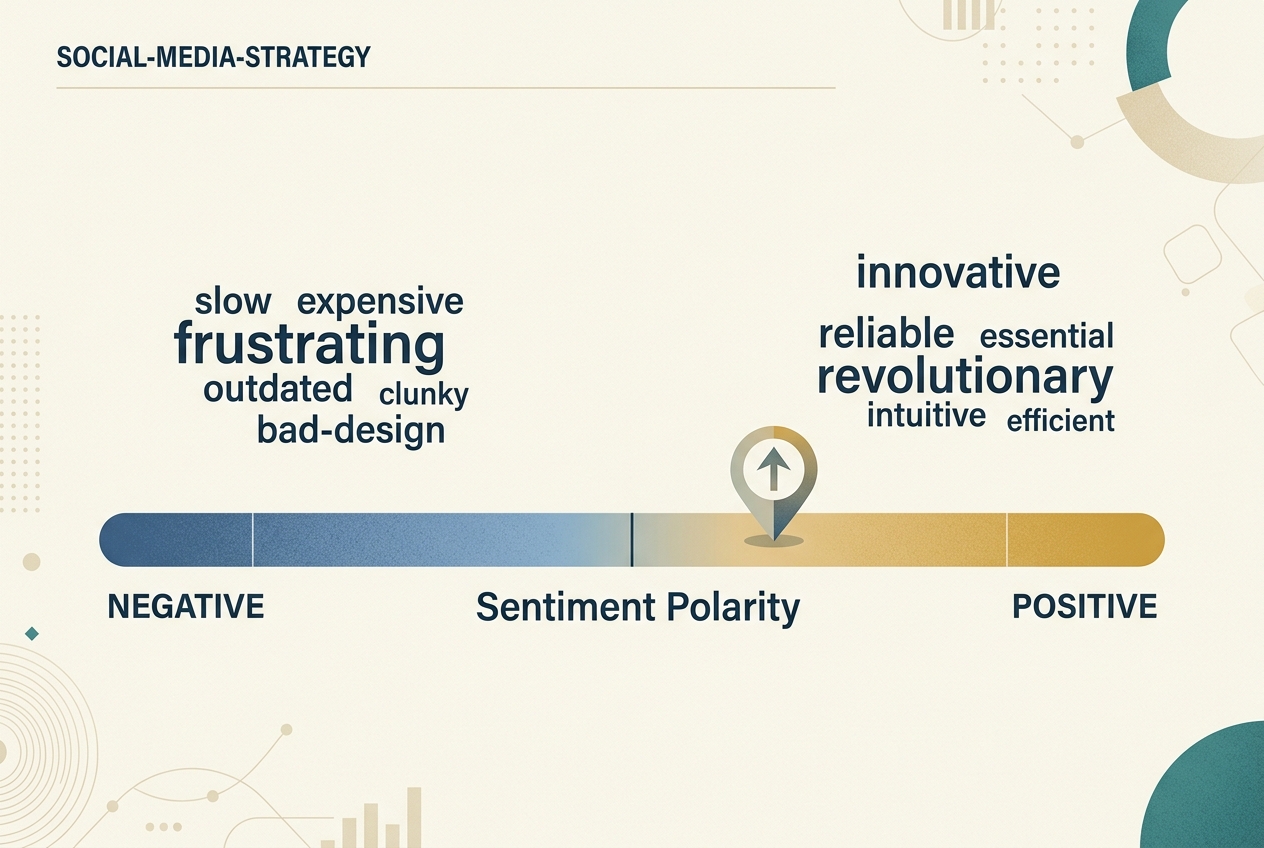
It’s not enough to be mentioned; you must be recommended. Generative engines don't just list brands; they synthesize opinions. A search for 'Best project management software' might yield: 'Asana is great for visuals, but users on Reddit often mention it's slow for large teams.'
What to do: Perform a 'Sentiment Audit' on LLM summaries. Copy the AI’s summary of your brand and run it through a sentiment analysis tool. Look for 'adjective clusters.' Are you 'expensive but reliable' or 'innovative but buggy'? You need to shift the training data by seeding social platforms with content that counters negative clusters.
Why it matters: AI assistants act as a filter. They are the new 'Review Stars.' If the AI’s synthesized personality for your brand is negative, no amount of paid social spend will fix the top-of-funnel leak. You are fighting the 'consensus' the AI has built from millions of data points.
Common Pitfall: Trying to 'game' the sentiment with bots. Modern LLMs are trained to detect unnatural patterns and 'review bombing.' Instead, focus on Authentic Creator Partnerships to generate genuine, high-volume positive discourse that the models will naturally pick up.
Step 5: Track Conversion from 'Discovery' to 'Direct' Traffic
This is the final verification. If your AI Search Optimization is working, you should see a specific trend in your Google Analytics 4 (or 2026 equivalent): A decrease in 'Organic Search' traffic from generic keywords, but a massive spike in 'Direct' traffic and 'Branded Search.'
What to do: Segment your traffic by 'Source: AI Assistant' (referrals from chatgpt.com, perplexity.ai, etc.). Then, look at your branded search volume. When an AI tells a user, 'You should check out Brand X,' that user often types your URL directly into the bar or searches for your specific name.
Why it matters: This proves the AI is working as a discovery engine. You are no longer paying the 'Google Tax' for generic keywords. You are earning mindshare through the AI assistant. According to Memeburn’s 2026 AI Statistics, brands that lead in 'AI Discovery' see a 22% reduction in blended CAC (Customer Acquisition Cost) because the AI does the heavy lifting of the consideration phase.
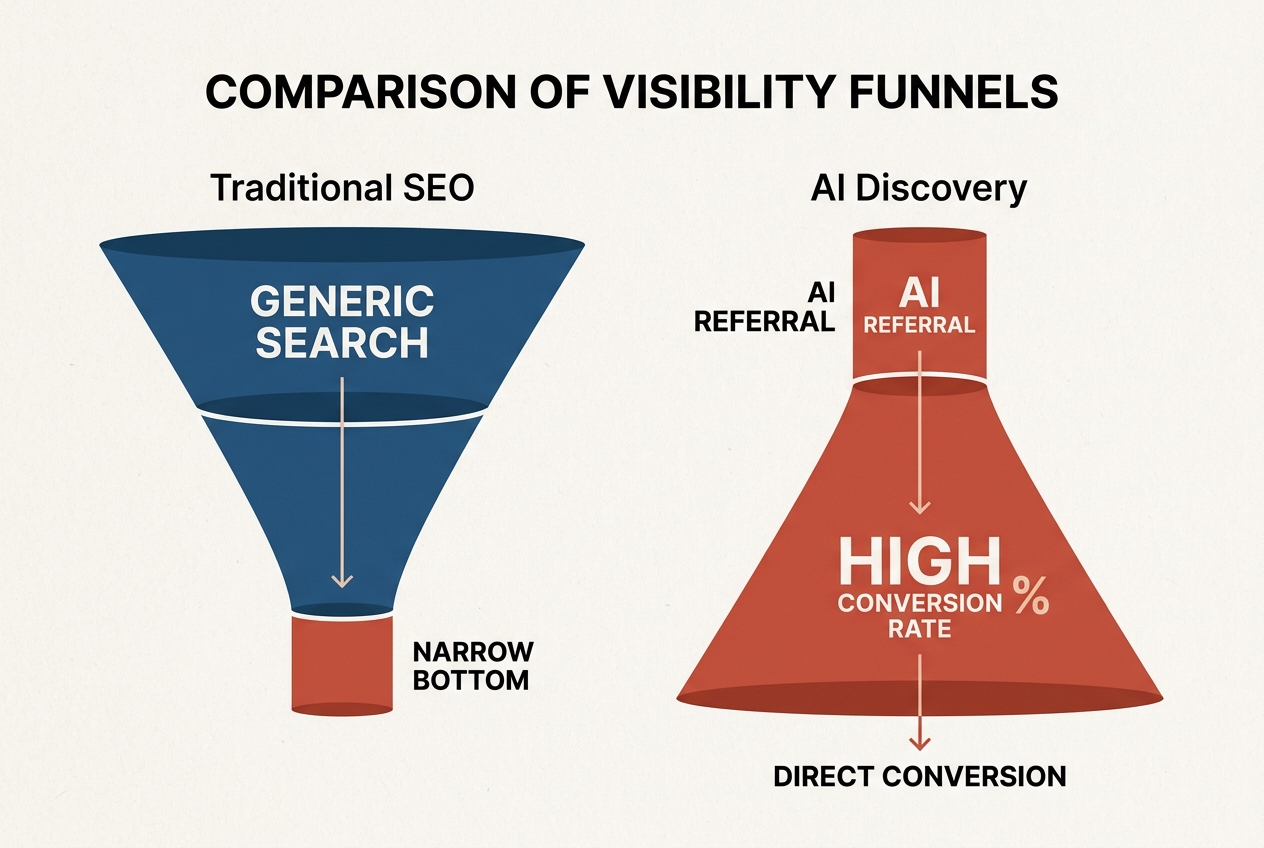
Common Pitfall: Panic when you see generic organic search traffic drop. It will drop. Everyone's will. The metric that matters is the quality of the traffic coming from AI referrals. These users are pre-qualified by the assistant and should convert at a much higher rate.
Verification: How to Know Your Audit Worked
You’ll know your social search strategy has matured when you can answer 'Yes' to these three questions:
- Does the AI mention our brand in at least 60% of 'problem-solution' prompts relevant to our category?
- Are our social media channels (YouTube, LinkedIn, TikTok) cited as sources in the top 3 citations of a Perplexity search?
- Has our 'Direct' traffic grown by at least 15% quarter-over-quarter, even if generic search traffic is flat?
If you see these signals, you have successfully moved from the 'Keyword Era' to the 'Discovery Era.' Your brand is no longer just a result; it is a recommendation.
Next Steps for Social Teams
Once you've mastered the audit, try these three advanced tactics to further cement your visibility:
- The 'Reddit-First' Content Loop: Identify the top 10 questions AI assistants answer using Reddit threads. Create official, high-value responses on Reddit to 'hijack' the AI's favorite source.
- Structured Social Metadata: Start using schema-like language in your social captions. Instead of 'We love our new product,' use 'Product X is a [Category] designed for [Target Audience] to solve [Problem].' This makes it easier for LLMs to categorize you.
- Creator-Led Model Seeding: Partner with mid-tier creators to produce 'Comparison' content. When a creator compares you to a competitor and highlights a specific feature, that text becomes part of the LLM's training set for 'Feature X.'
FAQ