
The social media landscape is currently bifurcating. On one side, we have the 'AI-everything' giants. Google is touting AI Max to unlock billions of new searches (per Search Engine Land, July 2024), and Havas is reporting revenue growth by leaning into an 'AI-first' identity. On the other side, a quiet rebellion is being funded. Yope, a platform built on the premise of 'algorithm-free' social interaction, recently secured a £9.2m seed round. This isn't just a niche playground for tech purists; it’s a signal that the pendulum of user sentiment is swinging back toward intentionality.
For marketers, this creates a fundamental tension. You’ve spent the last decade learning to 'feed the beast'—optimizing for the TikTok For You Page or the Instagram Reels algorithm. But what happens when the beast is removed? When there is no automated distribution to bail out mediocre creative, your strategy has to shift from 'gaming the system' to 'earning the attention'.
Why it matters: As users migrate to spaces like Yope, Mastodon, or Bluesky, the traditional paid-social playbook breaks. You cannot buy your way into a chronological feed with the same brute force you use on Meta. You have to build a presence that people actually want to follow, not just one that the algorithm decides to show them.
TL;DR
- The Shift: Yope and its peers prioritize chronological feeds and explicit interest groups over black-box AI recommendations.
- The Challenge: Without algorithmic amplification, 'organic reach' is truly organic—meaning if you don't provide value, your reach is zero.
- The Strategy: Brands must pivot to a 'community-first' model, treating social like a gated Discord or a niche subreddit rather than a broadcast channel.
- The Verdict: Algorithm-free apps are better for high-LTV loyalty building; traditional platforms remain the king of top-of-funnel discovery.
The Head-to-Head: Algorithm-Free vs. Algorithmic Social
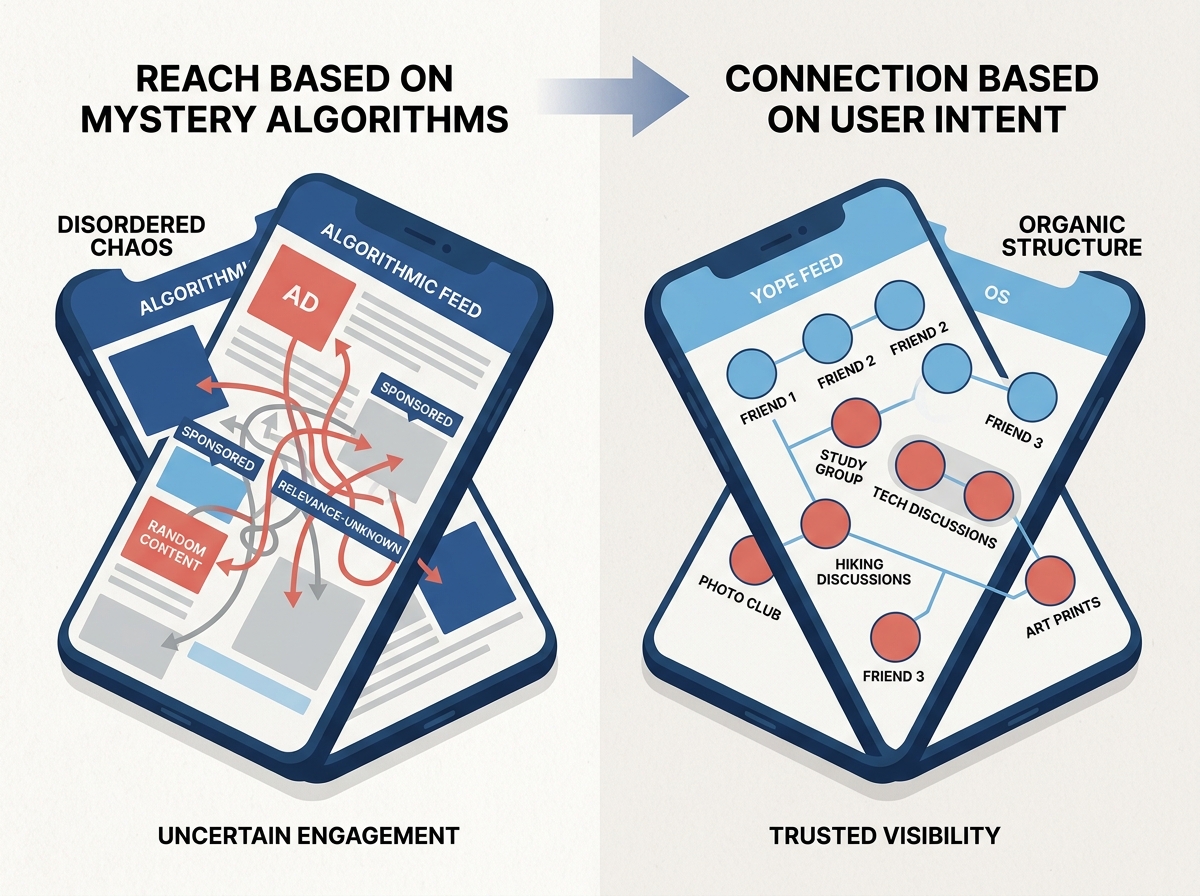
To understand where to place your bets, you need to see the mechanical differences. Traditional platforms use a 'Pull' model—they pull content they think you’ll like into your view. Algorithm-free platforms use a 'Push' model—users explicitly push content into their own feeds by following specific people or topics.
| Feature | Algorithmic (TikTok/Instagram) | Algorithm-Free (Yope/Mastodon) |
|---|---|---|
| Discovery Mechanism | AI-driven 'For You' feeds | Chronological following / Hashtags |
| Reach Potential | Infinite (Viral potential) | Finite (Follower count + Shares) |
| Brand Control | Low (Subject to algo shifts) | High (Direct line to followers) |
| Content Lifespan | Short (Hours to days) | Medium (Until pushed down feed) |
| Ad Products | Mature (Auction-based) | Minimal to None (Sponsorship-led) |
| Data Privacy | Aggressive tracking | High (Often decentralized/private) |
Yope and the New Guard: Pricing and Feature Realities
Yope isn't trying to be a 'Facebook killer.' Instead, it positions itself as a 'digital living room.' The £9.2m seed round suggests that investors believe there is a massive, untapped market of users who are exhausted by the dopamine-loop of TikTok.
From a workflow perspective, Yope focuses on 'Groups' and 'Shared Feeds.' Unlike the public square of X (formerly Twitter), Yope encourages smaller, high-velocity interactions within trusted circles. For a brand, this means you aren't posting to 'the public.' You are hosting a space.
Key Features for Marketers
- Chronological Integrity: Every post you make is seen by your followers in the order it was posted. No 'shadow-banning' by a shadow-algorithm.
- Interest-Based Nodes: Users join Yope based on specific hobbies or communities. This is 'intent-based' social without the Google AI Max overhead.
- Zero-Ad Experience (For Now): Because these platforms often lack a formal ad manager, your 'cost' isn't CPM; it’s the salary of the community manager who has to actually talk to people.
The Survival of the 'Anti-Algo' App: A History of Failure?
We’ve been here before. Remember Vero? Remember Ello? The history of 'algorithm-free social media' is littered with platforms that spiked in the App Store and then cratered. The 'survival' of these apps depends on a critical mass of creators.
building an effective brand presence on TikTok
TikTok succeeded because it made creators famous overnight. Algorithm-free apps do the opposite: they make it harder to get famous because you have to earn every single follower manually. However, the current climate is different. Since Meta deprecated CrowdTangle in August and Twitter's API became cost-prohibitive, researchers and power users are fleeing to decentralized spaces like Mastodon and Bluesky.
According to Sensor Tower data from early 2024, 'niche' social apps saw a 15% increase in time-spent-per-user compared to the previous year, even as total downloads for the 'Big Three' plateaued. Users aren't leaving social; they are diversifying where they spend their 'quality' time.
Ideal User and Brand Workflow: Who Should Pivot?
If you are a high-volume e-commerce brand relying on 2% conversion rates from massive cold-audience reach, Yope is not for you. You need the 'billions of monetizable searches' Google is promising.
However, if you are a luxury brand, a B2B software company, or a creator with a dedicated 'super-fan' base, the algorithm-free wave is your sanctuary.
The Real-World Workflow:
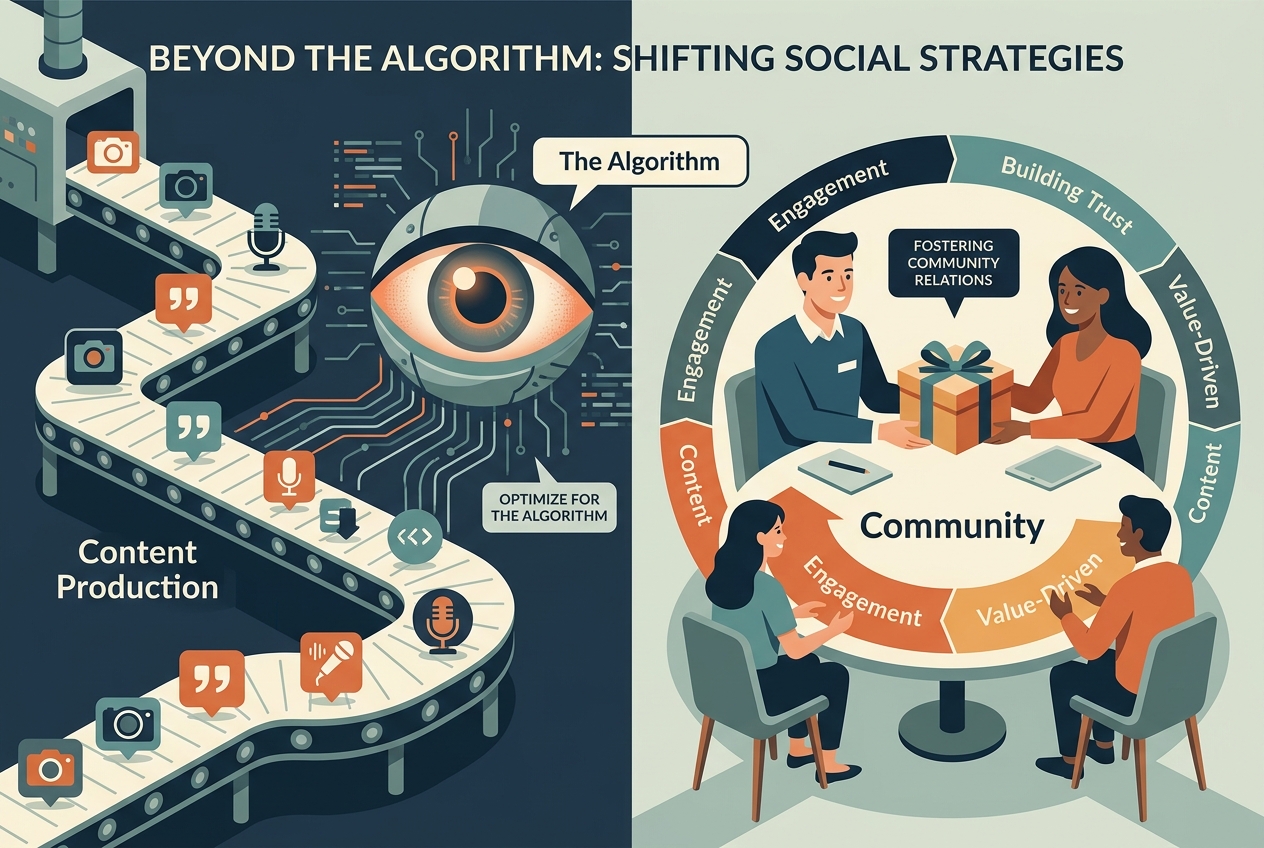
- Traditional: Create 10 Reels -> Post -> Analyze which one the algorithm 'picked' -> Put spend behind the winner.
- Algorithm-Free: Identify 5 key community leaders -> Invite them to a private Yope group -> Seed exclusive content -> Foster 1-to-1 conversations.
It’s the difference between a billboard and a dinner party. You cannot automate a dinner party.
Deal-Breakers: Why You Might Stay with the Giants
Let's be dryly honest: the lack of an algorithm is also a lack of a safety net.
- No 'Viral' Bailout: On TikTok, a great video can reach 1 million people even if you have 0 followers. On Yope, if you have 0 followers, your reach is exactly 0.
- Measurement Gaps: These platforms often lack the robust API integrations with tools like Sprout Social or Sprinklr. You’ll be back to manual reporting and 'link-in-bio' tracking.
- Scaling Issues: Scaling a community-first strategy is linear. To get 10x the results, you often need 10x the human effort. Algorithmic scaling is exponential.
YouTube on TV: What Marketers Need to Know
As YouTube on TV becomes a major frontier (per Social Media Examiner, July 2024), we see that 'big' media is getting bigger and more automated. Choosing an algorithm-free path is a choice to go small and deep rather than big and wide.
The Verdict Matrix: Which Path Should You Take?
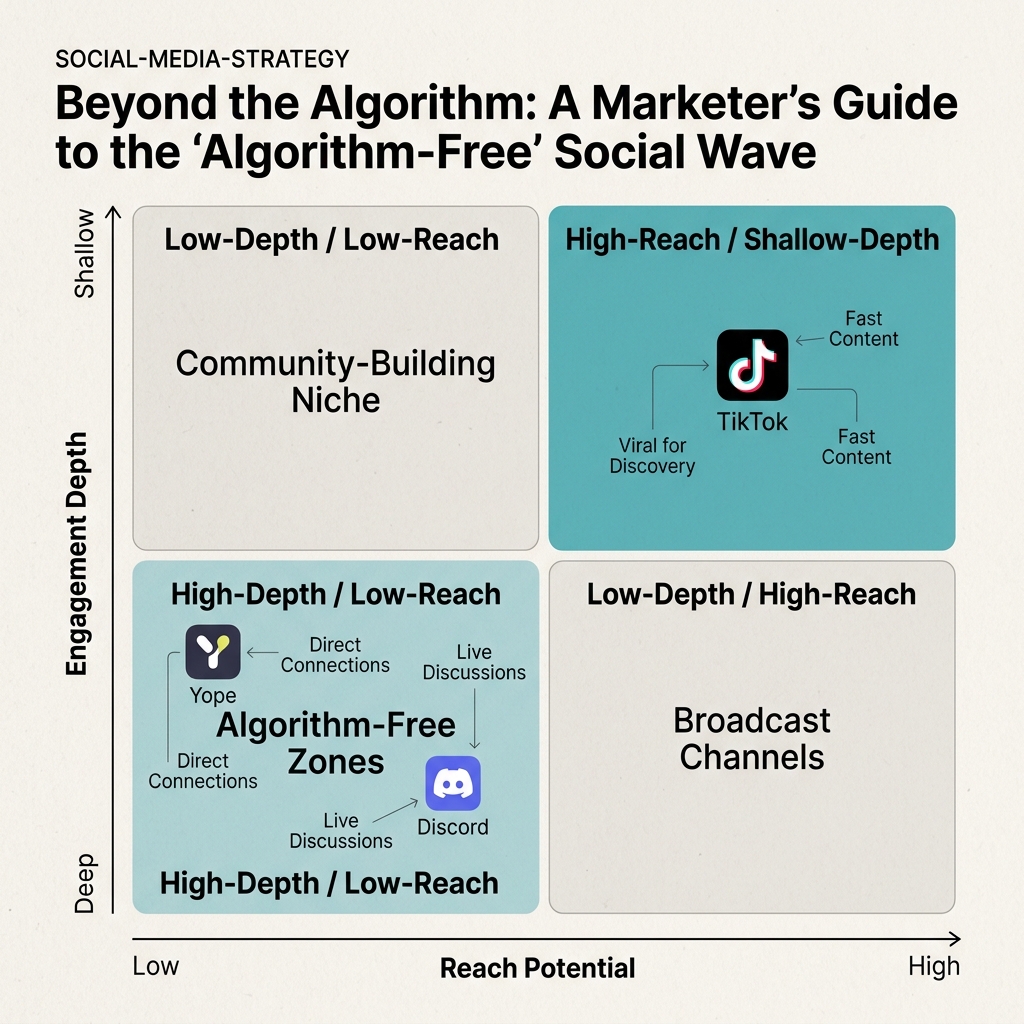
To help you decide, we've mapped out the 'Verdict Matrix' based on your primary marketing objective.
| If your goal is... | Pick... | Because... |
|---|---|---|
| Rapid Customer Acquisition | Meta / Google AI Max | You need the machine to find the 'intent' for you. |
| Brand Loyalty / Retention | Yope / Discord | Direct, unfiltered access to your best customers. |
| Thought Leadership | LinkedIn / Bluesky | Professional networks still value chronological relevance. |
| Mass Awareness | TikTok / YouTube | The distribution engine is unmatched for raw eyeballs. |
| Niche Community Building | Mastodon / Yope | You can escape the 'noise' and 'rage-bait' of the main feeds. |
How to Apply This Tomorrow
You don't need to delete your Instagram account to experiment with the algorithm-free wave. Start by treating one of your existing channels as if the algorithm didn't exist.
Stop looking at 'Views' and start looking at 'Replies.' If you can't get your existing followers to talk to you without an algorithmic 'boost,' you won't survive on a platform like Yope. The 'Algorithm-Free' wave is a stress test for your brand's actual value.
As Brandon Cooke joins BarkleyOKRP to drive 'thoughtful' growth (per Adweek, July 2024), the industry is clearly moving toward a more intentional, less 'spray-and-pray' approach. Whether you use Yope or not, the philosophy of algorithm-free social—prioritizing the user over the machine—is the only way to build a brand that lasts beyond the next algorithm update.
The Future of Decentralized Social
We are moving toward a 'fediverse' model where users own their data and can take their followers from one app to another. This is the ultimate threat to the walled gardens of Meta and Bytedance. If Yope’s seed round is any indication, the 'Algorithm-Free' wave isn't just a trend; it's a structural realignment of the internet.
For the practitioner, this means the 'Social Media Manager' role is evolving back into a 'Community Manager' role. The skills required aren't 'hacking the algorithm'—they are empathy, conversation, and curation. The machine is getting better at ads, but humans are getting better at avoiding them. To reach those humans, you have to go where the machines aren't invited.
FAQ