
How do you stop your brand from being the 'unread' notification in a user's most personal inbox? For years, the WhatsApp Business API has been treated by many marketers as a glorified SMS channel—a place for shipping updates, one-time passwords, and the occasional promotional blast. But as of July 2026, Meta is forcing a tectonic shift in how we view the green bubble.
With the rollout of new 'life-integration' features [S1], WhatsApp is no longer just a place to talk; it is becoming a place to do. From native scheduling and collaborative list-making to deeper AI-driven task management, the platform is evolving into a functional utility. For brands, this means the 'notification-only' era is dying. If you aren't providing a service that simplifies a user's daily routine, you are just noise.
Why it matters: This pivot transforms the messaging funnel from a linear path (Awareness -> Message -> Conversion) into a circular utility loop where the brand lives permanently in the user's chat list as a functional tool.
TL;DR
- Utility over Promotion: WhatsApp is moving toward 'life-integration,' favoring brands that offer functional tools (scheduling, tracking, AI assistance) over those just sending ads.
- Confidence as Currency: Success in the new ecosystem requires being a 'source of truth' for AI agents, as highlighted by industry veterans like Bill Hunt [S2].
- The Peer-to-Peer Funnel: Brands must now compete for space alongside family and friends by mimicking the helpfulness of a personal contact.
The shift from messaging to life integration
Think of the old WhatsApp strategy as a digital billboard that occasionally pings your pocket. You saw a sale, you clicked a link, you left the app. The new model is more like a Swiss Army knife. Meta's July 2026 update [S1] introduces features that allow users to manage their lives—appointments, shared tasks, and even financial tracking—without ever exiting a chat thread.
This isn't just about convenience; it's about dwell time and platform stickiness. When a user creates a shared shopping list in a group chat, they are engaging with a utility. If your brand provides the API-driven backend that populates that list with real-time inventory or price comparisons, you aren't 'advertising' anymore. You are assisting.
We are seeing a move away from 'Brand Sovereignty'—the idea that a brand must control the entire environment—toward a model where the brand provides the 'highest-confidence evidence' to the platform's AI [S2]. If a user asks Meta AI, "When is my next oil change?", the brand that has integrated its service history into the WhatsApp utility layer is the one that wins the interaction.
Understanding the mechanism of conversational utility
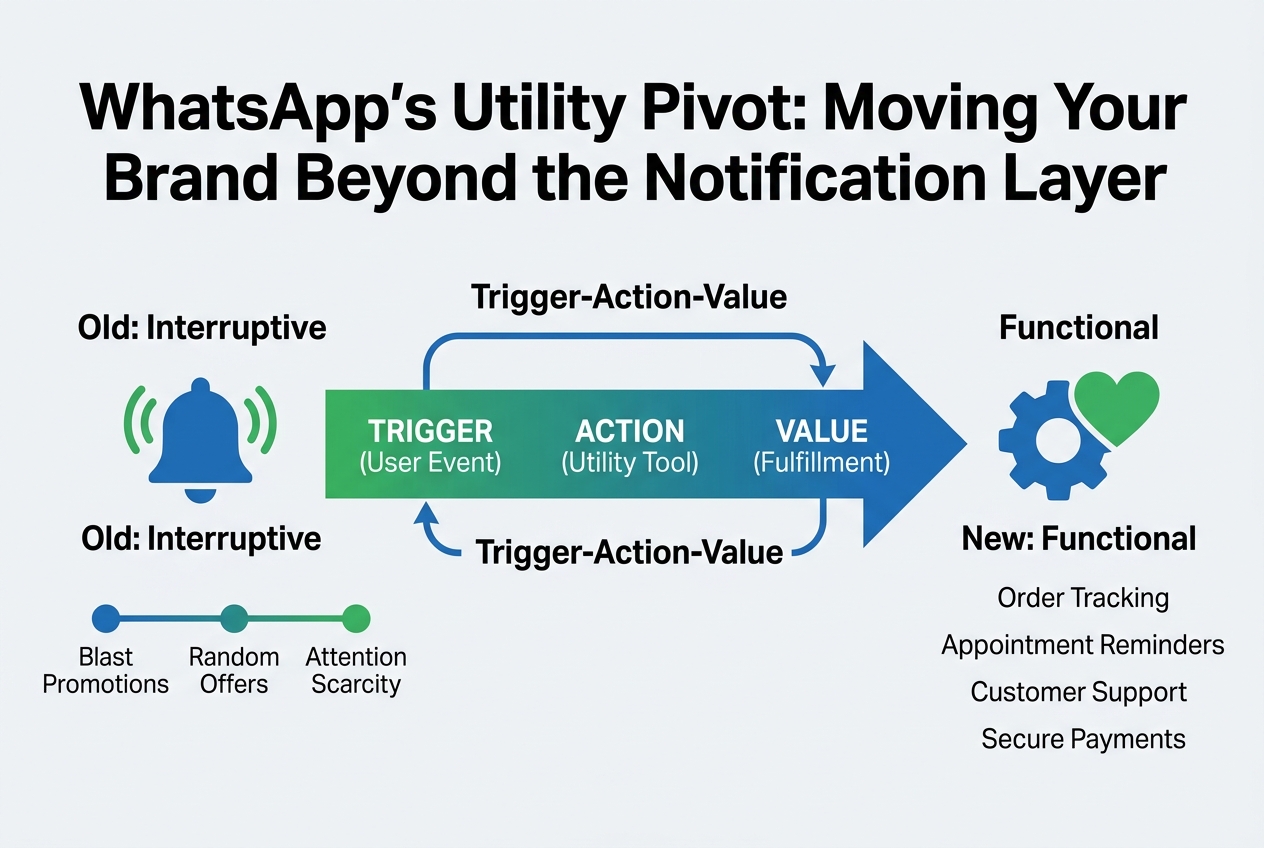
To build a utility-first strategy, you have to understand how these features actually trigger. It starts with the Trigger-Action-Value loop.
- The Trigger: A user's real-life need (e.g., "I need to book a haircut" or "I need to check my loyalty points").
- The Action: Instead of opening a browser, the user sends a natural language prompt to your brand's WhatsApp thread.
- The Value: Your API doesn't just reply with a link; it executes the task within the chat window using Meta's new interactive components.
This mechanism relies heavily on the WhatsApp Business API's ability to handle complex logic. Recent data from internal Meta benchmarks suggests that users are 3x more likely to complete a transaction when it happens entirely within the chat interface compared to being redirected to an external mobile site. This is the 'frictionless' ideal that social commerce has promised for a decade, finally manifesting through utility rather than just 'Shop' tabs.
Learn more about the evolution of social commerce
The three pillars of a life-integration strategy
To move beyond the notification layer, your brand must anchor its WhatsApp presence on three specific pillars: persistence, context, and agency.
Pillar 1: Persistence through service
Persistence means staying at the top of the chat list without being annoying. How? By being useful. American Eagle recently demonstrated this by shifting their back-to-school playbook to focus on fragmented Gen Z subcultures [S4]. Instead of a broad blast, they used messaging to offer specific style-concierge services. On WhatsApp, this looks like a persistent 'Wardrobe Assistant' that helps users track their orders and suggests outfits based on past purchases. Because the service is valuable, the user doesn't archive the thread.
Pillar 2: Contextual awareness
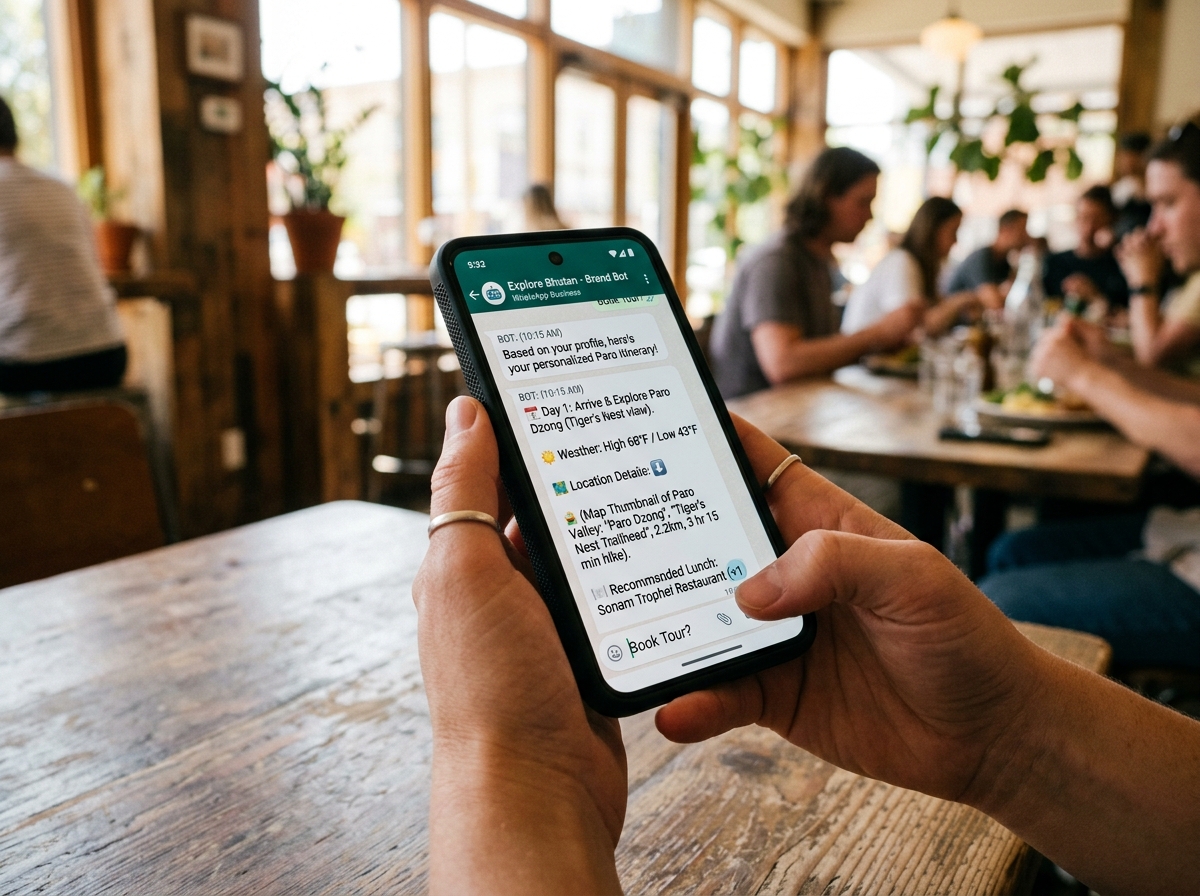
Context is the difference between a helpful suggestion and spam. If a travel brand knows a user is currently in Lisbon because of a recent booking confirmation sent via WhatsApp, the utility feature should offer a 'Live Itinerary' tool. This tool should update in real-time with gate changes or local weather alerts. This is what Meta means by features that "keep up with the way you actually live" [S1].
Pillar 3: AI-Ready Agency
As Bill Hunt notes in his analysis of AI-ready sources of truth [S2], AI rewards confidence. Your WhatsApp bot shouldn't just guess; it should have access to your deep product catalog and real-time data. When a user interacts with a brand on WhatsApp, they are often interacting with an AI agent. If that agent can't provide high-confidence answers, the utility is broken.
Moving from broadcast to peer-to-peer dynamics
One of the most difficult hurdles for brand marketers is the 'peer-to-peer' psychological barrier. WhatsApp is where people talk to their mothers, their spouses, and their best friends. When a brand enters that space, it is competing for attention with the most important people in a user's life.
If you use a broadcast tone, you will be muted. The goal is to adopt a 'utility tone'—dry, helpful, and concise. Short sentences. Direct answers. No marketing fluff.
Consider the recent update on Instagram that allows users to change music on existing posts [S3]. While this seems like a creator-centric feature, it points to a broader trend: the ability to edit and refine digital presence after the fact. In WhatsApp, this translates to 'editable' utility. If a brand sends a booking confirmation, it should be an interactive object that the user can modify directly in the chat, much like they might edit a shared note with a friend.
How to optimize your brand voice for AI agents
The technical debt of a utility-first approach
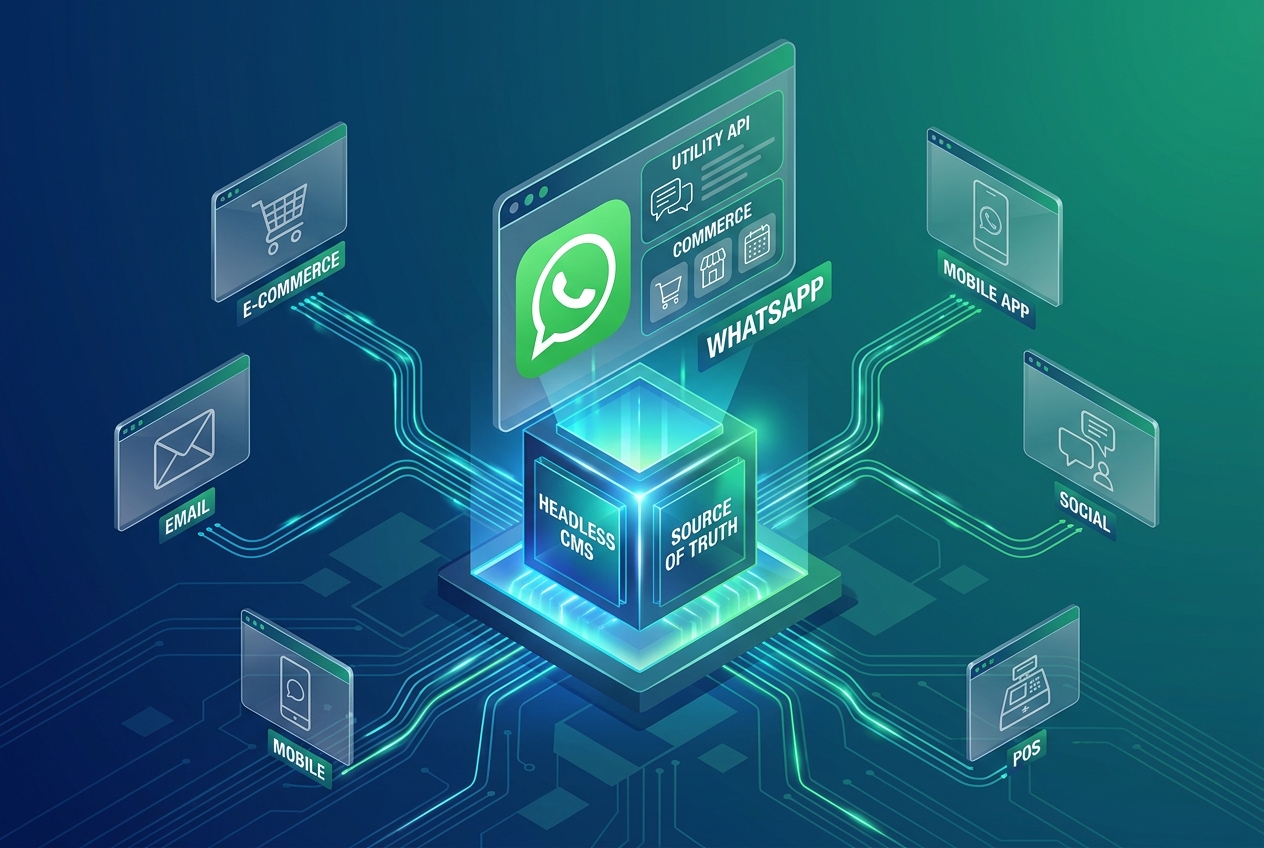
Transitioning to this model isn't just a creative shift; it's a technical one. You cannot build a life-integration feature on top of a messy database. To be a 'source of truth' [S2], your backend must be able to talk to the WhatsApp Business API in real-time with zero latency.
Many brands are still struggling with legacy CRM systems that take minutes to sync. In the world of conversational utility, a 60-second delay is an eternity. Users expect the 'instant' in instant messaging. This requires a move toward 'headless' commerce architectures where your WhatsApp interface is just one of many front-ends pulling from a centralized, high-speed data core.
Furthermore, as AI video and media tools become more prevalent [S5], the expectation for rich media within these utility threads will grow. A brand providing a 'how-to' utility for a product might soon be expected to generate a bespoke, AI-edited video tutorial on the fly, delivered directly in the WhatsApp thread to solve a specific customer problem.
What this means for your strategy: Concrete actions
If you are managing a brand account today, your roadmap for the next six months should focus on de-emphasizing 'blasts' and prioritizing 'hooks.'
1. Audit your current automated flows. Are you sending messages that require the user to leave the app? If so, map out how those actions—booking, buying, or tracking—can be brought natively into the chat using Meta’s latest UI components.
2. Become a 'Source of Truth.' Follow the guidance of SEO and data veterans [S2]. Ensure your product data, FAQ banks, and inventory levels are structured in a way that an AI agent can interpret them with 100% confidence. If the AI is unsure, the utility fails.
3. Experiment with 'Micro-Utilities.' Don't try to move your whole website into WhatsApp. Start with one high-value, high-frequency task. For a grocery brand, it’s a shared list. For a bank, it’s a quick-balance check. For a retailer like American Eagle [S4], it’s a subculture-specific style guide.
4. Monitor the 'Mute' rate, not just the 'Open' rate. In the utility era, the most dangerous metric is the mute button. If users are muting your thread, you have failed to integrate into their life. High engagement on a single utility feature is worth more than a 90% open rate on a broadcast message that results in a subsequent mute.
WhatsApp is no longer a satellite of your social strategy; it is the center of the functional relationship you have with your customer. By embracing 'life-integration' [S1], you stop being a guest in their inbox and start being a permanent resident in their daily routine.
FAQ