
Is TikTok Shop a digital storefront or a billboard that happens to have a cash register attached? For the last two years, the industry has treated it as the former—a high-friction, high-reward conversion tool designed to shorten the path to purchase. But as we move into late 2026, the data suggests a fundamental pivot. The most sophisticated brands aren't looking at the 'Buy' button as the finish line. They're looking at the shop infrastructure as the primary driver of the interest graph.
If you've been managing social spend for any length of time, you know the frustration of the 'attribution gap.' You see the lift in brand search, you see the spike in direct traffic, but the platform dashboard insists the ROAS is middling. By treating TikTok Shop as a discovery engine first and a sales channel second, brands are finally aligning their measurement with how users actually behave: they discover through entertainment, and they validate through the shop interface.
Key takeaways
- Discovery First, Sales Second: High-growth brands are using TikTok Shop to feed the algorithm data on user interest, rather than just chasing immediate last-click revenue.
- Algorithm Weighting: The TikTok algorithm 2026 update prioritizes content with high 'intent signals'—like clicking a shop tag—even if the user doesn't complete the purchase immediately.
- The Attribution Shift: Move away from pure ROAS toward 'Total Ecosystem Lift' to account for the halo effect of shop presence on search and retail-media performance.
The shift from transactional commerce to interest-graph fuel
Think of the traditional e-commerce funnel as a narrow hallway. You lead the customer through the door (awareness), down the hall (consideration), and into a room (conversion). If they don't reach the room, the hallway is considered a failure. TikTok Shop, however, functions more like a town square. Every time a user interacts with a product tag, even if they bounce, they are signaling a specific interest to the platform's recommendation engine.
Jamie Love, CEO of the agency Monumental, recently highlighted this shift, noting that TikTok Shop is a discovery channel first. The logic is simple: TikTok’s primary product isn't the shop; it's the feed. The feed needs to know what you like. When a brand integrates its catalog into TikTok Shop, every 'Product Detail Page' (PDP) view becomes a high-intent signal that informs what that user sees next.
This creates a feedback loop. A user sees a creator using a new skincare tool, clicks the shop tag to check the price, and leaves. In a legacy attribution model, that’s a 0% conversion rate. In the 2026 discovery model, that click just tagged the user as a 'skincare enthusiast' with a 'high-intent' modifier. The algorithm now has permission to serve that user more of your brand's organic content and top-of-funnel ads. You aren't just buying a lead; you're buying residency in their FYP.
Why the TikTok algorithm 2026 rewards shop-active brands
We've seen a marked change in how the algorithm weights engagement since the platform's infrastructure overhaul in early 2025. It’s no longer enough to get likes and shares. The 'Commerce Signal' is now one of the heaviest weights in the ranking system.
When you link a product directly in a video, TikTok’s AI—let's call it the 'Intent Engine'—scans the product category, price point, and sentiment of the comments. If a user spends more than five seconds on the Shop overlay, the algorithm flags that content as 'High Utility.' Per internal benchmarks shared by agency partners in Q3, videos with active shop tags see a 15-20% higher reach in the first 24 hours compared to standard organic posts, provided the initial engagement-to-click ratio is healthy.
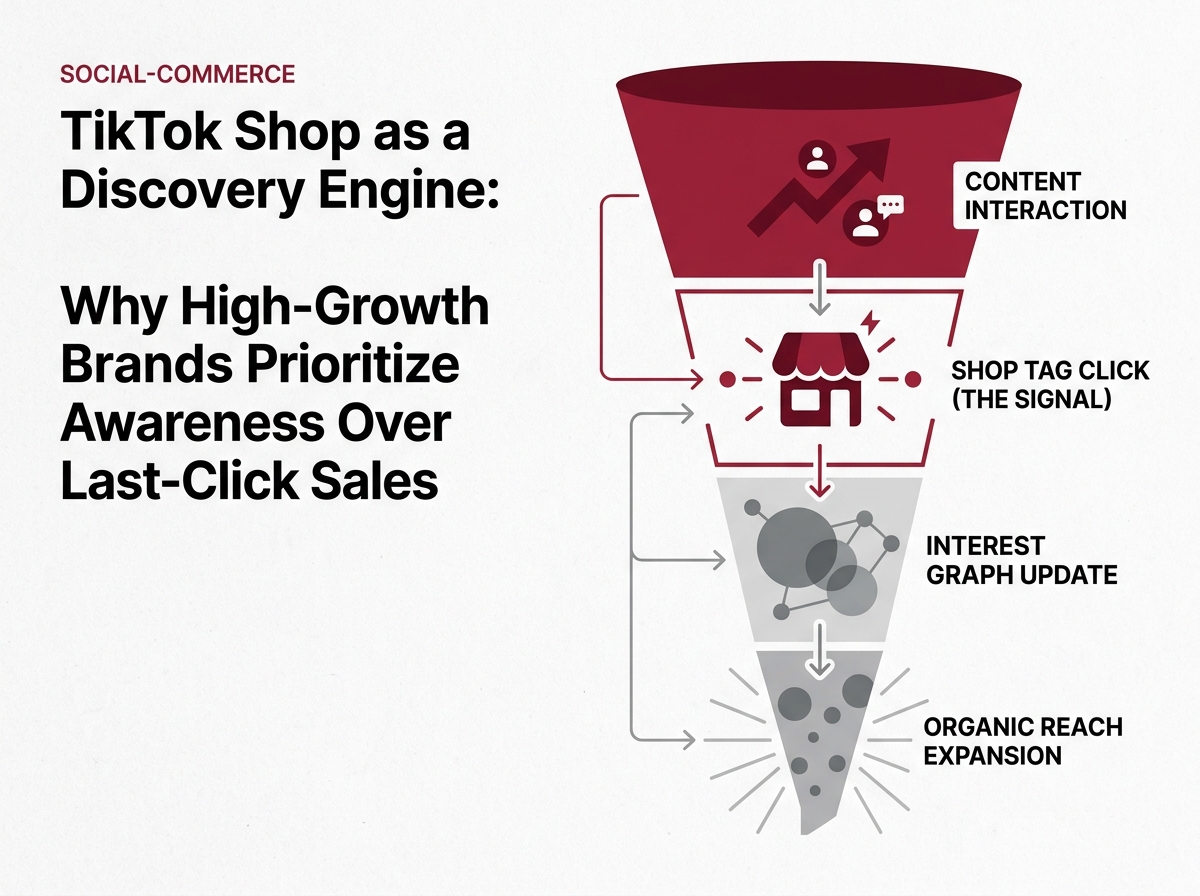
This creates a 'Discovery Halo.' Brands that prioritize awareness are finding that their shop-enabled videos act as a lighthouse. They draw in users who might not be ready to buy a $60 supplement on a whim but are now primed for a retargeting sequence on Instagram or a branded search on Google. This is particularly relevant as [INTERNAL: AI-driven search answers become more prevalent -> ai-search-impact-marketing], where brand mentions and 'social proof' across platforms dictate your visibility in LLM-generated recommendations.
Moving beyond ROAS: The new social media attribution framework
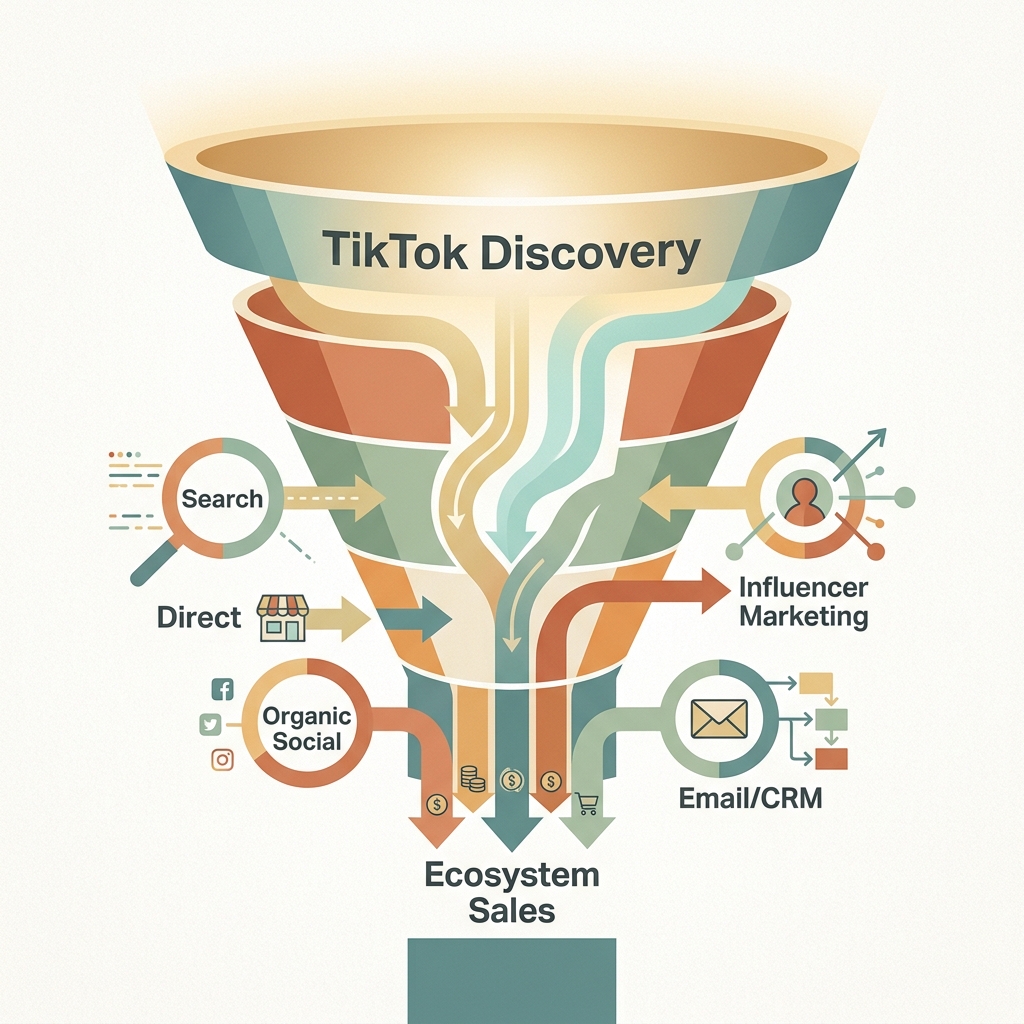
If you are still judging your TikTok Shop manager solely on the 'Shop Ads' dashboard, you're missing roughly 60% of the value. The industry is moving toward a 'Total Impact' model. This isn't just fluffy brand awareness talk; it's about tracking the correlation between Shop activity and external lift.
Consider these three metrics that high-growth brands are now prioritizing over last-click ROAS:
- PDP-to-Search Correlation: Tracking the volume of branded search queries on Google and Amazon within 48 hours of a high-reach TikTok Shop live stream or creator post.
- Earned Media Value (EMV) of Shop Tags: Calculating the value of the 'Intent Signals' generated. If 10,000 people click a shop tag, that is 10,000 data points fed into the TikTok interest graph for your brand. What is the cost-per-signal compared to your standard CPM?
- Cross-Platform Lift: As seen in recent studies by MarTech, traffic drops aren't always content problems; they are often intent shifts. Brands using TikTok Shop as a discovery engine report a 'stabilizing effect' on their blended CAC (Customer Acquisition Cost) even when specific channel ROAS fluctuates.
We are seeing a resurgence in Marketing Mix Modeling (MMM) because of this. Since the deprecation of granular tracking (post-iOS 14.5 and the ongoing cookie phase-out), the 'Shop' has become a closed-loop environment where you can at least see some behavior clearly. But the real win is using that data to fuel the broader machine.
The Creator's role in the discovery ecosystem
Creators are the lifeblood of this discovery engine. But the way brands brief them is changing. Instead of the 'Here is a discount code, please drive sales' approach, the focus has shifted to 'Show the utility, encourage the click.'
Recent activations, like the TikTok spotlight on local creators at the Las Vegas Downtown Summerlin Farmers Market, show that the platform is pushing for 'real-world validation.' When a creator shows a product in a lived-in, authentic environment, the shop tag acts as a 'Learn More' button that doesn't feel like an ad.
For the marketer, this means shifting creator KPIs. You want to see 'Shop Click-Through Rate' (SCTR) as a primary metric. A high SCTR with a low conversion rate isn't a failure; it’s a successful discovery campaign. It means the creator did their job—they sparked enough curiosity to make the user take a high-friction action (clicking a product tag). Now, your middle-funnel strategy needs to take over.

Strategies for prioritizing awareness in TikTok Shop
How do you actually execute a 'Discovery-First' strategy without lighting your budget on fire? It requires a shift in both creative production and media buying.
1. The 'Low-Friction' Entry Point
Don't lead with your most expensive, complex bundle. Use TikTok Shop to showcase 'Entryway Products'—items that are visually arresting, easy to understand in 15 seconds, and priced for impulse interest. The goal is the click, not the $200 checkout. Once they've clicked, they are in your 'Interest Audience.'
2. Live Stream as Focus Group
High-growth brands are using Shop Lives not just to sell, but to gather data. Which product features are people asking about in the chat? Which shop tags are getting the most clicks? This is real-time market research that informs your broader Q4 strategy. If a product gets a 5% click-through rate in a Live but 0 sales, you don't have a traffic problem; you have a landing page or pricing problem.
3. The 'Always-On' Catalog Sync
Ensure your entire catalog is synced, even items you aren't actively promoting. The TikTok algorithm 2026 is adept at 'Visual Search.' If a user sees a product in the background of a video and it's in your shop, the platform can often make that connection. This 'passive discovery' is the ultimate goal of the interest-based graph.
What this means for your 2027 planning
If you continue to treat social commerce as a siloed sales channel, you will find your CAC rising as the competition for 'last-click' space becomes unsustainable. The brands winning right now—the ones seeing double-digit growth in a stagnant economy—are those that view TikTok Shop as a giant, interactive top-of-funnel filter.
Stop asking "How much did we sell on TikTok today?" and start asking "How many new users entered our interest graph via the Shop interface?" The former is a measurement of what happened; the latter is a prediction of what will happen to your bottom line next month. The register is important, but in the era of interest-based graphs, the discovery is where the real value lies.
How to audit your current shop performance
Before you overhaul your strategy, run a 'Signal Audit.' Look at your last 30 days of TikTok data. Compare your 'Shop Clicks' to your 'Total Sales.' If you have a high volume of clicks but low sales, don't delete the shop. Instead, look at your branded search volume on other platforms. You will likely see a correlation.
This is the 'Invisible Funnel' in action. By acknowledging it, you can stop over-optimizing for a 'Buy' button that many users simply aren't ready for yet, and start optimizing for the curiosity that fuels long-term brand equity. In the GLP-1 era of marketing—where behavior change is the new battleground, as seen in Noom's recent strategy shifts—understanding the psychology of discovery is more important than the mechanics of the transaction.
FAQ