
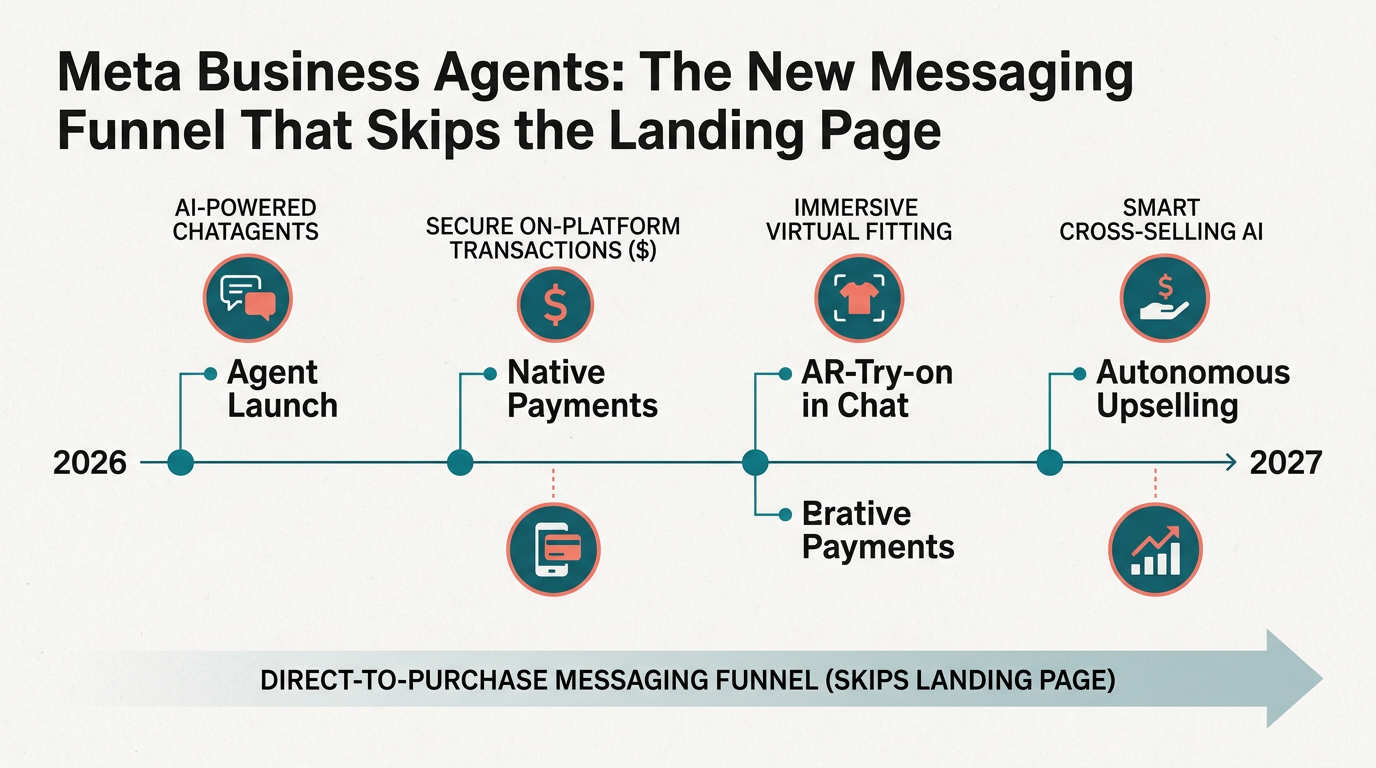
Meta has officially launched Business Agents for WhatsApp and Messenger, a move that enables brands to deploy autonomous AI representatives to handle the entire customer journey from product discovery to final payment. The rollout, which began in mid-July 2026, targets enterprise and mid-market advertisers looking to reduce friction by eliminating the traditional mobile landing page.
For social media marketers, this isn't just a new chatbot feature—it's a fundamental restructuring of the conversion funnel. By keeping users within the messaging interface, Meta is effectively bypassing the open web, forcing a major rethink of attribution, creative strategy, and the role of the brand website. If your current strategy relies on driving traffic to a Shopify or custom-built landing page, your cost-per-acquisition (CPA) benchmarks are about to be disrupted.
Key takeaways
- On-platform dominance: Meta Business Agents allow for full-funnel transactions without the user ever leaving WhatsApp or Messenger.
- Attribution shift: Traditional tracking pixels become less relevant as Meta's internal signals handle the entire conversion event.
- Creative evolution: Click-to-message (CTM) ads are no longer just for lead gen; they are now the primary entry point for immediate commerce.
- Data ownership: Brands must trade website session data for higher conversion rates within Meta's ecosystem.
The Death of the Landing Page Friction
The industry has long known that every second of load time on a mobile landing page costs conversion percentage points. Meta's answer is to remove the page entirely. Business Agents use Llama-based models to interpret intent, recommend products based on real-time inventory, and process payments via Meta Pay or integrated gateways like Stripe.
This shift mirrors the broader "walled garden" trend we've seen across the landscape. While Google's Nick Fox recently claimed that AI features in Search send billions of clicks to websites weekly—a figure that remains unverified—Meta is taking the opposite tack [INTERNAL: why platform-native commerce is winning -> social-commerce-trends-2026]. They aren't promising to send you traffic; they are promising to send you revenue, provided you stay inside their walls.
For a paid-social buyer at a high-growth D2C brand, this changes the day-to-day workflow. Instead of optimizing for Landing Page Views or Link Clicks, the primary KPI shifts to "Messaging Conversations Started" and "In-Thread Conversion Value." You are no longer managing a website experience; you are managing a conversational logic flow.
Why Click-to-Message Ads are the New Standard
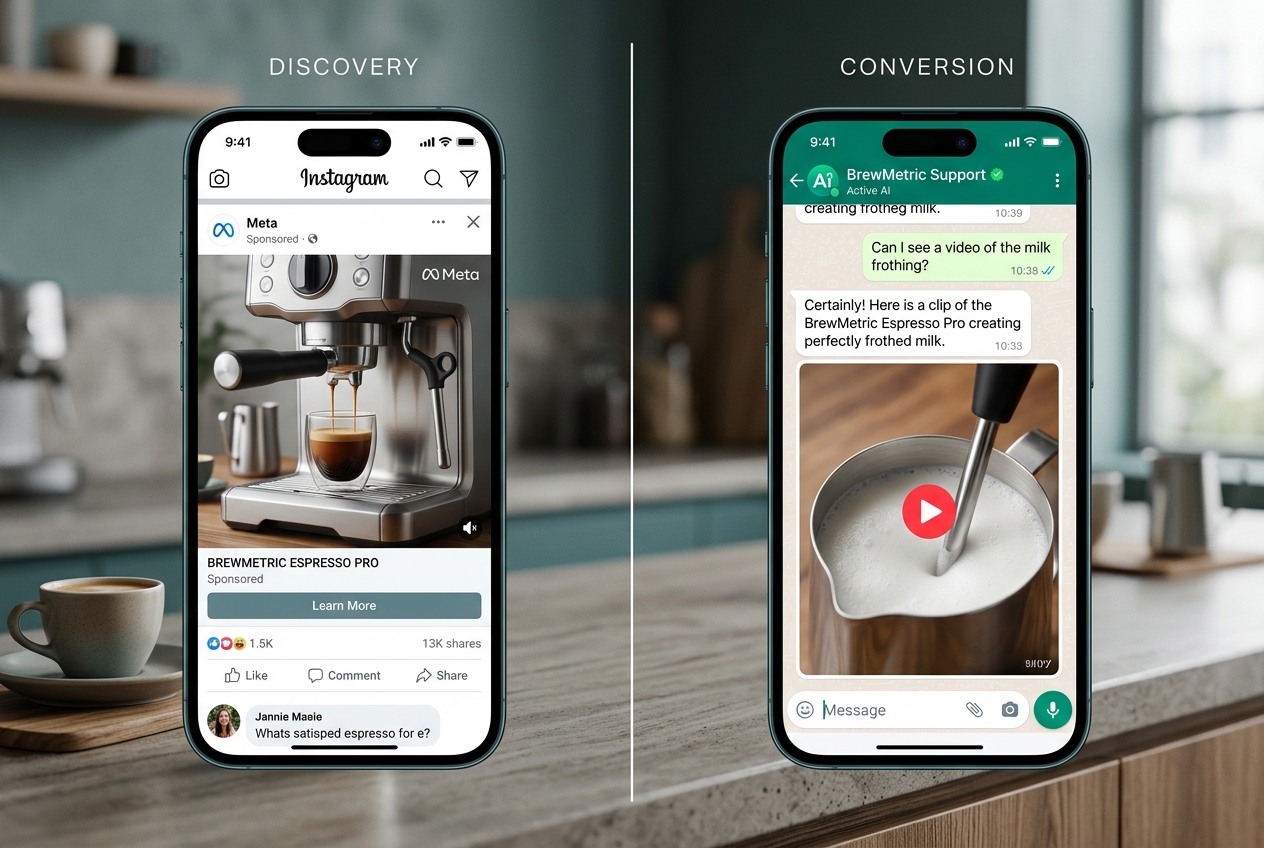
Click-to-message ads have historically been relegated to high-consideration industries like real estate or automotive. With the introduction of Business Agents, they are moving into mass-market retail and CPG. The agents can handle complex queries that a static product page cannot, such as "Do you have this in a size 10 in the Chicago store?" or "Compare this to the 2025 model."
According to internal Meta benchmarks from the beta testing phase in early 2026, brands using automated Business Agents saw a 22% increase in conversion rate compared to traditional traffic campaigns. The reason is simple: the user never has to wait for a browser to render. They are already logged in, their payment info is often saved, and the interaction feels like a text thread with a friend.
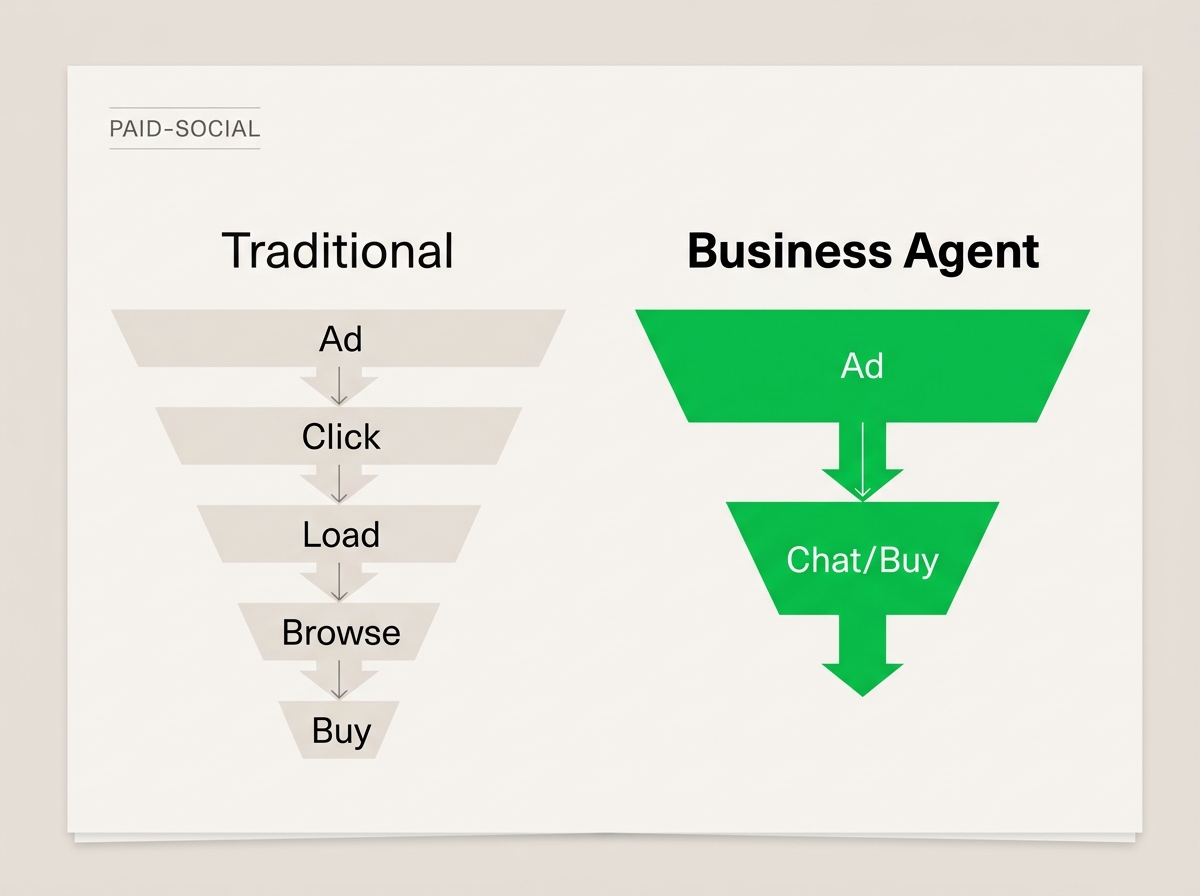
However, this requires a massive shift in creative production. Your video ads shouldn't just sell a product; they need to sell the conversation. The call-to-action (CTA) is no longer "Shop Now" but "Ask Us Anything" or "Get Yours in Chat." This requires a different psychological trigger in the feed—one based on immediate gratification and service rather than passive browsing.
Attribution and the Data Trade-off
The most contentious aspect of Meta Business Agents is the loss of third-party data. When a user converts inside WhatsApp, you don't get a Google Analytics session. You don't see the scroll depth or the heatmaps from Hotjar. You get the sale, but you lose the behavioral data of the "window shopper."
This follows a pattern of platforms prioritizing their own scraping and data retention. Just as Google's NotebookLM rebrand has raised concerns about AI scraping without attribution, Meta's messaging-first funnel keeps the most valuable consumer intent data within Meta's servers. Marketers must decide if the lower CPAs are worth the loss of platform-independent data.
For agency strategists, this means your reporting stacks need an overhaul. You'll need to rely more heavily on Meta's Conversions API (CAPI) for Messaging and direct CRM integrations. If you aren't already using a tool like Sprout Social or Sprinklr to manage these high-volume threads, the operational overhead of Business Agents will quickly become unmanageable.
Managing the Creative-to-Chat Transition
Successful implementation of Business Agents isn't just a technical hurdle; it's a creative one. In the old world, the ad stopped at the click. In the new world, the ad is the first sentence of a long dialogue.
We are seeing a rise in "Modular Creative" where the ad's hook directly informs the Agent's opening line. If a user clicks an ad for a specific pair of running shoes, the Business Agent shouldn't start with a generic "How can I help you?" It should immediately offer the size guide for those specific shoes. This level of personalization at scale is what separates a high-performing Business Agent from a basic 2018-era chatbot.
The Competitive Landscape: TikTok and Google
Meta isn't acting in a vacuum. AdExchanger reported in July 2026 that TikTok Shop is aggressively embracing AI video to close the loop on its own social commerce efforts. While TikTok focuses on short-form video as the storefront, Meta is betting on the intimacy and persistence of the message thread.
A WhatsApp thread is permanent. It sits in the user's inbox next to messages from their family. This gives Meta a "retention" advantage that TikTok's ephemeral feed lacks. Once a Business Agent starts a thread, the brand has a direct, low-cost channel for re-engagement—provided they don't spam the user and get blocked.
What to Watch Next: The Rise of the 'Conversational Architect'
As this technology matures through the end of 2026, we expect to see a new job title emerge within agencies: the Conversational Architect. This role sits between the copywriter and the technical strategist. They don't write headlines; they write decision trees and personality prompts for Llama-based agents.
For now, the move is clear: start testing Click-to-Message ads with a small percentage of your budget. Don't wait for your landing page conversion rates to drop further as users grow accustomed to the frictionless chat experience elsewhere. The brands that win in 2027 will be the ones that stopped trying to force users onto their websites and started meeting them in their inboxes.
How to Apply This Tomorrow
If you're managing spend today, here is your immediate checklist:
- Audit your mobile speed: If your landing page takes more than 3 seconds to load, you are the prime candidate for a Business Agent pilot.
- Verify your Meta Pay setup: You cannot run a frictionless funnel if the checkout process still requires a manual credit card entry in a web-view.
- Test 'Soft' CTAs: Run an A/B test between a "Shop Now" destination and a "Message Us" destination using the same creative. Measure the cost per qualified lead, not just the initial click.
- Prepare your CRM: Ensure your backend can ingest data from WhatsApp threads so you don't lose the customer's history once the chat ends.
Meta Business Agents represent the most significant shift in ad product philosophy since the introduction of the Facebook Pixel. It is a move toward a truly verticalized platform where Meta provides the discovery, the consideration, and the transaction. For those who adapt, it offers a way out of the rising costs of the open web. For those who cling to the landing page, the path to conversion is only getting steeper.
FAQ