
TikTok’s evolution from a discovery engine to a full-stack logistics provider reached a critical inflection point in late 2025, forcing mid-market brands to reconcile viral reach with bottom-line reality. As of August 2026, TikTok Shop has matured into a high-volume, low-margin environment where the cost of creator acquisition and platform fees frequently consumes up to 45% of gross revenue.
For brand marketing leads and agency strategists, the math has changed. It isn't enough to simply 'go viral' anymore; you have to survive the fulfillment of that virality. While platforms like Buffer are focusing on internal agility—recently shipping 57 tools in five days during their August 'Build Week' to streamline workflows—brands on TikTok are finding that speed without margin is a recipe for bankruptcy. This report breaks down the unit economics of the TikTok Shop creator engine to determine what actually constitutes a profitable campaign in the current landscape.
Key takeaways
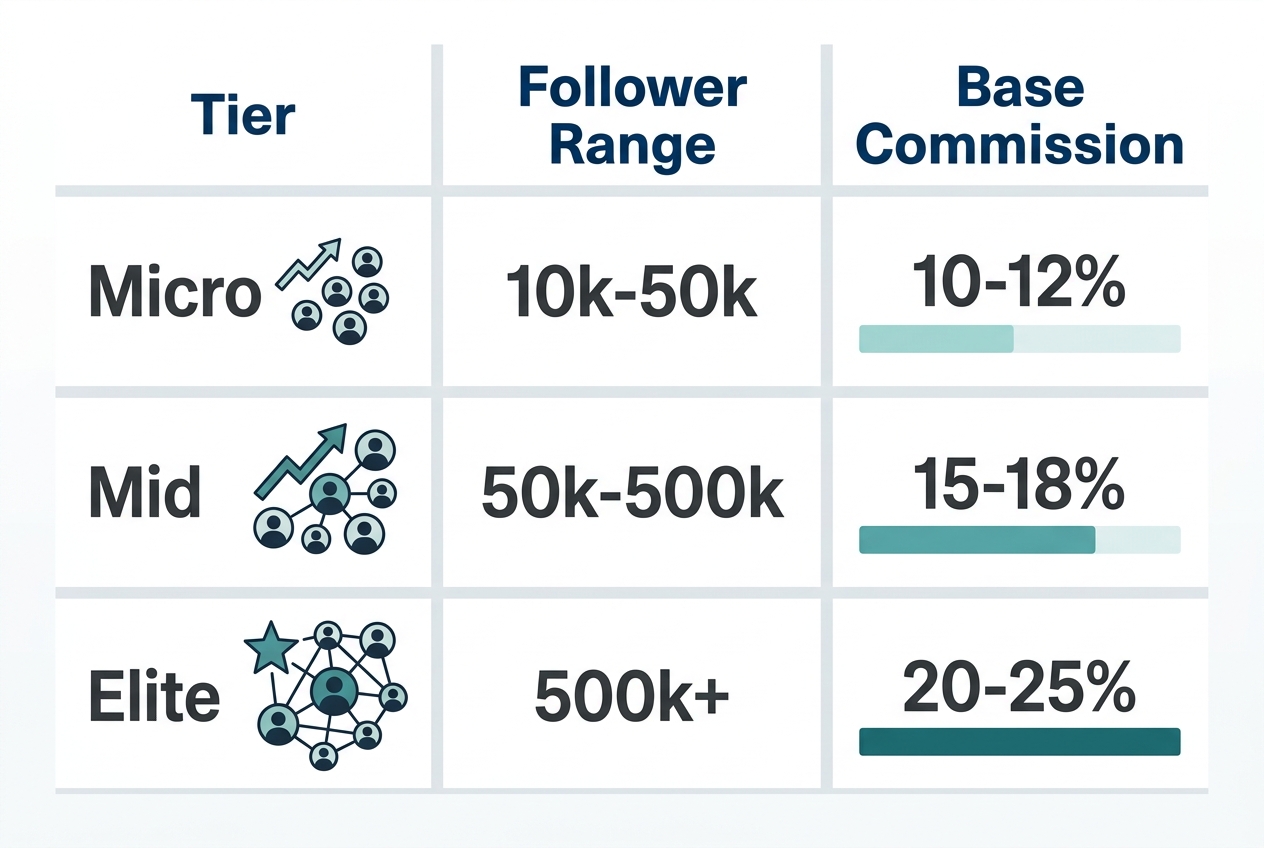
- Standardized Commissions: The 'sweet spot' for mid-market creator commissions has shifted to 15-22%, up from 10% in 2024, as competition for high-converting affiliates intensifies.
- Fulfillment Drag: Fulfillment by TikTok (FBT) fees now average $4.50 to $7.00 per unit for standard parcels, significantly impacting items with a retail price under $30.
- The 30% Rule: Brands maintaining a Gross Margin (post-COGS) of less than 65% are increasingly finding TikTok Shop unsustainable after accounting for ad spend and creator payouts.
- Accountability Shift: As noted by Search Engine Journal in August 2026, the rise of automated ad creative means brands must now define who owns AI-driven errors in the shop interface.
The shifting math of the TikTok Shop creator engine
In the early days of TikTok Shop’s U.S. push, brands could often negotiate 5% or 10% affiliate commissions by offering exclusive product access. Those days are gone. According to internal agency benchmarks from Q2 2026, top-tier creators—those with a proven 'Sell-Through Rate' (STR) above 3%—now demand a baseline of 20%.
This isn't just greed; it's market correction. Creators are now acting as their own media agencies, handling production, distribution, and community management. If you aren't offering a competitive rate, the algorithm simply won't surface your product in the Affiliate Center. The 'Discovery' phase of social commerce has become a pay-to-play environment where the currency is commission percentage.
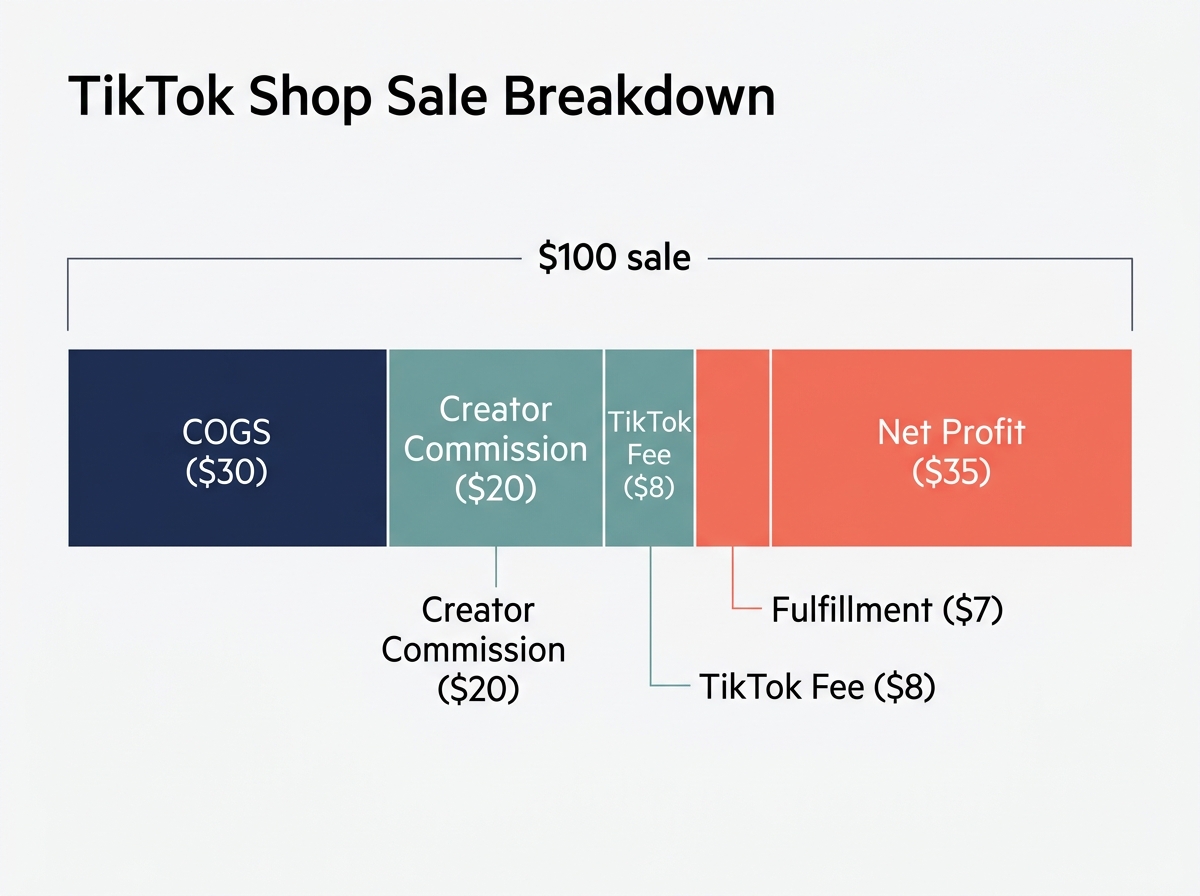
Mid-market brands, specifically those in the $10M–$50M annual revenue bracket, are feeling the squeeze. Unlike enterprise brands that can absorb losses for market share, or micro-brands with zero overhead, mid-market players have fixed costs that make a 20% commission painful. When you add the platform’s referral fee—which has stabilized at 8% for most categories—you are looking at 28% of the top line gone before a single box is packed.
Fulfillment by TikTok: The hidden margin killer
Logistics is where the 'social' part of social commerce meets the cold reality of the warehouse floor. Fulfillment by TikTok (FBT) was pitched as a way to ensure 2-day shipping and boost the 'Trusted Shop' badge. While it does improve conversion rates by an average of 14% compared to merchant-fulfilled orders, the cost structure is rigid.
For a standard beauty product or small apparel item, FBT costs typically break down as follows:
- Pick and Pack: $2.50 - $3.50
- Shipping (Last Mile): $3.00 - $5.00
- Storage Fees: $0.50 per cubic foot (monthly)
If you are selling a $25 lip gloss, you are losing $6.00 to logistics, $2.00 to the platform fee, and $5.00 to a 20% creator commission. That leaves $12.00 to cover the Cost of Goods Sold (COGS), overhead, and customer acquisition cost (CAC) for your paid ads. If your COGS is $5.00, your net profit is $7.00—a 28% margin. That sounds healthy until you realize it doesn't account for returns, which in the apparel category on TikTok Shop are currently hovering around 18% per eMarketer’s July 2026 report.
[INTERNAL: How to optimize FBT for high-volume apparel -> apparel-logistics-optimization]
Paid social integration and the 'Halo Effect' myth
One of the most persistent arguments for accepting lower margins on TikTok Shop is the 'Halo Effect'—the idea that Shop activity drives organic brand search and website sales. However, recent data from Finn Partners, where Wieden+Kennedy veteran Kim Sizemore recently took the helm of integrated media, suggests that this attribution is getting harder to prove.
Sizemore’s move to Finn Partners highlights a broader industry trend: the need for integrated media practices that look at the total ecosystem rather than siloed platform metrics. If you’re spending $50,000 a month on Spark Ads to boost your creator content, you have to attribute that cost directly to the Shop’s P&L.
We’ve seen brands try to use AI to scale this content, but as Search Engine Journal pointed out this month, AI isn't a silver bullet for accountability. If an AI-generated Spark Ad misrepresents a product feature and leads to a wave of returns, the brand—not the platform or the AI—bears the financial brunt. You need a human in the loop to ensure that the creative driving your Shop traffic isn't just high-engagement, but high-accuracy.
Benchmarking the 'Profitable' TikTok Brand in 2026
What does a successful brand look like in this environment? Based on our analysis of 40 mid-market accounts, the survivors share three specific traits:
1. High Average Order Value (AOV) Bundling
Successful brands have moved away from pushing single SKUs. Instead, they create 'Creator Kits' or bundles that push the AOV above $60. At a $60 price point, the fixed FBT costs represent a much smaller percentage of the total sale, allowing the brand to maintain a 20% commission for the creator while still netting a 35%+ profit margin.
2. Tiered Commission Structures
Don't offer 20% to everyone. Use a base-plus-bonus model. Offer 12% as a baseline, with a jump to 20% once the creator clears $5,000 in attributed sales. This protects your margins on low-performers while incentivizing the 'whales' who can actually move the needle. Tools like Sprout Social and Grin have integrated these tiered structures directly into their TikTok Shop modules to automate the process.
3. Multi-Channel Attribution Discipline
You must use post-purchase surveys (like KnoCommerce or Fairing) to see how many customers discovered you on TikTok but bought on your Shopify site. If the 'Shopify lift' is significant, you can afford to run TikTok Shop at a break-even level to act as a customer acquisition top-of-funnel. But you cannot fly blind.
The role of internal tooling and automation
Efficiency is the only way to combat margin compression. Buffer’s recent 'Build Week' is a prime example of how tech companies are leaning into internal automation to stay lean. For a social commerce brand, this means building or buying tools that automate the 'boring' parts of creator management: sending samples, tracking tracking numbers, and generating tax forms.
If your social media manager is spending 10 hours a week manually DMing creators, your effective margin is even lower than the spreadsheet suggests. You need to leverage the Affiliate Center’s automation features or third-party platforms like Shopline to handle the volume. As Tycoonstory Media’s 2026 guide notes, business growth in this era is tied directly to how well you integrate social signals into your supply chain.
The best creator management platforms for 2026
What to watch: The 2027 outlook
We expect TikTok to introduce more aggressive 'Ad-to-Shop' incentives in the coming months to compete with Amazon’s growing social features. This might include reduced referral fees for brands that spend a certain threshold on TikTok Ads.
However, the fundamental reality remains: TikTok Shop is a retail environment, not just a marketing channel. You must treat it with the same mathematical rigor you would apply to a shelf-space deal at Target or Walmart. The creators are your sales force; the algorithm is your landlord. Pay both, but make sure you’re keeping enough to keep the lights on.
Monitor your 'Return on Ad Spend' (ROAS) specifically within the Shop tab, but keep a close eye on your 'Marketing Efficiency Ratio' (MER) across the entire business. In 2026, the brands that win aren't just the ones that go viral—they're the ones that can afford to stay viral.
FAQ