
Synthetic audiences are the marketing industry's latest shortcut to empathy, but they are currently failing because they prioritize statistical averages over human friction. While LLMs can simulate a '45-year-old suburban homeowner,' they consistently miss the irrational, high-signal behaviors that actually drive conversions. To fix this, you must stop treating AI as a crystal ball and start treating it as a processor for raw social listening data from platforms like Brandwatch or Sprout Social. Without these real-world inputs, your synthetic personas are just high-resolution hallucinations of people who don't exist.
Key takeaways
- The 'Flat Persona' Problem: LLMs gravitate toward polite, generic archetypes that lack the specific grievances and slang of real communities.
- Social Data Ingestion: Effective synthetic modeling requires feeding raw, recent social conversation logs into the prompt to ground the AI in current sentiment.
- The Attribution Gap: As Google Analytics adds diagnostics for missing aggregate identifiers how to fix GA4 attribution, relying on simulated data risks doubling down on inaccurate measurement.
- Falsifiable Prediction: By Q4 2026, brands relying solely on 'out-of-the-box' AI personas will see a 20% decline in creative resonance compared to those using grounded social-topical maps.
The dangerous allure of the 'Average' consumer
We have entered the era of the 'Push-Button Persona.' A strategist types a few demographic parameters into a custom GPT, and seconds later, they have a detailed biography of 'Sarah, the Eco-Conscious Millennial.' It feels like magic. It looks like work. But it is fundamentally flawed.
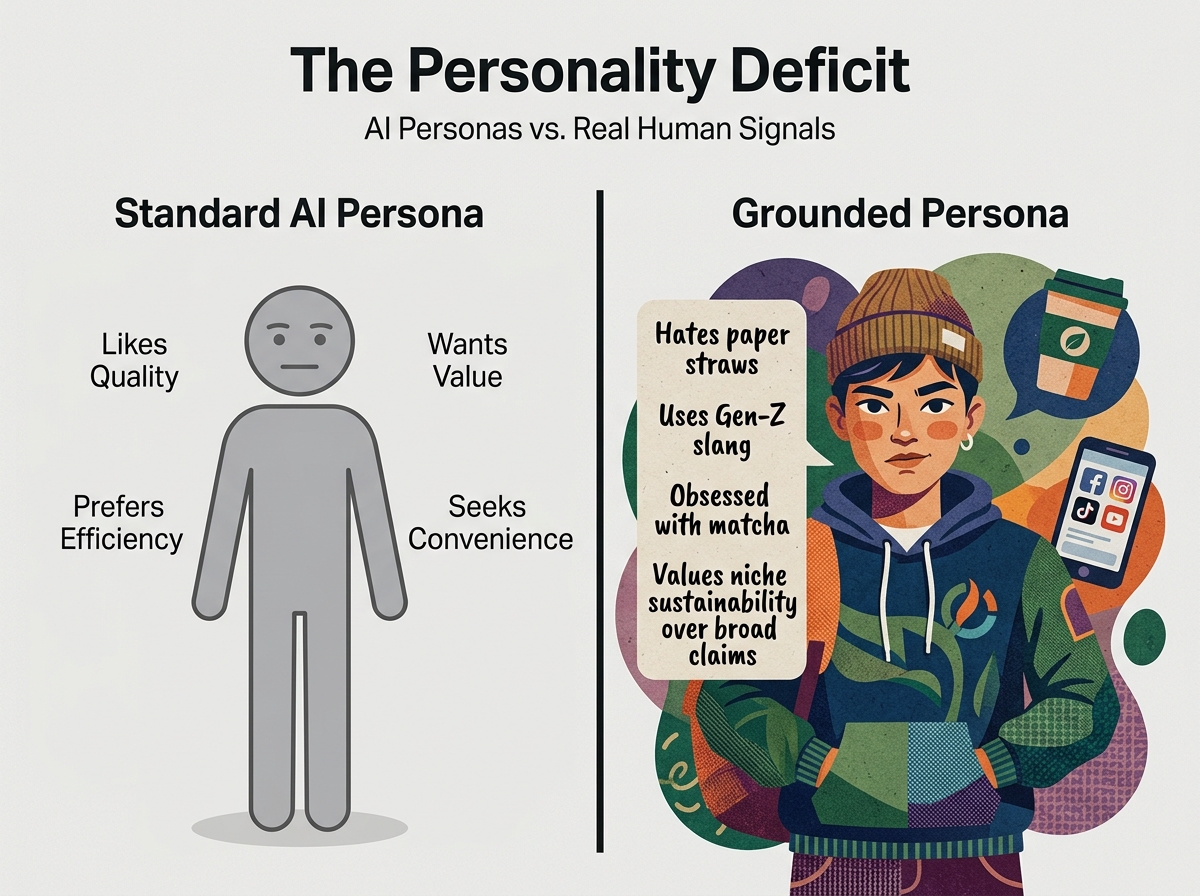
LLMs are trained on the internet, which means they are trained on a flattened version of reality. They predict the most likely next word, which naturally leads them to the most 'likely' (read: generic) version of a human being. When you ask a synthetic audience how they feel about a new product, they give you the polite, balanced response of a corporate training manual. They don't give you the snark of a Reddit thread or the frantic urgency of a TikTok comment section during a product drop.
This is a crisis of specificity. In social media marketing, the 'average' is useless. We win in the margins—the specific weirdness of a niche community, the inside jokes, the localized grievances. By relying on synthetic audiences that haven't been 'salted' with real-world data, marketers are building campaigns for a ghost population that never complains, never gets confused, and never buys impulsively.
Why social listening is the missing 'Soul' of AI modeling
The fix isn't to abandon AI; it's to stop letting it guess. The most sophisticated agency strategists are now using a 'Grounding-First' approach. Instead of asking an LLM to 'imagine' a customer, they are exporting the last 30 days of mentions from Brandwatch or Sprout Social and feeding that raw text into the context window.
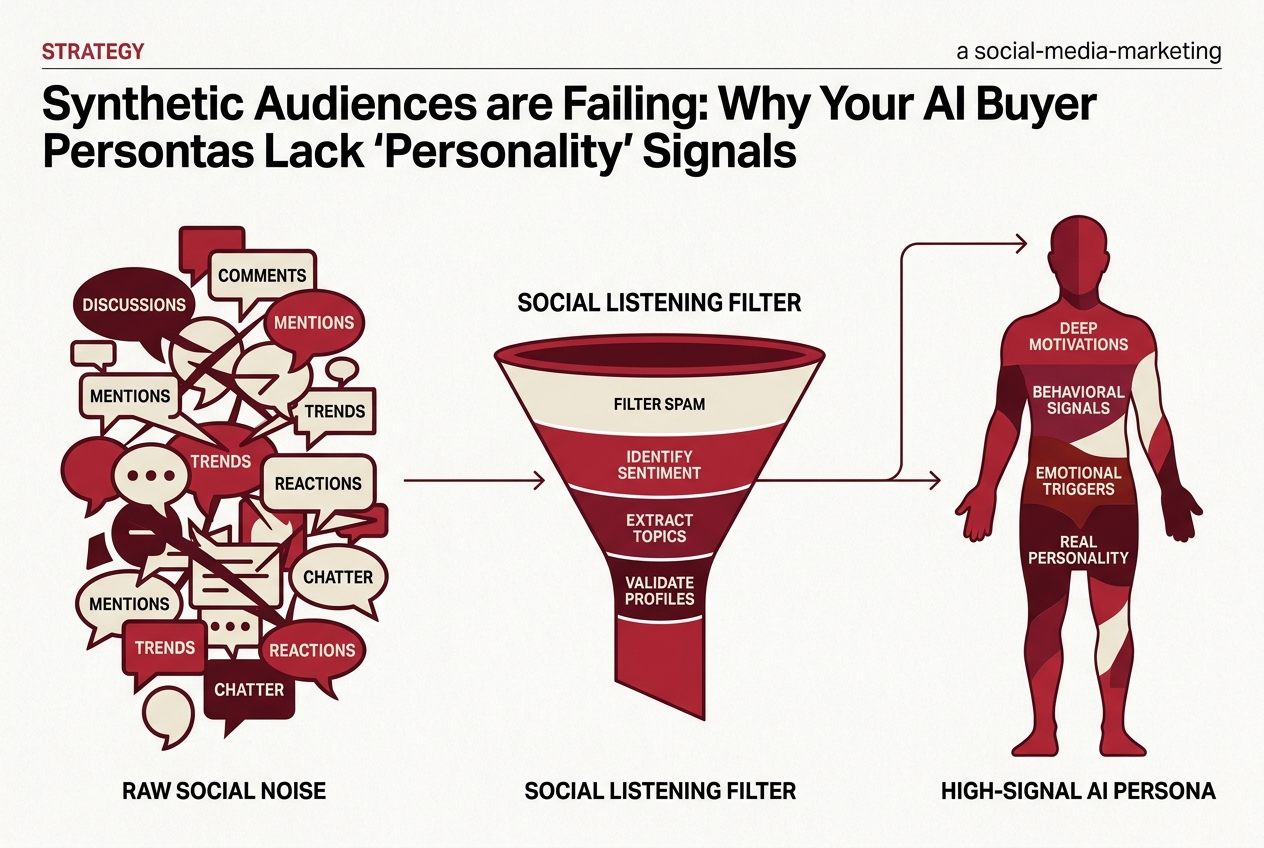
When you provide an LLM with 500 actual customer complaints and 200 positive shout-outs, the 'synthetic' response changes instantly. It stops saying 'I value sustainability' and starts saying 'I'm tired of paper straws that disintegrate in five minutes.' That shift from a value statement to a visceral frustration is the difference between a campaign that flops and one that scales.
This mirrors a broader trend in search and social. As noted by industry analysts regarding the need for a social topical map for SEO, your brand's visibility is increasingly tied to how well you map real-world conversations across platforms like YouTube and TikTok. If your AI personas aren't informed by these maps, they are effectively blind to the current cultural climate.
The risk of 'Clean' data in a messy world
There is a technical reason these personas feel flat: Reinforcement Learning from Human Feedback (RLHF). OpenAI and Google have spent billions making their models helpful, harmless, and honest. While great for a chatbot, this is terrible for a marketing simulator. Real customers are often unhelpful, occasionally harmful (to your brand reputation), and frequently dishonest about their motivations.
If you use ChatGPT to simulate a focus group, you are talking to a version of a human that has been scrubbed of all its 'edges.' You won't hear the toxic sentiment that might be brewing on X (formerly Twitter) or the chaotic energy of a Discord server. This creates a false sense of security. You launch a campaign that your synthetic audience 'loved,' only to have it shredded by real humans who don't share the AI's programmed politeness.
We see this tension in new ad formats as well. OpenAI is reportedly testing [INTERNAL: chatbot-native ads that launch AI agents -> openai-agent-ads], which will likely rely on these same synthetic profiles to determine targeting. If the underlying profile is a cardboard cutout, the ad interaction will be equally two-dimensional.
Counterargument: Isn't synthetic data better than no data?
Critics of my position argue that for small-to-medium businesses (SMBs), synthetic audiences are a godsend. They argue that a 'flat' persona is better than a blind guess, and that most brands lack the budget for $50,000 focus groups.
I concede that as a brainstorming partner, AI is unmatched. If you need to quickly generate ten possible objections to a price increase, an LLM will give you a solid starting point. However, the danger lies in the substitution of research for simulation. When the simulation becomes the final word—when the budget is allocated based on what a 'synthetic' panel said—you aren't doing marketing. You're doing creative fan fiction.
For the SMB, the answer isn't to spend $50k on a focus group; it's to spend $500 on a social listening tool and two hours reading real comments. The 'personality signals' you find in ten real Instagram comments are more valuable than a 20-page AI-generated white paper on 'The Modern Consumer.'
Injecting 'Friction' back into your prompts
To get better results, you must purposefully introduce 'friction' into your AI workflows. Stop asking the AI to be 'helpful.' Tell it to be 'cynical.' Tell it to be 'a customer who just had a bad day and is looking for a reason to hate your brand.' Better yet, use specific prompt engineering techniques like 'Chain of Thought' combined with 'Few-Shot Prompting' using real customer verbatim.
For example, instead of: "Act as a target customer for a new audio-only YouTube ad format." (Referencing Google's new YouTube audio ad guide)
Use: "Here are five real comments from users complaining about audio ads on Spotify. Based on these specific complaints about volume levels and repetitive jingles, act as a skeptical listener and critique this new YouTube audio ad script."
This forces the AI to move away from its 'average' training and toward the specific behavioral signals that actually matter for creative performance.
The 2026 Prediction: The Great Re-Humanization
As we move toward a world where AI agents talk to other AI agents, the value of 'human-origin' data will skyrocket. We are already seeing Google Analytics struggle with attribution as privacy regulations increase and aggregate identifiers disappear. If we lose the ability to track real humans, and we replace our understanding of them with synthetic simulations, marketing will enter a feedback loop of irrelevance.
My prediction is this: By the end of 2026, the most successful social media teams will be those that have 'Human-in-the-Loop' listening as a mandatory step in their AI pipeline. The 'Synthetic-Only' brands will be easy to spot—their copy will be flawless, their imagery will be perfect, and their engagement rates will be at an all-time low because they forgot that real people are messy, irrational, and wonderfully unpredictable.
Don't let your brand become a simulation of a brand. Use the tools to scale your reach, but use real human voices to ground your strategy. The data is out there in the comments, the DMs, and the threads. Feed that to your AI, or prepare to be ignored by the very people you're trying to reach.

FAQ