
In the third quarter of 2026, the creator economy has moved past the era of 'spray and pray' distribution. We’ve seen the fallout from the November 2025 regulatory shifts that forced a hard decoupling of algorithm data between TikTok and its Western competitors. As platform-specific features become more distinct—and as Gen Z’s preference for Claude over other AI assistants grows by a staggering 7-to-1 margin per Search Engine Journal's August data—the cost of keeping a creator away from a rival platform has skyrocketed.
Exclusivity is no longer a standard checkbox in a Master Services Agreement (MSA). It is a premium asset. According to internal benchmarks from top-tier talent agencies like WME and United Talent, exclusivity premiums now account for 35% to 60% of total contract value, up from just 15% in 2023. You aren't just paying for their reach; you're paying for their absence elsewhere. This guide outlines the eight critical exclusivity tiers and pricing structures currently dominating the market.
Key takeaways
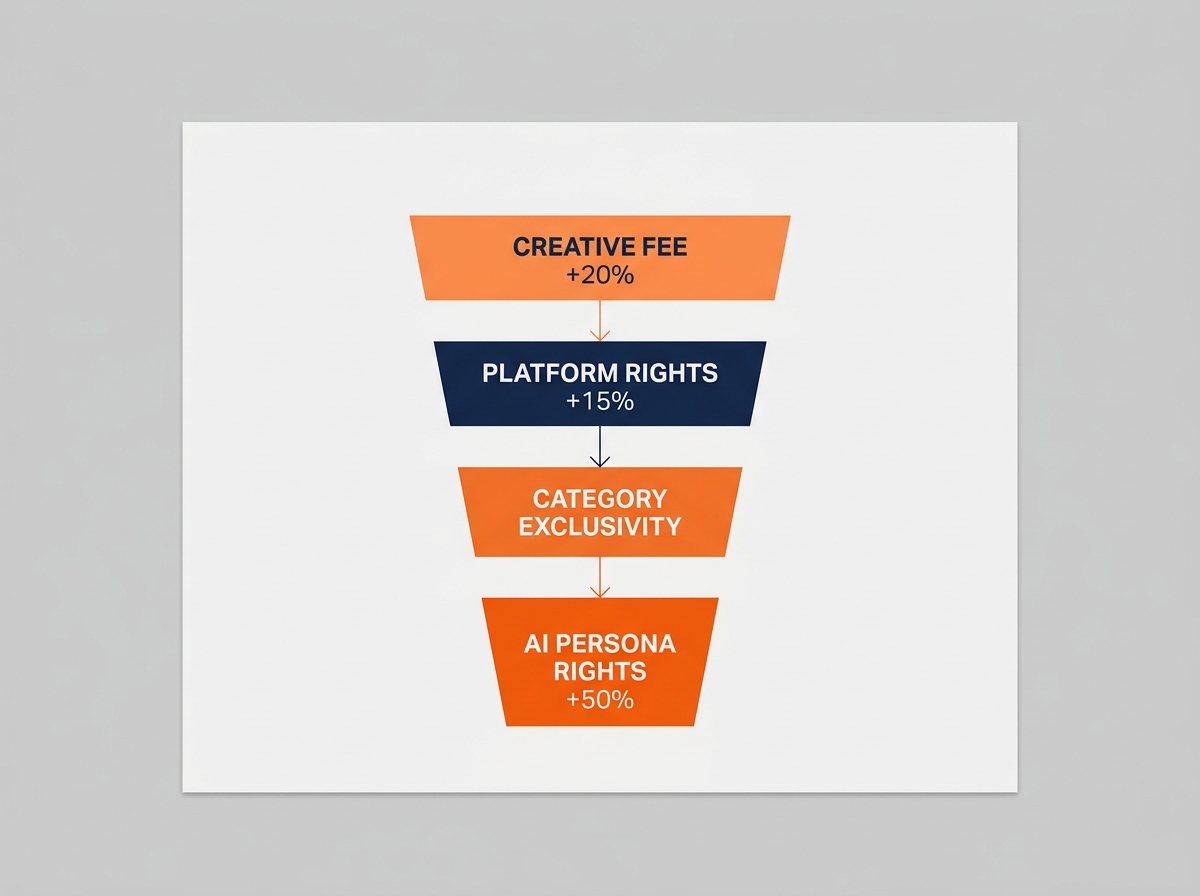
- The 25% Baseline: Standard category exclusivity now carries a minimum 25% premium on the base creative fee, tiered by platform.
- Platform Blackouts: Total platform blackouts (e.g., 'No TikTok for 30 days') are increasingly rare and cost 2x the standard post rate.
- AI-Agent Rights: A new frontier in 2026 is 'Persona Exclusivity,' preventing creators from licensing their likeness to AI-driven brand assistants for competitors.
- Attribution over Reach: Brands are shifting from CPM-based pricing to 'Exclusivity-Adjusted ROAS' models to justify high retention fees.
1. The Category-Specific Platform Blackout
The most common 2026 clause, preventing creators from mentioning competitors on a specific platform while the campaign is live.
In the current landscape, a creator posting for Estée Lauder on Instagram cannot reasonably be expected to ignore the beauty category on TikTok entirely—unless you pay for it. As we saw with the Estée Lauder 'Group Chat' campaign featuring Bowen Yang, the value lies in the perceived authenticity of the conversation. If that conversation is interrupted by a rival brand's placement 24 hours later, the 'Group Chat' vibe is killed.
Pricing for this tier usually sits at a 20-30% premium over the base rate. It is highly effective for short-burst product launches where you need to own the 'Share of Voice' for a specific 72-hour window.
Best for: High-impact product launches and seasonal retail events where cross-platform noise dilution is a risk.
2. The 'Cross-Pollination' Restriction
Prohibits creators from repurposing the same creative assets for rival platforms, even if the brand isn't mentioned.
With TikTok expanding public placement opportunities for advertisers in late 2026, the platform is hungry for original vertical video. However, brands are now realizing that a video that goes viral on TikTok and is then immediately reposted to YouTube Shorts with the same watermark dilutes the brand's unique presence on both.
Negotiators are now inserting 'Platform-Native Exclusivity' clauses. This doesn't stop the creator from working with others, but it mandates that the style and aesthetic used for Brand A cannot be mimicked for Brand B for 90 days. This carries a 15% premium because it increases the creator's production workload.
Best for: Brands with a very specific 'visual identity' or those using unique creator-led editing styles that function as brand codes.
3. The AI Likeness & 'Digital Twin' Lockout
A 2026-specific clause preventing creators from licensing their voice or face to a competitor's AI customer service agent.
This is the newest and most contentious area of creator contract negotiation. As AI brand preference splits by generation—with Gen Z favoring Claude’s conversational style—brands are building custom AI agents using creator likenesses. If you’ve hired a creator to be the face of your brand, the last thing you want is their AI 'Digital Twin' answering support tickets for a competitor.
Industry benchmarks suggest this 'Persona Exclusivity' can command a 50% to 100% premium on the base fee. You are essentially buying a portion of their identity. Agencies are currently advising creators to limit these deals to 6-month terms to avoid 'Likeness Obsolescence.'
Best for: Long-term brand ambassadors and 'Face of the Brand' campaigns in the tech and beauty sectors.
4. The 'Shadow Exclusivity' Dark Post Clause
Allows brands to run 'dark posts' (ads that don't appear on the creator's profile) while preventing the creator from posting organically for competitors.
Since Meta deprecated certain organic reach signals in early 2026, the 'Dark Post' has become the workhorse of paid social. However, if a brand is spending $500k in ad spend behind a creator's face, they cannot have that creator posting an organic 'Get Ready With Me' featuring a competitor.
This is called 'Shadow Exclusivity.' The creator doesn't have to post more, but they have to stay silent for the duration of the paid flight. This typically adds $5,000 to $15,000 per month to the contract, regardless of the initial production fee.
Best for: Performance marketing teams who rely heavily on Whitelisting and Creator Licensing (formerly Spark Ads).
How to optimize dark post creative for 2026 algorithms
5. The Search-Intent Exclusivity Tier
Prevents creators from using specific high-value keywords or 'search triggers' in their captions for other brands.
Following the shift toward building content briefs around people rather than just keywords, brands are now identifying the 'situations' that drive search. If a creator is the top result for 'best morning skincare routine,' a brand will pay to ensure they don't use that specific phrase—or even that specific lighting setup—for any other brand for six months.
This is a surgical form of exclusivity. It doesn't stop the creator from working, but it protects the brand's SEO and Social Search dominance. Expect to pay a 10% premium for every 'Locked Keyword Phrase' included in the contract.
Best for: Brands focused on Social SEO (TikTok Search, YouTube Search) and 'Solution-Aware' customers.
6. The Multi-Platform 'Ecosystem' Lockout
The 'Nuclear Option' where a creator is barred from all major social platforms for a competitor, including emerging ones like OpenAI’s ad-supported ChatGPT interface.
As OpenAI begins testing exclusion targeting for ChatGPT ads, brands are worried about their creators appearing in the 'wrong' AI-generated conversations. A multi-platform lockout is the most expensive contract type in 2026. It covers TikTok, Reels, Shorts, X, LinkedIn, and AI-chat interfaces.
Because this severely limits a creator's earning potential, the premiums here start at 100% (a 2x multiplier) of the base creative fee. Most creators will only agree to this for 3-month windows. It is the gold standard for 'Category Domination.'
Best for: Market leaders (e.g., Nike, Coca-Cola) who need to ensure total visual separation from challengers.
7. The 'Community Engagement' Exclusivity
A niche but growing clause that prevents creators from replying to or engaging with competitor content in the comments section.
In 2026, a creator's 'Community' is often more valuable than their 'Followers.' Brands are now noticing when their sponsored creators 'heart' a competitor's comment or engage in a friendly banter thread with a rival brand.
This clause treats the creator's engagement as a brand asset. It is difficult to police but is often included in 'Moral Clauses' or 'Brand Affinity' sections. While it rarely has a standalone fee, it is used as leverage to negotiate lower base rates in exchange for long-term stability.
Best for: Community-led brands and those in highly tribal categories like gaming or fitness.
8. The 'First-Look' and 'Right of First Refusal' (ROFR) Hybrid
Not a total lockout, but a contractual requirement that the creator must offer the brand the chance to match any competitor offer before signing.
This is the 'lite' version of exclusivity that savvy strategists use to keep costs down. Instead of paying a massive upfront premium, the brand pays a smaller 5-10% 'Retention Fee.' If a competitor approaches the creator, the brand has 48 hours to match the deal.
This is becoming the standard for 'Creator-Led Commerce' brands who want to keep their top-performing affiliates from jumping ship to a rival's affiliate program. It provides flexibility for the creator while giving the brand a safety net.
Best for: Growth-stage D2C brands and affiliate-heavy marketing programs.
[INTERNAL: The rise of creator-led commerce in Q3 2026 -> creator-commerce-trends]
How to Calculate Your Exclusivity Budget
To determine which tier you need, you must first calculate your 'Risk of Dilution.' If your creator posts three times a day, the risk of a competitor appearing in their feed is high. If they post once a week, it’s low.
Use this simple formula:
Base Creative Fee x (1 + Exclusivity Premium %) x Platform Multiplier = Total Contract Value
For example, a $10,000 video with 30% Category Exclusivity and a 1.2x Multiplier for cross-platform rights results in a $15,600 contract. In 2026, trying to get that same deal for $10,000 will likely result in your brief being ignored by top-tier talent.
The Future of Creator Rights Management
As we look toward 2027, the focus will shift even further toward 'Data Exclusivity.' Brands will not just want to keep creators off rival platforms; they will want to own the 'Pixel Data' and 'Audience Clusters' generated by the creator's content, preventing that data from being used to train a competitor's lookalike models.
Negotiation is no longer about how many people see the post. It’s about who doesn't get to see the creator, and what the creator doesn't say. If you aren't pricing in these silences, you aren't really buying exclusivity—you're just renting a moment of attention.

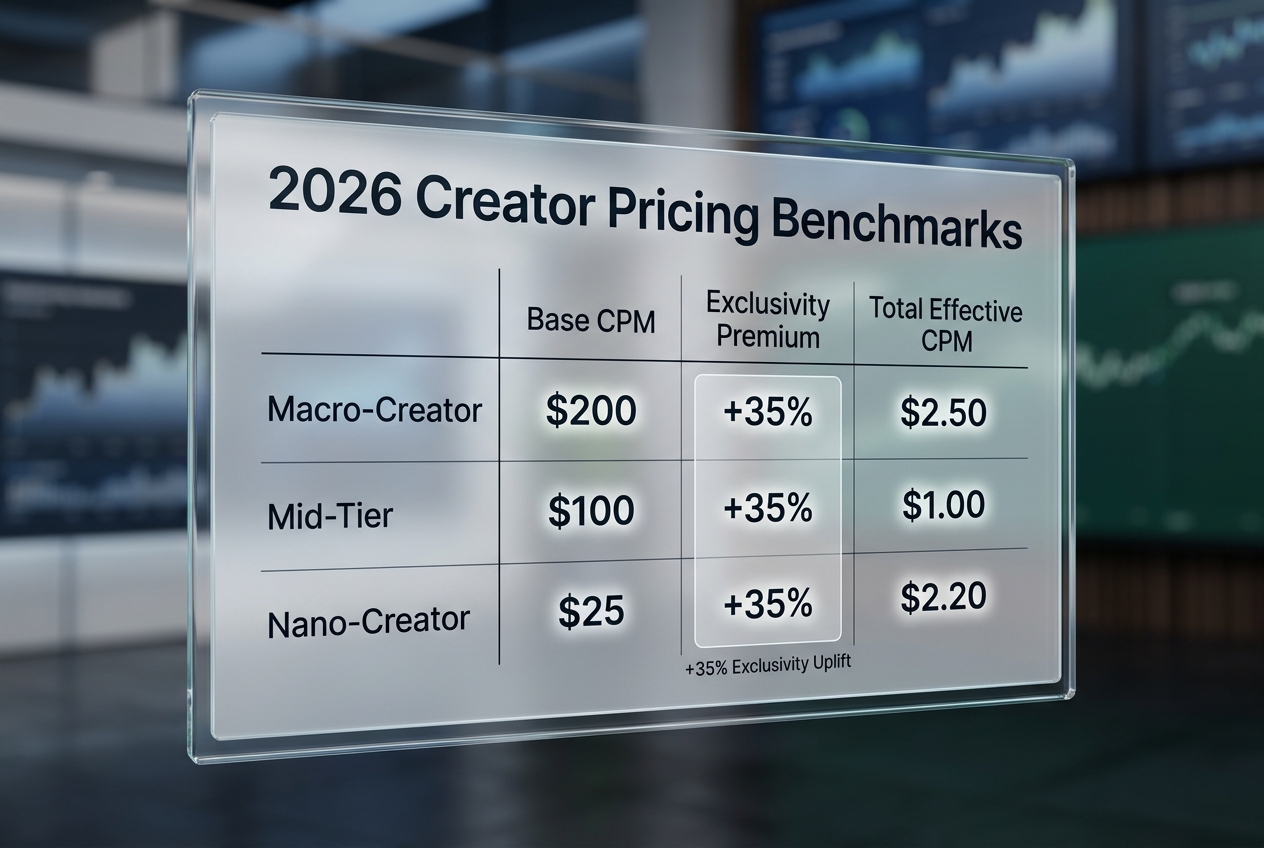
Summary of 2026 Pricing Benchmarks
| Exclusivity Tier | Typical Premium | Duration | Primary Benefit |
|---|---|---|---|
| Category Blackout | 25% | 30 Days | Share of Voice |
| Platform Native | 15% | 90 Days | Creative Originality |
| AI Likeness | 75% | 6-12 Months | Brand Persona Protection |
| Shadow (Dark Post) | $10k/mo | Flight Dates | Performance Purity |
| Keyword/Search | 10% per phrase | 6 Months | SEO Dominance |
By understanding these tiers, you can move from a 'one-size-fits-all' contract to a targeted negotiation strategy that protects your brand without overpaying for unnecessary restrictions. The 2026 creator market rewards precision, not just deep pockets.
FAQ