
Branded search volume is lying to you. For a decade, we treated the Google Search Console graph for your brand name as the ultimate truth of demand generation—if the line went up, the marketing was working. But in 2026, that line is decoupling from reality. As fragmented AI discovery and vertical social feeds cannibalize the traditional search journey, relying on branded search as your primary demand proxy isn't just outdated; it's a strategic liability that hides your most valuable growth signals.
Key takeaways
- The Search Gap: Consumers now satisfy intent within social apps and AI agents, never reaching the traditional search bar.
- Social Lift > Search Volume: Success in 2026 is measured by cross-platform visibility and 'in-feed' conversions, not just navigation to a URL.
- Attribution Debt: Traditional Last-Click and even U-Shaped models fail to capture the multi-touch influence of creator-led discovery.
- Platform-Native Buying: The rise of TikTok Shop and integrated checkout means the 'search' phase is being bypassed entirely.
The Great Decoupling: Why the Search Bar is Losing Its Signal
We've entered the era of the "zero-click journey," but not in the way Google intended. Previously, we assumed a linear path: a user sees a TikTok, thinks about the product, and searches for the brand on Google to buy. Today, that middle step is evaporating. Per the shift toward social commerce, the transaction now happens where the discovery occurred.
When Jamie Love of Monumental notes that TikTok Shop is a "discovery channel first," he's highlighting a fundamental shift in user behavior. Users aren't searching for your brand because the platform's algorithm has already served them exactly what they needed, including a 'Buy' button. If your KPIs are still anchored to branded search volume, you're missing the massive volume of demand being captured and converted before it ever hits a browser.
Furthermore, the quality of search data is degrading. As noted by Search Engine Journal in July 2026, AI-generated answers are frequently hallucinating brand details, location data, and service offerings. When a user asks an AI agent about a brand and receives an incorrect or synthesized answer, that interaction never registers as a "branded search" in your dashboard, even though demand was expressed. You are losing visibility into the very moment of intent.
The 'Social Lift' Framework: Measuring Demand in a Fragmented World
If branded search is no longer the North Star, what is? We are seeing the emergence of "Social Lift"—a composite metric that tracks the delta in brand mentions, share of voice, and platform-native conversions following a campaign. Unlike search volume, which is reactive, Social Lift is proactive. It measures the energy of a brand within the environments where consumers actually spend their time.
Consider the recent activity at the Downtown Summerlin Farmers Market, where TikTok spotlighted local creators. A traditional marketer might look for a spike in "Las Vegas Farmers Market" searches. A 2026 strategist looks at the localized surge in geo-tagged content, the increase in creator-affiliate sales within a 50-mile radius, and the sentiment shift in comment sections.
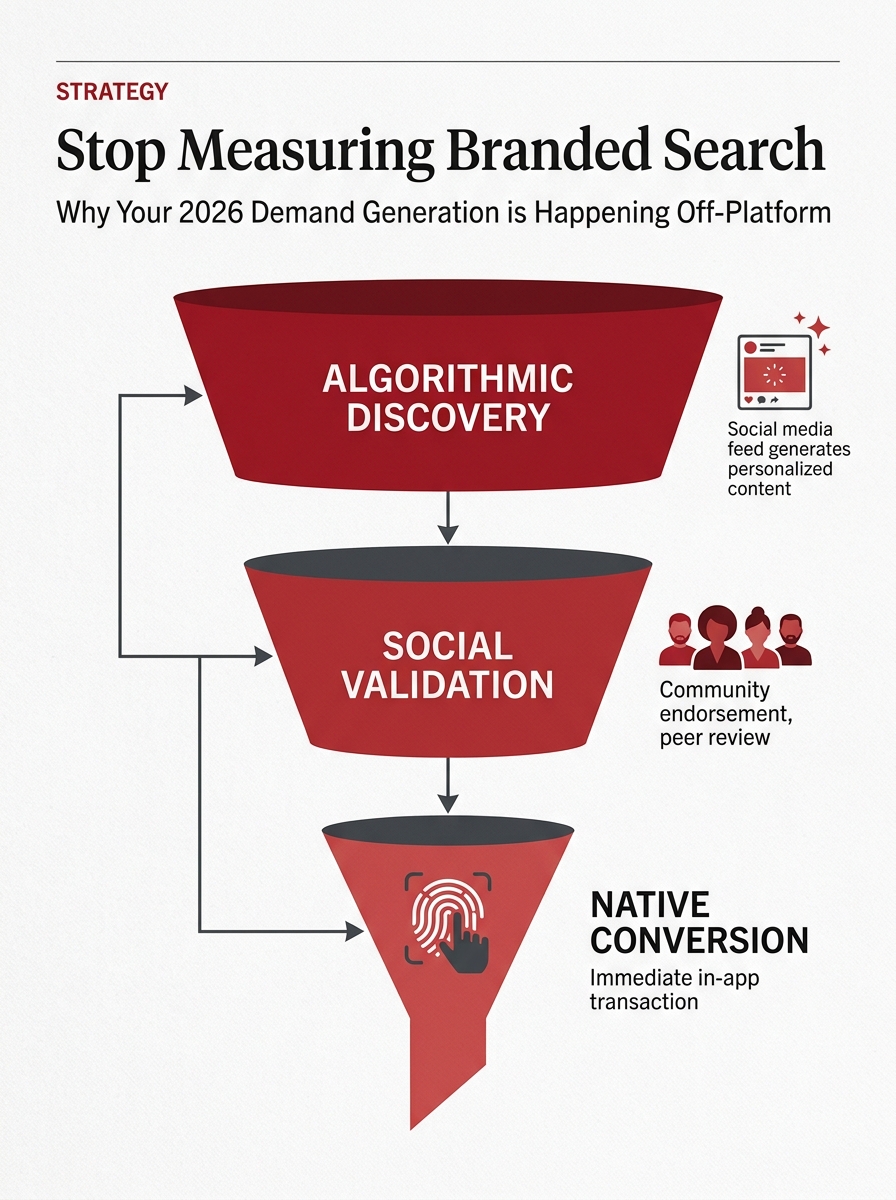
This isn't just about "engagement." It’s about understanding that demand is now a liquid asset that flows across platforms. When Noom bets on its behavior-change roots to compete in the GLP-1 era, as reported by Adweek, they aren't just buying keywords for "weight loss." They are building a narrative that lives in the advice-seeking sections of Reddit and the transformation-story loops of Instagram. If you only measure the people who eventually type "Noom" into a search bar, you're ignoring the 90% of the funnel that was built through consistent, off-platform presence.
The Counterargument: The 'Navigational Intent' Fallacy
Critics of this view argue that branded search remains the highest-intent signal we have. They aren't wrong—someone searching for your brand by name is undeniably close to a purchase. The flaw in this logic is the assumption that the absence of that search implies an absence of demand.
In the old model, we viewed the search bar as a necessary gateway. In 2026, it is a friction point. Every time a user has to leave an app, open a browser, and type a name, you lose a percentage of the conversion. Platforms like Meta and TikTok have spent billions to ensure users never have to do that. By the time a user resorts to a branded search, your platform-native funnel has already failed them. You are measuring your failures, not just your successes.
Moreover, the rise of AI-driven search (SGE, Perplexity, OpenAI Search) means that even when users do search, they aren't clicking through to your site. They are getting the "answer" in the SERP. If your demand gen strategy relies on capturing that click to trigger a pixel, your attribution model is already broken. You must move toward [INTERNAL: privacy-first measurement -> attribution-modeling-post-cookie] that accounts for these invisible impressions.
The Death of the URL: Why Your Website is a Secondary Destination
For twenty years, the website was the sun at the center of the marketing solar system. In 2026, the website is just another moon. Demand is generated, nurtured, and often harvested within the walled gardens of social platforms and AI ecosystems.

This shift requires a radical reallocation of budget. If you are still spending 60% of your budget on protecting your branded keywords in Google Ads, you are paying a "tax" on demand you've already created elsewhere. That capital is better spent on creator partnerships that drive native checkout or on high-velocity content that feeds the AI discovery engines.
We should look at the MarTech analysis from July 2026 regarding traffic drops. Not every decline in site traffic is a ranking problem; often, it’s a shifting intent problem. If your branded search is down but your TikTok Shop revenue is up 40%, you haven't lost demand—you've simply migrated it to a more efficient environment. The brands that will win in the next two years are those that stop trying to force users back to their legacy websites and instead meet them where the buy button already lives.
2027 Prediction: The 'Search-to-Sales' Ratio Will Collapse
I’ll put a stake in the ground: By the end of 2027, for top-tier consumer brands, less than 20% of digital revenue will involve a traditional search engine touchpoint. Branded search volume will become a "vanity metric" similar to how Facebook Page Likes are viewed today—a nice-to-have indicator of general health, but entirely disconnected from the mechanics of the modern transaction.
Marketers who fail to adapt will find themselves optimizing for a ghost. They will see "stable" branded search numbers while their competitors, who have embraced fragmented discovery, see exponential growth in native social sales. The search bar was a bridge to the digital world. Now that we live inside that world, we no longer need the bridge.
You need to start auditing your "Off-Platform Visibility" today. How does your brand appear in a ChatGPT recommendation? What is your conversion rate inside the Instagram shop? These are the questions that will define your 2026 performance. The search bar is closing. The feed is open.
FAQ