

If you are still using social listening to tally brand mentions and resolve customer complaints, you are operating in the past. By the time a trend hits your dashboard as a volume spike, the opportunity to lead the conversation has already evaporated. The shift from reactive management to proactive social media intelligence requires a fundamental change in how you interrogate platform data.
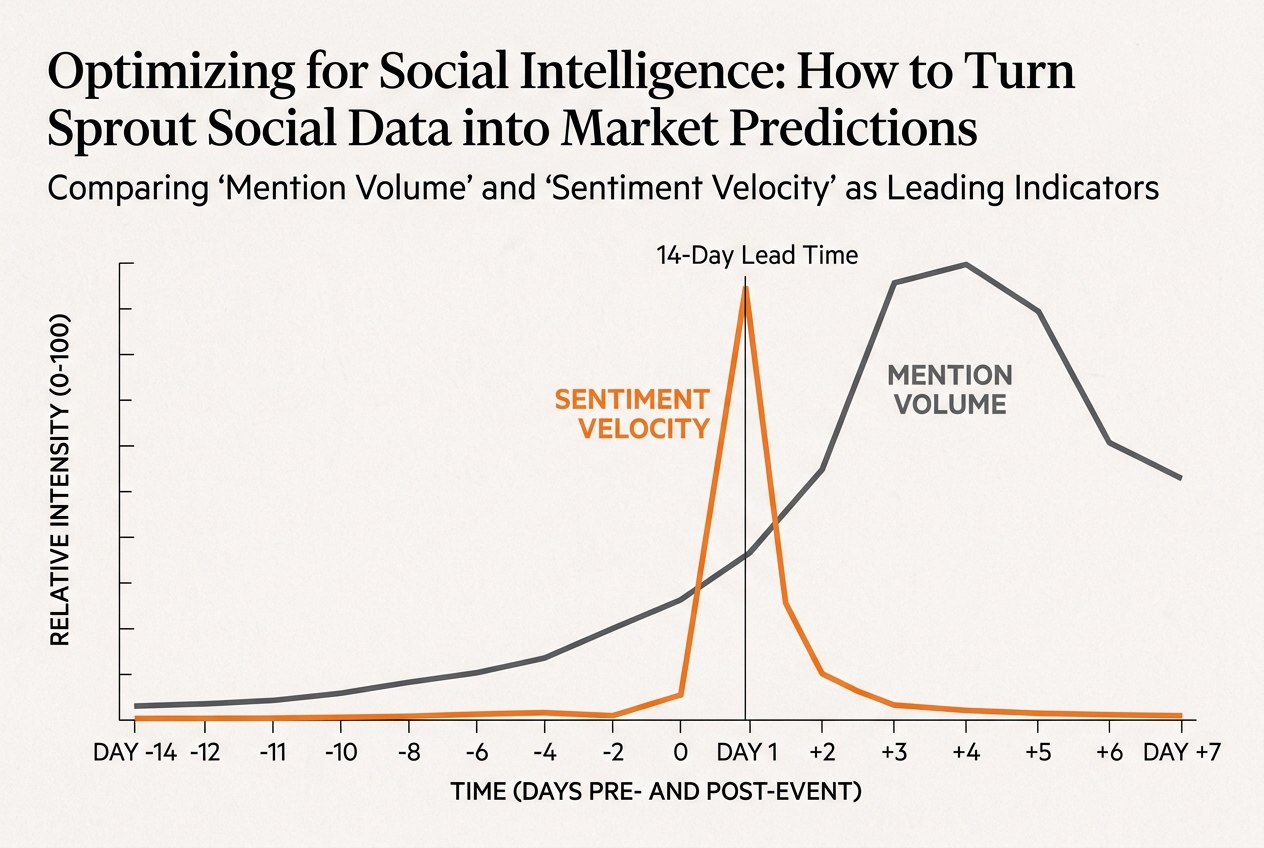
According to the 2026 Social Intelligence Report, the gap between a localized sentiment shift and a full-scale market disruption is now approximately 14 days. Brands that identify these 'micro-signals' early can pivot their creative and media spend before CPMs skyrocket. This tutorial outlines the exact workflow for using Sprout Social's advanced listening and audience insight tools to build a predictive market engine.
TL;DR
- Move beyond volume: High mention volume is a lagging indicator; sentiment velocity and keyword volatility are leading indicators.
- Cluster by narrative: Use Sprout’s Topic Clustering to separate bot-driven spam from authentic consumer shifts.
- The 14-day window: Identify 'early adopter' sentiment in niche groups to predict mainstream adoption within two weeks.
- Actionable integration: Connect social intelligence to your broader BI stack to influence product and inventory decisions.
The Shift from Monitoring to Social Media Intelligence
Traditional social monitoring is a defensive play. You wait for someone to say your name, then you react. Social media intelligence is an offensive strategy. It involves looking at the white space—the things your audience is talking about when they aren't talking about you.
Per the July 2026 report from WION on narrative communication, the industry is moving toward 'narrative-first' metrics. Views and impressions are being replaced by 'narrative resonance'—how well a brand's story integrates into existing consumer conversations. If you're only tracking your own handle, you're missing 90% of the data that matters.
In Sprout Social, this means moving away from the 'Smart Inbox' and into the 'Listening' tab. While the Inbox handles the 'now,' Listening handles the 'next.' To predict market shifts, you must track the peripheries of your industry. For a beauty brand, this isn't just tracking 'moisturizer'; it's tracking 'skin barrier health' or 'dopamine beauty' before those terms become mainstream SEO keywords.
Building the Predictive Listening Architecture
To identify signals two weeks ahead of the market, your listening queries must be structured for discovery, not just confirmation. Most marketers make the mistake of being too specific. If you only track your product names, you only see your current reality.
Step 1: The Three-Tier Query Structure
In Sprout’s Listening tool, create three distinct types of topics:
- The Core: Brand names, product names, and direct competitors. (Reactive)
- The Category: Broad industry terms, pain points, and 'how-to' phrases. (Informative)
- The Frontier: Adjacent interests, emerging slang, and technological shifts. (Predictive)
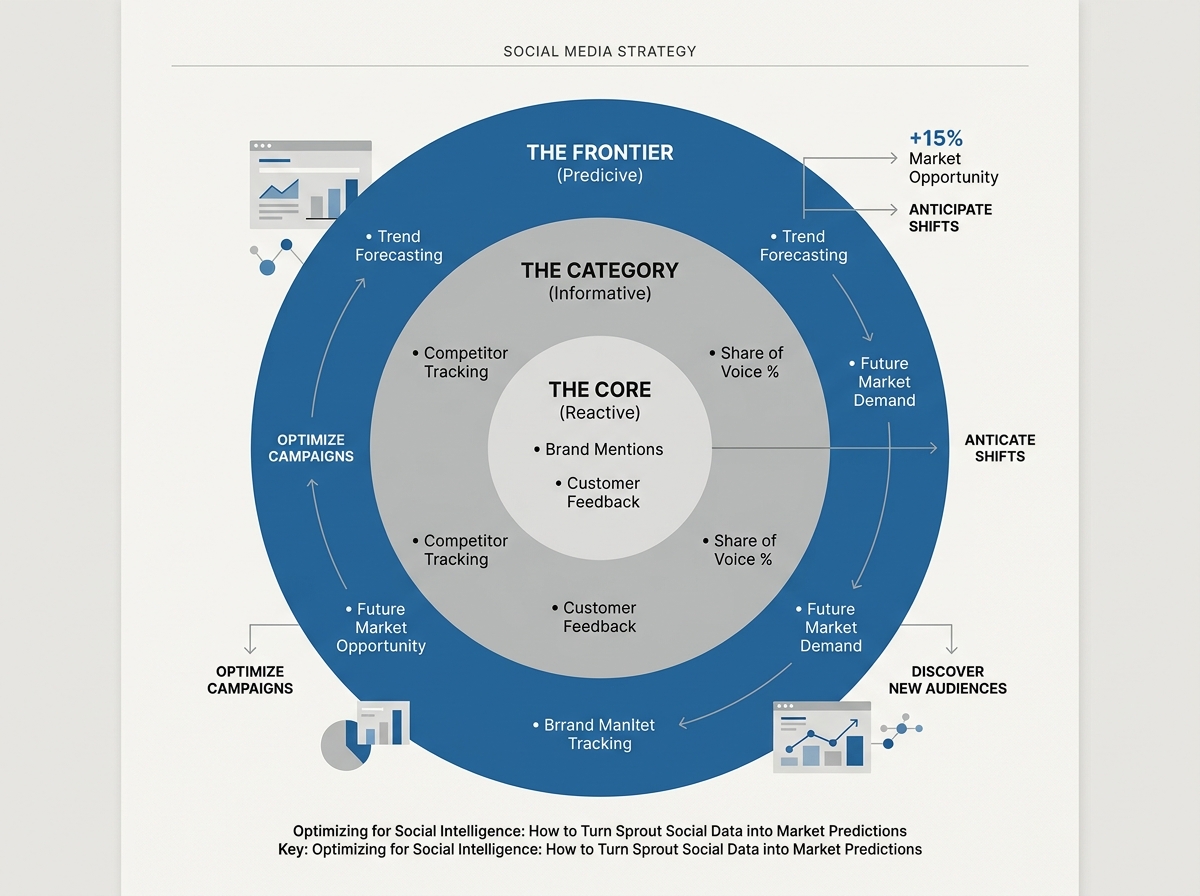
For example, if you are a fintech firm, your 'Frontier' queries might include 'AI-driven budgeting' or 'decentralized savings' long before you have a product in those spaces. By monitoring the sentiment velocity—the speed at which sentiment is changing—within these Frontier topics, you can spot trouble or opportunity.
Step 2: Filtering for Authenticity
One of the biggest challenges in 2026 is the rise of AI-generated noise. As reported by Search Engine Journal in July 2026, platforms like X are actively fighting 'chatbot spam' that can skew sentiment data. To get clean market sentiment analysis, you must use Sprout’s 'Profile Filters' to exclude accounts with low follower counts or high post-frequency patterns that suggest automation.
Analyzing Sentiment Velocity and Narrative Shifts
Once your queries are running, the real work begins in the 'Sentiment' and 'Trends' tabs. You aren't looking for a high volume of mentions; you are looking for a change in the type of conversation.
Identifying the 'Tipping Point'
In Sprout Social audience insights, look for a divergence between volume and sentiment. If volume is steady but 'Negative' sentiment is increasing in your 'Category' topic, a market-wide frustration is brewing. If you can identify the specific keyword driving that negative sentiment—perhaps 'subscription fatigue' or 'hidden fees'—you have a two-week window to adjust your messaging to highlight your brand's transparency before the competitors even realize there's a problem.
The Role of TikTok Native Content
As noted by CEOWORLD magazine, the future of affiliate and influence marketing is 'TikTok Native.' This means trends are born in short-form video and migrate to other platforms. In Sprout, pay special attention to the 'Media Type' filter. If a trend is spiking on TikTok but hasn't hit X or LinkedIn yet, you have found a lead indicator.
Turning Insights into Market Predictions
Data is useless if it stays in the social team's silo. To turn social intelligence into market predictions, you must translate social metrics into business outcomes.
Creating a 'Signal Report'
Every Friday, your team should produce a Signal Report that categorizes findings into three buckets:
- Noise: High-volume trends with no long-term substance (e.g., a viral meme with no brand affinity).
- Signals: Growing conversations in the 'Frontier' query tier that show high engagement-to-follower ratios.
- Action Items: Shifts that have reached a sentiment velocity threshold requiring a pivot in creative or product strategy.
Case Study: The Meta Algorithm Shift
Consider the recent reporting from organiser.org regarding how Meta’s algorithms influenced political and social narratives in mid-2026. Brands that were using advanced social listening saw the shift in 'Content Recommendation' patterns early. They noticed that 'Protest' and 'Social Justice' content was being weighted differently in the feed. By identifying this shift through Sprout’s 'Post Performance' and 'Listening' tools, savvy marketers adjusted their organic distribution strategy to align with the new algorithmic reality before their reach plummeted.
Troubleshooting Common Intelligence Gaps
Even with the best tools, gaps occur. The most common is the 'Echo Chamber' effect, where you only listen to the audience you already have.
Problem: Your listening data feels repetitive. Solution: Use the 'Related Keywords' cloud in Sprout to find terms you haven't included in your queries. If a new term appears in the center of the cloud, it’s time to build a new 'Frontier' topic around it.
Problem: High volume but low actionable insight. Solution: Apply a 'Verified Only' filter. Sometimes the most valuable market signals come from industry thought leaders and journalists whose posts carry more weight than 10,000 anonymous accounts.

Advanced Variant: The 'Dark Social' Proxy
Much of the most valuable social intelligence happens in private groups (Discord, WhatsApp, Slack). While Sprout cannot scrape these directly, you can use 'outbound link tracking' as a proxy. By monitoring which pieces of content your audience is sharing out of your ecosystem via Sprout’s link tracking, you can infer what is being discussed in private circles. If a specific technical whitepaper is getting 5x the usual 'copy link' actions, that is a market signal that a high-intent segment is researching a specific solution.
How to Apply This Tomorrow
You don't need a total strategy overhaul to start. Tomorrow morning, take these three steps:
- Audit your Listening Topics: Archive any topic that hasn't provided an actionable insight in 30 days.
- Create one 'Frontier' Topic: Choose a trend that is currently 'fringe' to your industry and set up a query.
- Set a Sentiment Alert: Configure Sprout to email you if 'Negative' sentiment on a category-level topic increases by more than 20% in a 24-hour period.
By the time the rest of the market reads about the shift in a trade publication, you’ll already have your new campaign in market. That is the power of social intelligence. It isn't about counting what happened; it's about predicting what's next.
The Future of Narrative Analytics
As we look toward the end of 2026, the integration of generative AI within Sprout Social will likely automate the 'Signal vs. Noise' detection. However, the human element—the strategist who understands the why behind the data—remains the competitive advantage.
Platforms will continue to change their algorithms, as seen with Meta and X’s recent shifts. But the underlying human behaviors—the desire for community, the frustration with friction, and the pursuit of value—remain constant. Social media intelligence is simply the modern way of listening to those timeless signals at scale.
How to master Meta's 2026 algorithm updates [INTERNAL: The rise of TikTok-native affiliate marketing -> tiktok-affiliate-strategy-2026]
By mastering these tools today, you aren't just managing a community; you are guiding a brand through an increasingly volatile market landscape. Stop reacting. Start predicting.
FAQ