
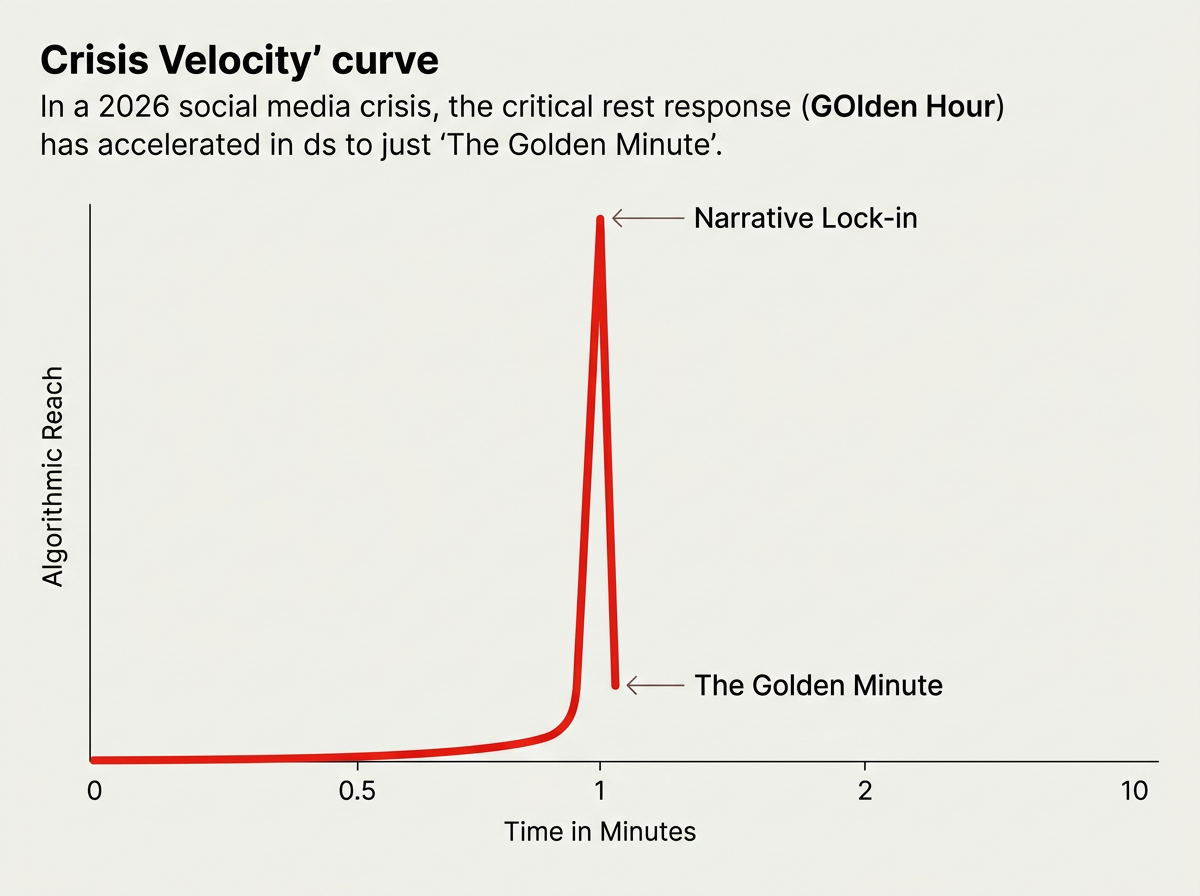
How long does your brand have before a single disgruntled TikTok video becomes a PR catastrophe that wipes millions off your market cap? In 2016, the industry spoke of the "Golden Hour"—that sixty-minute window to acknowledge an issue before it solidified in the public consciousness. By 2026, that window has shrunk to the "Golden Minute."
If you aren't active in the comments within sixty seconds of a viral spark, the algorithm has already decided the narrative for you. New research from MarTech Cube confirms that social media is now the primary channel for brand crisis response, surpassing traditional press releases and even direct email communications in perceived authenticity and effectiveness. This shift isn't just about speed; it's about the fundamental way platforms like TikTok and Instagram have rewritten the rules of attention.
TL;DR
- The Golden Hour is dead. You now have roughly 60 seconds to signal presence before a narrative is locked in by algorithmic weight.
- Social Intelligence is the engine. Monitoring must move from "listening" to "predictive sentiment analysis" using tools like Brandwatch or Sprinklr.
- Templates over drafts. Pre-approved, modular legal language is the only way to meet modern speed requirements without sounding like a robot.
- Algorithmic Agency. Users now have more control over their feeds (per Instagram's latest 'Your Algorithm' updates), meaning brands must earn their way back into favor through high-intent engagement.
The physics of a 2026 social media crisis
To understand why speed is the only remaining defense, we have to look at how information travels today. Think of a brand crisis like a forest fire. In the 2010s, the fire spread through the undergrowth—slow enough that you could see the smoke and call the fire department. In 2026, the fire is an atmospheric event. It’s lightning striking a dry field while a high-velocity wind (the algorithm) is already blowing.
When a creator posts a video criticizing your product—perhaps a wellness brand's supplement that didn't meet expectations, a sector eMarketer notes is currently racking up massive TikTok views [S1]—the platform's recommendation engine doesn't wait for a second opinion. It looks for immediate engagement signals. If that video gets 10,000 views and a 15% share rate in the first three minutes, it is pushed to millions. If your brand's voice is absent from the top-voted comments during that initial surge, you have effectively conceded the truth.
This is the decade that rewrote social media marketing [S2]. We have moved from a "broadcast and wait" model to a "participate or perish" reality. The mechanism of the crisis is no longer just the content of the complaint; it is the speed at which the platform's 'Your Algorithm' settings [S4] prioritize the conflict over the resolution.
The Social Intelligence Framework: Moving from listening to acting
Most brands use social listening tools to generate weekly reports. In a crisis, a weekly report is an autopsy. You need a social intelligence framework that functions like a nervous system. This requires a three-tier monitoring setup that differentiates between noise, friction, and fire.
Tier 1: The Baseline (Noise). This is your daily volume. You're looking for mentions of your brand, your TikTok Shop presence [S3], and general category sentiment.
Tier 2: The Friction. This is when sentiment dips by more than 15% within a rolling 60-minute window. This should trigger an automated Slack or Teams alert to the senior social lead. It’s not a crisis yet, but it’s the heat before the flame.
Tier 3: The Fire. When a high-authority account (verified or high-engagement creator) mentions a core brand vulnerability. This is the moment the "Golden Minute" clock starts.
Your monitoring stack—whether you're using Sprout Social's listening suite or Talkwalker's AI-assisted trend detection—must be configured to bypass the social media manager and go straight to the stakeholders who can authorize a response. You cannot afford a four-hour email chain between the agency and the legal department.
Legal-approved templates that don't sound like AI slop
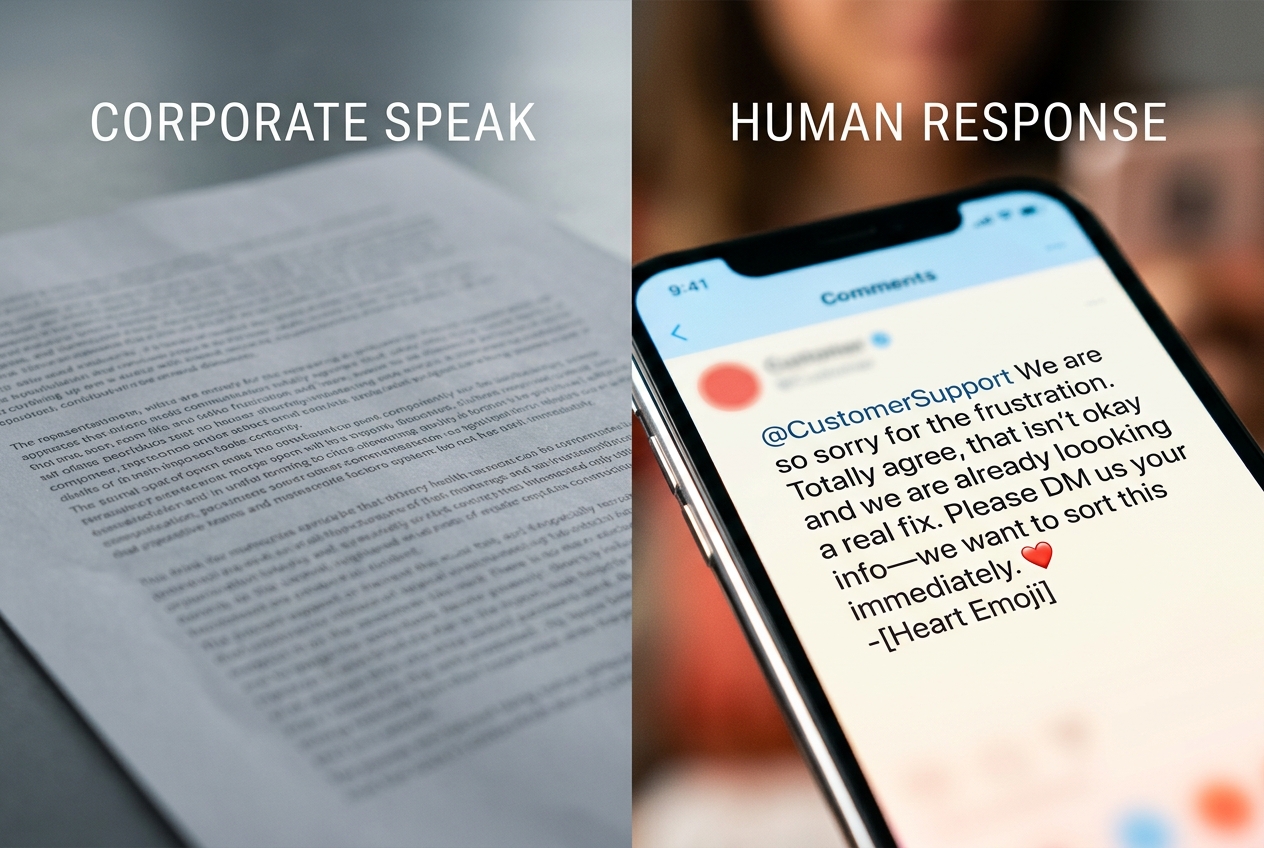
One of the biggest hurdles to the Golden Minute is the "Corporate Cringe" factor. When brands finally do respond, they often use language so sanitized and legalistic that it actually fuels the fire. Users can smell a ChatGPT-generated apology from a mile away.
To solve this, you need a library of "Modular Response Components." These are pre-approved phrases and stances that have been vetted by legal in peacetime so they can be deployed in wartime.
- The Acknowledgment: "We're seeing the reports about [Issue] and our team is looking into it right now. We'll have a specific update for you shortly."
- The Human Element: "We hear you, and we're frustrated too. This isn't the experience we want for our community."
- The Action: "If you're affected by [Issue], please DM us your order number so we can prioritize your fix."
Notice what's missing: "We take this very seriously" or "Your experience is important to us." These are hollow hedges. Instead, use active voice and direct address. If you are using TikTok Shop to expand abroad [S3], your response templates must also be localized. A response that works in the US might fail in the UK or Southeast Asia due to cultural nuances in how corporate accountability is perceived.
Navigating the Algorithmic Shift: Why 'Your Algorithm' matters
In mid-2026, Instagram and other platforms began testing features that allow users to customize their algorithm settings more aggressively [S4, S5]. This is a double-edged sword for crisis management. On one hand, users can choose to see less "negative" content; on the other, if your brand is flagged as a source of friction, you may be permanently muted by a significant portion of your audience.
This makes the first response even more critical. If your initial response is helpful, transparent, and highly engaged with, the algorithm is more likely to categorize the thread as a "resolution" rather than a "conflict." This determines whether the crisis stays within a niche community or breaks out into the general 'For You' or 'Discovery' feeds.
How the 2026 Instagram algorithm update changes reach
Case Study: The Wellness Brand Pivot
Consider a hypothetical wellness brand, "VitalFlow," which faced a crisis when a creator claimed their new Vitamin D gummies caused a rash. Per eMarketer's data on wellness brand volume [S1], VitalFlow was already under the microscope.
Instead of waiting for a lab report (which took 48 hours), VitalFlow’s social team responded within 90 seconds of the video hitting 5,000 views. Their comment: "We're pausing sales of this batch immediately while we investigate. If you have these, stop using them and DM us for a full refund + a prepaid label to send them back to our lab for testing. We need to get to the bottom of this."
By taking immediate, radical accountability, they turned the comment section from a lynch mob into a focus group. The creator even pinned the brand's comment. The crisis didn't end the brand; it built a new layer of trust. This is only possible when the social team has the agency to make high-stakes decisions without a committee.
Implementing the 2026 Crisis Framework tomorrow
What does this mean for your strategy? You need to move from a defensive posture to a proactive, intelligence-led one.
- Audit your alert latency. How long does it actually take for a viral negative post to reach the eyes of a decision-maker? If it's more than 10 minutes, your tech stack or your reporting chain is broken.
- Empower your social leads. Give your senior social managers a "Crisis Budget"—the authority to issue refunds, pause ads, or post acknowledgments without a C-suite sign-off for issues under a certain threshold.
- Test your templates. Run a "Red Team" exercise where you simulate a crisis and see how your pre-approved templates hold up. Do they sound like a person or a press release?
- Monitor the 'Algorithm Settings'. Stay updated on how platforms are allowing users to filter content. If your brand is caught in a crisis, you need to know if your "correction" is even being seen by the people who saw the "accusation."
5 Social Intelligence tools for 2026
Crisis management in 2026 is no longer about "managing" the media. It is about managing the math of the algorithm. Speed is the only variable you can control. If you lose the Golden Minute, you lose the narrative. If you lose the narrative, you lose the brand.

What to watch next
As AI-generated video becomes indistinguishable from reality, the next frontier of social media crisis management will be "Deepfake Defense." Brands will need to verify their own content and respond to synthetic crises with the same Golden Minute urgency. The infrastructure you build today for real-world friction will be the same infrastructure that saves you from the synthetic friction of tomorrow.
FAQ