
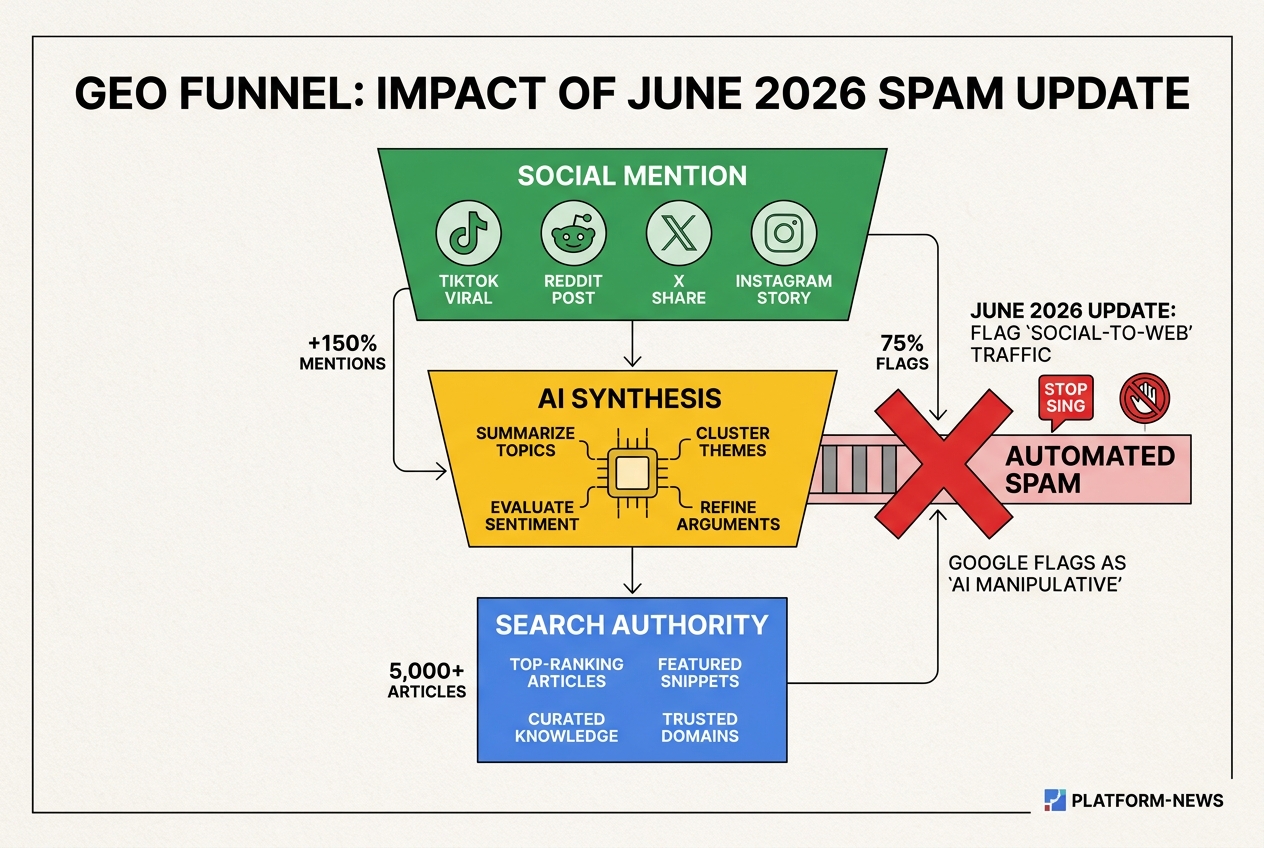
Google released its June 2026 Spam Update on June 27, introducing new detection mechanisms aimed at 'AI-manipulative' content that originates on social platforms to influence Search and AI Overviews. The update specifically targets brands using large-scale automated social posts to engineer synthetic brand mentions and drive traffic to thin, AI-generated landing pages.
For social media marketers, this isn't just an SEO problem—it's a distribution crisis. If your strategy relies on high-volume, AI-assisted posting to trigger 'trending' signals that Google’s crawlers pick up, you are now in the crosshairs. The platform is moving beyond simple text analysis to evaluate the intent behind social-to-web pipelines, potentially de-indexing sites that appear to be gaming the new Generative Engine Optimization (GEO) landscape.
TL;DR
- The Target: 'Synthetic authority' created by AI-generated social mentions intended to trick Google’s AI Overviews into citing a brand.
- The Penalty: Rapid loss of visibility in both traditional SERPs and AI-driven answer boxes; potential flagging of the domain as 'Manipulative Content'.
- The Fix: Shift from automated volume to 'verified human' signals and high-value, original research that AI cannot replicate.
The Crackdown on Brand Mention Engineering
Google’s June update represents a fundamental shift in how the search giant views the 'social signal.' For years, a spike in social mentions was a precursor to search visibility. However, as documented by Search Engine Journal, the line between earning a brand mention and engineering one is getting redrawn. The update targets what engineers call 'mention stuffing'—using AI to flood platforms like X (formerly Twitter) and LinkedIn with specific keywords to force a brand into a Google AI Overview.
Matt G. Southern noted in his analysis of the update that "enforcement is hard," but Google has improved its ability to identify patterns of non-human behavior. This isn't just about bots; it's about the 'marketing madness' seen in TikTok ad strategies where automated scripts generate thousands of variations of a single hook to see what sticks, as reported by MSN in late June. When these ads or organic posts link back to a site that lacks original depth, Google now classifies the entire journey as spam.
If you have been using tools to automatically comment on trending threads or generate 'summary' posts of your own articles, you are likely triggering these new filters. Google’s algorithm is looking for the 'delta' between the social hype and the on-site value. If the social post is a 10 in terms of engagement but the landing page is a 2 in terms of original information, the system flags it as a manipulative redirect.
Why Social Search Optimization is Changing
Social search optimization (SSO) has become the primary driver for Gen Z and Millennial discovery. But as brands move toward GEO (Generative Engine Optimization), they are falling into the trap of 'thin content.' The U.S. Chamber of Commerce emphasized in its 2025 guide that a social media plan must be step-by-step and grounded in brand pillars. Google’s June 2026 update effectively punishes those who skipped the 'pillars' and went straight to the 'automation.'
We are seeing a divergence in how social traffic is treated. Traffic coming from a verified creator with a long history of high-quality Reels—following the 'simple rules' of the Instagram algorithm as outlined by Mashable—is still treated as high-authority. Conversely, traffic from newly created accounts or accounts with a high ratio of AI-generated imagery and captions is being throttled.
Google is now cross-referencing the 'Social Tab' data—which, interestingly, is seeing more ad placement in Gmail as of June 25, per ALM Corp—with its main search index. If your brand is buying heavy social ads but your organic search footprint is nil, Google’s spam brain sees a red flag. It assumes the brand is trying to buy its way into the 'authority' conversation without the underlying content to support it.
The 'AI Manipulative' Label: What It Means for Your Brand
When Google flags a site as 'AI Manipulative,' it isn't just a temporary dip in rankings. It is a fundamental trust score reassessment. The June update introduces a 'Source Veracity' check. It asks: Is this brand being talked about by humans, or by other AI agents?
For social media managers, this means your community management is now an SEO function. Genuine replies, long-form discussions on Reddit or LinkedIn, and citations in reputable news outlets are the only way to counter the 'AI Manipulative' flag. If your brand mentions are coming from accounts that only post 24/7 or have no profile history, those mentions are now discounted—or worse, used as evidence of a spam campaign.
How to audit your social content for AI detection
Consider the impact on your paid social strategy. If you are using AI to generate 500 different ad creatives for a TikTok campaign, and those ads drive users to a landing page that was also generated by an LLM, you are creating a 'closed loop' of AI content. Google’s June update is designed to break that loop. It wants to see 'human-in-the-loop' evidence.
Strategic Pivot: Moving from Volume to Veracity
To survive the June 2026 update, you must change your success metrics. The era of 'more is more' in social posting is officially dead for SEO purposes. Instead, focus on the following three pillars of Veracity Marketing:
- Proprietary Data: AI can summarize, but it cannot conduct a survey or run a lab test. Publish original findings on your site and use social to discuss the implications of that data.
- Human-Centric Video: Google’s crawlers are increasingly adept at indexing video content. A video of a real person explaining a concept carries more weight than a text-based AI summary.
- Cross-Platform Consistency: Ensure your brand voice on social matches the technical depth of your website. A disconnect here is a primary signal for the new spam filters.

As Search Engine Journal highlighted, the enforcement of these rules is the new frontier. We expect to see a 'cooling off' period where brands that were previously dominating AI Overviews suddenly vanish. This isn't a glitch; it's the algorithm re-calibrating to find the human heart of the internet. You don't want to be the brand that gets left behind because you automated your way into a corner.
What to Watch Next: The Convergence of Search and Social
The most significant takeaway from the June 2026 update is that Google no longer views 'social' and 'web' as separate silos. The 'Social Tab' in Gmail and the 'Social' filters in Search are now part of a unified identity graph. If you are a social media manager, you are now an identity manager. Your job is to prove to the algorithm that your brand is a real entity with real people behind it.
Watch for further updates in Q3 that may target 'AI-generated video' on social platforms. As AI video tools become more prevalent, Google will likely apply the same 'manipulative' filters to Reels and TikToks that it currently applies to text. The goal remains the same: rewarding content that provides a unique perspective, not just a rehash of what already exists.
[INTERNAL: The rise of video-first SEO in 2026 -> video-seo-trends]
In the coming weeks, monitor your Search Console 'Manual Actions' and 'Security Issues' reports. While this update is algorithmic, extreme cases of mention engineering have resulted in manual reviews. If your social-to-web traffic drops by more than 30% in a week, it’s time to audit your automation tools and return to a manual, high-touch content strategy. The shortcut is now the long way around.
FAQ