
How do you maintain a 1:1 human connection when your brand is actually 150 regional sub-accounts, three global regions, and a fleet of 500 employee advocates? This is the central tension of enterprise social media strategy. You're told to be 'authentic' and 'responsive,' yet the sheer physics of managing a global footprint requires automation. Most brands fail here because they treat automation as a megaphone—a way to blast the same corporate PDF-style graphic to every corner of the internet simultaneously.
Scaling social media content successfully isn't about increasing your post frequency. It is about building a system of high-velocity approvals and modular templates that allow a local manager in Berlin to sound just as on-brand as the CMO in New York, without waiting 48 hours for a legal review. Since Meta deprecated CrowdTangle in August and platform algorithms increasingly favor 'originality' over syndicated corporate noise, the cost of being robotic has never been higher.
TL;DR
- Shift from syndication to modularity: Stop pushing identical posts; start pushing 'Lego-brick' assets that local teams can customize.
- The 'Hub-and-Spoke' Governance: Centralize the high-risk assets (legal, brand identity) but decentralize the execution (engagement, local context).
- Automated Guardrails: Use tools like Brandwatch or Sprinklr to bake compliance into the workflow rather than making it a manual bottleneck.
- Measurement Realignment: Move beyond visibility metrics to unified attribution, especially as Nielsen’s $2B DoubleVerify deal (August 2026) signals a shift toward more rigorous independent measurement.
The Modular Asset Library: Moving Beyond the Static DAM
Traditional Digital Asset Management (DAM) systems are where social media content goes to die. They are archives, not engines. For an enterprise social media strategy to scale, you need a dynamic library—a system where assets are broken down into components rather than finished files. Think of it like a restaurant kitchen. You don't ship a fully cooked steak across the country; you ship the pre-prepped ingredients and a precise recipe so the local chef can finish it fresh.
In practice, this means your central creative team isn't producing 'Post_v3_Final.mp4'. They are producing a 'Creative Kit' that includes a B-roll background, three approved text overlays, a specific color LUT (Look-Up Table), and a set of localized captions. When a regional manager in Singapore opens their dashboard, they aren't just hitting 'Share.' They are selecting the 'Trust' theme, picking the local customer testimonial, and the system automatically wraps it in the brand’s visual identity.
This approach solves the 'dilution' problem. Brand voice is diluted when local teams, starved for content, create their own low-quality graphics in Canva. By providing a 'sandbox' of approved parts, you give them the autonomy they crave with the guardrails you require. This is the difference between being a gatekeeper and being an enabler. If you want to scale, you must stop being the bottleneck and start being the infrastructure.
The Governance Framework: Rules That Don't Kill Creativity
Brand governance is often viewed as the 'Department of No.' In a high-scale social environment, that attitude is a liability. According to recent industry shifts, brands that demonstrate high responsiveness see a 20% higher retention rate, but you can't be responsive if every tweet requires a VP's signature. You need a tiered governance framework that categorizes content by risk.
- Green Tier (Low Risk): Daily engagement, responding to mentions, and sharing user-generated content (UGC). These actions should be fully decentralized to local managers with zero prior approval required, provided they stay within a pre-defined 'Voice & Tone' guide.
- Yellow Tier (Medium Risk): Product launches, regional campaigns, and influencer partnerships. These require a 'peer-review' or a single-manager sign-off within a tool like Sprout Social or Khoros.
- Red Tier (High Risk): Crisis communication, financial disclosures, and global brand pivots. These remain centralized and require multi-stakeholder approval.
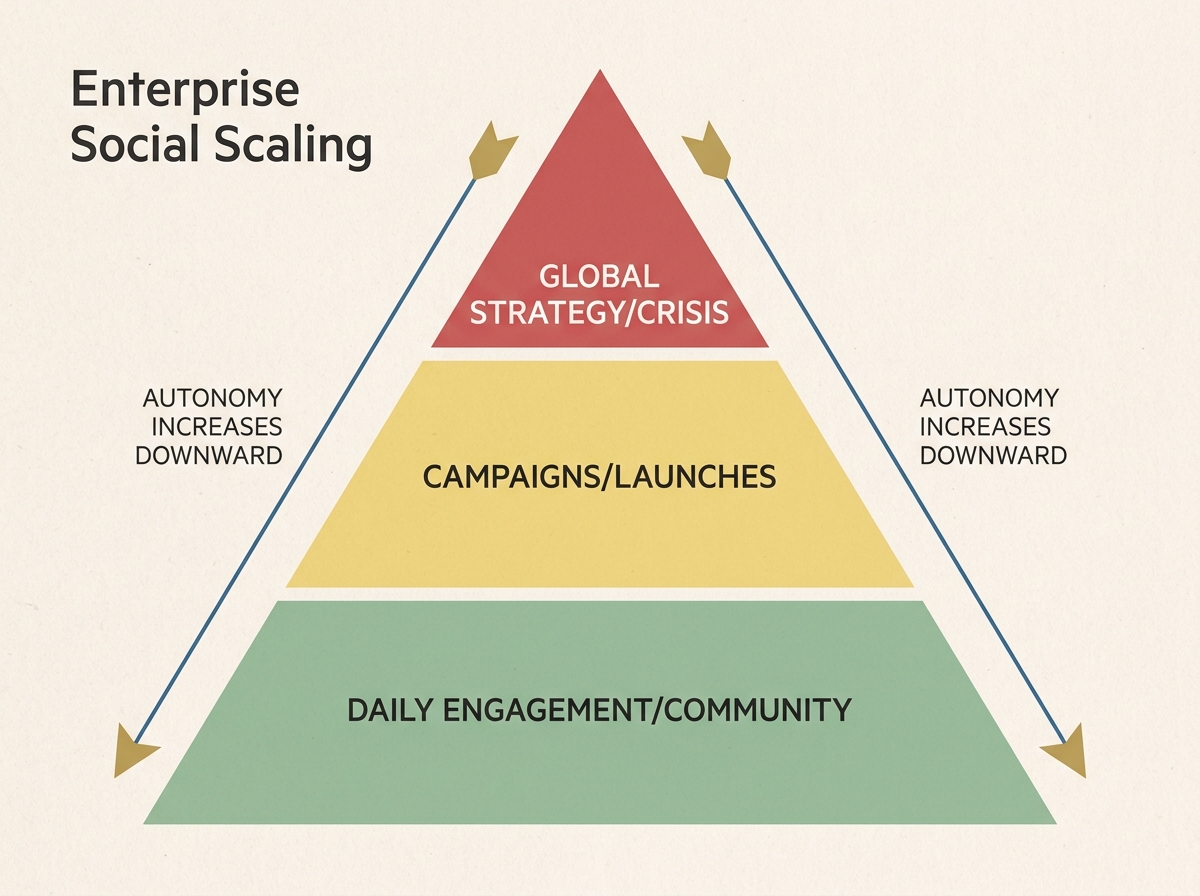
By automating the routing of these tiers, you remove the friction. A 'Green Tier' response doesn't sit in an inbox; it goes live. This allows your brand to maintain that 1:1 human feel. It feels human because it is human—you've just used automation to clear the administrative brush out of the way so your social media managers can actually talk to people.
Automation as a Safety Net, Not a Ghostwriter
We have to address the AI elephant in the room. Many enterprise social media strategy decks are currently obsessed with 'generative AI' for caption writing. This is a mistake. AI-generated captions are the fastest way to sound like a commodity. Instead, use social media automation tools for the invisible work.
Use automation for 'Smart Routing.' If a customer mentions a technical glitch on X (formerly Twitter), automation should instantly tag that post, sentiment-score it, and route it to the specific engineering Slack channel. Use it for 'Auto-Moderation' to hide spam or toxic comments before a human even has to see them. Use it for 'Dynamic Scheduling'—not just setting a time, but using an algorithm to analyze when your specific audience in the UK is most active compared to your audience in Brazil.
When you automate the logistics, you free up the humans to do the one thing machines can't: exercise judgment. A machine can't tell you if a trending meme is 'too soon' after a tragic news event. A machine can't understand the subtle sarcasm in a customer's 'thanks for nothing' tweet. By scaling the systems, you preserve the brand voice for the moments where it matters most.
How AI is shifting social listening workflows
The Measurement Crisis: Proving Value at Scale
Scaling social media content is an expensive endeavor. If you are running 50+ accounts, your SaaS bill and headcount are significant. The problem, as noted by Revista Merca2.0 in August 2026, is that while social generates visibility, demonstrating direct sales remains the 'white whale' of marketing.
In an enterprise environment, you cannot rely on platform-native analytics. They are 'walled gardens' designed to make the platform look good. You need a unified attribution model. This is why the Nielsen-DoubleVerify deal is so critical for the industry; it signals a move toward independent, third-party verification of reach and impact.
To scale effectively, you need a 'Common Data Language' across all 50 accounts. If the London team defines an 'engagement' differently than the Tokyo team, your global reporting is useless. Automation tools should be configured to normalize this data into a single dashboard. This allows you to see, for example, that 'Educational Video' content has a 3x higher conversion rate in B2B segments across all regions, allowing you to shift budget globally in real-time. This is the 'scenic route' to ROI—understanding the non-linear path a customer takes from seeing a Reel to eventually signing an enterprise contract.

Localized Execution: The 'Last Mile' of Social Scaling
Why does a global brand like Nike or Starbucks feel local? Because they understand the 'Last Mile.' Scaling social media content doesn't mean the content is the same everywhere; it means the quality is the same everywhere.
You must empower your local 'spokes' to add the final 10% of context. If there is a local holiday in Italy, the Italian sub-account should be the one leading that conversation, not a global handle using a translated template. Automation should be used to 'push' the core assets to the local team, but the local team should have the 'edit' rights to make it land.
This requires a shift in how we hire for social. We no longer need 'posters'; we need 'community strategists' who can take a global framework and make it feel like it was born in their city. The tools are there to handle the 90% of the work that is repetitive. The human is there for the 10% that is irreplaceable.
[INTERNAL: Building a creator-led enterprise strategy -> creator-economy-for-brands]
What This Means for Your Strategy Tomorrow
If you are currently managing an enterprise social footprint, your first step isn't to buy a new tool. It is to audit your 'Time to Live.' How long does it take for a great idea to become a public post? If the answer is longer than 4 hours, your systems are failing you.
Start by building a 'Modular Component Library.' Stop thinking in 'Posts' and start thinking in 'Assets.' Create a governance document that actually gives people permission to speak. And finally, look at your measurement. If you can't see all 50 accounts in one view with normalized data, you aren't scaling—you're just getting bigger. There is a very expensive difference between the two.
As we move toward the end of 2026, the brands that win won't be the ones with the biggest budgets, but the ones with the most efficient systems. They will be the ones who realized that automation isn't a way to replace the human voice, but a way to amplify it without losing its soul. Success in scaling social media content is found in the balance: global standards, local flavor, and a system that makes both possible at the speed of the feed.
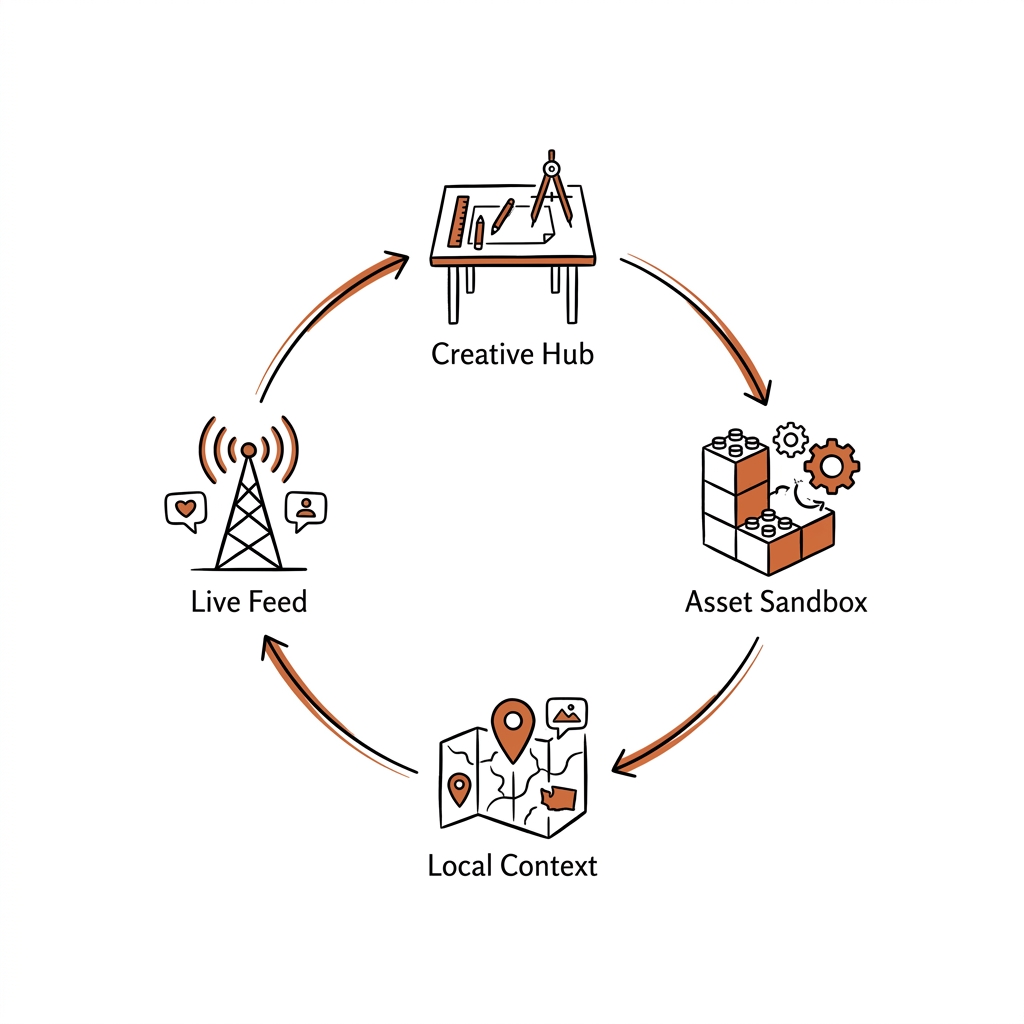
Scaling is a marathon of infrastructure. By implementing these five frameworks—modular libraries, tiered governance, logistic automation, unified measurement, and localized execution—you move from a chaotic collection of accounts to a unified brand presence that can weather any algorithm shift or market change.
FAQ