
Ana Kostic recently highlighted a scenario that keeps every performance marketing lead awake at night: an e-commerce brand followed every platform-suggested 'best practice' and watched their revenue plummet by 40% in a single quarter. This wasn't a failure of creative or a shift in market demand. It was a failure of automation—specifically, the blind acceptance of platform-driven optimizations that prioritize volume over value.
Why it matters: If you're relying on Google's 'Auto-apply' recommendations or Meta's 'Advantage+' default settings without rigorous oversight, you aren't just saving time; you're likely subsidizing the platform's inventory at the expense of your bottom line.
Key takeaways
- Automation is a floor, not a ceiling: Platform recommendations are designed to maximize spend and reach, which rarely aligns perfectly with a brand's specific ROAS targets.
- The Cannibalization Trap: Settings like 'Display Expansion' and 'Search Partners' often siphon budget away from high-intent search terms toward low-quality placements.
- Attribution Blindness: Automated campaigns often take credit for brand-term conversions that would have happened organically, masking a net loss in incremental revenue.
The Setup: A Brand Trapped in the Efficiency Paradox
Before the 40% revenue drop, the brand in question was a mid-market apparel retailer with a healthy $150,000 monthly ad spend. They were managed by an agency that prided itself on 'platform-native' strategies. This meant a heavy reliance on Google's Optimization Score and Meta's automated placements.
On paper, the account looked perfect. The Google Ads Optimization Score was a pristine 94%. Meta's Advantage+ campaigns were fully scaled. The agency's reports showed 'efficient' CPAs and high click-through rates. However, the internal Shopify dashboard told a different story. While the ad platforms claimed record-breaking attributed revenue, the total bank account balance was shrinking.
This is the efficiency paradox: your ads look like they are winning because they are capturing the 'easiest' conversions—people who were already searching for your brand name or who had already visited your site three times. By allowing the algorithms to optimize for 'conversions' without constraints, the brand was paying a premium for traffic they already owned.
The Strategy: Reclaiming Control from the Black Box
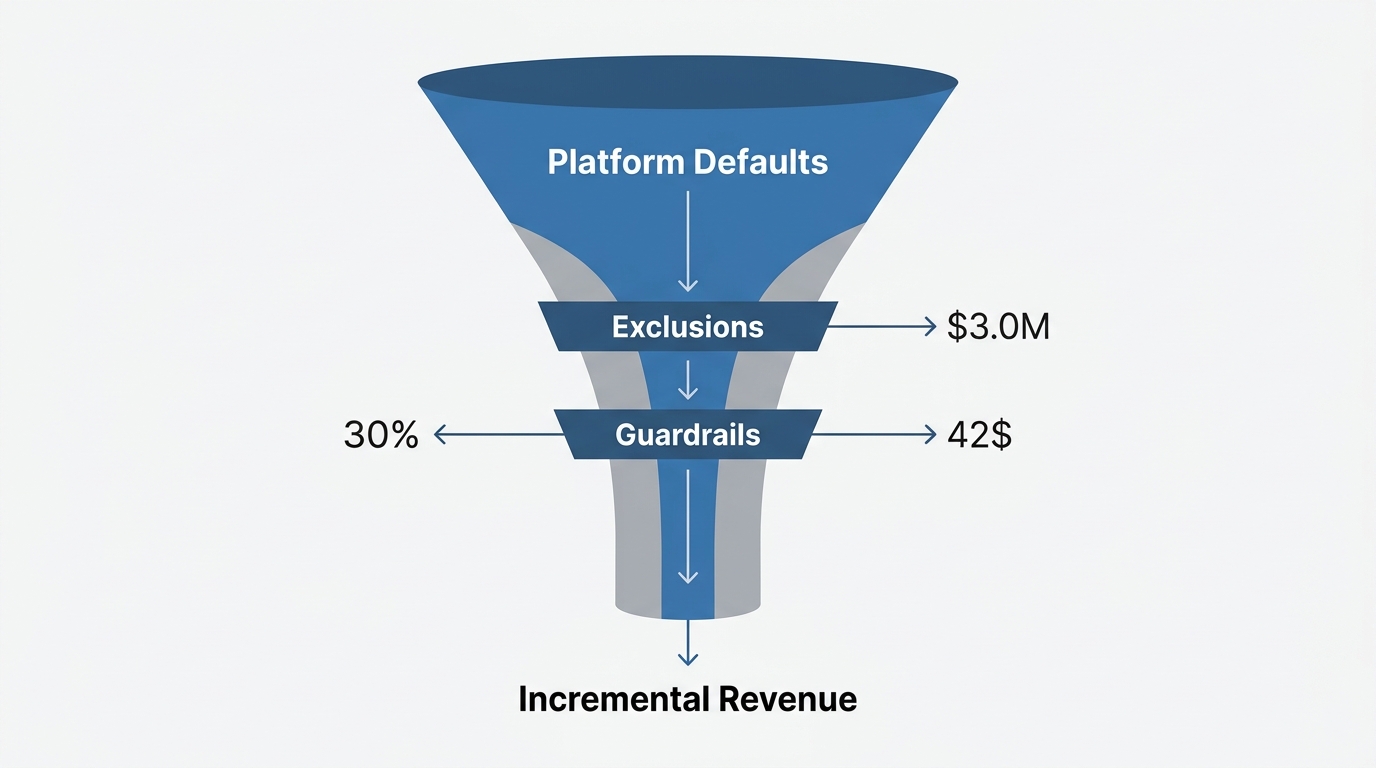
To reverse the slide, the team had to systematically dismantle the 'best practices' that were bleeding the account. This wasn't about moving back to manual bidding for every keyword, but about setting the guardrails that the platforms intentionally leave open.
1. The Great 'Auto-Apply' Purge
Google Ads has a feature that allows the platform to automatically implement recommendations. While this sounds helpful, it often includes adding 'Broad Match' versions of your high-performing 'Exact Match' keywords. In this case, Google had introduced thousands of broad terms that were technically related to the product but lacked any purchase intent.
We disabled all 14 'Auto-apply' categories, specifically targeting 'Remove redundant keywords' and 'Add segments of your audience.' This stopped the algorithm from constantly shifting the goalposts of what a 'good' keyword looked like.
2. Quarantining Brand Search
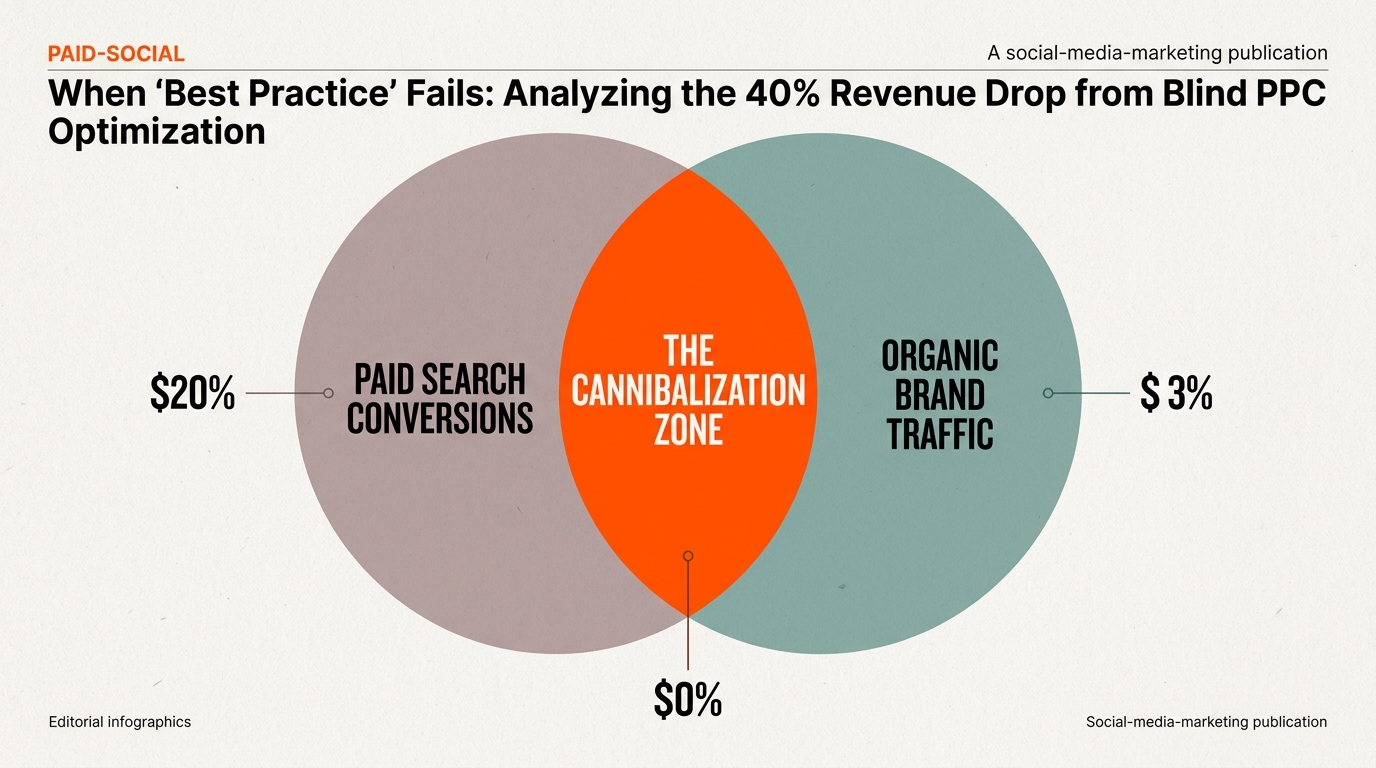
One of the biggest drivers of the 40% revenue drop was 'Brand Cannibalization.' The automated campaigns were bidding aggressively on the brand's own name. While this yields a high ROAS on paper, it provides zero incremental value if the user was going to click the top organic result anyway.
We implemented a strict brand-exclusion list across all Performance Max and Advantage+ campaigns. We then moved brand search into a dedicated campaign with a capped budget and a high ROAS target. This forced the automated 'prospecting' campaigns to actually find new customers rather than just poaching existing ones.
3. Killing the 'Display Expansion' Leak
Google's 'Display Expansion' for search campaigns allows your text ads to show on the Google Display Network when there is leftover budget. For this brand, this setting was eating 15% of the search budget but producing a 0.02% conversion rate. The traffic was almost entirely 'fat-finger' clicks from mobile apps and gaming sites.
We audited the 'Placements' report—a step many modern marketers skip—and found that the brand's ads were appearing on 'flashlight' apps and low-tier kids' YouTube channels. By disabling Display Expansion and Search Partners, we instantly redirected $22,000 a month back into high-intent search queries.
The Execution: A 90-Day Reconstruction
The recovery didn't happen overnight. Changing these settings causes a temporary 'learning' phase where performance can dip further. We followed a phased rollout to stabilize the account.
- Month 1: Audit and Exclusion. We spent the first 30 days identifying the waste. We used tools like Optmyzr to visualize where the PMax budget was actually going. We found that 60% of the 'prospecting' budget was actually hitting retargeting audiences.
- Month 2: Structural Pivot. We shifted to a 'Hagakure' or 'Simplified' account structure but with manual overrides. We consolidated 40 tiny ad groups into 4 large ones to give the algorithm enough data to learn, but we kept match types restricted to 'Phrase' and 'Exact' for the core 20% of revenue-driving terms.
How to audit your Performance Max spend
- Month 3: Creative Diversification. Once the technical leaks were plugged, we addressed the creative. Automation loves to repeat what works, which leads to creative fatigue. We introduced 15 new video assets for Meta, focusing on 'problem-solution' hooks rather than just lifestyle imagery.
The Results: Beyond the Platform Dashboard
By the end of the 90-day period, the metrics shifted in a way that the agency's previous 'best practice' approach never could have achieved.
| Metric | Before (Blind Automation) | After (Strategic Control) | Change |
|---|---|---|---|
| Monthly Revenue | $410,000 | $585,000 | +42.6% |
| Blended ROAS | 2.4x | 3.8x | +58.3% |
| New Customer Acquisition | 18% | 44% | +144% |
| Avg. CPC | $0.85 | $1.20 | +41.1% |
Wait—why did the CPC go up? Because we stopped buying cheap, worthless clicks from the Display Network and started bidding competitively for the high-intent keywords that actually convert. This is the most important lesson: low CPC is often a sign of waste, not efficiency.
Lessons for Your Readers: How to Avoid the 40% Trap
You don't need to wait for a revenue crash to fix your account. Apply these three principles tomorrow to ensure your 'best practices' aren't just platform-sanctioned waste.
1. Audit your 'Search Partners' and 'Display Expansion' immediately
Go to your Google Ads 'Campaigns' view, click 'Segment,' and select 'Network (with search partners).' If your conversion rate on Search Partners is significantly lower than on Google Search, turn it off. The same applies to Display Expansion. These are 'opt-out' settings for a reason—they benefit Google's inventory clearance more than your ROI.
2. Force your 'Prospecting' to actually prospect
If you use Meta Advantage+ Shopping Campaigns (ASC) or Google PMax, you must use the 'Existing Customer' exclusion features. Without them, the algorithm will naturally gravitate toward your past purchasers because they are the most likely to click and convert, making the algorithm look 'smart' while your business stagnates.
3. Treat 'Optimization Score' as a suggestion, not a KPI
Google's Optimization Score is a measure of how well you are following Google's rules, not how much money you are making. A score of 70% with a 5.0x ROAS is infinitely better than a score of 100% with a 2.0x ROAS. Never 'Apply All' just to see the blue bar hit 100%.
[INTERNAL: Why high-intent search is making a comeback in 2025 -> search-marketing-trends]
What to Watch Next
As we move further into the 'Black Box' era of advertising, the role of the media buyer is shifting from 'operator' to 'auditor.' You are no longer just pulling levers; you are the person who ensures the machine isn't hallucinating success.
Platforms like Snapchat are already shifting away from AI-generated content in favor of human authenticity (per Search Engine Journal's August report), and we expect a similar 'human-centric' correction in PPC management. The brands that win won't be the ones with the best automation, but the ones with the best constraints on that automation.

Your next step: Run a 'Script' in Google Ads to see exactly how much of your PMax spend is going to 'Other' (unclassified) placements. If it's more than 15%, you're likely in the middle of a revenue leak you haven't noticed yet.
FAQ