
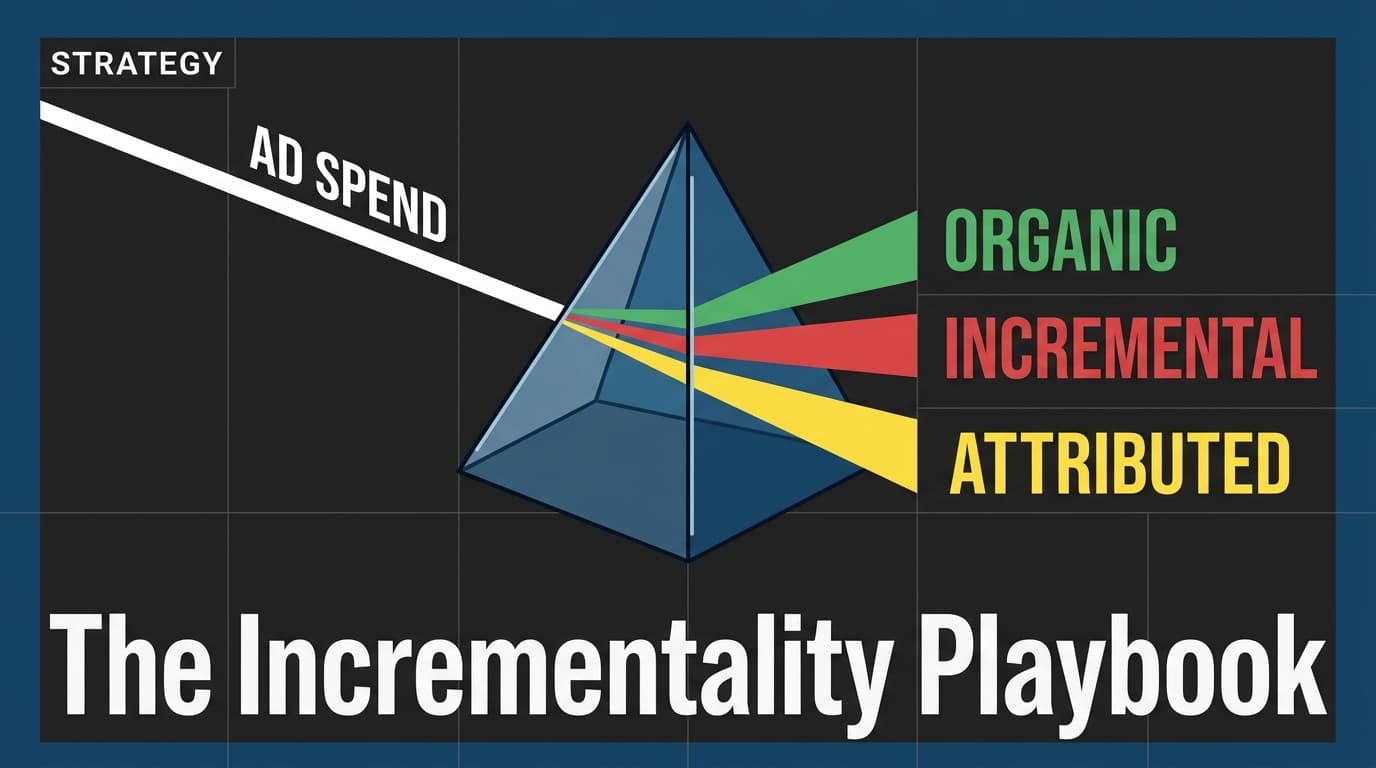
If you are still relying solely on the Meta Ads Manager 7-day click attribution window to justify your budget, you're operating on borrowed time. The industry’s shift toward privacy—accelerated by the deprecation of third-party cookies and the lingering shadow of Apple’s AppTrackingTransparency (ATT)—has rendered last-click and even multi-touch attribution (MTA) fundamentally incomplete. We are now in the era of incrementality: the practice of measuring only the conversions that would not have happened without your ads.
But here is the trap: many sophisticated brands have swung too far. In a quest for "pure" data, they over-test, keeping 10-20% of their audience in permanent holdout groups, effectively burning potential revenue to prove a point. According to recent industry benchmarks, over-testing can lead to a 5-8% drag on annual revenue for high-growth D2C brands. Conversely, under-testing leads to the 'zombie ad spend' phenomenon, where brands continue to fund retargeting campaigns that merely claim credit for organic behavior.
This playbook provides a rigorous framework for when to lean into incrementality testing and, crucially, when to stop and let the algorithms run.
TL;DR: Key Takeaways
- Test for Decision-Making, Not Validation: Only run a lift study if the results will change your budget allocation. If you won't cut the spend regardless of the result, don't waste the reach on a holdout.
- The 10% Threshold: Aim for a minimum of 10% expected lift to achieve statistical significance in standard 28-day windows. Anything lower often gets lost in the noise of platform volatility.
- Retargeting is the Primary Target: Always prioritize testing mid-to-bottom funnel campaigns where the risk of 'organic poaching' is highest.
- Hybrid Measurement is Mandatory: Use incrementality to calibrate your Marketing Mix Modeling (MMM) and daily platform reporting.
The Hierarchy of Evidence: Why Incrementality Wins
To understand why we test, we have to acknowledge the failure of the pixel. When a user sees an ad for a gummy vitamin brand like AG1 or Grüns—both currently fighting for shelf and digital space as noted in recent Adweek analysis—and then buys three days later via a direct search, Meta wants the credit. The pixel sees the view; the browser sees the click. But did the ad cause the purchase, or was the user already on their way to the checkout page?
Incrementality testing (specifically Randomized Control Trials or RCTs) is the only way to answer this. By splitting your audience into a 'Test' group (sees ads) and a 'Control' group (never sees ads), you isolate the causal impact.
The Three Tiers of Social Measurement
- Platform Attribution (The 'What'): Real-time, granular, but biased. Great for creative optimization but terrible for budget justification.
- Incrementality / Lift Studies (The 'Why'): Causal and clean, but slow and expensive. These are your 'ground truth' calibration points.
- Marketing Mix Modeling (The 'Total'): Top-down view that accounts for external factors like seasonality or economic shifts.
You cannot manage a $10M+ annual social budget without all three working in concert. If your Meta ROAS is 4.0x but your incrementality study shows a lift of only 1.5x, your 'True ROAS' is the latter. That gap is your baseline—the sales that would have happened anyway.
When to Initiate a Paid Social Holdout Test
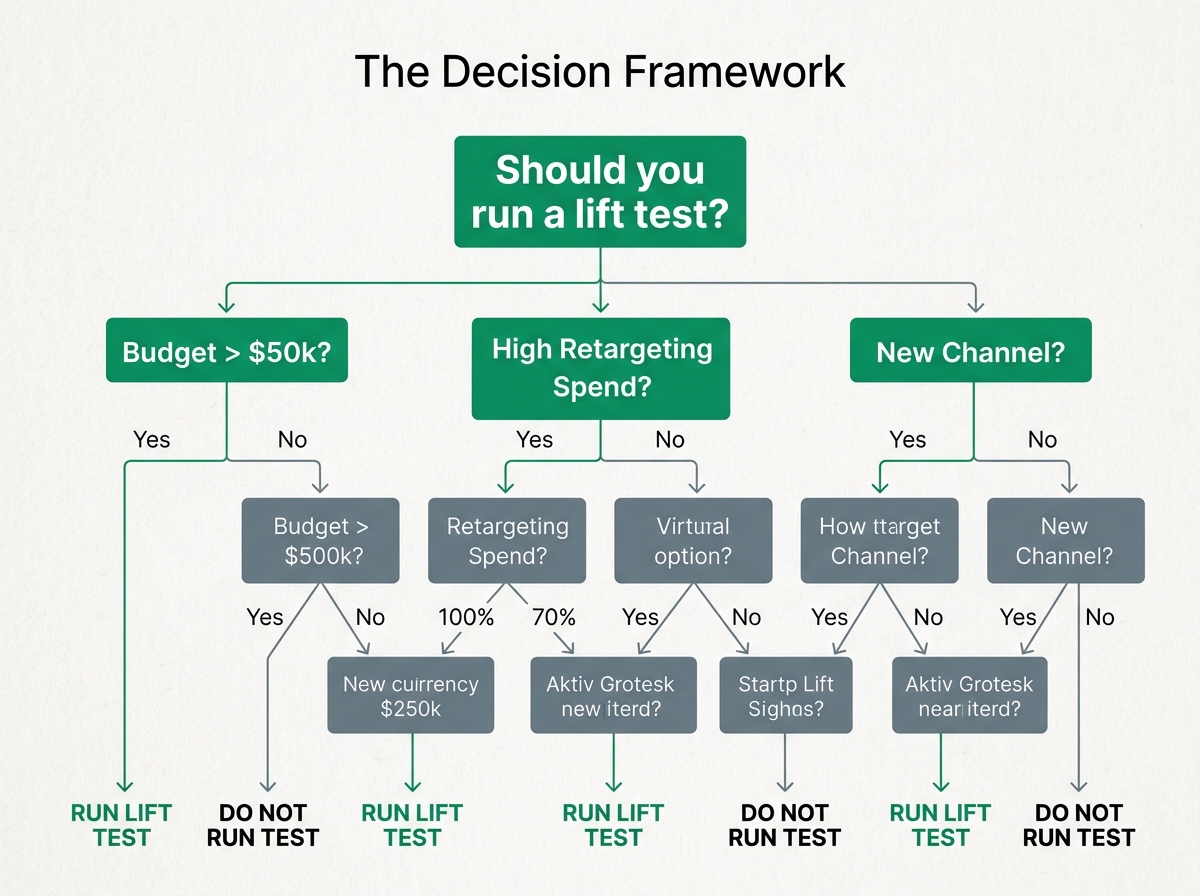
Not every campaign deserves a lift study. In fact, for most small-to-mid-sized accounts, the 'signal-to-noise' ratio is too low to get a readable result. You need volume. Per Meta’s internal documentation, a standard Conversion Lift study usually requires at least 500-1,000 conversions within the test period to reach a 95% confidence level.
Scenario A: The Retargeting Audit
If your retargeting (DABA/DPA) spend accounts for more than 30% of your total social budget, you must test. Retargeting is notorious for high 'claimed' ROAS and low incrementality. You are often paying to reach people who already have your product in their cart. A 14-day holdout test here can reveal if you can cut spend by 20% without losing a single dollar in bottom-line revenue.
Scenario B: The New Channel Entry
When expanding from Meta to TikTok or Pinterest, the 'halo effect' is real but hard to quantify. Running a geo-match lift test (where specific cities receive ads and others don't) during the first 60 days of a TikTok launch prevents the common mistake of over-attributing success to the new platform while Meta’s performance appears to dip due to click-cannibalization.
Scenario C: The Scaling Ceiling
If you have increased spend by 50% but your total company revenue has only grown by 5%, your platform-reported ROAS is lying to you. This is the 'Diminishing Returns' wall. An incrementality test here will show you the marginal cost per incremental conversion—often a much scarier number than the blended CPA shown in Ads Manager.
How to Structure the Test: A Technical Workflow
Modern platforms have made this easier, but the 'default' settings are often designed to favor the platform. Here is how to set up a rigorous test on Meta or TikTok.
1. Define Your Test Cells
Do not just test 'Ads vs. No Ads.' That is too broad. Instead, test specific strategies.
- Cell 1 (Control): 10% of your target audience. They receive no impressions from your brand.
- Cell 2 (Broad/Advantage+): 45% of the audience. Lean into the algorithm's power.
- Cell 3 (Interest/Lookalike): 45% of the audience. The manual approach.
2. The Ghost Ad vs. Intent-to-Treat
Most platforms use 'Intent-to-Treat' (ITT) modeling. They track the control group as if they would have seen the ad. This is generally sufficient for social, but if you are using a third-party tool like Haus or Measured, you might use 'Ghost Bids' to more accurately track the cost of the impressions you didn't buy.
3. Minimum Viable Duration
Never run a lift test for less than 14 days. You need to account for the full conversion cycle. If your product has a high consideration period (like luxury furniture or B2B software), you may need 28 or even 60 days. Stopping early leads to 'false negatives' where the lift hasn't had time to manifest.
Interpreting the Data: The 'So What?' Factor
Once the test concludes, you will receive a 'Lift Percentage' and a 'Confidence Level.'
| Metric | Definition | Actionable Threshold |
|---|---|---|
| Incremental Conversions | The raw number of sales caused by ads. | Should be >10% of total conversions. |
| Causal ROAS | Total Incremental Revenue / Total Spend. | If this is below your break-even, cut spend. |
| Conversion Lift | The % increase in the test group vs control. | Aim for 95% statistical significance. |
If your lift is 'Not Statistically Significant,' it does not mean your ads aren't working. It means the test was underpowered. You either didn't spend enough, didn't run it long enough, or your control group was too small. In this case, do not make drastic budget cuts. Instead, refine your creative testing framework to increase the 'thumb-stop' impact, which usually drives higher lift.

The Dangers of Perpetual Testing
There is a cost to knowledge. Every person in your control group is a potential customer who isn't buying. If you run a 10% holdout on a campaign that generates $1M in monthly revenue with a 2.0x iROAS (incremental ROAS), you are effectively 'burning' $100,000 in potential monthly revenue just to maintain the study.
When to stop testing:
- The Baseline is Established: Once you know that your Broad Prospecting campaigns consistently deliver a 1.8x iROAS, stop testing for 6 months. Use that 1.8x as a 'multiplier' for your daily reporting.
- Creative Fatigue: Lift studies are highly dependent on creative quality. If you haven't refreshed your ads in 3 months, your lift study is measuring the decay of your creative, not the effectiveness of the channel.
- High Seasonality: Do not run lift tests during Black Friday/Cyber Monday (BFCM). The noise from other channels and the extreme shift in consumer behavior will skew your baseline, making the data useless for the rest of the year.
Calibrating Your Marketing Mix Model (MMM)
Incrementality tests should not live in a vacuum. Their primary job is to 'anchor' your MMM. While the MMM looks at the last two years of data to predict future performance, the lift study provides a real-time 'pulse check.'
If your MMM says Meta's contribution is 20%, but your latest lift study says it's 35%, you need to investigate. Often, this indicates that Meta is driving significant 'view-through' value that the MMM's regression analysis is missing. Use the lift study results to adjust the 'priors' in your model, ensuring your budget forecasting is grounded in reality.
Troubleshooting Common Experimentation Errors
Even the most seasoned strategists at agencies like True North Social (recently highlighted by The Manila Times for their digital presence expansion) run into 'dirty' data.
Issue: Selection Bias If you are running a lift test on a specific 'Lookalike' audience but not on your 'Broad' audience, you cannot apply the findings of one to the other. Incrementality is audience-specific. A 1% Lookalike of past buyers will almost always have lower incrementality than a Broad audience because the Lookalike is already 'pre-conditioned' to buy.
Issue: Cross-Channel Contamination If you run a heavy YouTube campaign at the same time as a Meta lift study, your control group (who isn't seeing Meta ads) might still see your YouTube ads. This 'inflates' the control group's performance and makes your Meta ads look less effective.
The Fix: Coordinate your testing calendar. If you are testing Meta, keep your spend on other channels 'flat' for the duration of the test. No new launches, no budget spikes, no massive influencer drops.
Advanced Strategy: Multi-Cell Creative Testing
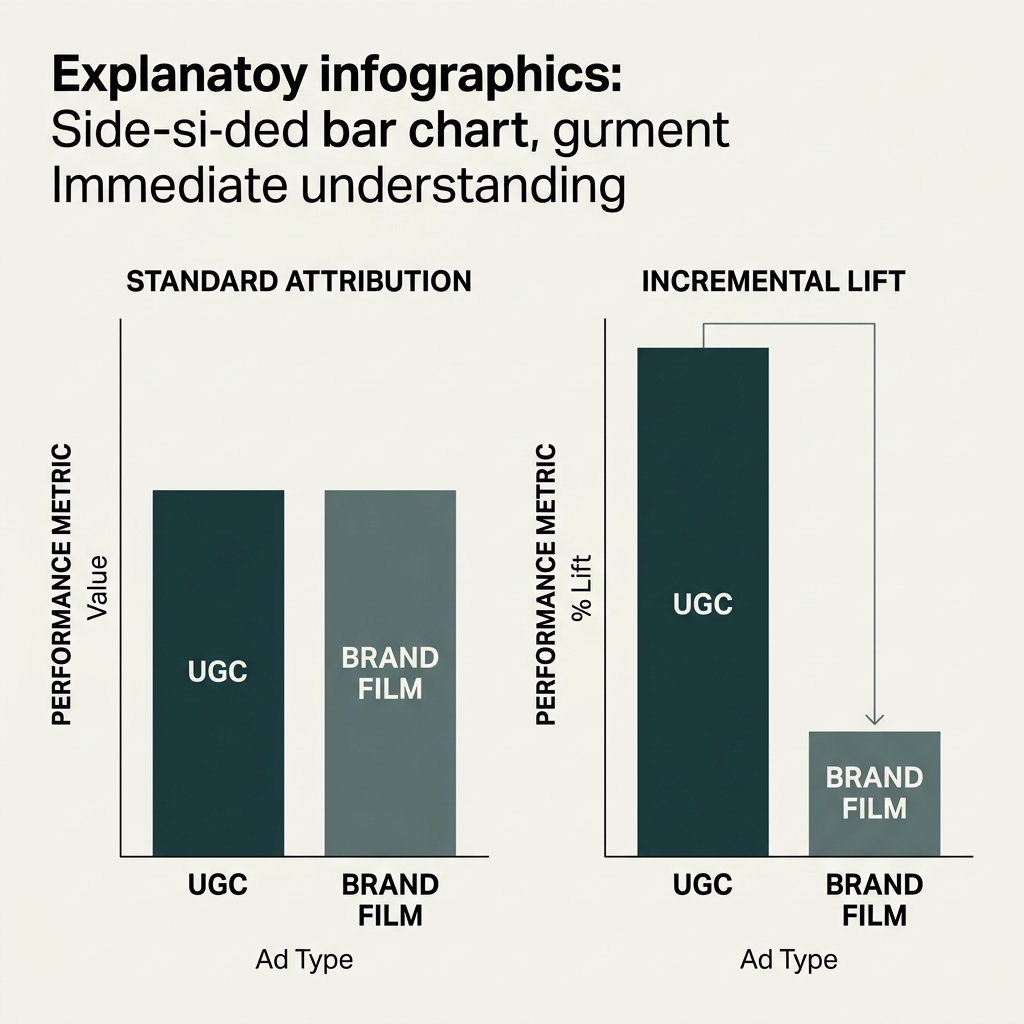
Once you have mastered the basic holdout, move to 'Creative Incrementality.' This involves testing two different creative directions against a single control group.
For example, does 'User-Generated Content (UGC)' drive more incremental sales than 'High-Production Brand Film'? Often, the Brand Film drives more total clicks, but the UGC drives higher lift because it builds trust with people who were previously skeptical of the brand. This insight is invisible in standard Ads Manager reporting but becomes clear in a three-cell lift study.
Final Checklist for Your Next Lift Study
Before you hit 'Start' in the Meta Experiments tool or TikTok's Lift Center, ensure you can check these four boxes:
- Hypothesis: "I believe our Advantage+ Shopping campaign is over-valuing existing customers, and a lift study will show an iROAS 30% lower than reported."
- Threshold: "If the iROAS is above 1.5, we will increase budget by 20%. If it is below 1.0, we will pivot spend to TikTok."
- Clean Window: No major site sales or product launches are scheduled for the next 21 days.
- Power: We have at least $25,000 in planned spend for the test cell to ensure we hit the conversion minimums.
Incrementality isn't a one-time project; it's a muscle. By systematically testing, learning, and then stopping to implement those learnings, you move from being a 'platform spender' to a true growth architect. Don't let the platforms grade their own homework—but don't spend so much time grading that you forget to teach the class.
FAQ