


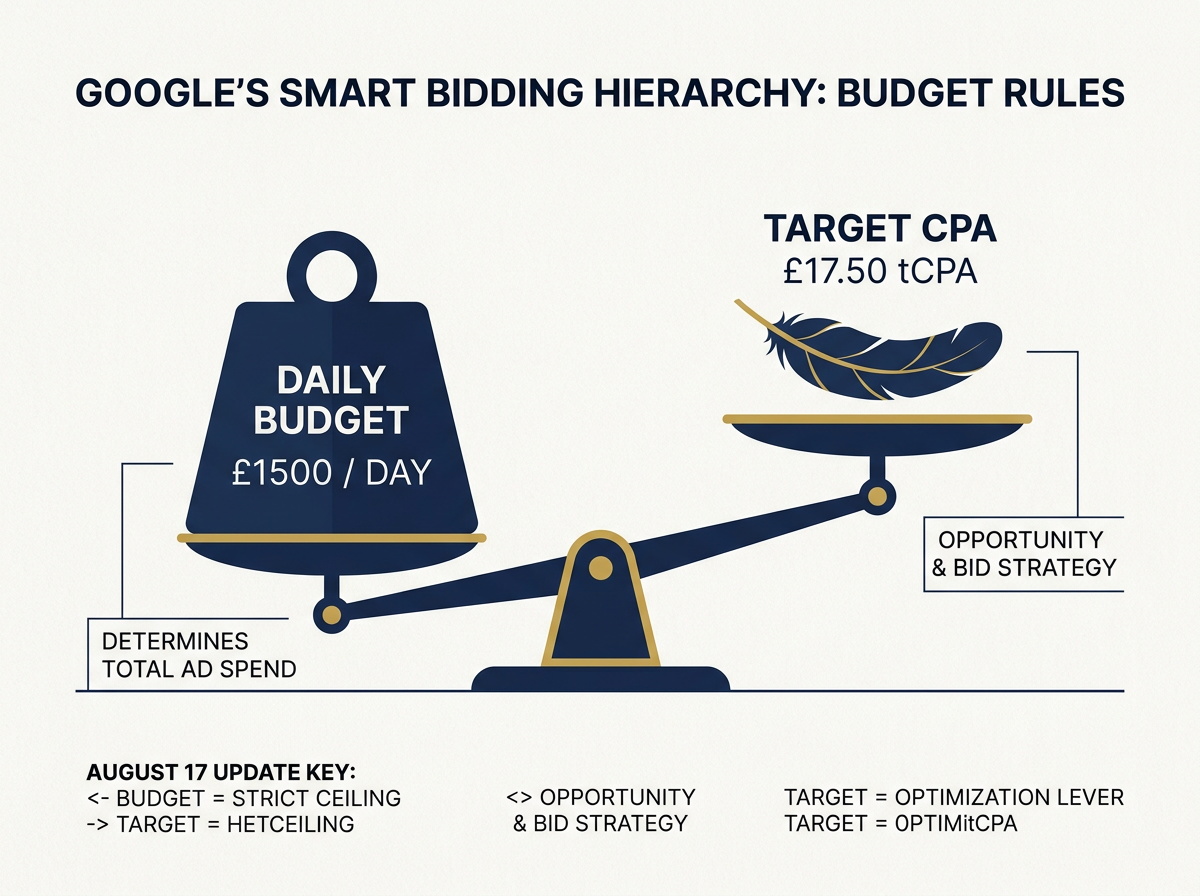
Google confirmed a pivotal change to its Smart Bidding logic effective August 17, 2026, clarifying that when campaigns are restricted by budget, the system will deprioritize specific Target CPA (tCPA) and Target ROAS (tROAS) constraints. The update aims to maximize conversion volume within a fixed spend, even if it means exceeding your set efficiency targets.
For social media marketers who also manage cross-channel search or Performance Max (PMax) budgets, this isn't just a technical footnote. It represents a fundamental shift in how Google handles the 'Limited by Budget' status. If you've been relying on tCPA as a hard ceiling to prevent overspending on expensive leads, that ceiling is effectively becoming a suggestion during peak traffic periods. You risk a sudden spike in acquisition costs if your daily caps are too low relative to market demand.
The mechanics of the August 17 Smart Bidding shift
Historically, Smart Bidding was perceived as a balancing act between your efficiency target and your budget. However, the new clarification from Google—first detailed by Brooke Osmundson at Search Engine Journal [S5]—makes it clear that budget is the ultimate master. When a campaign hits its daily spend limit, the algorithm's primary directive shifts from 'find conversions at this price' to 'get as much value as possible before the money runs out.'
This behavior is particularly aggressive in campaigns using Target ROAS. In a 'Limited by Budget' scenario, the algorithm may ignore your 500% ROAS target to capture a 300% ROAS conversion simply because that conversion is available and the budget hasn't been exhausted yet. For brands with tight margins, this 'silent' shift can turn a profitable day into a loss-leader overnight.
We are seeing this play out across the broader Google ecosystem. Just as Google is expanding its Travel campaign beta to include 'Things to Do' and 'Events' [S3], the complexity of these automated bidding systems is increasing. More inventory means more opportunities to spend, but if your bidding logic isn't aligned with your budget constraints, that spend won't be efficient.
Why 'Limited by Budget' is now a performance risk
In the past, seeing the 'Limited by Budget' warning in the Google Ads UI was a prompt to increase spend to capture more volume. Post-August 17, it should be viewed as a warning that your tCPA and tROAS targets are being actively compromised.
When the system detects a budget constraint, it enters a 'Maximize' mode. If you are on Target CPA, it behaves more like 'Maximize Conversions.' If you are on Target ROAS, it behaves like 'Maximize Conversion Value.' The algorithm assumes that if you've set a budget, you want to spend every penny of it, even if the marginal cost per acquisition is higher than your stated goal.
How to audit your Performance Max asset groups
This is a departure from how many agency strategists have managed accounts for years. We used to use tight budgets as a safety net. Now, that safety net actually triggers the removal of our efficiency guardrails. The system prioritizes spend over the specific target you've entered in the settings. This is especially risky for high-ticket lead generation where a single 'expensive' lead—one that the algorithm would usually skip—might now be pursued just to fulfill the daily budget requirement.
Adjusting your workflow for the August 2026 rollout
To protect your margins, you must change how you respond to budget limitations. The old reflex of 'set it and forget it' with a conservative budget and an aggressive target is now a recipe for inefficiency.
First, audit your 'Limited by Budget' status across all Search and PMax campaigns. If a campaign is consistently limited, you have two choices: increase the budget to let the tCPA/tROAS signals regain control, or lower your targets to align with the reality of what the algorithm is actually doing.
Second, consider using Seasonality Adjustments or Data Exclusions if you anticipate temporary budget spikes that might trigger this behavior. Google’s expansion into more niche event and travel categories [S3] suggests they are hungry for more granular data signals, but as Tom Critchlow noted regarding AI Search [S4], the risk of losing control over specific outcomes is growing. Marketers must be more hands-on with the 'knobs' of the machine than ever before.
Third, implement automated rules. Set a rule that notifies you or pauses a campaign if the actual CPA exceeds the target by more than 20% over a rolling 3-day period. This acts as the manual guardrail that Google has effectively removed from the bidding logic itself.
The impact on Target CPA vs Target ROAS strategies
The impact isn't uniform across both bidding types. Target CPA users are likely to see a volume increase at the expense of lead quality or cost. Because the algorithm is trying to fill the budget, it may bid on lower-intent keywords that it previously ignored.
Target ROAS users face a more complex challenge. Since ROAS is a value-based metric, the algorithm might chase high-value orders that have an even higher cost of acquisition, resulting in a net-negative return on ad spend for that specific day. This is particularly dangerous for e-commerce brands during flash sales or holiday periods where traffic volume is high and budgets are easily exhausted.

We should also look at the broader media environment. In the same way that NewsNation's New York bureau had to evacuate and find new workspaces due to structural concerns [S2], marketers need to find new 'workspaces' for their logic when the structural integrity of Smart Bidding changes. You cannot continue to operate in the same UI environment with the same assumptions when the underlying 'building' has shifted its foundation.
What to watch: The future of automated control
This update is part of a larger trend toward 'black box' optimization. Google is moving away from being a tool that follows instructions and toward a partner that pursues outcomes—sometimes at the expense of your specific constraints.
Watch your 'Impression Share Lost to Budget' metric closely. If this is high, your tCPA is likely being ignored for a significant portion of the day. We expect to see more updates like this as Google integrates more AI-driven search features, which will inevitably change how 'GEO outcomes' are measured and won [S4].
If you are managing social budgets alongside Google Ads, keep an eye on how Meta and TikTok respond. Often, when one major platform shifts toward 'Spend-First' logic, others follow. The era of using budget as a way to force efficiency is ending; efficiency must now be managed through creative excellence and first-party data signals rather than simple spend caps.
[INTERNAL: Why first-party data is the only hedge against AI bidding -> first-party-data-strategy-2026]
How to apply this tomorrow
Don't wait for August 17 to see the impact. Start by identifying your 'constrained' campaigns today.
- Move campaigns out of 'Limited by Budget' status by either reducing targets or increasing budget by 10-20% to give the algorithm breathing room.
- Shift high-priority, high-margin products into their own campaigns with uncapped budgets but very strict tROAS targets.
- Monitor the 'Average Target CPA' vs 'Actual CPA' daily. If the gap widens, the 'silent shift' is happening to you.
This update proves that in the world of 2026 performance marketing, the budget isn't just a limit—it's a signal. Make sure it's the signal you actually want to send.

FAQ