
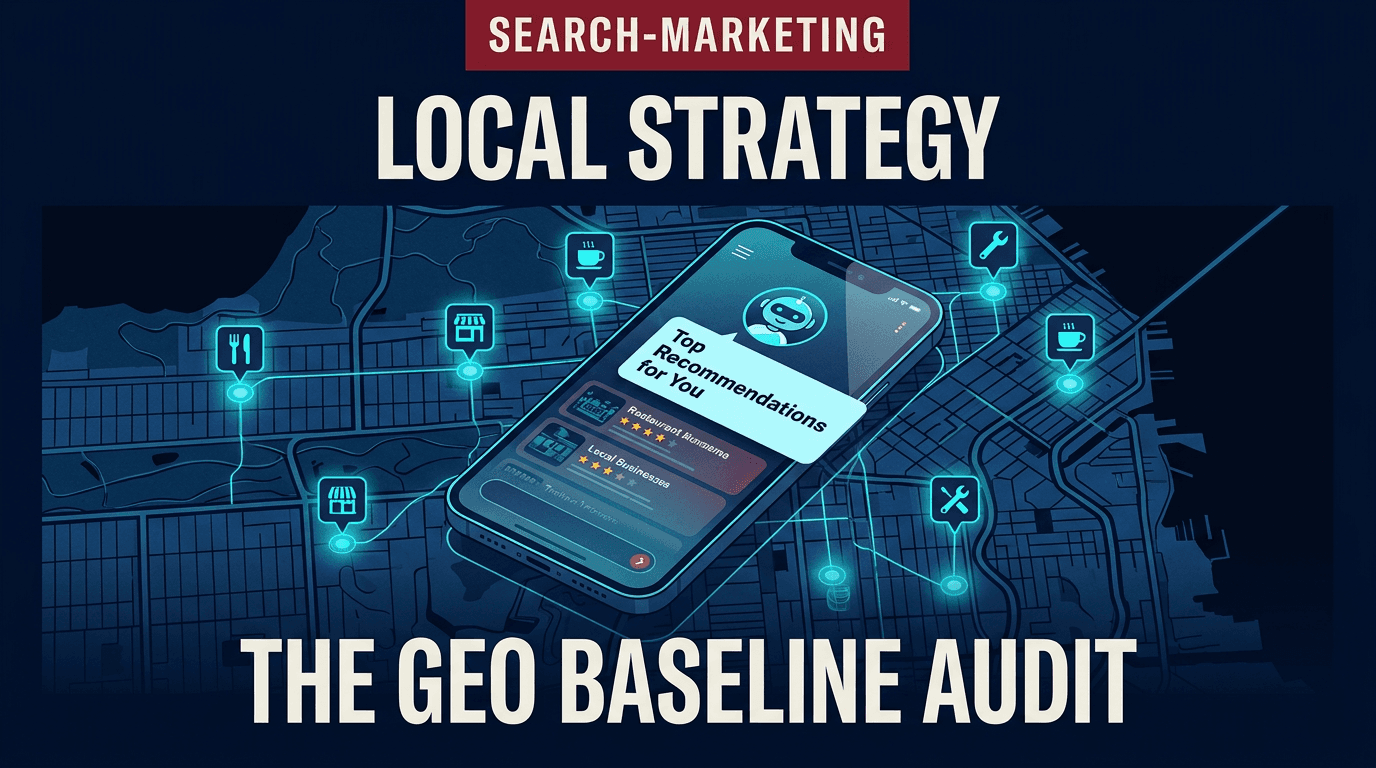
If your brand relies on local foot traffic or regional service leads, you're likely already feeling the squeeze. The traditional 'Blue Link' era of search is receding, replaced by conversational summaries and AI-driven recommendations. When a user asks, "Where is the best place to get a carbon-fiber mountain bike serviced in Austin?" they aren't looking for a list of ten websites. They want a single, authoritative answer.
This shift is Generative Engine Optimization (GEO). But you cannot optimize what you haven't measured. Before you dump more budget into local PPC or traditional SEO, you must establish a GEO baseline. This audit will reveal exactly how AI models—specifically Google Gemini, Perplexity, and the Reddit-heavy citations currently dominating the landscape—perceive your brand's authority.
By the end of this guide, you will have a repeatable framework to quantify your brand's Share of Model (SoM) and a punch-list of technical fixes to improve your local citation frequency.
TL;DR
- The Problem: AI models favor Reddit and high-authority forums for local sentiment, often ignoring brand-owned websites.
- The Fix: A GEO baseline audit measures your "citation density" across specific geographic clusters.
- The Toolset: You'll need access to LLM interfaces (Gemini, Perplexity), a local VPN or location-spoofing tool, and a sentiment analysis scraper like Brandwatch.
- The Outcome: A prioritized roadmap for Answer Engine Optimization (AEO) based on real-world AI recommendation gaps.
Step 1: Define Your Geographic Clusters and Query Matrix
Local AI discovery isn't monolithic. A recommendation in downtown Chicago differs wildly from one in the suburbs, even for the same query. To start, you need to move beyond broad keywords. You are auditing for "intent-based discovery."
First, identify 5–10 high-value zip codes or neighborhoods where your business operates. For each, develop a matrix of 20 queries. These should not be "brand name + city." Instead, use natural language questions that a user would actually ask an AI assistant. Think: "Where can I find a vegan-friendly bakery near [Neighborhood] that is open after 8 PM?" or "Who is the most reliable HVAC contractor for emergency repairs in [Zip Code]?"
Why it matters: AI models prioritize proximity and specific attributes (like hours, amenities, or specialized services) over general category relevance. If your audit uses generic terms, you'll miss the nuance of how the LLM weighs your specific business attributes.
Common Pitfall: Using a single location for your entire audit. Even if you are a national brand, AI models pull from hyper-local data sources. Spoof your location to the exact street level to see the true "Answer Engine" result.
Step 2: Map the Citation Source Hierarchy
Unlike traditional Google Search, which indexes the web broadly, AI models have a clear hierarchy of "trusted" sources for local recommendations. Per research from Search Engine Journal in July 2026 [S3], Reddit has become a primary citation engine for local intent. If a local subreddit (e.g., r/Austin or r/Seattle) has a thread discussing your industry, that thread is likely the primary source for Gemini or Perplexity's answer.
Run your query matrix through three primary engines: Google Gemini, Perplexity, and ChatGPT (with Search enabled). For every response, document the citations. Are they citing your website? Your Google Business Profile? Or are they citing a three-year-old Reddit thread or a Yelp 'Best of' list?
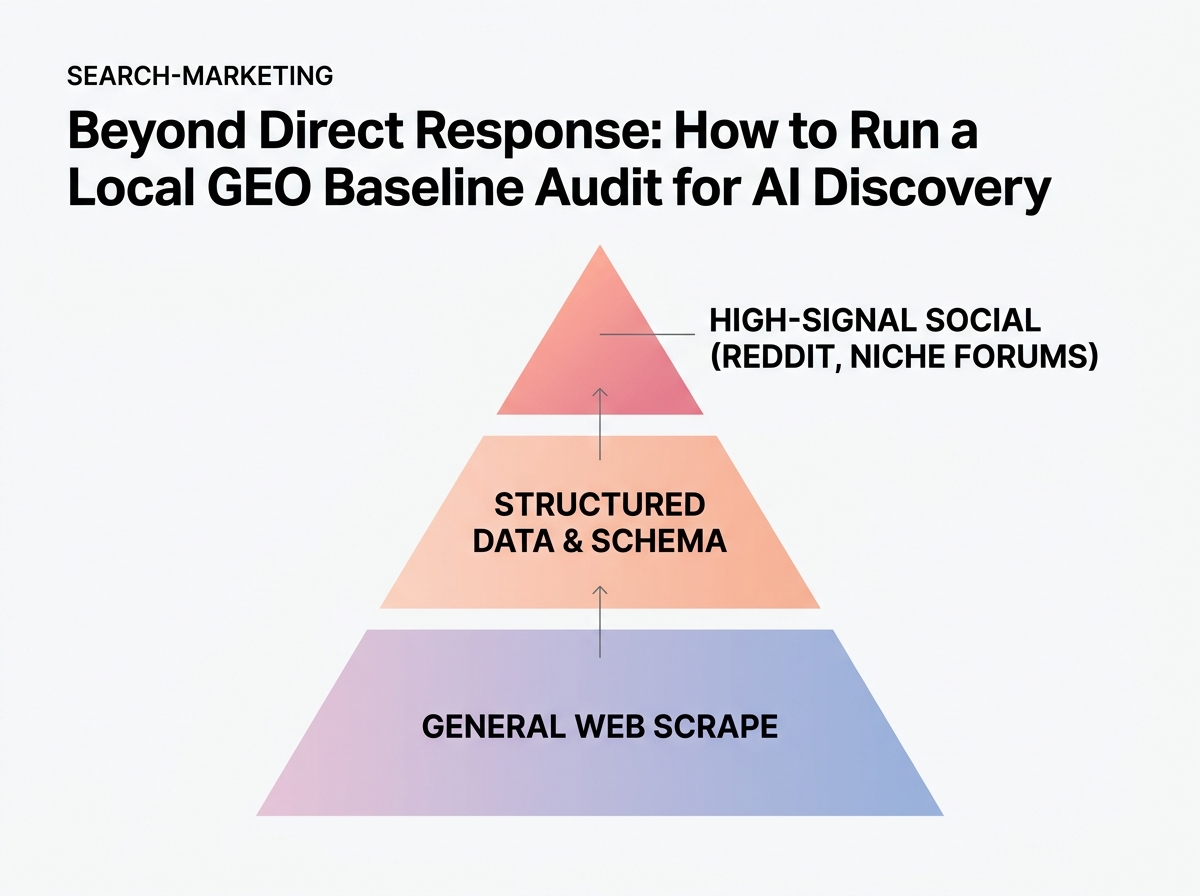
Why it matters: You need to know where the "knowledge" is coming from. If 80% of your AI citations are coming from Reddit, your SEO strategy shouldn't be focused on blog posts; it should be focused on community management and forum presence. As seen with the delay of Gemini 3.5 Pro [S2], platforms are struggling with data quality, making them lean harder on high-signal social platforms.
Common Pitfall: Ignoring the "References" or "Sources" tab in the AI interface. The prose of the answer is important, but the links are your roadmap. If the links are dead or outdated, the AI is hallucinating your brand's current status.
Step 3: Quantify Share of Model (SoM) vs. Share of Voice
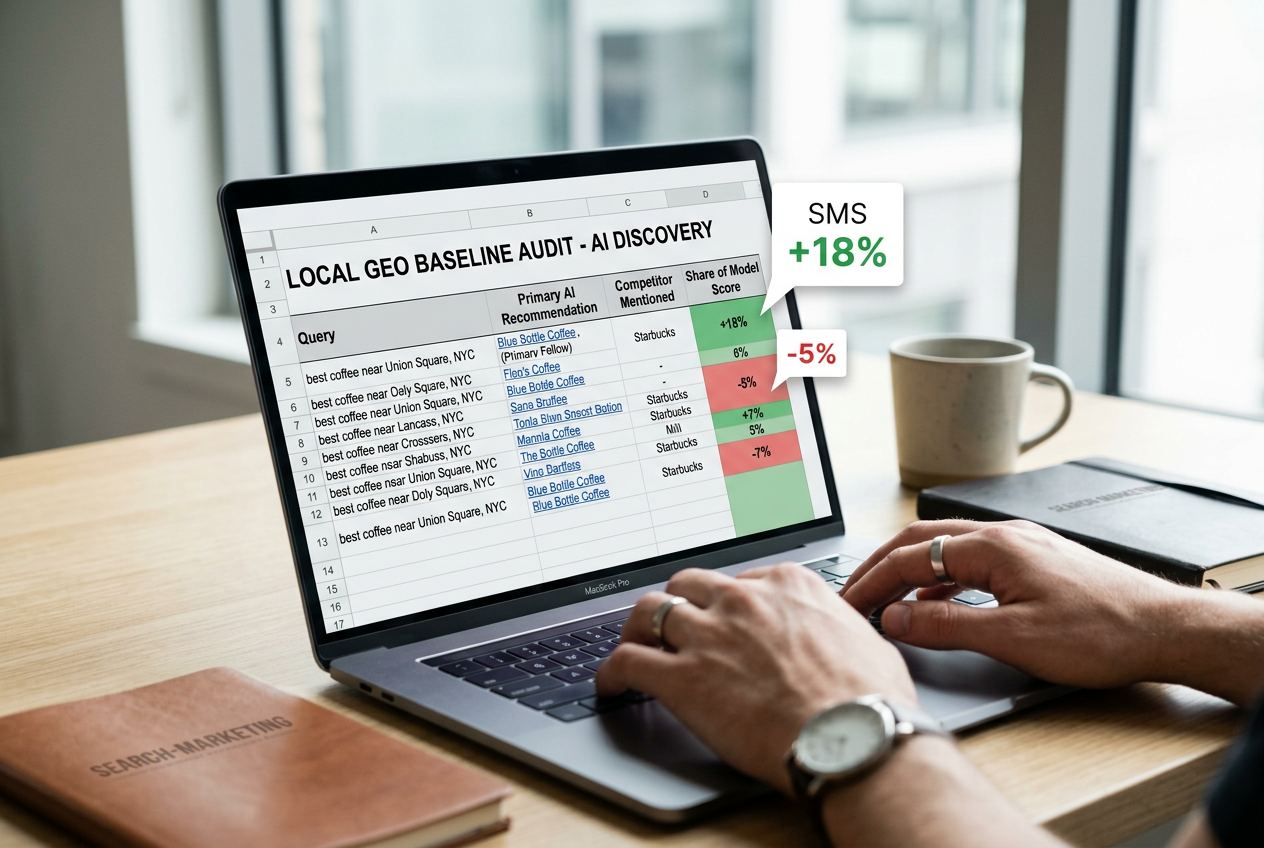
Traditional Share of Voice (SoV) measures how often you appear in search results relative to competitors. Share of Model (SoM) measures how often you are the recommended choice in the AI's primary prose.
Create a spreadsheet with three columns: Recommended, Mentioned, and Omitted.
- Recommended: Your brand is the first or second option suggested with a positive endorsement.
- Mentioned: Your brand appears in a list of options but without a specific "best for" label.
- Omitted: Your brand is not mentioned at all, despite being a top-three player in the physical market.
Calculate your SoM: (Recommended + Mentioned) / Total Queries. If your SoM is below 30% in your primary geographic cluster, you have a discovery crisis that no amount of Meta ad spend can fix.
Why it matters: As platforms like TikTok expand their local ad offerings—evidenced by Vendasta's new TikTok Channel Sales Partnership [S4]—users are moving toward discovery-first platforms. If you aren't in the AI's "inner circle" of recommendations, you're invisible to the highest-intent customers.
Common Pitfall: Being satisfied with a "Mention." In the world of Answer Engines, being the fourth choice is often as bad as not being there at all. Most users stop reading after the first two bullet points in an AI summary.
Step 4: Audit Your Structured Data for AEO Compatibility
AI models are essentially massive pattern-matching machines. They love structured data because it removes ambiguity. If your website's Schema.org markup is outdated or missing, the AI has to "guess" your details from third-party sites, which often leads to errors in pricing, hours, or service availability.
Use the Google Rich Results Test or a specialized schema auditor like Merkle’s Schema Generator to check your LocalBusiness markup. Look specifically for openingHours, priceRange, and aggregateRating. Furthermore, ensure your sameAs attributes point to your active social profiles, especially Reddit and LinkedIn, to help the model connect the dots between your brand and its social proof.
Why it matters: Correct schema acts as a "source of truth" that can override conflicting information from third-party scrapers. In the 2026 search landscape, your schema is more important than your meta descriptions.
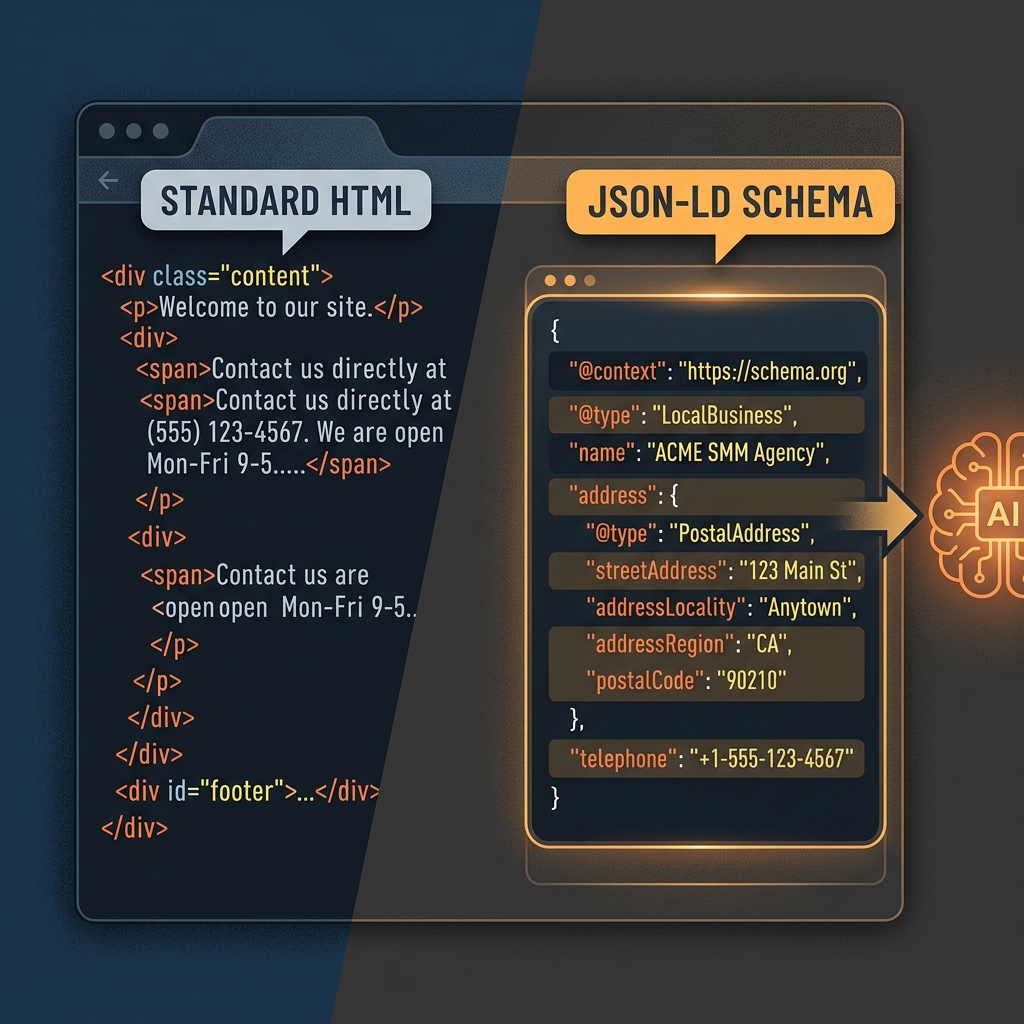
Common Pitfall: Using generic Organization schema when you should be using specific LocalBusiness or ProfessionalService subtypes. The more specific the subtype, the easier it is for the AI to categorize you for niche queries.
Step 5: Verification and Iteration
How do you know your GEO baseline audit is accurate? You must verify the "persistence" of the AI's answers. AI models are non-deterministic; they can give different answers to the same prompt.
Run your query matrix at three different times of day over a 48-hour period. If your brand disappears from the recommendations in the evening but appears in the morning, the model may be weighting your "Open Now" status too heavily or pulling from a fluctuating data source.
Once verified, this audit becomes your North Star. You now know which neighborhoods you're losing and which citation sources (Reddit, TripAdvisor, local news) you need to influence. This is the foundation of your 2026 local SEO strategy.
Three Tactics to Try Next
Now that you have your baseline, move from measurement to action with these three advanced AEO tactics:
- The Reddit "Seed" Strategy: Identify the top 5 Reddit threads cited in your audit. Don't spam them. Instead, have your local store managers or subject matter experts provide genuine, helpful answers to questions in those threads. The goal is to update the "sentiment pool" the AI draws from.
- Hyper-Local Video Sourcing: With TikTok's increasing role in local discovery [S4], start tagging your short-form content with the exact geographic coordinates of your business. AI models are increasingly indexing video transcripts to provide "vibe-based" recommendations (e.g., "Where is a coffee shop with a quiet atmosphere?").
- Cultural Response Mapping: As discussed at the ADWEEK Sports Marketing Summit [S1], brands must be ready to respond to cultural moments. Use your GEO audit to identify "seasonal triggers" in your local area—festivals, sports events, weather shifts—and pre-verify how AI models recommend services during those specific windows.
FAQ