
How do you know if your brand is actually winning in AI search? If you've spent the last six months tracking your share of voice in Google’s AI Overviews or Perplexity, you've likely noticed something unsettling: the data doesn't sit still. You run a report on Tuesday and you're the top recommendation for "best enterprise CRM." You run it again on Wednesday, and you've vanished.
This isn't necessarily a failure of your content or a penalty from the algorithm. According to July 2026 research highlighted by Search Engine Journal, AI visibility rankings are plagued by high levels of statistical noise. Because large language models (LLMs) are probabilistic rather than deterministic, they can produce different outputs for the identical prompt across different sessions. For a social media manager or an SEO lead, this creates a dangerous trap: making high-stakes budget pivots based on a single, unstable data point.
To solve this, we need to move past the "snapshot" mentality of traditional SEO. We need a framework to decide when a ranking report is actually representative of reality. That framework is the Stopping Rule.
TL;DR
- AI search is non-deterministic: Unlike traditional Google SERPs, AI responses can change between identical queries due to model temperature and sampling.
- The 10-Run Minimum: Research suggests that a single "check" of an AI ranking is statistically useless; you need multiple iterations to find the mean.
- The Stopping Rule: Use a variance-based threshold to determine when you've collected enough data to trust the result.
- Actionable GEO: Pivot from "rank tracking" to "probability of citation" as your primary KPI.
Why AI Visibility Rankings Are Inherently Unstable
Traditional search engines are indexed-based. If you search for "flights to London" on Google, the index is relatively stable for minutes or hours at a time. Generative AI, however, is a prediction engine. When an LLM generates a response, it is essentially rolling dice on the next token based on a probability distribution.
This inherent randomness means that "Generative Engine Optimization" (GEO) cannot be measured with a single scrape. Search Engine Journal reported on a paper published in mid-2026 that analyzed thousands of queries across platforms like Perplexity and ChatGPT. The researchers found that visibility scores fluctuated by as much as 40% between identical runs.
If your agency presents you with a report saying you have a 15% share of voice in AI search, you have to ask: "Is that the result of one query, or the average of fifty?" Without a multi-run approach, you're essentially looking at a single frame of a movie and trying to guess the ending. This instability is why many CMOs are skeptical of GEO—they see the numbers jump and assume the measurement tools are broken. In reality, it's the model itself that is fluid.
The Anatomy of the Stopping Rule
To combat this noise, researchers have introduced the concept of a "Stopping Rule" for AI audits. In simple terms, a stopping rule is a mathematical boundary that tells you when you have enough samples to stop testing because the addition of more data won't significantly change the average.
Think of it like polling for an election. You don't just ask one person who they're voting for; you ask a thousand. But you also don't need to ask every person in the country to get a statistically significant result. The stopping rule identifies that "sweet spot" where the margin of error becomes negligible.
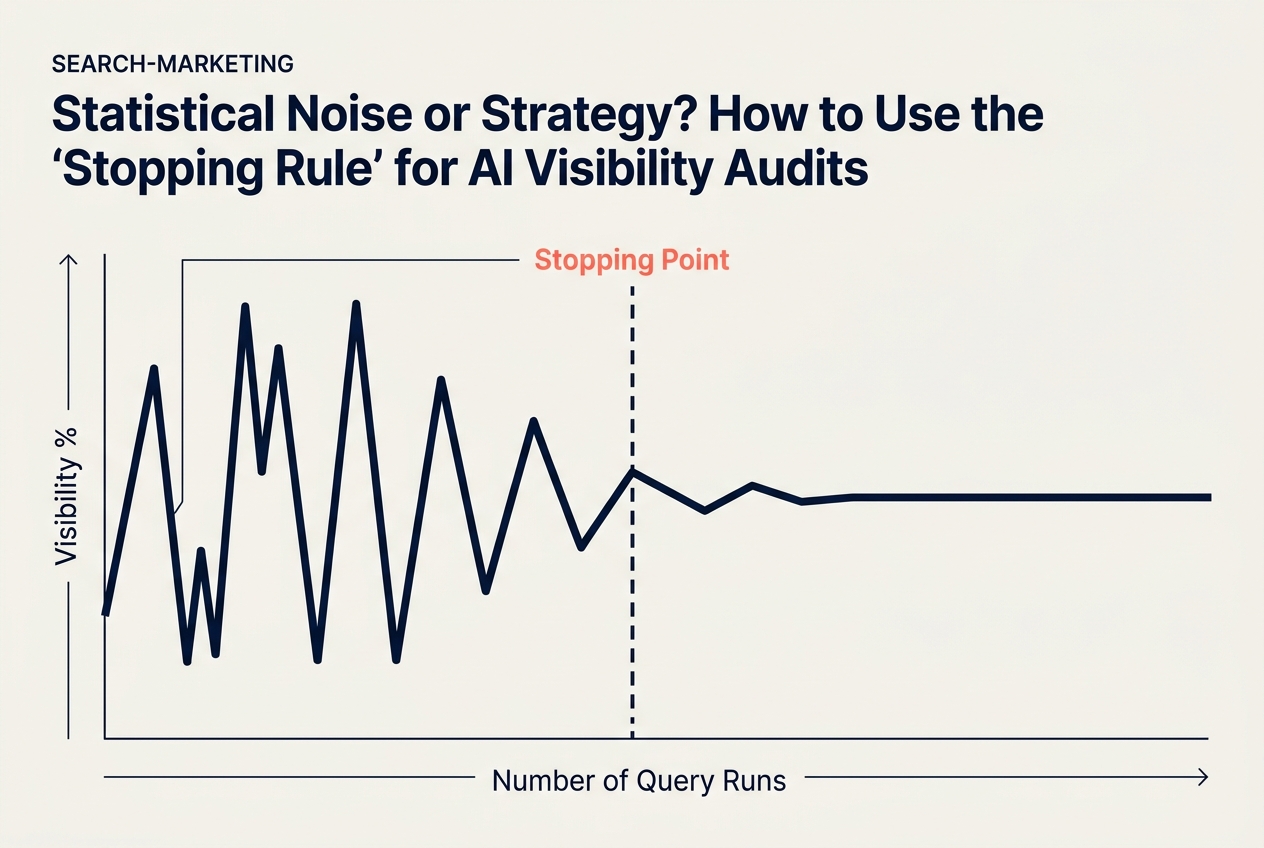
In the context of AI visibility, the stopping rule typically triggers when the "Rolling Average Visibility" stabilizes. If you run a prompt 10 times and your brand appears in 3 of them, your visibility is 30%. If you run it 20 times and it's still 31%, you've likely reached a point of stability. If it's still swinging wildly between 10% and 50%, you need to keep sampling.
For practitioners, this means your measurement workflow must change. You can no longer rely on a weekly manual check. You need automated scripts that query the AI API 30 to 50 times per keyword, then apply a variance check. Only when the variance drops below a certain threshold (typically <5%) should the data be pushed to your executive dashboard.
Moving from Rank Tracking to Probability of Citation
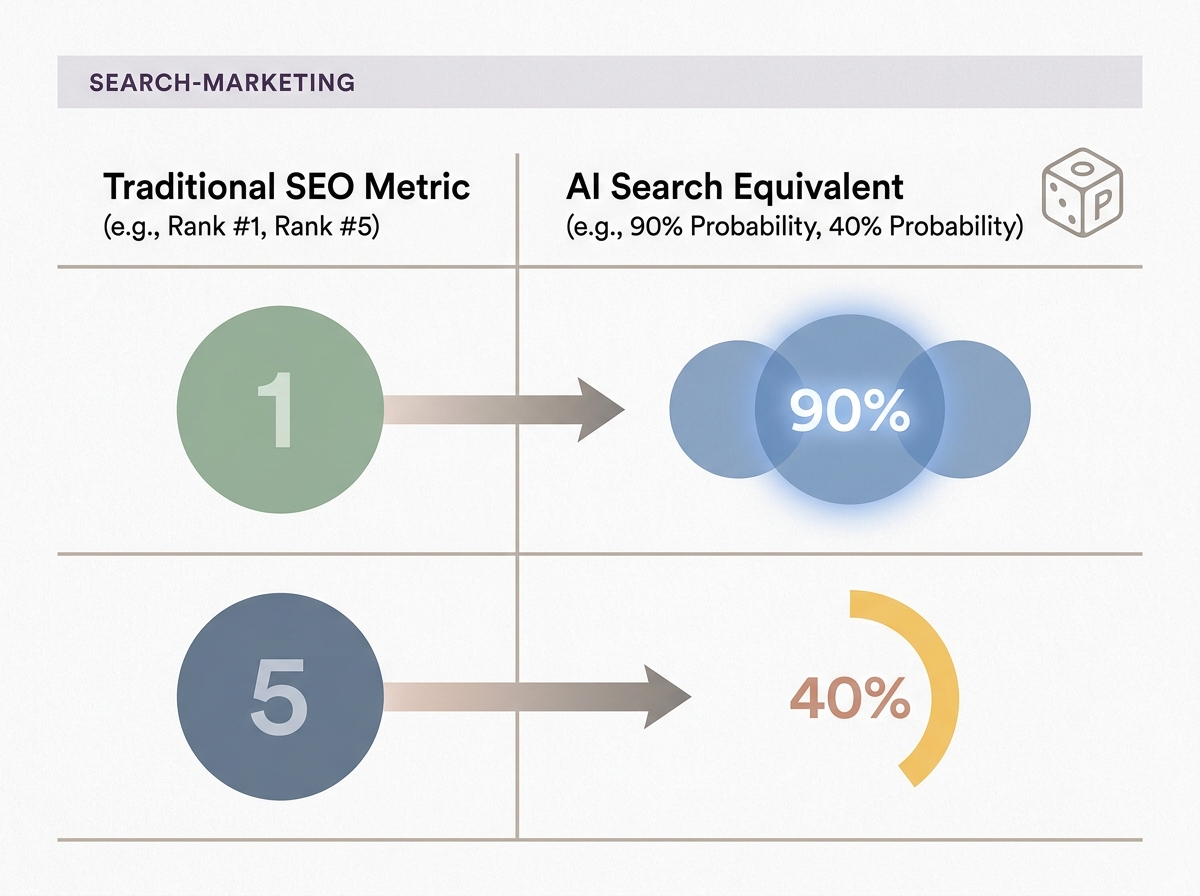
If the data is this noisy, how do we report on it? We have to stop using the language of "Rank 1" or "Rank 3." In AI search, those positions are fleeting. Instead, we should talk about Probability of Citation (PoC).
PoC is a much more honest metric for the generative era. It acknowledges that you won't be there every time, but aims for a high frequency of inclusion.
- High PoC (80%+): Your brand is a foundational part of the LLM’s training data or high-authority context window for that topic.
- Medium PoC (40-70%): You are in the consideration set, but the AI is weighing you against 2-3 other competitors depending on the specific phrasing of the prompt.
- Low PoC (<30%): Your presence is likely a "hallucination" or a lucky break based on a specific niche source the AI happened to pull that second.
This shift in language changes how you react to the data. If your PoC drops from 80% to 20%, that's a crisis requiring a content strategy overhaul. If it moves from 55% to 48%, that's just a Tuesday. By using the stopping rule, you gain the confidence to tell the difference between a trend and a hiccup.
Practical Application: How to Audit Your AI Presence
To implement this tomorrow, you don't need a PhD in statistics, but you do need a change in your tooling. Most current "AI Trackers" are still using the old SEO model of one-and-done scraping. Here is the workflow you should demand from your analytics team or agency partners:
- Define the Prompt Set: Don't just track "SaaS marketing." Track the long-tail questions your customers actually ask, like "Which SaaS marketing platform has the best ROI for startups?"
- The N=30 Baseline: Set a baseline of at least 30 iterations per prompt. Research shows that N=10 is often still too volatile to provide a reliable mean.
- Calculate the Standard Error: If the standard error is high, the data is "noisy." This often happens when the AI is confused by conflicting information on the web about your brand.
- Analyze the Sources: When you do appear, which URL is the AI citing? If it's a 3-year-old press release instead of your current product page, you have a "freshness" problem in the AI's retrieval-augmented generation (RAG) process.
This rigorous approach prevents the "knee-jerk pivot." We've seen brands slash their social media spend because a single ChatGPT session didn't mention them, only to realize later that they were cited in 9 out of 10 subsequent sessions. The stopping rule saves you from making expensive mistakes based on bad math.
What This Means for Your Long-Term Strategy
As AI search matures, the platforms (Google, Perplexity, OpenAI) will likely work to reduce this volatility to provide a more consistent user experience. However, the underlying technology will always have a degree of randomness.
Your goal shouldn't be to "win" a single search result. Your goal is to become so ubiquitous in the high-authority sources that the AI cannot ignore you, regardless of the random seed it uses for a particular generation. This is where your social media and PR strategy intersects with GEO.

If you are being discussed on Reddit, cited in major trade publications like Adweek or Search Engine Journal, and featured in influencer-led SaaS campaigns (as seen in recent Salesforce or Influencer Marketing Hub case studies), you are building the "authority floor" that stabilizes your AI visibility.
Stop looking at the daily fluctuations. Use the stopping rule to find your true baseline, and then focus on the long-term work of being the most cited brand in your niche. The noise will always be there; your job is to find the signal.
How to Apply the Stopping Rule to Your Team's Workflow
To make this actionable, you need to change the "Definition of Done" for your monthly reports. A report is no longer finished when the data is gathered; it is finished when the data is validated.
- For Social Leads: Stop reporting on "AI mentions" as a raw count. Report on the "Consistency Score" of those mentions. If a creator's video is being cited by AI as a source, how often does that happen over 50 test queries?
- For SEO Leads: Integrate API-based testing into your tech stack. Tools like BrightEdge or specialized GEO scripts can automate the multi-run process.
- For Brand Managers: Use these audits to identify "fringe" competitors. Sometimes a smaller brand will show up in 10% of AI results. In a traditional SEO world, you'd ignore them. In an AI world, that 10% represents a foot in the door that could grow as the model updates.
By adopting a statistical mindset, you move from being a victim of the algorithm to a master of the data. The "Stopping Rule" isn't just a math trick—it's the only way to maintain sanity in an era where the search results are literally being written on the fly.
FAQ