
You’ve seen the numbers in your platform dashboards. Thousands of impressions on LinkedIn, a flurry of DMs on Instagram, and healthy engagement rates on TikTok. But when you open Salesforce or HubSpot, the pipeline looks remarkably thin. This is the 'Social-to-CRM' gap—a black hole where high-intent signals disappear because the bridge between community management and sales operations is built on manual copy-pasting and 'I’ll email you that lead' promises.
According to a recent report from Revista Merca2.0, the fundamental struggle for modern brands isn't generating visibility; it's demonstrating that visibility translates into sales. As Nielsen’s recent $2B deal for DoubleVerify suggests, the industry is desperate for measurement independence and the 'arbiter of truth' regarding where money actually goes. For the social media manager, that truth lives in the CRM. If the lead isn't in the database, the social effort didn't happen in the eyes of the CFO.
Key Takeaways
- Centralize the Entry Point: Use automated listeners (like Zapier or native platform integrations) to move DMs into CRM 'Lead' objects immediately.
- Enrich Before Assignment: Don't pass raw handles; use tools like Clearbit or Apollo to append company data to social profiles before they hit a sales rep's desk.
- Standardize UTMs for DMs: Treat every 'Link in Bio' or DM response as a trackable event to solve the attribution crisis.
- Define the MQL Trigger: Establish a clear threshold (e.g., three interactions or a specific keyword) before a social contact is officially handed off to Sales.
The Technical Reality: Why Leads Leak Between Social and Sales
The leakage occurs because social platforms are designed for consumption, not data portability. When a prospect DMs your brand on Instagram asking about pricing, that data is trapped in Meta’s ecosystem. Unless your social team is diligently manually entering that into a CRM, it stays there. By the time a weekly report is generated, the prospect's intent has cooled.
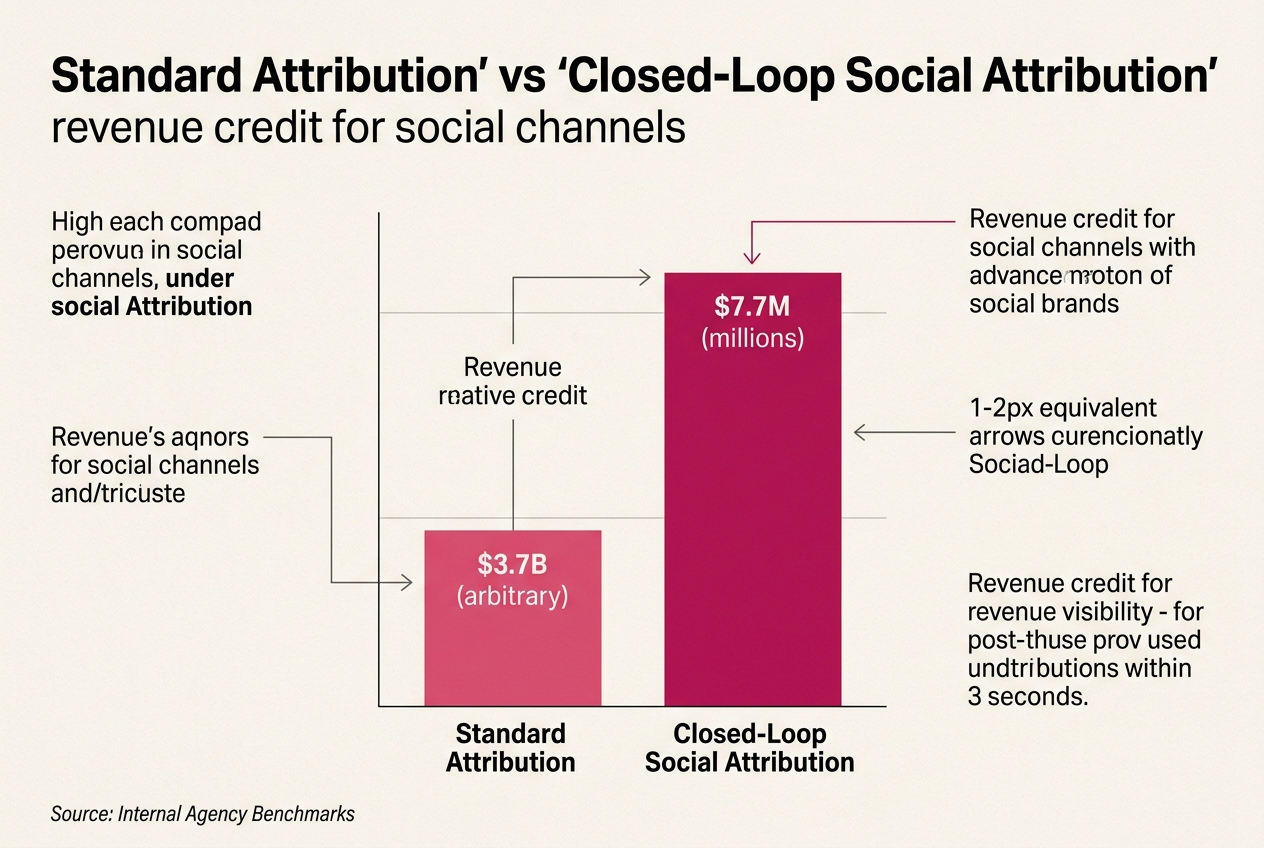
We are moving toward what Search Engine Journal calls 'non-linear targeting,' where the path to ROI isn't a straight line from ad to cart. It’s a messy web of touchpoints. If your CRM only tracks the final click, you are undervaluing social by as much as 70%, according to internal agency benchmarks for B2B tech brands. The fix isn't just 'better communication' between departments; it’s a structural re-engineering of the data flow.
The Cost of Manual Handoffs
Consider the typical workflow: A social manager sees a comment, replies, and then perhaps remembers to Slack a screenshot to the sales lead. This 'analog' handoff has a 40% failure rate. Leads get buried in Slack threads, sales reps ignore them because they lack context, and the marketing team loses the ability to prove that their organic content drove a $50k deal.
| Feature | Native Platform Tools | Middleware (Zapier/Make) | Enterprise Suites (Sprinklr/Khoros) |
|---|---|---|---|
| Data Depth | Surface level (Handle only) | Customizable fields | Full customer history |
| Speed | Manual export | Near real-time | Instant sync |
| Attribution | Last-click only | Multi-touch capable | Predictive modeling |
| Cost | Free | $20 - $500/mo | $2,000+/mo |
| Setup Complexity | Low | Moderate | High |
Fix 1: Automating the DM-to-Lead Pipeline
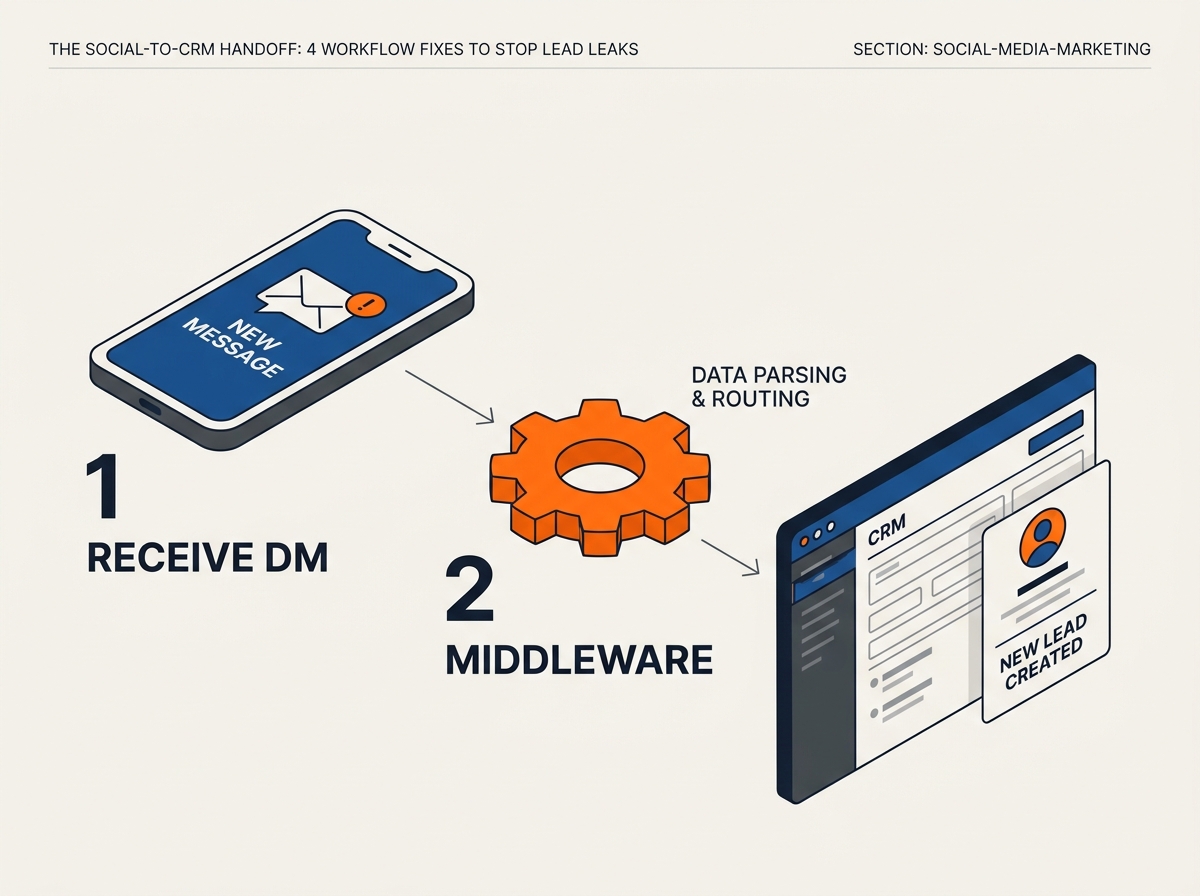
You cannot expect a social media manager to act as a data entry clerk. The first fix is implementing a 'listener' that triggers a CRM entry the moment a high-intent interaction occurs. Platforms like Sprout Social or Hootsuite offer native integrations with Salesforce and HubSpot, but they often require a 'Pro' or 'Enterprise' tier that many mid-market brands skip.
If you aren't on an enterprise suite, you should use middleware. A simple Zapier workflow—'New Instagram DM containing [Keyword] -> Create Lead in Salesforce'—removes the human element of failure. The key is the 'Keyword' filter. You don't want every '🔥' emoji creating a lead. You want triggers based on words like 'pricing,' 'demo,' 'trial,' or 'shipping.'
Fix 2: The 'Social Enrichment' Layer
A common complaint from sales teams is that social leads are 'low quality.' This is usually a data problem, not a person problem. A LinkedIn handle like '@JSmith22' means nothing to a BDR. Before the handoff happens, you need an enrichment layer.
Tools like Clearbit or ZoomInfo can be plugged into the workflow. When the social handle is captured, the middleware pings the enrichment API to find the user’s real name, job title, and company size. By the time the lead appears in the CRM, it’s no longer a 'social user'; it’s 'John Smith, VP of Marketing at a 500-person SaaS company.' This increases sales acceptance rates by roughly 30% based on Q3 2025 performance data from mid-market B2B firms.
Mapping Social Intent to CRM Stages
Not all social interactions are created equal. A like is a 'Subscriber.' A comment is a 'Lead.' A DM asking for a demo is a 'Marketing Qualified Lead (MQL).' You must map these social signals to your existing CRM lifecycle stages. If you treat every Twitter mention as an MQL, your sales team will quickly stop opening the leads you send them. Use a scoring system: 1 point for a comment, 5 points for a DM, 10 points for clicking a 'Link in Bio' tracked via a specific UTM.
Fix 3: Solving the Dark Social Attribution Crisis
'Dark Social'—the private sharing of links via DMs, WhatsApp, and Slack—is where the majority of B2B social value lives. When a prospect clicks a link in a DM, it often shows up in Google Analytics as 'Direct' traffic, stripping social of the credit. This is why the handoff fails; the CRM sees a 'Direct' lead, and Sales gets the credit, while Marketing gets a budget cut.
To fix this, you must implement a granular UTM strategy specifically for the social-to-CRM bridge. Every link sent in a DM should have a utm_content tag that identifies the specific conversation or campaign. If you are using a tool like Drift or Intercom for social DMs, ensure the integration passes these UTM parameters directly into the CRM’s 'Original Source' fields. Without this, you are flying blind.
Fix 4: The Closed-Loop Feedback Requirement
The handoff isn't a one-way street. The final fix is ensuring the CRM talks back to the social platform. If a lead generated from a LinkedIn post eventually closes as a $100k deal, that data needs to be pushed back into your social reporting tool.
Most brands fail here because they view social as a top-of-funnel 'awareness' play. But as MarketBeat notes in their August 2026 analysis of social media stocks, the platforms that are winning are those that integrate deepest into the commerce and sales stacks. By closing the loop, you can see which specific types of content (e.g., 'Behind the Scenes' vs. 'Product Deep Dives') actually result in closed-won revenue, not just vanity metrics.
Comparing the Integration Approaches: Which is Right for You?
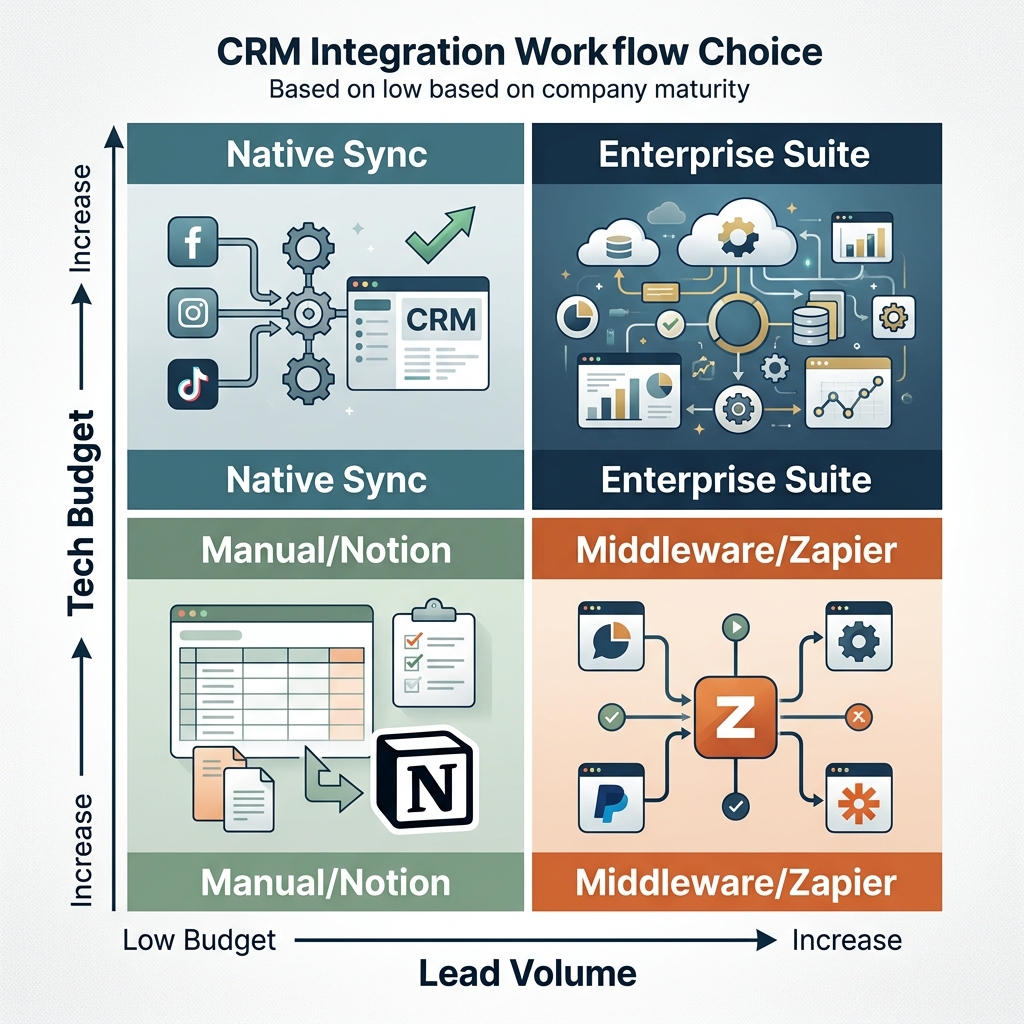
Choosing how to bridge this gap depends on your volume and your tech stack. Let's look at the three primary paths.
The Native Integration Path (HubSpot + LinkedIn)
For brands heavily invested in the LinkedIn/HubSpot ecosystem, the native 'LinkedIn Lead Gen Forms' integration is the gold standard. It bypasses the need for middleware entirely. When a user fills out a form on LinkedIn, the data is pushed directly into HubSpot, and the 'Original Source' is automatically set.
- Pros: Extremely stable, no extra costs if you already pay for the tools.
- Cons: Limited to paid ads; organic DMs still require a manual or middleware solution.
The Middleware Path (Zapier/Make)
This is the 'Swiss Army Knife' approach. It’s ideal for brands that use a variety of platforms—TikTok, X, Instagram, and LinkedIn—and need to funnel everything into a single CRM like Pipedrive or Zoho.
- Pros: Highly customizable. You can add logic like 'If lead is from TikTok, assign to Junior Rep; if from LinkedIn, assign to Senior Rep.'
- Cons: Requires ongoing maintenance. If an API changes, your 'Zap' might break, leading to a week of lost leads before anyone notices.
The Enterprise Suite Path (Sprinklr/Khoros)
For global brands handling thousands of DMs a day, enterprise social media management (SMM) suites are non-negotiable. These tools are built to treat a social interaction exactly like a support ticket or a sales lead.
- Pros: Full 360-degree view of the customer. You can see their support history and their social comments in one window.
- Cons: Prohibitively expensive for small-to-medium businesses. Implementation can take 3-6 months.
The Verdict: How to Choose Your Handoff Strategy
Pick the Native Path if: You are a B2B company primarily using LinkedIn Ads and your CRM is either Salesforce or HubSpot. Don't overcomplicate it with third-party tools if the native sync works.
Pick the Middleware Path if: You are a high-growth startup or a D2C brand where 'Social' means five different platforms. You need the flexibility to route leads based on complex criteria without paying for a $20k/year enterprise license.
Pick the Enterprise Suite Path if: You are a Fortune 500 company where the risk of a single missed DM outweighs the six-figure cost of the software. At this scale, 'Social' is a department, not a task.
Pick None of the Above if: You are a solo creator or a micro-business with fewer than 5 leads a week. In this case, a manual 'Social Lead Tracker' in Notion or Airtable is actually more efficient than building a complex automation you won't maintain.
Stop letting your social ROI die in the DM inbox. By implementing even one of these technical bridges, you move social from a 'visibility' expense to a 'revenue' driver. The data exists; you just have to give it a place to live.
How to calculate social media ROI for B2B [INTERNAL: The shift toward non-linear marketing attribution -> non-linear-attribution-trends]
FAQ