
If you are asking whether Bluesky is just another 'Twitter clone' destined to fade like Pebble or Post, you are asking the wrong question. For brand marketers and agency strategists, the value of Bluesky isn't just in its current monthly active user count—though that figure has surged following the continued volatility at X. The real story is the underlying architecture: the AT Protocol (Authenticated Transfer Protocol).
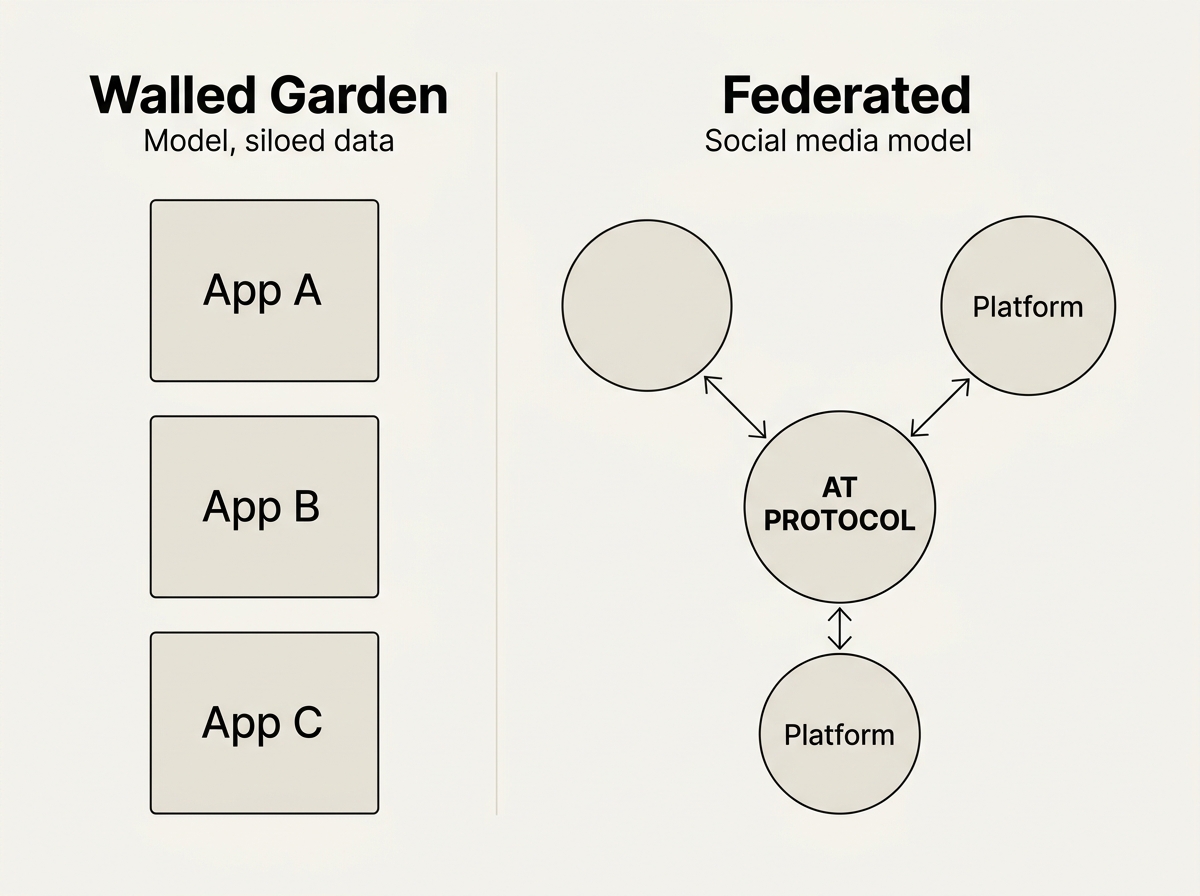
We have spent a decade locked into 'walled gardens.' When you build a following on Instagram or X, you don't own that relationship; the platform does. If the algorithm changes, your reach drops. If the platform dies, your community vanishes. Bluesky is the first major experiment in 'portable' social media that has actually achieved cultural velocity. This isn't just a new app; it's a new way of thinking about brand-to-consumer data ownership.
Understanding the AT Protocol: The 'Email' Analogy for Social Media
To understand why the AT Protocol matters for your Bluesky marketing strategy, think about how email works. You can have an Outlook account and send a message to someone on Gmail. You can move your entire contact list from Mailchimp to Klaviyo without losing your subscribers' permission. Social media has never worked this way—until now.
The AT Protocol is designed to make social media federated. This means that while Bluesky (the app) is the most popular way to access the network today, it isn't the only way. Theoretically, a brand could host its own 'PDS' (Personal Data Server). If Bluesky changed its terms of service in a way that harmed your brand safety, you could move your entire account—followers, posts, and engagement history—to a different provider on the same protocol.
This shift in power dynamics is why early adopters are flocking there. According to recent industry sentiment, the appeal isn't just the lack of ads (for now); it's the sense of agency. For a strategist, this means the 'platform risk' that has haunted social teams since the 2018 Facebook algorithm pivot is finally being addressed at the code level.
Algorithmic Choice vs. The Black Box
On Meta or TikTok, you are at the mercy of a singular, proprietary recommendation engine. On Bluesky, 'Custom Feeds' are the primary discovery mechanism. Users don't just see what a central AI wants them to see; they subscribe to specific algorithms built by the community.
There are feeds for 'Journalists,' 'Science Lovers,' and even 'Brand Managers.' For your business, this changes the distribution game. Instead of trying to 'hack' a global algorithm, your goal is to get your content into the specific feeds that your target audience actually follows. It's a return to niche community management.
[INTERNAL: How to master community-led growth -> community-management-strategies]
If you are a travel brand, you don't just post and hope. You identify the top three travel-related custom feeds on Bluesky and tailor your content to the specific moderation and curation rules of those feeds. This is much closer to the early days of subreddit marketing than it is to modern-day Instagram ad buying. It requires a high degree of cultural fluency and a low tolerance for 'corporate speak.'
The Data Portability Argument for Brand Safety
We've seen the headlines: NewsNation bureaus evacuating due to building collapses [S2], or the shifting sands of Google search as AI-generated outcomes threaten traditional SEO [S4]. The digital landscape is physically and structurally fragile. Brands are tired of being 'platform-homeless.'
Bluesky’s commitment to data portability means that your social graph—the digital map of who follows you and who you follow—is yours. In a world where X can change its verification rules overnight or Meta can deprecate tools like CrowdTangle (as they did in August 2024), having a 'portable' audience is the ultimate hedge.
From a technical standpoint, this is achieved through DIDs (Decentralized Identifiers). Your brand’s handle isn't just a string of text on a database; it's a cryptographic identity. This prevents the kind of 'impersonation' crises we saw during the early days of the paid-verification rollout on X. On Bluesky, you can even use your own domain (e.g., @news.socialmediamarketing.com) as your handle, providing an instant, DNS-level blue checkmark that costs nothing and can't be taken away by a platform owner.

Does Your Brand Need a Dedicated Bluesky Seat?
Deciding whether to allocate a full-time community manager to Bluesky depends on your vertical. If you are in media, tech, or high-end creator circles, the answer is likely yes. The 'early adopter' sandbox is currently populated by the very people who set the cultural agenda for the rest of the web.
However, don't expect the same ROI metrics you see in Google Ads Travel betas [S3] or Meta's Smart Bidding updates [S5]. Bluesky is currently an 'earned' play, not a 'paid' play. There is no formal ad manager. There are no 'boosted posts.' You are paying with time and talent, not with credit cards.
Key takeaways for your 2026 social roadmap:
- Own your handle: Use your brand's domain as your handle immediately to establish 100% verified authority.
- Map the feeds: Don't just look at followers; look at which Custom Feeds are driving the most engagement in your niche.
- Audit your data: Start thinking about your social followers as a portable database rather than platform-locked assets.
- Prioritize 'The Hangout': Bluesky users are currently hostile to traditional broadcast marketing. Your content must contribute to the conversation, not just interrupt it.
The Competitive Landscape: Bluesky vs. X for Business
The comparison between Bluesky and X is often framed as a political or cultural choice, but for a strategist, it's a functional one. X still holds the lion's share of real-time breaking news and global reach. If you are a brand that needs to react to the 2026 Emmy nominations in real-time [S1], you cannot ignore X.
But X is increasingly a 'broadcast' platform dominated by high-volume accounts and paid-priority replies. Bluesky is a 'conversational' platform. The engagement rates on Bluesky—measured as replies and 'reposts' per follower—often dwarf those on X for accounts with similar follower counts. This is the 'early adopter' advantage: a high-intent, highly active audience that hasn't yet been fatigued by an onslaught of programmatic advertising.
Why engagement rate is the only metric that matters in 2026
How to Apply This Tomorrow
You don't need a 20-page strategy to start. Start by setting up a 'listening post.' Create a Bluesky account, set your handle to your domain, and spend a week just following the 'Discover' feed and a few niche custom feeds.
Observe how users interact. Notice the lack of 'main character' energy that often plagues other platforms. Bluesky is currently in its 'dinner party' phase. If you burst into the room shouting about a 20% discount code, you'll be ignored or blocked. If you join the table and offer a genuine insight or a well-timed, self-deprecating joke, you'll find an audience that is remarkably loyal.

As we look toward the end of 2026, the brands that succeed on the AT Protocol won't be the ones with the biggest ad budgets. They will be the ones who understood that the 'social' in social media was never supposed to be a one-way street. They will be the ones who took their data back and built a community that can follow them anywhere.
What to Watch Next
The next major milestone for Bluesky will be the introduction of 'Ozone,' their independent moderation tool. This will allow communities to set their own safety standards, further distancing the platform from the 'one-size-fits-all' moderation failures of the past. For brands, this offers a level of brand safety control that is currently impossible on larger platforms. Keep a close eye on how these 'independent moderation labels' evolve; they may soon become the new standard for how we define 'safe' digital environments.
FAQ