
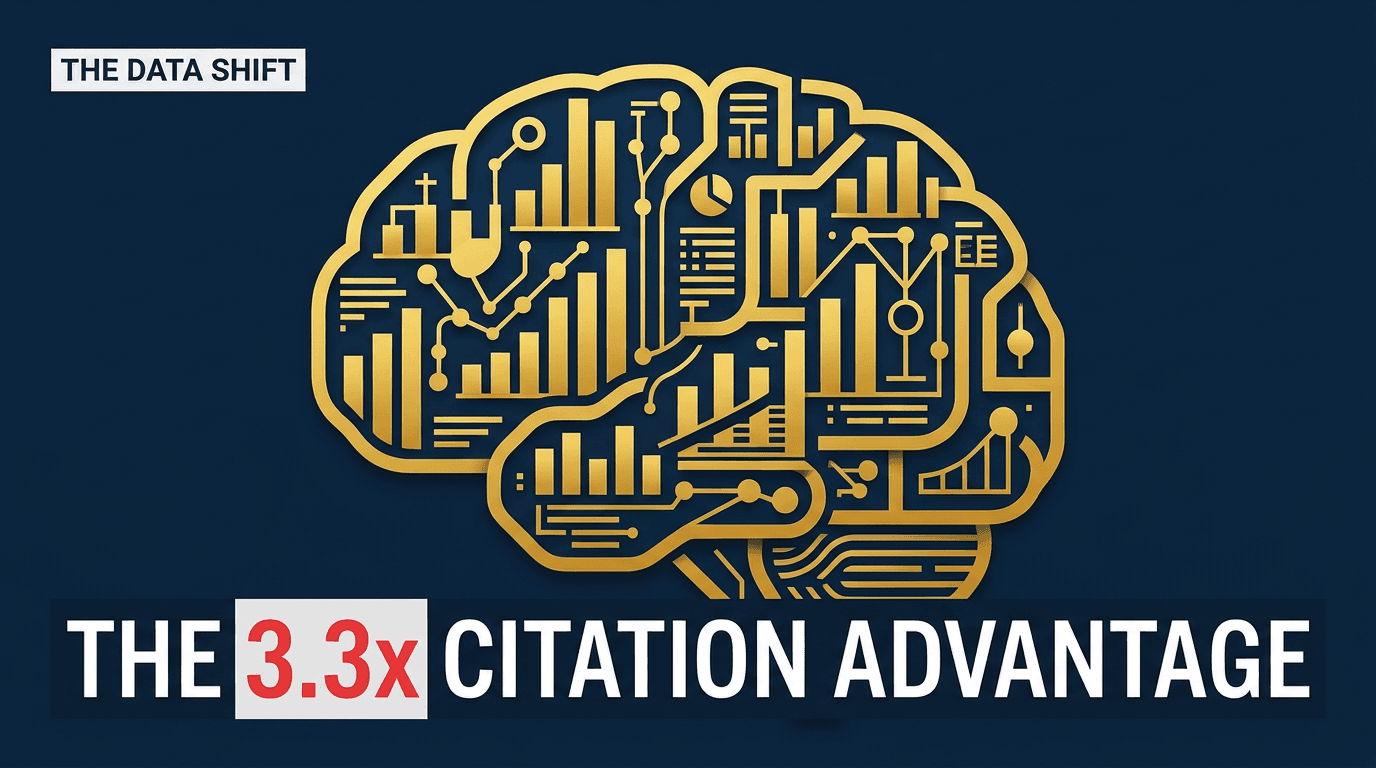
If you are still optimizing for the blue links of 2022, you are managing a sunset industry. The pivot is no longer coming; it is here. Recent Search Engine Land data confirms that primary research—proprietary surveys, internal data sets, and original experiments—earns 3.3x more citations in AI LLMs like Perplexity and ChatGPT than standard 'how-to' or opinion-based content. To survive the shift toward Generative Engine Optimization (GEO), brands must stop acting like publishers and start acting like data labs.
The Death of the 'Definitive Guide' and the Rise of the Data Point
For a decade, the social and SEO playbook was simple: write the longest, most comprehensive 'Definitive Guide to X' and wait for the backlinks to roll in. That era is over. Large Language Models (LLMs) do not need your 3,000-word guide to summarize a topic for a user; they have already ingested the entire internet for that. What they cannot synthesize out of thin air is new, proprietary data.
When a user asks Perplexity about the average CPM for TikTok ads in Q3, the model doesn't look for the most beautifully written blog post. It looks for the most recent, credible data point. If your agency or brand is the one that published the benchmark report based on $50M in managed spend, you get the citation. If you just wrote a post titled 'Why TikTok Ads are Great,' you get nothing.
This is the core of the 'Data-First Social' thesis. Your social assets shouldn't just be pretty pictures; they should be the distribution vehicle for the unique facts only your company knows. We are seeing a massive divergence in performance between brands that curate and brands that create. Per the July 2026 Search Engine Journal report on GEO outcomes, search marketer Tom Critchlow notes that AI search is exposing a fundamental risk: SEOs might no longer 'own' the outcome if they don't own the underlying information.
Why LLMs Crave Your Internal Benchmarks
LLMs are built on probability, but they are tuned for utility. In the current iteration of AI search, models prioritize 'information gain.' If your content provides a fact that doesn't exist elsewhere—a specific survey result, a unique customer behavior trend, or a documented experiment—the algorithm flags it as high-value.
Consider the recent Emmy nominations analysis by Adweek. While everyone reported the winners, the value lay in the strategy analysis of platforms like NBC and streamers like Widow's Bay. In the same way, your brand's value in the age of AI is not your ability to repeat industry news, but your ability to add to the global data set.
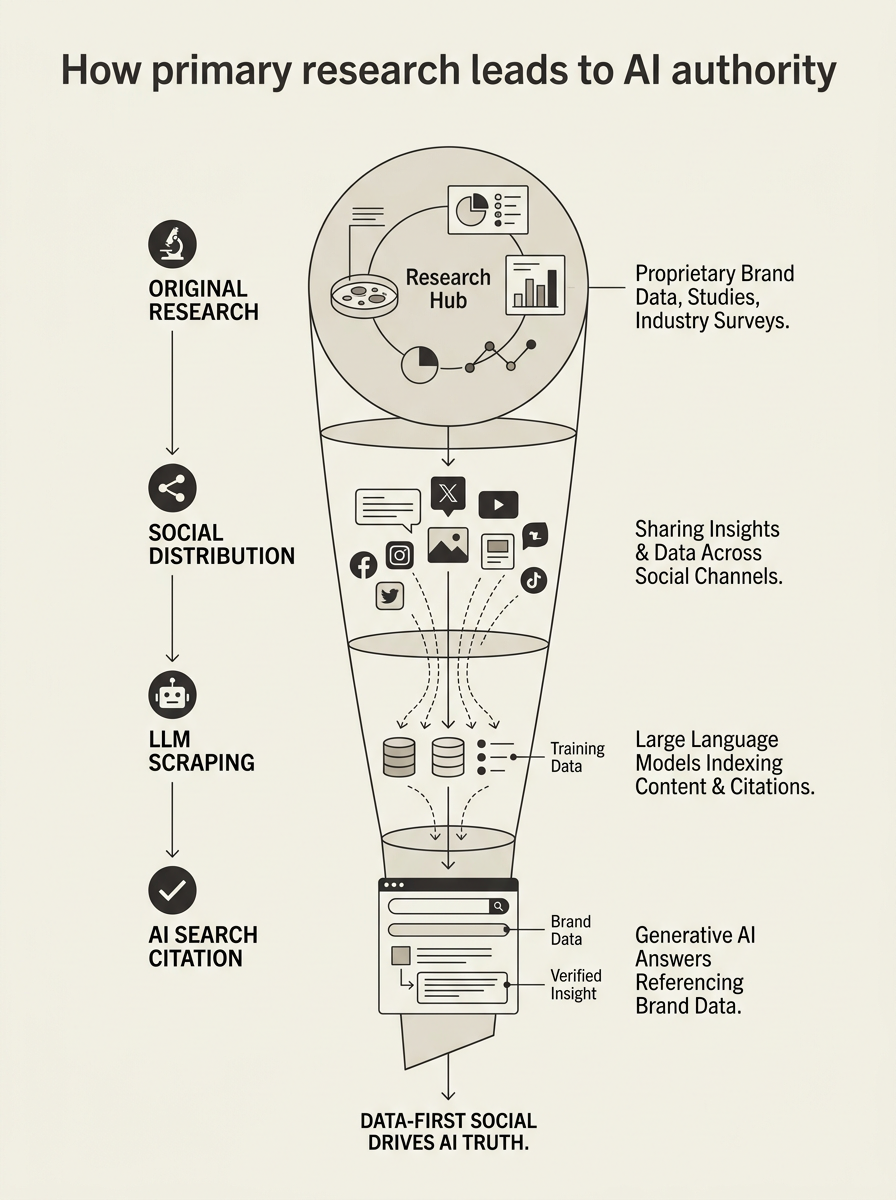
When you publish a 'State of the Industry' report, you aren't just creating a lead magnet. You are creating a 'citation magnet' for the next 12 months of AI queries. Every time a user asks a chatbot for a statistic related to your niche, your brand name becomes the authoritative source. This is the highest form of brand awareness available in 2026. It is passive, authoritative, and occurs exactly when the user is in a high-intent research phase.
The GEO Strategy: Turning Social Posts into LLM Food
Generative Engine Optimization (GEO) is the practice of formatting your content so it is easily ingested and cited by AI. This goes beyond schema markup. It requires a fundamental shift in how we structure social media updates and blog posts.
- Lead with the Stat: Don't bury your findings in a PDF. Put the headline statistic in the first sentence of your LinkedIn post and the H1 of your landing page.
- Provide Contextual Metadata: LLMs need to know the 'who, what, and when.' Instead of saying 'most marketers are worried about AI,' say 'A June 2026 survey of 450 mid-market CMOs conducted by [Your Brand] found that 72% are worried about AI search attribution.'
- Visual Data for Multi-Modal AI: As GPT-4o and Gemini 1.5 Pro become more visual, your charts and infographics are being 'read' just like text. Ensure your charts have clear labels, source citations, and high contrast.
[INTERNAL: How to optimize visual assets for multi-modal AI -> ai-visual-optimization-guide]
We've seen this play out in the travel sector. Since Google Ads expanded its Travel campaigns to 'Things to Do' and 'Events' in July 2026, the brands winning the AI-generated itineraries are those with the most structured, proprietary data about ticket availability and event specifics. They aren't just 'optimizing for keywords'; they are providing the raw data that feeds the engine.
The Counterargument: Is the 'Data Moat' Sustainable?
Critics argue that once you publish your data, the LLM will simply scrape it, provide the answer, and never send you a click. They call this 'zero-click search on steroids.' It's a valid fear. If the goal of your marketing is purely to drive sessions to a website to show display ads, you are in trouble.
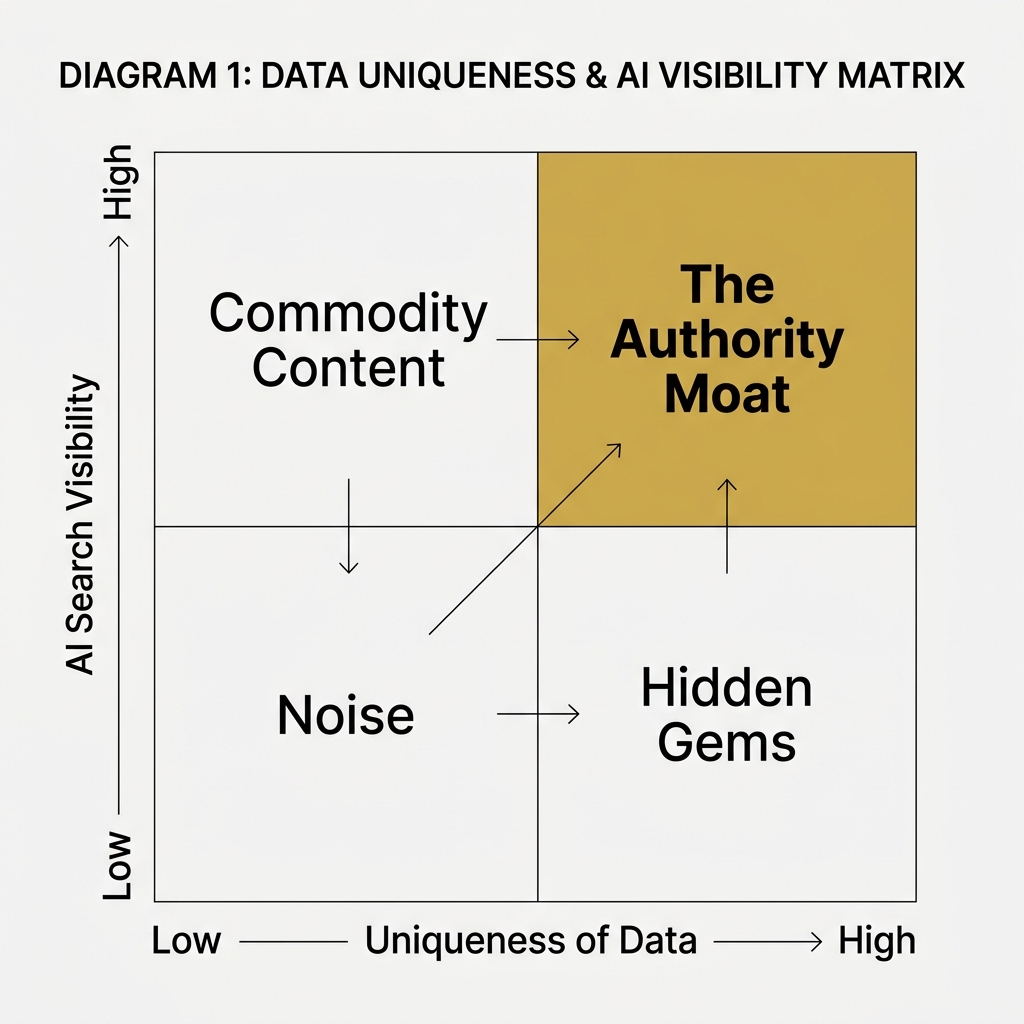
However, this perspective misses the 'Attribution of Authority.' In a world where AI can hallucinate or produce generic filler, the source of the data becomes the only thing that matters. If a CMO sees your brand cited five times in a single Perplexity session as the source for B2B benchmarks, you have won the trust battle before they ever land on your site. The citation is the new click.
Furthermore, the 'moat' isn't the data itself—it is your ability to produce new data. Data has a half-life. A 2024 benchmark is useless in 2026. By the time an LLM has fully commoditized your old research, you should be releasing the next iteration. It is a treadmill, yes, but it’s one that keeps your brand at the top of the 'authority' stack.
How to Apply the Data-First Model Tomorrow
You don't need a $100k research budget to start. You already have the data; you're just not packaging it.
- Client Benchmarks: Aggregate your internal performance data (anonymized, obviously). What is the average engagement rate for your specific industry this month?
- Customer Surveys: Use your social following or email list to ask three specific, high-value questions every month.
- Search Trend Analysis: Use tools like Brandwatch or Sprout Social to identify 'data gaps'—questions people are asking that don't have a clear, cited answer yet.
If you are an agency, this is your new primary service offering. Stop selling 'content calendars' and start selling 'quarterly research initiatives.' The former is a commodity that AI can do for $20 a month; the latter is a strategic asset that keeps your clients relevant in a generative world.
The agency's guide to selling research as a service
The 2027 Prediction: The 'Verified Source' Premium
I predict that by mid-2027, LLMs will introduce a 'Verified Source' tier for citations, similar to social media verification but based on historical accuracy and data provenance. Brands that have consistently provided primary research that other sites link to will receive a ranking boost within AI responses.
We already see the beginnings of this with Google's clarification on Smart Bidding updates in August 2026. Google is increasingly relying on its own proprietary data to make decisions for advertisers because it trusts its own signals more than third-party ones. In the same vein, AI engines will gravitate toward the 'original' source of any fact. If you aren't the source, you're just noise.
Start building your data library now. Every survey you run and every benchmark you set is an investment in your brand's future visibility. In the age of AI, the brand with the most facts wins.

FAQ