
If you've spent any time on TikTok or Instagram lately, you've noticed the search bar isn't just a place for hashtags anymore. It's a prompt box. With the June 2026 rollout of Meta’s 'AI Mode' in Facebook and Instagram search—which pulls directly from public Reels and group conversations—the way users find brands has fundamentally shifted. You aren't just optimizing for a keyword like "best CRM for startups." You're optimizing for the three questions the user is going to ask after they find that list.
This is the era of Generative Engine Optimization (GEO). In this new landscape, the 'Next-Question' framework is your most potent tool. It’s a method of structuring social captions that anticipates the logical progression of a user's curiosity, ensuring your content doesn't just appear in the initial search results, but becomes the cited authority in the AI's synthesized response.
TL;DR
- Anticipate the Follow-up: AI engines like Meta AI and Bing's Citation Share prioritize content that answers secondary and tertiary user intents.
- Structure Matters: Use a 'Lead-Context-Clarity' caption structure to feed AI scrapers the specific data points they crave.
- Authority via Advocacy: Employee-led content carries higher weight in AI-driven discovery than generic brand handles.
- Semantic Clustering: Stop targeting single keywords. Target query chains to secure your spot in the AI response loop.
Why social search is moving toward generative intent
For years, social SEO was a game of keyword density. You stuffed your TikTok captions with "skincare routine" and hoped the algorithm caught the drift. But as Microsoft’s Bing Webmaster Tools recently demonstrated with its 'Citation Share' and 'Intents' dashboard, the back-end of search is now looking for more than relevance. It’s looking for utility within a larger conversation.
When a user asks Meta AI, "What are the best B2B social strategies for 2026?", the AI doesn't just show a list of posts. It reads the posts, summarizes them, and then suggests: "Would you like to see how to implement employee advocacy within these strategies?" If your post only covers the 'what' and ignores the 'how-to-next,' you lose the citation. You’re left out of the loop.
Think of it like a conversation at a dinner party. A traditional search engine is the guy who hands you a business card when you ask for a plumber. An AI discovery engine is the friend who says, "Here’s a great plumber, and by the way, here is exactly what you should ask him about your old copper pipes so you don't get overcharged."
To win in 2026, your social captions need to be that second friend. You need to provide the 'copper pipe' context before the user even realizes they need it. This is why Hootsuite’s June 2026 data on B2B social media marketing highlights that reach is no longer about the first touch—it’s about the depth of the lead journey within the platform itself.
The mechanism of the Next-Question Framework
The framework operates on a simple psychological premise: every answer creates a new vacuum of information. If I tell you that a specific SaaS tool is great for remote teams, your brain immediately generates the next logical questions: How much does it cost? Does it integrate with Slack? Is it hard to set up?
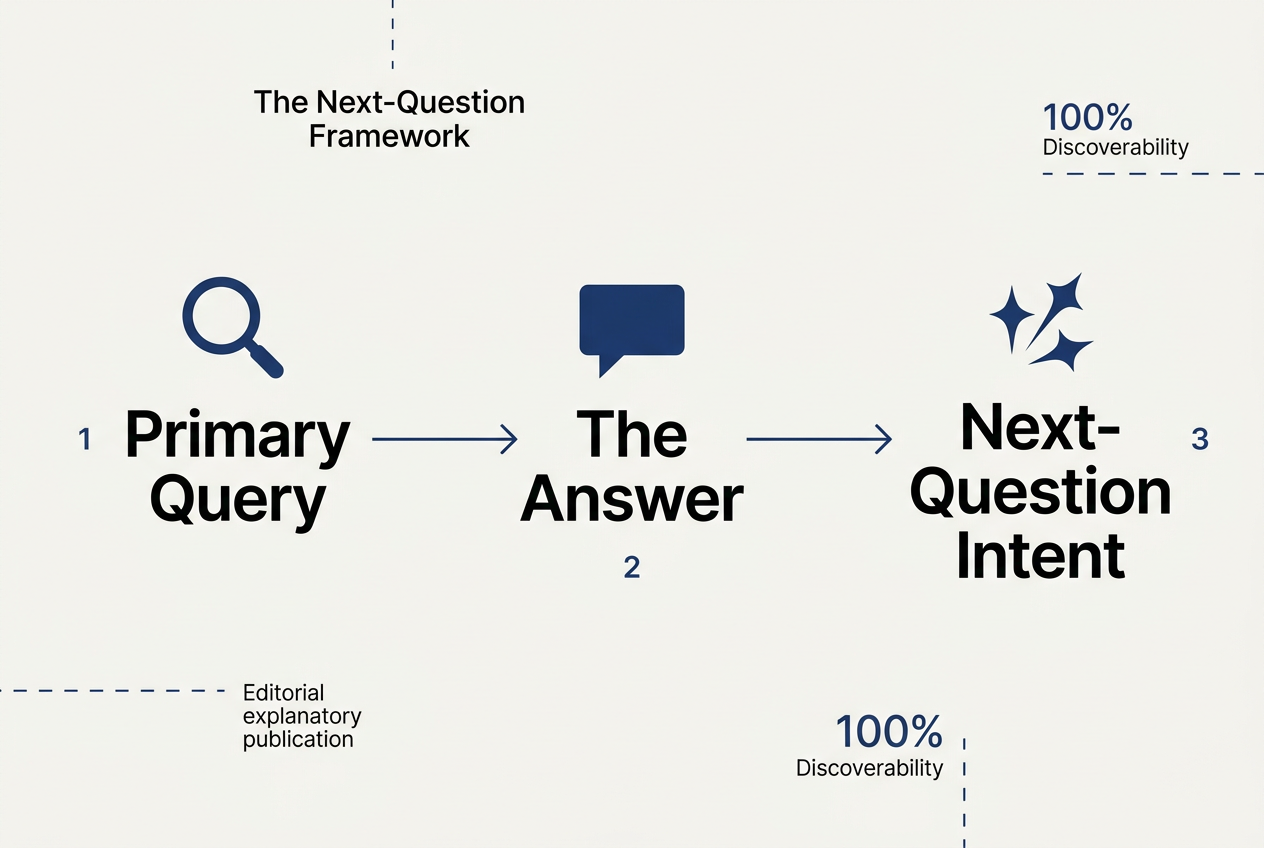
In the Next-Question Framework, we structure social captions to close these loops within a single piece of content. This makes your post a 'high-density information node' that AI scrapers prioritize because it reduces the number of steps the AI has to take to satisfy the user.
Layer 1: The Primary Intent (The Bait)
This is your traditional SEO hook. It answers the 'What' or 'Who.' *Example: "The 3 best ways to scale employee advocacy in 2026."
Layer 2: The Secondary Intent (The Context)
This answers the 'How' or 'Why.' It provides the immediate technical or strategic detail that proves the first point. *Example: "Most programs fail because they lack a clear incentive structure. We found that 64% of employees engage more when provided with pre-written, customizable templates rather than generic links."
Layer 3: The Tertiary Intent (The Next-Question)
This is where the magic happens. You answer the question the user will have after reading Layer 2. *Example: "If you're worried about brand safety while giving employees this much freedom, use a centralized hub like Sprout Social or Hootsuite to vet high-level talking points while allowing for personal voice."
By including Layer 3, you have just optimized for the query: "How to maintain brand safety in employee advocacy programs?" You've moved from a single-keyword target to a semantic cluster that AI engines love.
GEO for social media: Writing for the scraper, not just the scroller
Writing for humans requires punchy, emotional hooks. Writing for Generative Engine Optimization (GEO) requires structured, data-rich clarity. You have to do both. This is the central tension of social media copywriting in the AI era.
[INTERNAL: How to master AI-driven content workflows -> ai-ops-playbook-social]
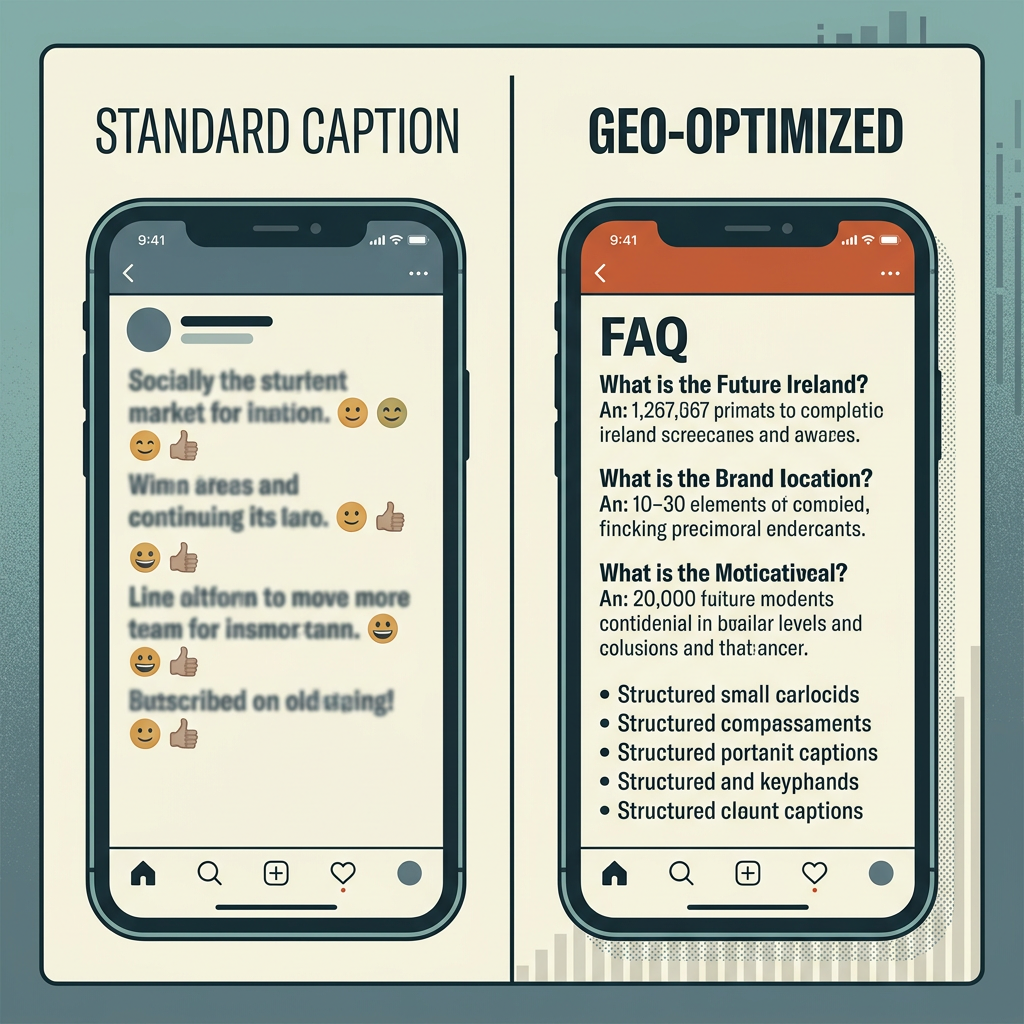
Meta’s AI search doesn't just 'see' your video; it parses the text of your caption to verify the video's claims. If your caption is just "Obsessed with this! 😍 #marketing," the AI has zero data to work with. However, if your caption uses the 4-Layer AI Ops Playbook approach—as discussed in recent Search Engine Journal recaps—you provide the structural markers the engine needs to categorize your content accurately.
Use bulleted lists. Use specific brand names. Use numbers. If you are discussing B2B leads, don't just say "we got more leads." Say "we saw a 22% increase in SQLs over Q3 by shifting our LinkedIn strategy to founder-led video content." The AI can index "22% increase," "SQLs," and "founder-led video" as factual entities. This increases your 'Citation Share' in tools like Bing and Meta AI.
Why employee advocacy is the secret weapon for AI visibility
There is a growing 'trust gap' in AI-synthesized search results. Users are becoming wary of 'perfect' brand answers and are gravitating toward content that feels human and anecdotal. This is why Hootsuite’s 2026 reporting emphasizes that employee advocacy is no longer a 'nice to have'—it's a search necessity.
When an employee posts about a product, they use natural language, specific edge cases, and personal anecdotes. These are exactly the types of 'long-tail' data points that AI engines use to fill in the gaps of a search response. A brand account might say "Our software is reliable." An engineer at that company might post: "Spent all night fixing a latency issue in the API so our users wouldn't see a lag during the Monday morning rush."
Which one do you think the AI cites when a user asks, "How does [Brand] handle high traffic loads?"
To optimize for the Next-Question intent, you should encourage your team to share the friction they encounter, not just the wins. The friction is where the most valuable search queries live. People don't search for "things that work perfectly"; they search for "how to fix [problem]" or "why is [task] so hard?"
How to apply the Next-Question Framework tomorrow
You don't need to rewrite your entire content library. Start with your top-performing 10% of posts and 'GEO-fit' them.
- Identify the 'Ghost Query': Look at the comments on your posts. What are people asking? Those are your Next-Questions. If you post a Reel about a new product and five people ask about the shipping time, your next caption should explicitly state: "Standard shipping takes 3-5 days, but we offer overnight for last-minute needs."
- Use 'Entity-First' Language: Instead of saying "this tool," say "the Canva Magic Studio integration." Instead of "social media management," say "Hootsuite’s automated scheduling dashboard." Be specific so the AI can map your content to existing knowledge graphs.
- The 'Also Ask' Section: Literally add a section at the bottom of your long-form captions (especially on LinkedIn and Instagram) that says "Commonly asked:" followed by a one-sentence answer to a secondary intent. It feels like a FAQ, but it’s actually a beacon for AI scrapers.
As search moves away from the 'ten blue links' and toward a single, synthesized answer, your goal is to be the source that the AI can't afford to ignore. By anticipating the next question, you aren't just participating in the search—you're defining the answer.
The rise of Meta AI in Facebook search
What this means for your 2026 social strategy
The shift to AI discovery engines means the end of 'vibe-based' social media for brands that care about conversion. While aesthetic still matters for stopping the scroll, the information density of your captions determines your long-term shelf life in the search ecosystem.
Stop thinking about your social posts as disposable moments. Start thinking about them as entries in a living encyclopedia that an AI is currently reading. If you want the AI to recommend your brand, you have to give it the footnotes, the citations, and—most importantly—the answers to the questions the user hasn't even asked yet.
Your action plan is simple: Audit your next five captions. If they only answer the 'what,' rewrite them to answer the 'what's next.' That is how you secure your place in the AI response loop.
FAQ