
How do you reach an audience when the ‘For You’ page is no longer controlled by a single company?
For the last decade, brand marketing leads have operated under a predictable, if frustrating, set of rules. You produce content, Meta or TikTok’s black-box algorithm evaluates it for engagement signals, and you pay a toll in ad spend to reach the followers you’ve already earned. Bluesky, built on the AT Protocol (Authenticated Transfer Protocol), is systematically dismantling that model. As Sprout Social’s recent July 2026 guide highlights, the platform isn't just a Twitter clone; it’s a sandbox for a new kind of decentralized distribution where users—not engineers in Menlo Park—decide what constitutes a ‘feed.’
For practitioners, this isn't just another platform to cross-post to. It’s a fundamental shift in how content travels. If you treat Bluesky like a centralized silo, your reach will hit a hard ceiling. To succeed, you have to understand the mechanics of the 'Feed Generator' and why the technical stack of your social team is about to become as important as their creative output.
Key Takeaways
- Feed Sovereignty: Unlike X or Threads, Bluesky allows users to subscribe to custom algorithms (Feeds) built by third parties or brands themselves.
- The AT Protocol Advantage: Portability means your audience graph isn't locked into the platform; you own the relationship, but you must work harder to maintain the visibility.
- Community-Led Moderation: Brands must navigate 'Ozone,' the stackable moderation toolset that allows communities to filter out corporate noise if it doesn't add value.
- Technical Distribution: Success requires moving beyond scheduling tools to active participation in specialized feeds like 'Science,' 'Art,' or brand-specific community hubs.
The Decentralization Analogy: From Cable TV to the Open Web
To understand Bluesky brand strategy, stop thinking of it as a social network and start thinking of it as a browser.
In the centralized era (Facebook, Instagram, TikTok), the platform is like a cable provider. They choose the channels, they set the order, and they insert commercials wherever they please. You are the content creator trying to get a slot on their basic cable package. If the provider decides to change the channel lineup (an algorithm update), your viewership vanishes overnight.
Bluesky and the AT Protocol function more like the open web. The platform is the browser, but the 'Feeds' are the bookmarks and search engines. Users choose which 'Feed Generator' they want to use to view the world. One user might use a feed that only shows posts about Major League Soccer (MLS), while another uses a feed that prioritizes long-form educational threads.
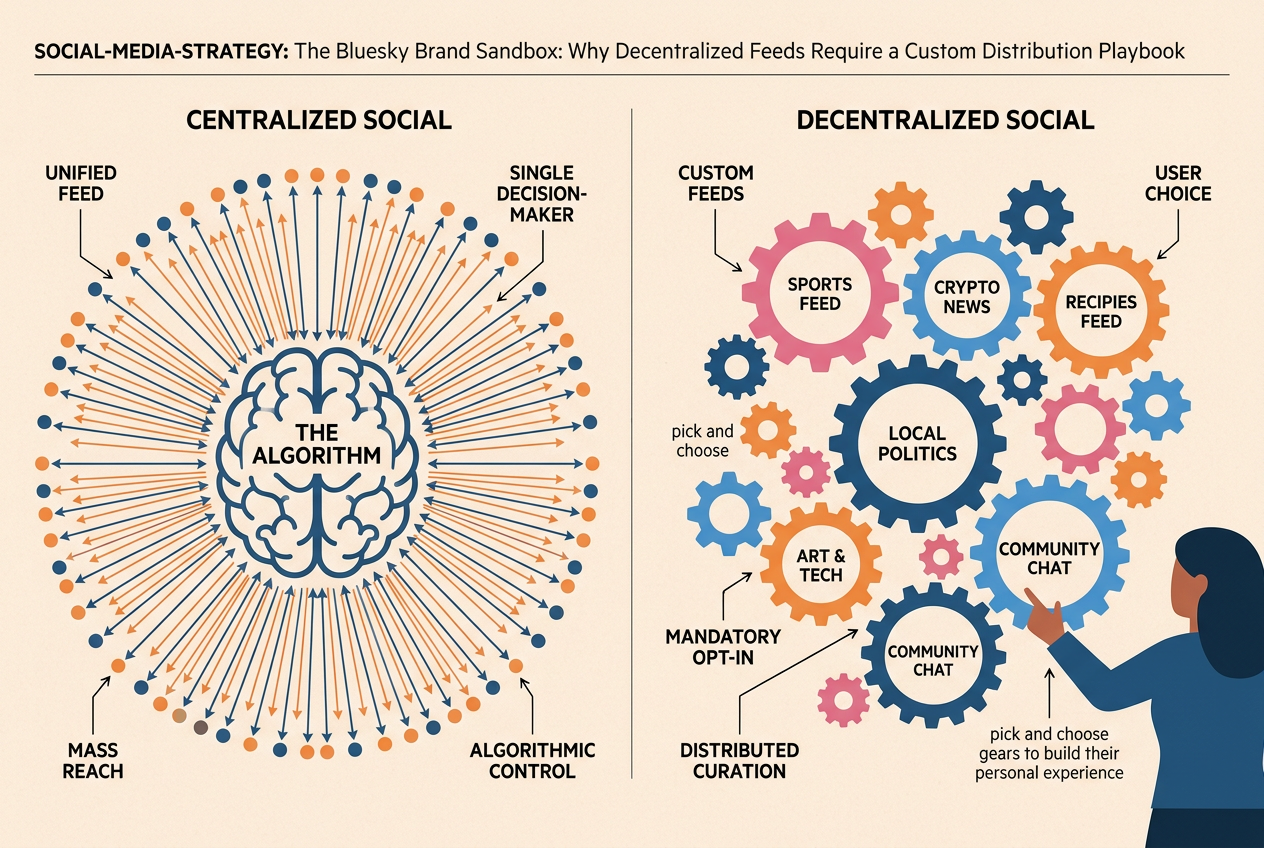
This means a brand’s reach is no longer a function of a global 'discovery' algorithm. Instead, your reach is the sum of your presence across dozens of independent feeds. If you aren't appearing in the feeds your target audience has subscribed to, you effectively don’t exist, regardless of your follower count. This is a radical departure from the 'follower-based reach' we've spent years optimizing for on LinkedIn or X.
Why Custom Feeds are the New SEO
On a centralized platform, you optimize for 'The Algorithm.' On Bluesky, you optimize for 'The Feeds.' This is where the Sprout Social analysis becomes actionable for agency strategists.
Custom feeds are essentially curated lists powered by specific code. Some are simple (posts containing a specific hashtag), but others are complex (posts from users followed by at least five people in a specific 'trust' circle). For brands, this creates a two-pronged distribution challenge:
- Feed Inclusion: How do you ensure your content meets the criteria of the most popular third-party feeds in your niche?
- Feed Creation: Should your brand host its own feed to serve as a utility for the community?
Consider the recent marketing push by MLS. According to Adweek’s July 2026 reporting, the league is embarking on its largest coordinated campaign in history ahead of the World Cup. In a Bluesky environment, the MLS wouldn't just post highlights; they would likely maintain a 'Verified Player & Club' feed. By providing this utility, they ensure that every fan who subscribes to that feed sees their content, bypassing the need to fight for space in a generic 'Sports' algorithm.
This is 'distribution as a service.' You aren't just shouting into the void; you are building the infrastructure that helps your audience find what they already want. It requires a shift from 'content creator' to 'ecosystem participant.'
The Technical Stack: Beyond the Scheduler
If you’re a paid-social buyer or a social media manager, your workflow has likely been dominated by tools like Sprout, Hootsuite, or Sprinklr. While these tools are integrating with Bluesky, they only handle the 'push' side of the equation. The 'distribution' side on the AT Protocol requires a deeper understanding of how data moves.
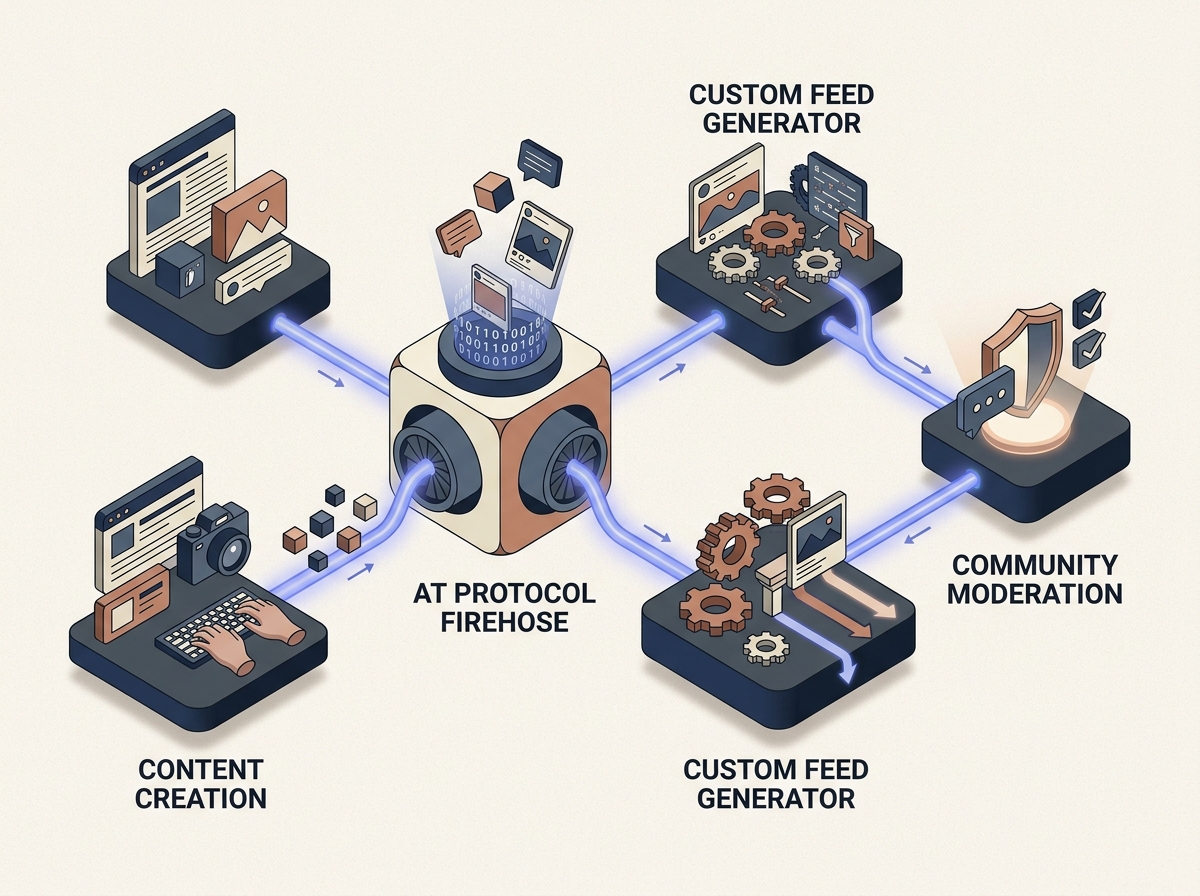
Unlike the walled gardens of Meta, Bluesky’s data is public and scrapable via the 'Firehose.' This allows for a level of transparency that makes traditional social listening look like guesswork. Brands can see exactly why a post performed well in a specific feed because the logic of that feed is often open-source.
However, this transparency is a double-edged sword. Decentralized social media relies on 'Labelers'—independent services that can flag content as spam, corporate shill, or high-quality. If your brand is flagged by a popular community labeler (like a 'Blue-Check-Only' filter or an 'Anti-Ad' filter), your visibility can drop to zero for large swaths of the user base. You can't just buy your way out of a bad reputation here.
We are seeing a revival of the 'community manager' as a high-stakes role. It’s no longer about replying with emojis; it’s about managing the brand’s standing within the technical moderation layers of the protocol. Much like the challenges in Generative Engine Optimization (GEO) discussed by Search Engine Land, where attribution is difficult but the impact is undeniable, Bluesky requires a leap of faith in 'presence' over 'perfect tracking.'
Navigating the 'Ozone' and Community Moderation
One of the most significant features for brands to monitor is Ozone, Bluesky’s collaborative moderation tool. In a centralized world, if you follow the Terms of Service, you stay online. In a decentralized world, communities can 'stack' moderation rules.
A brand might be perfectly compliant with Bluesky’s core rules but find themselves blocked by a specific community’s moderation stack because their content feels too 'ad-like.' This is the 'Brand Sandbox' problem. You are playing in a space where the users own the shovels and the buckets.
To mitigate this, brands must adopt a 'utility-first' content strategy. If you look at the top TikTok marketing agencies in 2026, as noted by Analytics Insight, the ones winning are those that lean into native-feeling, high-value content rather than polished commercials. On Bluesky, this is even more critical. Your 'ads' shouldn't look like ads; they should look like valuable contributions to a specific feed’s topic.
What This Means for Your 2026-2027 Strategy
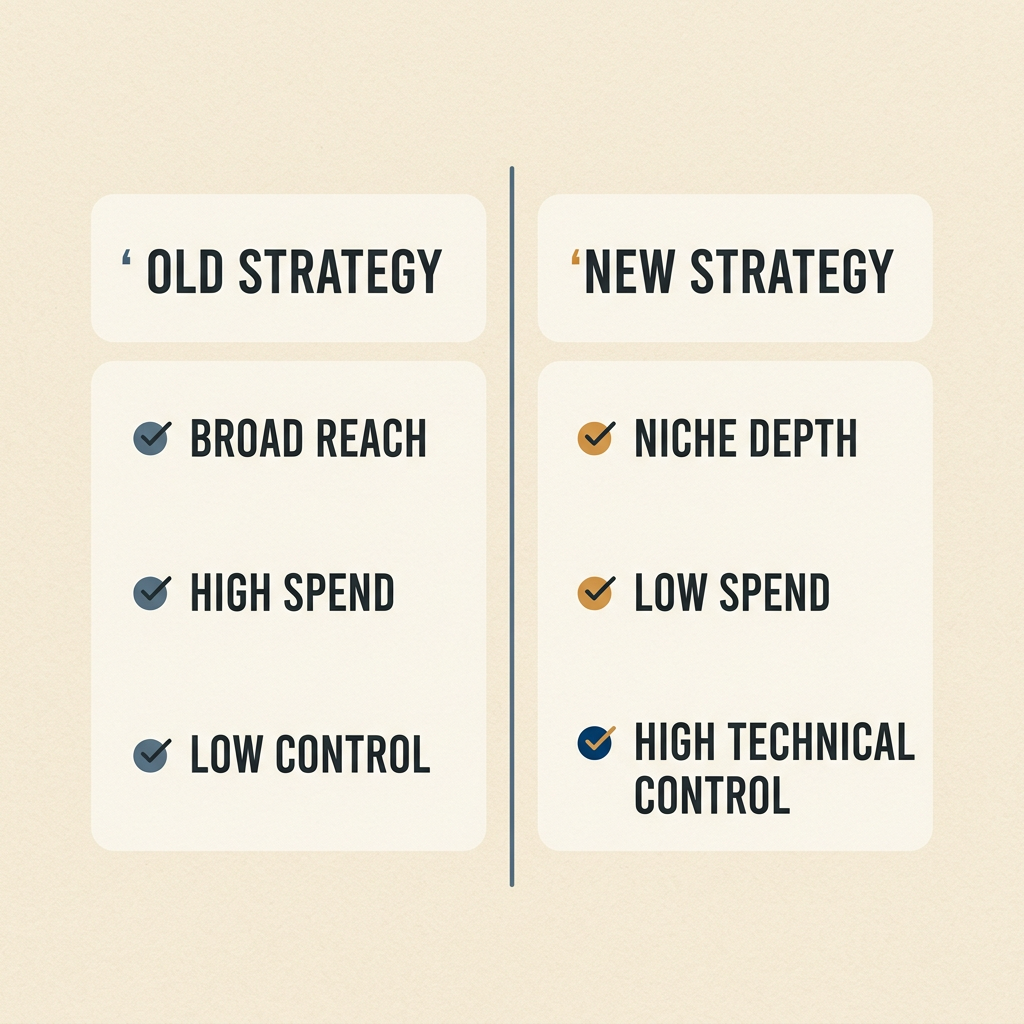
If you are drafting your 2027 social roadmap, Bluesky cannot be ignored, but it shouldn't be treated as a reach play. It is a 'depth' play.
1. Identify your 'Feed Graph' Don't just look at follower counts. Use tools to map which custom feeds your target audience is actually using. Are they in the 'Tech News' feed? The 'Sustainable Fashion' feed? Your goal is to reverse-engineer the inclusion criteria for those feeds. Sometimes it’s a specific keyword; sometimes it’s being followed by a specific set of 'seed' accounts.
2. Invest in Technical Social Your social team might need a developer—or at least a very technical strategist—who understands how to set up a PDS (Personal Data Server) or manage a custom feed. Owning a feed that becomes a community standard is the ultimate 'moat' in decentralized social. It’s the equivalent of owning the top-ranking organic spot for a high-volume keyword, but you own the keyword itself.
3. Prepare for 'Attribution Lite' As we’ve seen with Google’s recent clarifications on AI Search and Qualified Future Conversions (via Search Engine Journal), the path from discovery to conversion is becoming more fragmented. You won't always get a clean UTM click from a Bluesky feed. You have to measure 'ecosystem health'—are more people talking about your brand in the feeds that matter? Are your 'labels' positive across the major community moderators?
Conclusion: The End of the Algorithmic Monopoly
The era of the 'one-size-fits-all' algorithm is peaking. Whether it’s the rise of GEO or the migration to the AT Protocol, the trend is clear: users are reclaiming control over their attention.
Bluesky offers a preview of a world where brands must earn their way into a user’s self-selected reality. It’s a return to the early days of the web, where being 'useful' was the only way to stay relevant. For the brands that can master the technical and cultural nuances of custom feeds, the reward is a level of audience loyalty and 'un-throttled' reach that the centralized platforms simply can no longer provide.
FAQ