

Is it actually cheaper to let a robot run your Twitter account?
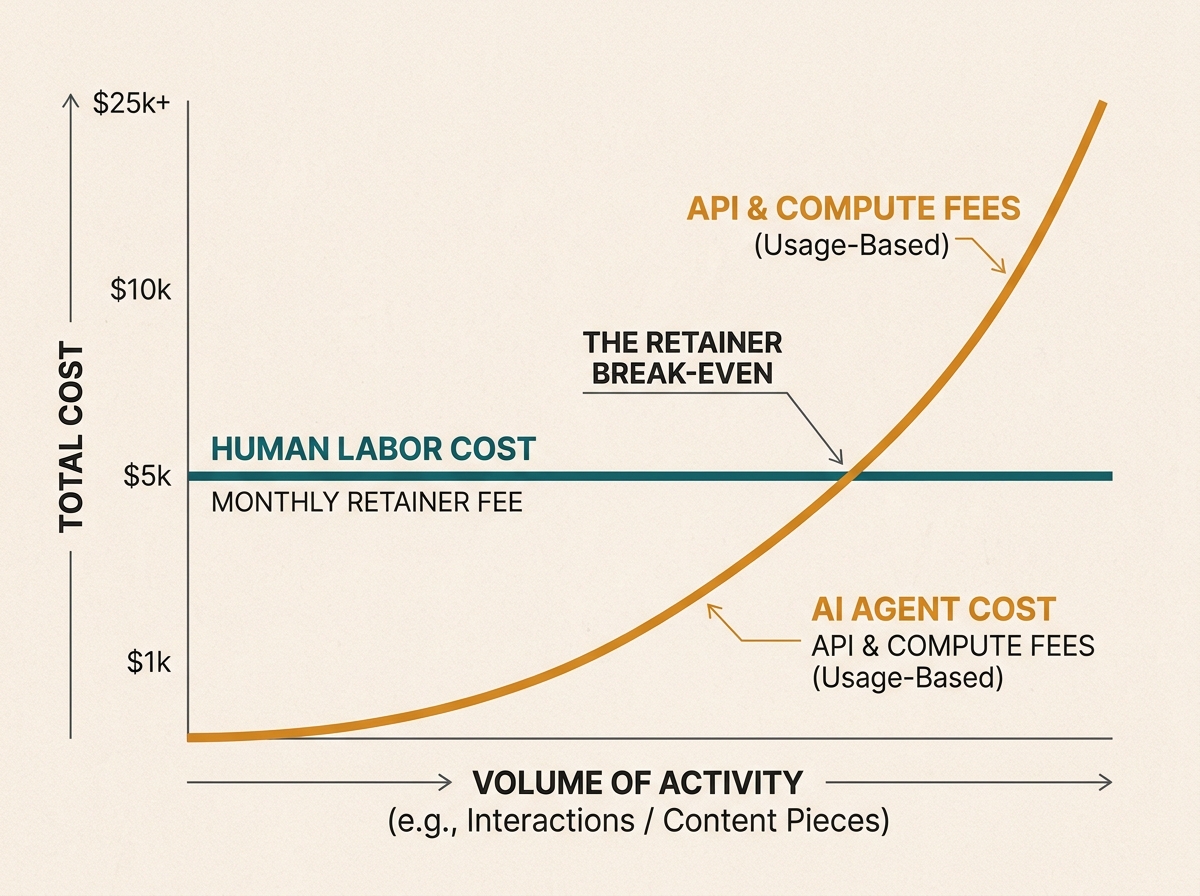
For the last eighteen months, the pitch to CMOs has been seductive: replace a $6,000-a-month agency retainer or a mid-level social media manager with an 'autonomous agent' that costs pennies per prompt. The logic follows the trajectory of SaaS—software scales at near-zero marginal cost, while humans require benefits, desk space, and sleep. But as we move into late 2026, the honeymoon period of cheap compute is ending. Between the rising cost of high-reasoning LLM tokens and the aggressive new tiering of social platform APIs, the 'robot tax' is becoming a line item that rivals traditional headcount.
If you aren't careful, you aren't automating a workflow; you're signing a blank check to OpenAI and X Corp. To understand why, we have to look past the hype of 'agentic workflows' and into the brutal math of high-frequency social engagement.
Key takeaways
- The Break-Even Point: For brands generating fewer than 500 high-quality interactions per month, AI agents are significantly cheaper than humans. Beyond 5,000 interactions, the combined cost of API access and LLM tokens often exceeds a junior staffer's salary.
- The 'Reasoning' Premium: Using high-reasoning models (like OpenAI’s o1 or Anthropic’s Claude 3.5 Sonnet) for every community management reply creates a cost-per-interaction that can reach $0.40 to $0.70 when factoring in context windows.
- Platform Tolls: X (formerly Twitter) and Reddit have set the precedent for high-cost API access, turning 'free' community management into a metered utility.
The unit economics of the 'Autonomous Agent' stack
To build an autonomous social agent, you aren't just paying for a ChatGPT Plus subscription. You are paying for a three-layered stack, each with its own toll booth.
First, there is the Platform API. Since the Great API Gating of 2023-2024, platforms like X have moved to tiered pricing where 'Pro' access—necessary for any meaningful automation—starts at $5,000 per month. Reddit followed suit, and Meta continues to tighten the screws on its Graph API for high-volume automated callers.
Second, there is the Inference Cost. This is the price per token (roughly 750 words) charged by the model provider. While simple content generation is cheap, 'autonomous' agents don't just generate; they think. They perform 'Chain of Thought' processing, where the model talks to itself to verify a brand's voice or check a legal compliance database before hitting 'post.' These hidden internal tokens can quintuple the cost of a single reply.
Third, there is the Orchestration Layer. Whether you use a tool like LangChain or a specialized marketing agent platform, these services often add a 20-30% markup on the raw compute to manage the 'memory' of the agent—ensuring it remembers what it said to a customer two days ago.
How Meta's new Reels ranking changes paid budget pacing
Why high-frequency engagement is a budget trap
In the old world of social media management, your costs were fixed. You paid a social media manager (SMM) a salary, and whether they replied to 10 comments or 1,000, your cost remained the same. This created a natural incentive for high-volume community management.
Autonomous agents flip this. Every single interaction is a metered event. If a brand like AG1 or Grüns—currently fighting for shelf space in the crowded gummy supplement market [S1]—decides to use an AI agent to engage with every mention of 'vitamins' on TikTok and X, they are creating an uncapped liability.
Consider this scenario: A viral moment occurs. Your AI agent, programmed to be 'helpful and engaging,' starts replying to thousands of threads. If each reply costs $0.15 in API and token fees, a single viral afternoon could cost $3,000 in compute alone. Unlike a human, who has a physical limit on how fast they can type, an agent can spend your entire quarterly budget in the time it takes you to finish a lunch meeting.
The 'Pollution' problem: When 10% isn't enough
We are already seeing the impact of this rush to automate. According to recent Pew Research data reported by Search Engine Journal, 1 in 10 webpages now shows signs of AI authorship [S2]. On social platforms, that number is likely higher in the comments section.
For brand managers, this creates a 'race to the bottom.' As more brands use agents to flood the zone, the platforms respond by raising API prices to curb 'spam.' This, in turn, makes it more expensive for legitimate brands to use the same tools. You are effectively paying a premium to participate in a noisier, less effective ecosystem.
If you are using 'SMM Panels' or low-cost automation services like FollowService24 [S3], you might think you’re dodging these costs. But these services often operate on the fringes of platform Terms of Service, risking shadowbans or total account de-platforming. For a serious brand, the only path is the official API, and the official API is expensive.
The Agency Retainer vs. The API Bill: A Head-to-Head
Agencies like True North Social are leaning into 'comprehensive' services that combine human strategy with digital presence management [S4, S5]. The value proposition here is shifting. You aren't paying the agency to type; you're paying them to act as a 'circuit breaker' for the AI.
| Feature | Autonomous AI Agent | Traditional Agency / In-House |
|---|---|---|
| Monthly Base Cost | $500 - $5,000 (API access) | $4,000 - $12,000 (Retainer/Salary) |
| Variable Cost | $0.05 - $0.80 per interaction | $0 (Fixed) |
| Scalability | Instant, infinite | Limited by man-hours |
| Risk Profile | Budget spikes, 'hallucinations' | Human error, slow response |
| Strategic Depth | Low (Pattern matching) | High (Market nuance) |
For a brand doing 'maintenance' social—posting three times a week and replying to direct customer service queries—the AI agent is a clear winner. But for 'offensive' social—the kind that builds a brand through witty, timely, and deeply human interaction—the unit economics of AI start to look like a bad deal.
[INTERNAL: The three creators who broke 1M followers this week using audio-first -> creator-growth-trends]
How to audit your automation for 'Token Waste'
If you have already started deploying agents, you need to conduct a 'Token Audit' immediately. Most marketing teams are over-provisioning their AI. You do not need a GPT-4o level model to tell a customer 'Thanks for the feedback!'
- Tier your models: Use 'small' models (like Llama 3 8B or GPT-4o-mini) for simple engagement. Reserve the 'large' models for content creation and sentiment analysis.
- Set hard caps: Your API orchestration layer must have a 'kill switch' that pauses the agent if spend exceeds a daily threshold.
- Filter at the edge: Don't send every mention to the LLM. Use simple keyword filtering to discard 'noise' before you pay the 'inference tax' to analyze it.

What this means for your strategy
The goal of social media marketing in 2027 won't be 'more content.' It will be 'more margin.' The brands that win will be those that use AI to handle the mundane, but keep the high-value, high-context interactions in human hands.
Don't let the allure of 'autonomous' social blind you to the reality of the balance sheet. A $5,000 API bill for a bot that provides 10% of the value of a $5,000-a-month strategist is a failing grade in marketing operations. Evaluate your tech stack not by what it can do, but by what it costs to do it at scale. The 'robot tax' is real, and it’s time to start accounting for it.
The path forward: Hybrid Social Operations
Instead of full autonomy, aim for 'Cyborg' workflows. Use AI to draft, but humans to approve. Use AI to monitor, but humans to engage. This keeps your API calls predictable and your brand voice authentic. As the gummy brands battle for shelf space [S1], they aren't winning because of their automation; they are winning because of their brand resonance. No amount of API spend can buy the 'squishy' human connection that makes a consumer choose one supplement over another.
Stop thinking about AI as a replacement for payroll. Start thinking about it as a high-performance, high-cost fuel. You only use it when you're ready to race.
FAQ