
Performance marketing has spent the last decade chasing a ghost. We’ve obsessed over the 'perfect' path to purchase, building increasingly fragile attribution models that break every time a browser updates or a platform shifts its privacy policy. By mid-2026, the cracks have become chasms. Google Ads has finally introduced dedicated reporting for new customer acquisition—a feature that renders the old 'reporting workarounds' for new-to-brand growth completely useless. Meanwhile, the impending Nielsen and DoubleVerify merger signals a massive shift toward consolidated, high-level verification over granular, pixel-based tracking.
If you're still using the same reporting dashboard you built in 2022, you aren't just measuring incorrectly; you're likely actively harming your brand's growth. The tools have changed. The algorithms, like Instagram's real-time customization engine, now move faster than a standard 7-day click window can capture. It is time for a ruthless audit.
Why it matters: Continuing to optimize for legacy metrics leads to 'zombie spend'—budgets that look profitable on paper but fail to drive incremental revenue in your bank account. As platforms move toward automated, black-box bidding, your only lever for control is the quality of the data you feed back into the system.
TL;DR
- Stop tracking platform-reported ROAS as a primary success metric; it’s an efficiency ratio, not a growth engine.
- Eliminate last-click social attribution which ignores the long-tail impact of video and mid-funnel awareness.
- Pivot to incrementality and MER (Marketing Efficiency Ratio) to see the true relationship between spend and total revenue.
- Leverage new platform-native tools like Google’s new customer reporting to separate retention from acquisition.
1. Platform-Reported ROAS (Return on Ad Spend)
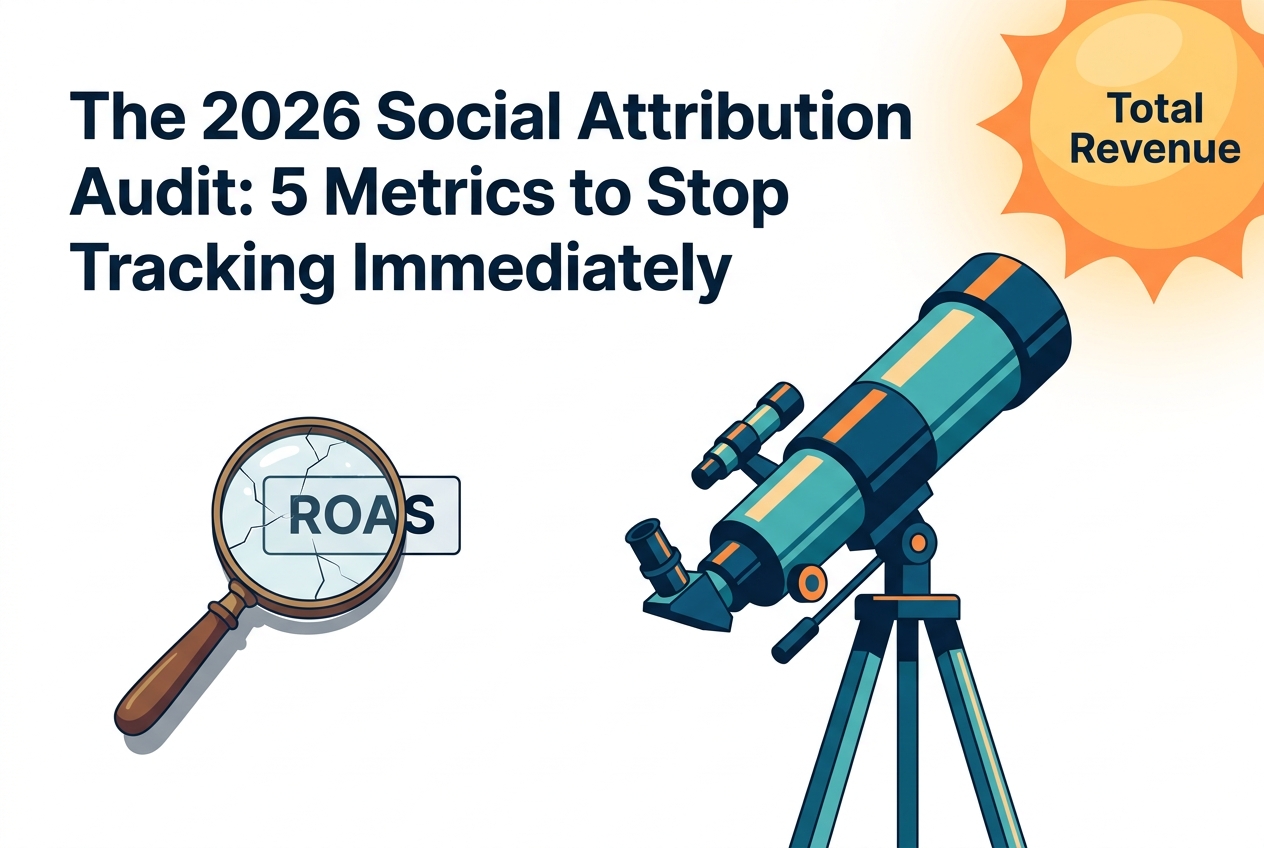
For years, ROAS was the North Star. If the Facebook pixel said you had a 4.0x return, you scaled. If it dropped to 2.0x, you cut. In 2026, this is a dangerous oversimplification. Platform-reported ROAS is increasingly a 'vanity efficiency' metric because it cannot distinguish between an ad that caused a sale and an ad that merely appeared in front of someone who was already going to buy.
With the rise of Advantage+ and TikTok’s automated targeting, platforms have a vested interest in showing ads to your most likely buyers—often your existing customers or high-intent shoppers who just came from your email list. When the platform claims credit for these sales, your ROAS looks phenomenal, but your business isn't actually growing. You are simply paying a tax on sales you would have made anyway.
Instead of ROAS, sophisticated teams are moving toward iROAS (Incremental Return on Ad Spend). This requires regular lift testing—turning off ads in specific geographic regions or for specific audience segments to see what happens to the baseline sales. If sales don't drop when the ads stop, your 4.0x ROAS was a lie.
Best for: High-volume e-commerce brands that have reached a saturation point and need to justify further scaling without cannibalizing organic sales.
2. Last-Click Social Attribution
Last-click attribution is the flat-earth theory of digital marketing. It assumes that the very last thing a person did before buying is the only thing that matters. In an era where YouTube is testing static image overlays during horizontal mobile playback and Instagram is adjusting feeds in real-time, the path to purchase is a tangled web, not a straight line.
How the latest YouTube ad formats are changing mobile behavior
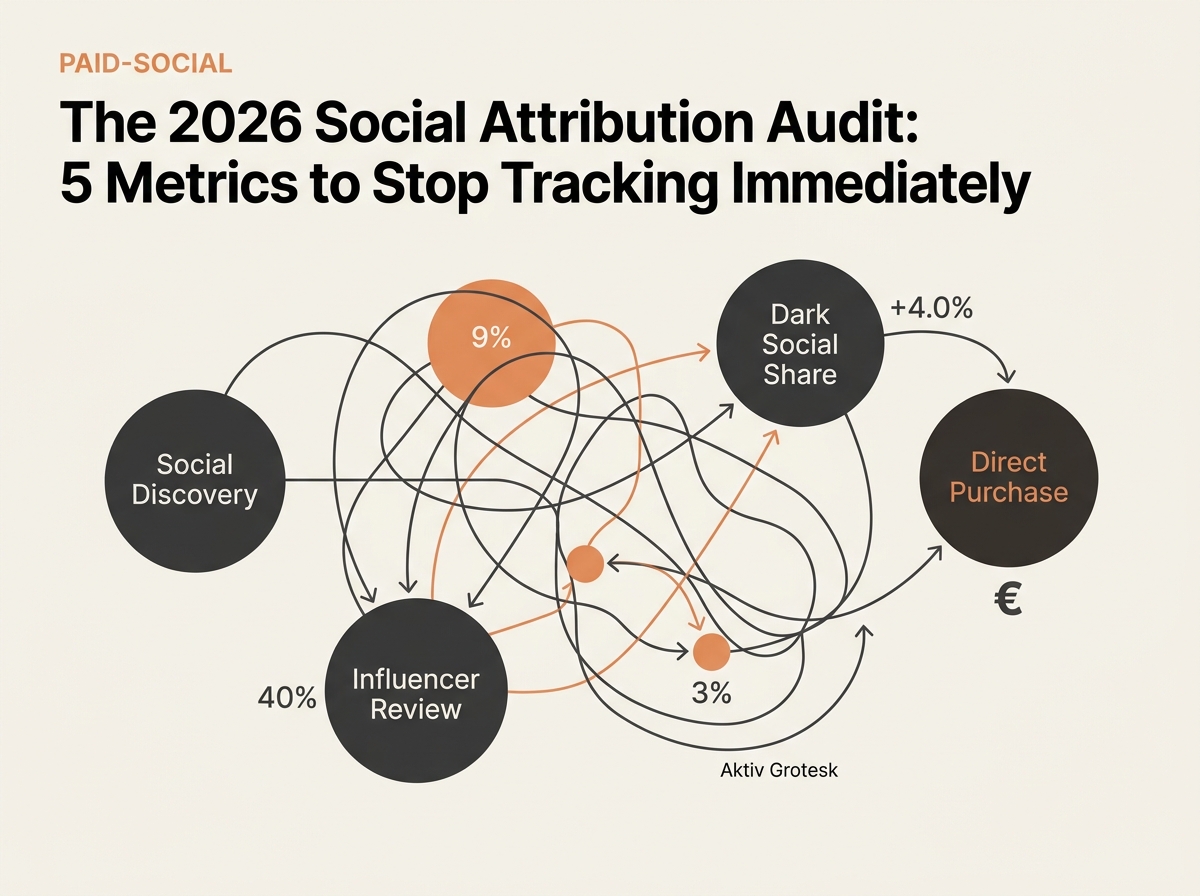
When you rely on last-click, you systematically undervalue your most important work: the top-of-funnel awareness that put your brand in the consumer's mind in the first place. Video content, specifically, suffers under last-click. A user might watch three of your Reels, see a creator's review, and then two weeks later type your URL directly into their browser. In a last-click model, social gets zero credit. Direct gets it all.
By 2026, the industry has moved toward MMM (Marketing Mix Modeling) and Triangulation. You don't look for one source of truth; you look for the intersection of three: platform data, post-purchase surveys ("How did you hear about us?"), and statistical modeling. If you don't acknowledge the 'dark social' and view-through impact, you will eventually turn off the very ads that are filling your funnel.
Best for: Brands with a high-consideration product or a sales cycle longer than 48 hours.
3. Blended Engagement Rate
We need to stop talking about 'engagement' as if a like, a comment, and a share are equal—or even valuable. In the current social landscape, engagement has been decoupled from reach. Instagram’s 2026 algorithm updates focus on 'real-time customization,' meaning the app prioritizes what you are likely to watch now, not necessarily what you've interacted with in the past.
High engagement rates can be misleading. A controversial post might garner thousands of comments (high engagement) but drive zero brand affinity or conversions. Conversely, a high-intent product demo might have low engagement but high 'save' and 'share' rates among a small, qualified audience.
Stop reporting on a generic engagement percentage. Instead, focus on Active Signal Mapping. Track the actions that actually correlate with your business goals. For most, this means 'Saves' (intent to revisit) and 'Shares' (organic amplification). A 'Like' is a micro-second habit; a 'Share' is an endorsement. If you are reporting to a CMO, replace the engagement slide with a 'Cost Per New Customer Acquired' slide using Google's new dedicated reporting tools.
Best for: Content-heavy brands and creator-led businesses trying to move beyond 'clout' into actual community-driven commerce.
4. Multi-Touch Attribution (MTA) Pathways
There was a time, roughly between 2015 and 2020, where we believed we could track every touchpoint. We thought we could see that a user saw a Pinterest pin, then a Facebook ad, then a Google search, and assign 20% credit to each. Privacy regulations like GDPR, CCPA, and Apple’s App Tracking Transparency (ATT) have effectively killed this.
Any tool that claims to give you a 100% accurate multi-touch path in 2026 is using probabilistic 'fingerprinting'—a technique that is increasingly being blocked by browsers and penalized by platforms. These paths are now mostly guesswork. When you base your budget on a guess, you're gambling, not marketing.
[INTERNAL: The impact of the Nielsen-DoubleVerify merger on transparency -> nielsen-dv-merger-analysis]
The alternative is Media Effectiveness Ratio (MER), often called 'Blended ROAS.' You take your total revenue and divide it by your total ad spend across all channels. It’s a blunt instrument, but it’s an honest one. It forces you to look at the business as a whole rather than getting lost in the weeds of which specific ad 'won.'
Best for: Omnichannel retailers who sell both online and in physical locations where digital tracking is inherently broken.
5. Follower Growth as a KPI
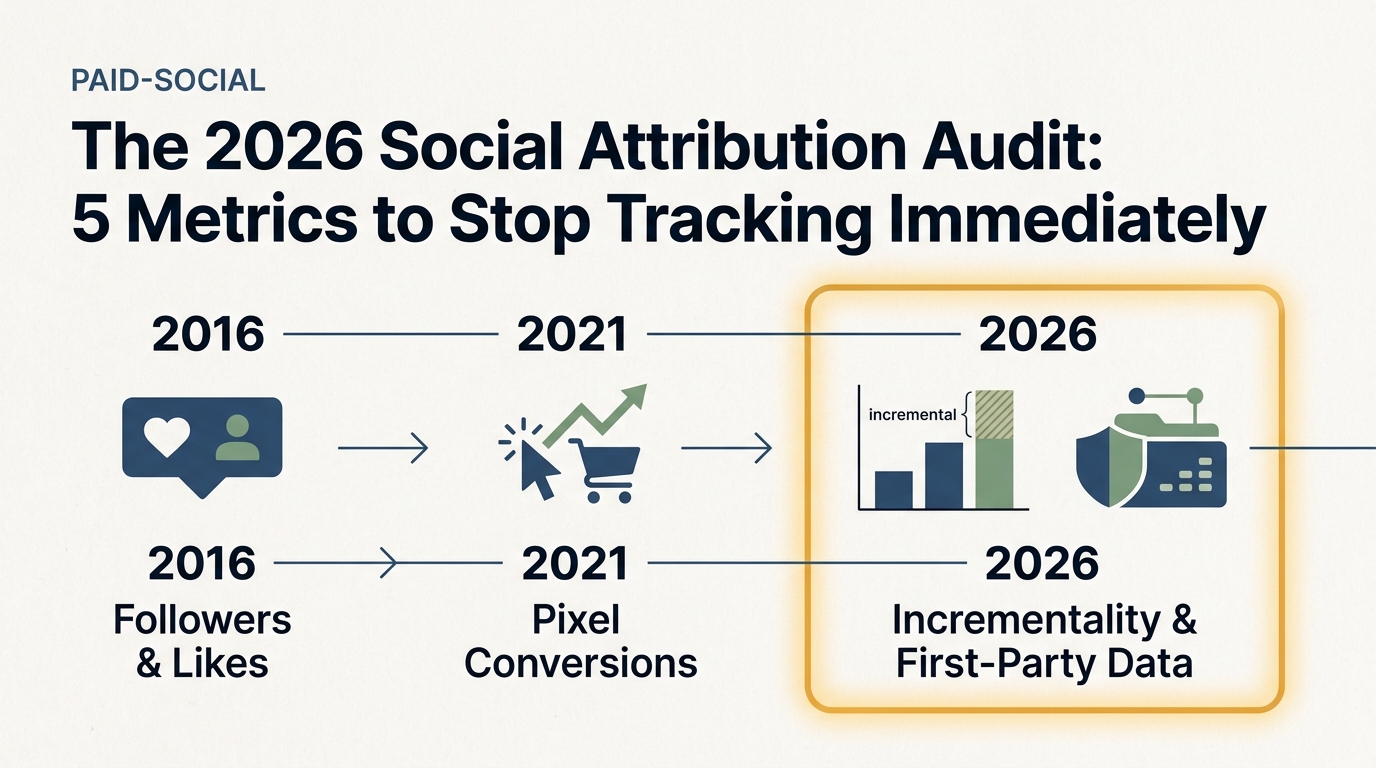
The 'Follower' is a legacy unit of measurement. On TikTok, your followers don't guarantee views. On Instagram, the 'Following' tab is a ghost town compared to the 'For You' or 'Reels' feeds. Building a massive follower count was the goal of 2016; in 2026, the goal is building an Addressable Audience.
If you have 1 million followers but your organic reach is 1%, those followers are an ego metric. They don't represent an asset; they represent a graveyard of past interest. High follower counts can even hurt you if those followers are inactive, as the algorithm sees a lack of interest from your 'core' fans and decides not to push your content to new people.
Stop reporting on follower growth. Start reporting on Repeat Reach and Owned Audience Conversion. How many people are seeing your content at least three times a week? How many people are moving from your social channels into your email list or SMS program? That is the only 'following' you actually own.
Best for: Any brand that has historically over-indexed on 'community management' without seeing a corresponding lift in customer lifetime value (LTV).
The New Measurement Framework for 2027
As we look toward 2027, the measurement landscape will be dominated by two things: First-Party Data and Incrementality. The platforms are no longer providing the data we need to be lazy. We have to do the work of building our own attribution loops.
Google’s move to provide dedicated 'New Customer' reporting is a gift. It allows you to bid specifically for people who have never bought from you before, without the platform 'cheating' by showing ads to your existing fans to hit a ROAS target. Microsoft is following suit with bulk policy tools that allow for faster adjustments to these new-to-brand campaigns.
To survive the next 18 months, you must simplify your reporting. If a metric doesn't directly answer the question, "If I spent an extra $10,000 here tomorrow, would I make more than $10,000 in additional profit?", then it doesn't belong on your primary dashboard. Kill the zombies. Focus on the increment.
How to Transition Your Reporting Next Quarter
You don't have to delete your old dashboards overnight. Start by adding a 'Validation' layer. For every platform-reported conversion, cross-reference it with your internal CRM data. Use post-purchase surveys to find the gap between what the pixel says and what the customer says.
Eventually, you will find that the 'truth' lies somewhere in the middle. By focusing on the 5 metrics listed above, you clear the fog. You stop optimizing for the platform's success and start optimizing for your own. The 2026 audit isn't just about cleaning up spreadsheets—it's about reclaiming your strategy from the algorithms that have been grading their own homework for far too long.
[INTERNAL: Why first-party data is the only hedge against algorithm shifts -> first-party-data-strategy]
Measurement is no longer a technical problem to be solved with a better pixel; it is a strategic problem to be solved with better logic. The brands that win in the second half of this decade will be the ones that stopped asking 'Which ad got the click?' and started asking 'Which ad changed the customer's mind?'
FAQ