
Can a messaging app really replace your B2B sales development representative? For years, WhatsApp was the place where customer service went to die in a sea of 'Press 1 for Sales' menus. But Meta's recent rollout of Business AI—initially launched in India with a global roadmap following—changes the math for B2B marketers. We aren't just talking about better chatbots; we are looking at a fundamental shift in how small-to-mid-sized businesses (SMBs) move prospects from a social ad to a signed contract.
Why it matters: As website traffic loses ground to AI-driven search and platform-native experiences (per MarTech's May 2026 reporting), the 'destination' for your B2B ads is no longer a landing page—it's a conversation. If you don't automate that conversation, you lose the lead.
Key takeaways
- Qualification at Scale: WhatsApp Business AI can now ingest your product PDFs and site data to answer complex B2B queries without human intervention.
- The 'Un-Gated' Shift: Instead of a whitepaper behind a form, use AI to deliver insights directly in the chat, capturing contact info via Meta's native profile sharing.
- CRM Integration: The real power lies in syncing these AI-led conversations back to Salesforce or HubSpot to trigger automated follow-ups.
The fundamental shift from FAQ bots to reasoning agents
To understand why this update matters, you have to look at what came before. Traditional WhatsApp automation relied on 'if-then' logic. If the user says 'pricing,' send the pricing PDF. It was brittle, frustrating, and distinctly un-human. Meta's new Business AI uses the Llama-3 architecture to understand intent. It doesn't just look for keywords; it looks for context.
Imagine a prospect asks: 'How does your SaaS platform handle GDPR compliance for German data centers?' A traditional bot would fail or send a generic security link. The new AI agent pulls specific data from your uploaded knowledge base—technical whitepapers, help docs, and past successful sales transcripts—to provide a nuanced, three-paragraph answer. It then asks a follow-up: 'Would you like to see our specific certification for the Frankfurt region?'
This is the difference between a gatekeeper and a concierge. For B2B brands, this reduces the friction of the 'research phase.' According to recent industry shifts noted by MarTech in May 2026, AI visibility is becoming a primary success metric. If your brand's 'knowledge' is accessible via a WhatsApp AI agent, you're winning the visibility game before the prospect even hits your website.
1. Automated lead qualification with dynamic scoring
One of the biggest drains on B2B resources is the 'junk lead.' You spend $50 per click on LinkedIn or Meta ads, only to have a student or a competitor fill out the form. WhatsApp Business AI allows you to move the qualification process to the very first touchpoint.
You can program the AI to ask the 'big three' qualifying questions: budget, authority, and timeline. But unlike a static form, the AI can pivot based on the answer. If a prospect says their budget is 'flexible,' the AI can ask for a range. If they mention a specific pain point—say, 'we are struggling with churn'—the AI can instantly prioritize that lead in your CRM and notify a senior account executive.
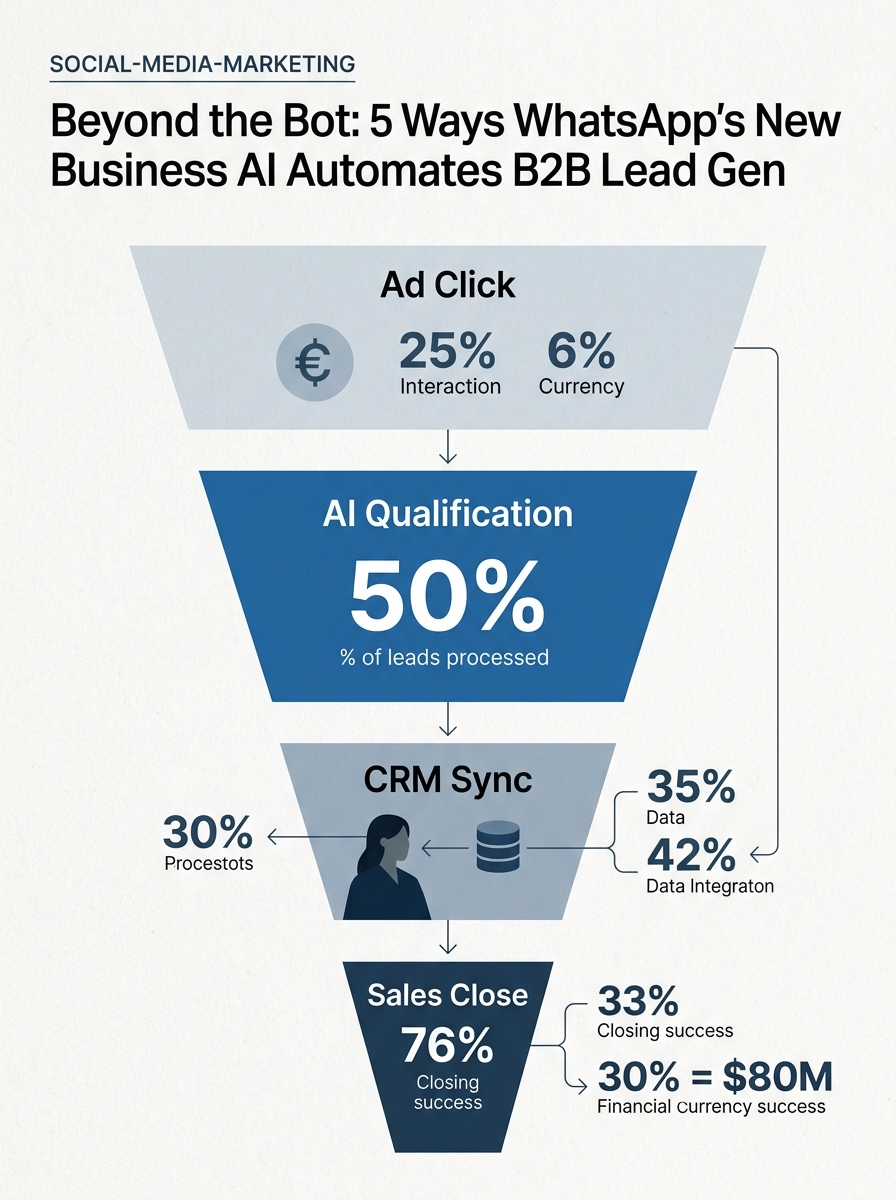
This isn't just theory. We are seeing SMBs in the initial rollout phases using these bots to filter out nearly 40% of non-qualified traffic before a human ever sees the notification. By the time the lead reaches your sales desk, you have a full transcript of their needs, their technical constraints, and their level of urgency. How AI is reshaping B2B attribution
2. The 'Always-On' technical support concierge
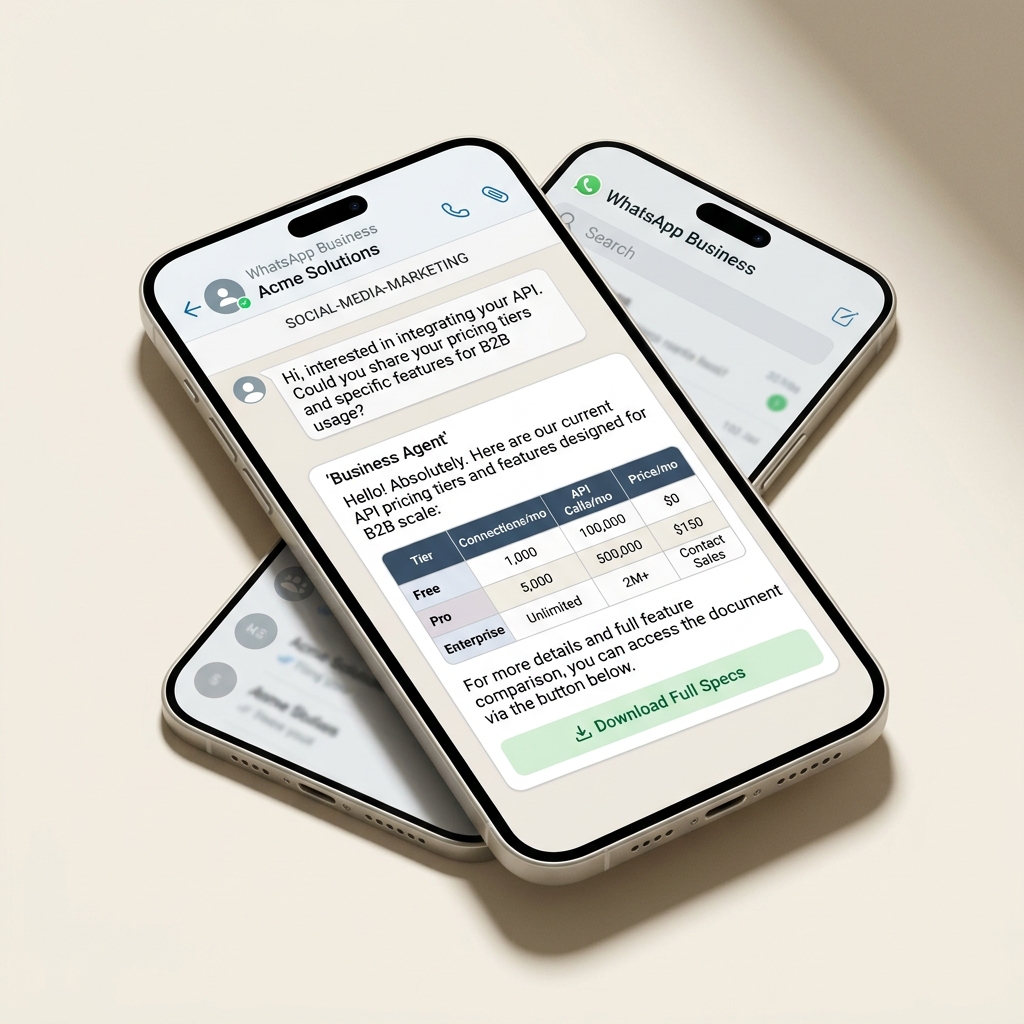
In B2B, the sale doesn't end at the signature. However, the pre-sale technical hurdles are often where deals go to die. Prospects have specific questions about integrations, API limits, or implementation timelines. Usually, these require a 'call with an engineer.'
WhatsApp Business AI acts as a bridge. By training the model on your technical documentation, you allow prospects to perform their own due diligence at 2 AM on a Sunday. This 'self-serve' model is becoming the gold standard. As Buffer's 2026 tool guide highlights, the most effective engagement tools are those that reduce the time-to-value for the end user.
If the AI can't answer a technical question, it doesn't just give up. It creates a ticket, summarizes the conversation, and tells the prospect exactly when a human expert will be in touch. This transparency builds trust faster than a 'we'll get back to you' auto-reply ever could.
3. Contextual content delivery (RIP the PDF Gate)
We have been taught for a decade that B2B lead gen requires a 'lead magnet' behind a gate. You want the ebook? Give us your email. But in a world where users are wary of spam, the friction of a form is a conversion killer.
WhatsApp Business AI allows for 'conversational gating.' Instead of a form, the AI offers a value-exchange. 'I see you're interested in our Q3 benchmarks. Would you like me to send the highlights here, or would you prefer the full 40-page report via email?' If the user says 'here,' the AI provides the data points directly in the chat. If they want the full report, the AI uses Meta's 'Click-to-WhatsApp' ad data to pre-fill their contact info.
This reduces the 'drop-off' rate between the ad click and the lead capture. You're meeting the user where they already are. Since Meta deprecated certain tracking features in late 2025, these first-party conversational data points have become the most reliable way to build a retargeting audience.
4. Re-engaging 'Cold' leads without the spam feel
Every B2B marketer has a database of 'dead' leads—people who downloaded a resource six months ago and never replied to an email. Email open rates in B2B continue to hover in the low 20% range. WhatsApp, conversely, sees open rates north of 80%.
With Business AI, you can trigger re-engagement campaigns that feel personal. Instead of a generic 'Checking in' email, the AI can reference the previous conversation. 'Hi Sarah, when we spoke in March, you were looking at expanding your team. We just released a new module for team scaling—would you like to see how it works?'
Because the AI remembers the context, it doesn't feel like a mass broadcast. It feels like a follow-up from a partner. This is particularly effective for mid-market companies where the sales cycle can last 6-12 months. Keeping the thread alive in a messaging app keeps your brand top-of-mind in a way a buried email folder never will.
5. Seamless handoffs to human sales teams
Automation shouldn't be a wall; it should be a trampoline. The ultimate goal of WhatsApp Business AI for B2B is to get the right person on a call with the right prospect.
The AI can monitor sentiment. If it detects frustration or a high-intent signal (e.g., 'I need to buy this by Friday'), it can trigger a 'Human Takeover.' This sends a push notification to your sales team's mobile device. They can jump into the live WhatsApp thread, see the entire AI-generated history, and take over the closing process seamlessly.
This hybrid approach—AI for the 'grunt work' of qualification and humans for the 'heart work' of closing—is the blueprint for 2026. It allows a small marketing team to act like a global enterprise without the massive headcount. [INTERNAL: The rise of hybrid AI-human social desks -> hybrid-social-teams-2026]
What this means for your 2026 strategy
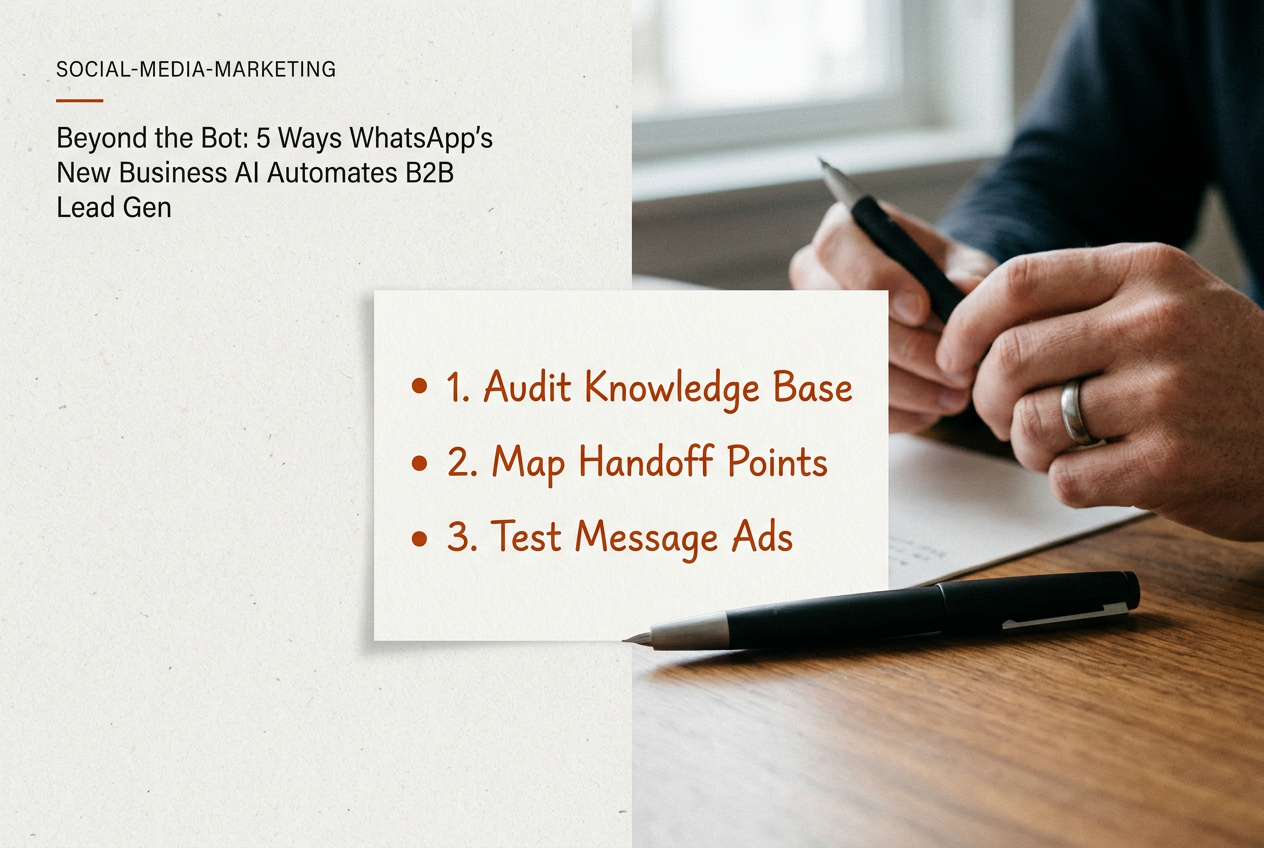
If you are waiting for the 'perfect' time to start with WhatsApp, you're already behind. The India rollout is the beta test for a global infrastructure. To prepare, you need to do three things immediately:
- Audit your knowledge base: AI is only as good as the data it eats. If your technical docs are out of date, your AI agent will lie to your prospects. Start cleaning up your internal FAQs and product specs now.
- Map your 'Handoff' points: Decide exactly when a bot should stop and a human should start. Is it after three questions? Is it when a certain budget threshold is mentioned? Map this in a flowchart before you touch the software.
- Test Click-to-WhatsApp ads: Switch 10% of your B2B ad budget from 'Lead Form' objectives to 'Message' objectives. Compare the cost-per-qualified-lead, not just the cost-per-click. You'll likely find that while the clicks are more expensive, the conversion to 'SQL' (Sales Qualified Lead) is significantly higher.
As we see with the rise of AI video generators (S4) and the shift in how TikTok Shop is being utilized (S5), the platforms are moving toward a 'closed-loop' ecosystem. Meta wants you to find the lead, qualify the lead, and close the lead without ever leaving their family of apps. WhatsApp Business AI is the engine that makes that possible for the B2B sector. Don't treat it as a support tool; treat it as your most efficient salesperson.
FAQ