
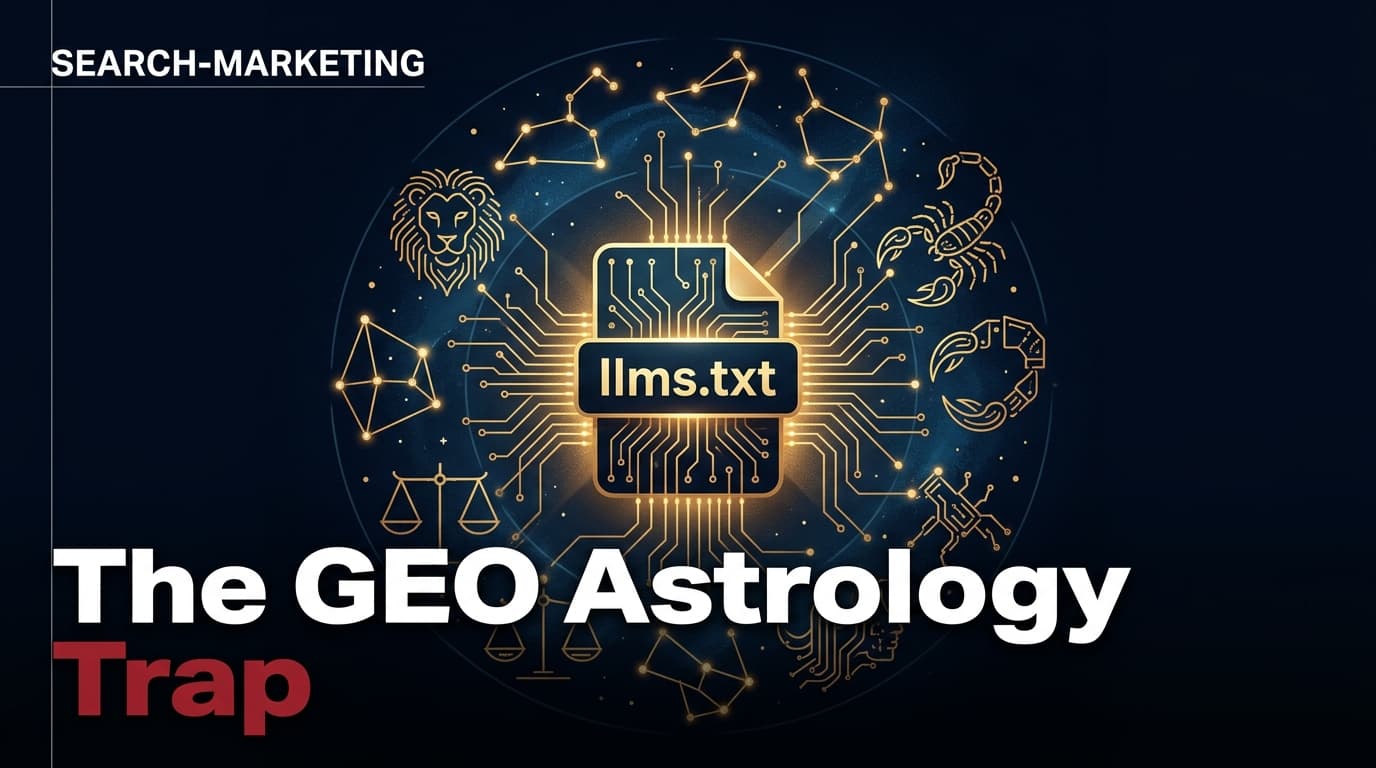
Generative Engine Optimization (GEO) is currently the marketing equivalent of reading tea leaves. The industry's sudden obsession with the llms.txt file—a proposed standard to feed compressed, high-priority context to Large Language Models—is built more on hope than on measurable performance. Until OpenAI, Perplexity, and Google provide transparent feedback loops, these tactics are 'GEO astrology': a set of rituals performed in the dark, lacking the empirical verification that turned traditional SEO into a multi-billion dollar discipline.
The Fallacy of the Magic Text File
The premise of llms.txt is seductive. By placing a markdown file at your root directory, you supposedly provide a 'cheat sheet' for AI agents. The theory suggests that when an agent from SearchGPT or Perplexity hits your site, it will prioritize this concise, structured data over the messy HTML of your blog posts. It’s an elegant solution to a real problem: LLMs have finite context windows and high compute costs. They should love a shortcut.
But 'should' is not a strategy. Recent internal testing by several enterprise-level agencies suggests that crawlers are largely ignoring these files in favor of their existing scrapers. Unlike the robots.txt file, which carries legal and functional weight for search engines, llms.txt is currently a suggestion that the most prominent AI labs have yet to formally commit to respecting at scale. We are seeing a repeat of the early 2010s 'Schema fever,' where marketers spent thousands of hours tagging data that Google simply didn't use for years.
If you're spending your Friday afternoon refining the tone of your llms.txt file, you're likely wasting your time. The 'intelligence' in these models is designed to parse the human-readable web. If your site requires a special summary to be understood by a trillion-parameter model, the problem isn't your lack of a text file; it's your site's information architecture.
The Attribution Gap and the 'Black Box' Problem
The primary reason GEO feels like astrology is the total absence of a 'Search Console' for the AI era. According to a recent report by Search Engine Journal, AI's impact is outrunning our ability to measure it. We are in a measurement vacuum. When a user asks Perplexity for the 'best social media scheduling tool' and Perplexity cites Hootsuite, Hootsuite sees that as a referral in their analytics. But what if the AI provides the answer without a link? Or what if it uses your llms.txt data to satisfy the query entirely on-platform, resulting in zero traffic?
AI's impact outrunning measurement
This is the 'Intelligence vs. Agency' split. We are optimizing for models that are increasingly incentivized to keep users on their own interface. By providing a perfect, pre-digested summary in llms.txt, you might actually be making it easier for the AI to cannibalize your traffic. You are handing the thief a map to the jewelry box. Traditional SEO was a fair trade: we provide the content, Google provides the traffic. GEO, as currently practiced, looks like a one-way street where brands provide the training data and get a 'citation' that 90% of users will never click.
Why Quality Still Trumps Technical Shortcuts
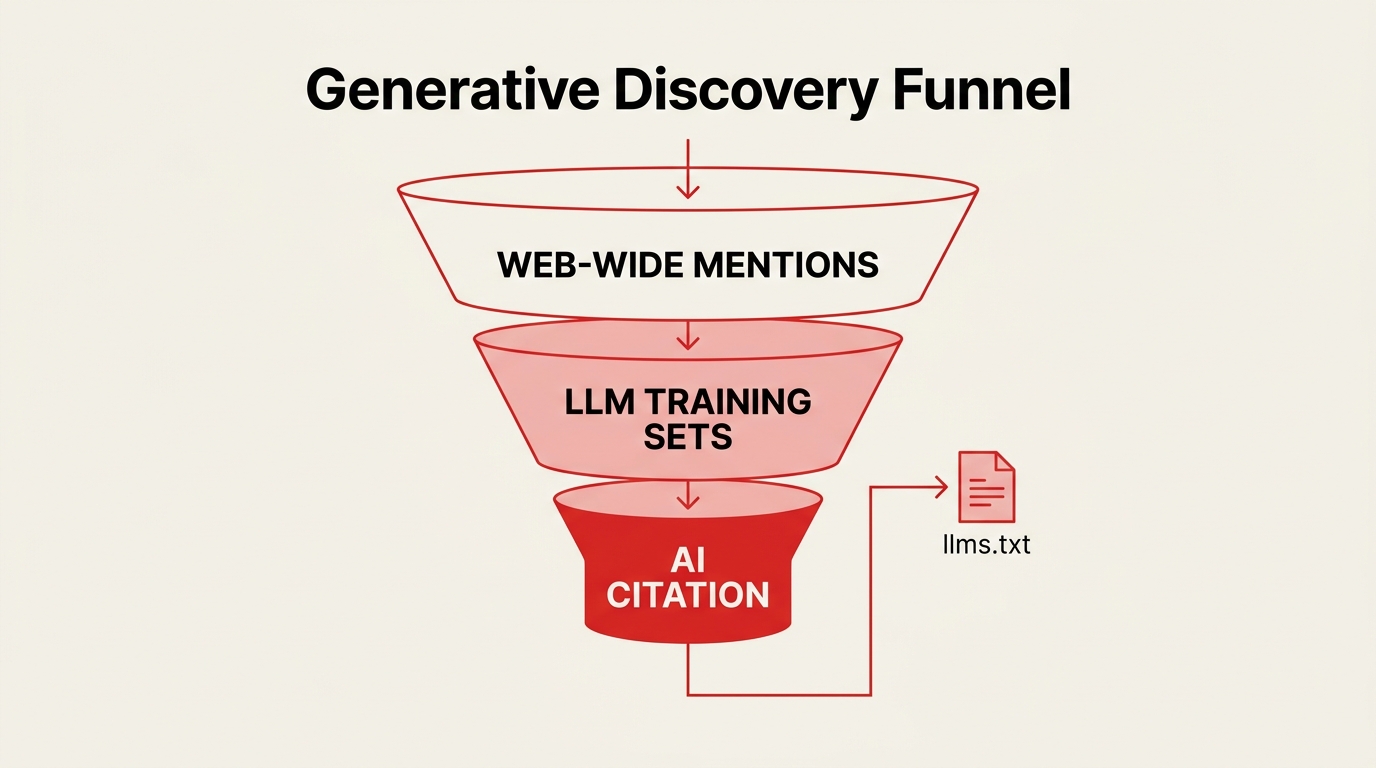
While the technical crowd argues over markdown syntax, the brands actually winning in AI summaries are doing so through sheer volume of high-authority mentions. Look at Disney’s recent TikTok deal. By turning fan creators into a marketing engine for their parks, Disney is creating a massive footprint of natural language sentiment across the web. When an LLM scans the social web to understand 'Disney Park experiences,' it isn't looking for a llms.txt file on Disney.com. It is looking at the aggregate of thousands of creator videos, reviews, and social posts.
Disney's TikTok creator strategy
AI models are probabilistic. They weight information based on frequency, recency, and authority across the entire web. A single markdown file at the root of your site is a whisper in a hurricane. To influence a generative engine, you need to influence the sources the engine trusts. This means doubling down on PR, creator partnerships, and high-value social content—the 'old school' digital marketing tactics that actually move the needle on sentiment.
We see this in how companies like Inspire Group are hiring specialists like Natalie Holder to sharpen their social focus. They aren't hiring 'GEO Technicians'; they are hiring people who understand how to create the kind of social signals that AI models eventually ingest as 'truth.'
The Counterargument: Is 'Something Better Than Nothing'?
The strongest argument for adopting GEO tactics now is the 'First Mover Advantage.' Proponents argue that even if the impact is currently unmeasurable, the cost of implementation is so low—literally just a text file—that it’s worth doing just in case. They point to the early days of SEO when keyword stuffing worked because the engines were primitive. If the engines are moving toward agentic workflows, shouldn't we give them the tools they need?
This argument fails because it ignores the opportunity cost of focus. Every hour a marketing team spends debating the 'AI-friendliness' of their site structure is an hour not spent on the content that actually earns links and social shares. Furthermore, by 'optimizing' for current models, you risk over-fitting for a technology that changes every six months. The 'hack' that works for GPT-4o today might be considered 'AI spam' by GPT-5 tomorrow.

What to Prioritize Instead of GEO Hacks
If you want to prepare for the AI-search future, stop looking for technical shortcuts and start looking at your brand’s 'Digital Twin.' How does your brand appear when you ask a model to describe it without looking at your website? That is your real GEO score.
- Aggressive Content Removal: As noted in recent Search Engine Journal guides, you must remove negative or outdated content before AI answers cite it. LLMs are notorious for hallucinating based on old data. If your 2018 pricing is still live on a PDF somewhere, the AI will find it and quote it as current. Clean your house before you invite the robots in.
- Creator-Led Authority: Follow the Disney model. Seed the web with third-party mentions. AI models trust what others say about you more than what you say about yourself in a
llms.txtfile. - Structured Data for Humans: Instead of a hidden text file, use visible, high-quality tables and lists. As Hootsuite’s 2026 benchmarks for social scheduling show, users (and AI) love structured, actionable templates. If a human can easily skim your page, an AI can easily parse it.
The 2027 Prediction
Here is the falsifiable reality: By the end of 2027, the llms.txt standard will either be deprecated or transformed into a paid 'Brand Verified' signal. The major AI players are not going to rely on a free, unverified text file to determine the truth for their users. They will either build their own proprietary crawling standards or, more likely, sell brands the right to 'correct' their AI profiles through an ad product.
Stop practicing GEO astrology. Start building a brand that is worth citing. The algorithm might change, but the value of a trusted recommendation—whether from a human or a machine—remains the only metric that matters.

The Role of Social Proof in Generative Discovery
We must acknowledge that the 'search' part of AI search is increasingly happening on social platforms. When users look for 'how to create a social media posting schedule in 2026,' they aren't just hitting Google; they are hitting TikTok and Instagram. The AI models of tomorrow are being trained on these social transcripts in real-time.
If your brand isn't part of the social conversation, you don't exist to the generative engine. The llms.txt file is a static document in a dynamic world. Your strategy should be to become 'unignorable' to the scrapers by being ubiquitous in the feeds. The brands that win the GEO war won't be the ones with the best markdown files; they will be the ones that the AI cannot avoid mentioning because they are the dominant voice in their category.
Social media posting benchmarks 2026
In conclusion, treat GEO as a byproduct of good marketing, not a separate technical discipline. If you write clearly, earn mentions from reputable sources, and maintain a clean digital footprint, you are already doing 90% of what 'GEO' claims to offer. The rest is just noise.
FAQ