

The era of the ten blue links is effectively over for local discovery. When a user asks Gemini, "Where is the best place for a business lunch in downtown Chicago that isn't too loud?" the AI doesn't just return a list of websites. It synthesizes a recommendation based on real-time social signals, review sentiment, and structured metadata. If you aren't the cited source in that zero-click response, you don't exist to that customer.
By the end of this guide, you will have a comprehensive framework for aligning your local social presence with the retrieval mechanics of modern Large Language Models (LLMs). You will learn how to turn your Instagram tags, Google Business Profile (GBP) updates, and even your LinkedIn 'business speak' into high-confidence signals that AI assistants crave.
Key takeaways
- Signal Density Matters: AI assistants prioritize locations with high volumes of recent, geographically tagged social content.
- Structured Data is the Bedrock: Your Google Business Profile isn't just a map pin; it's the primary training set for Gemini's local reasoning.
- Citations over Clicks: Success is no longer measured solely by site visits, but by being the 'Recommended' choice in an AI dialogue.
Step 1: Audit your Knowledge Graph footprint
Before you can optimize for AI, you must understand how AI sees you. LLMs do not crawl the web in real-time for every query. Instead, as detailed in recent research regarding ChatGPT’s retrieval stack published in August 2026, these systems rely on a sophisticated hierarchy of indexed pages, cached summaries, and high-authority knowledge bases how AI retrieval works.
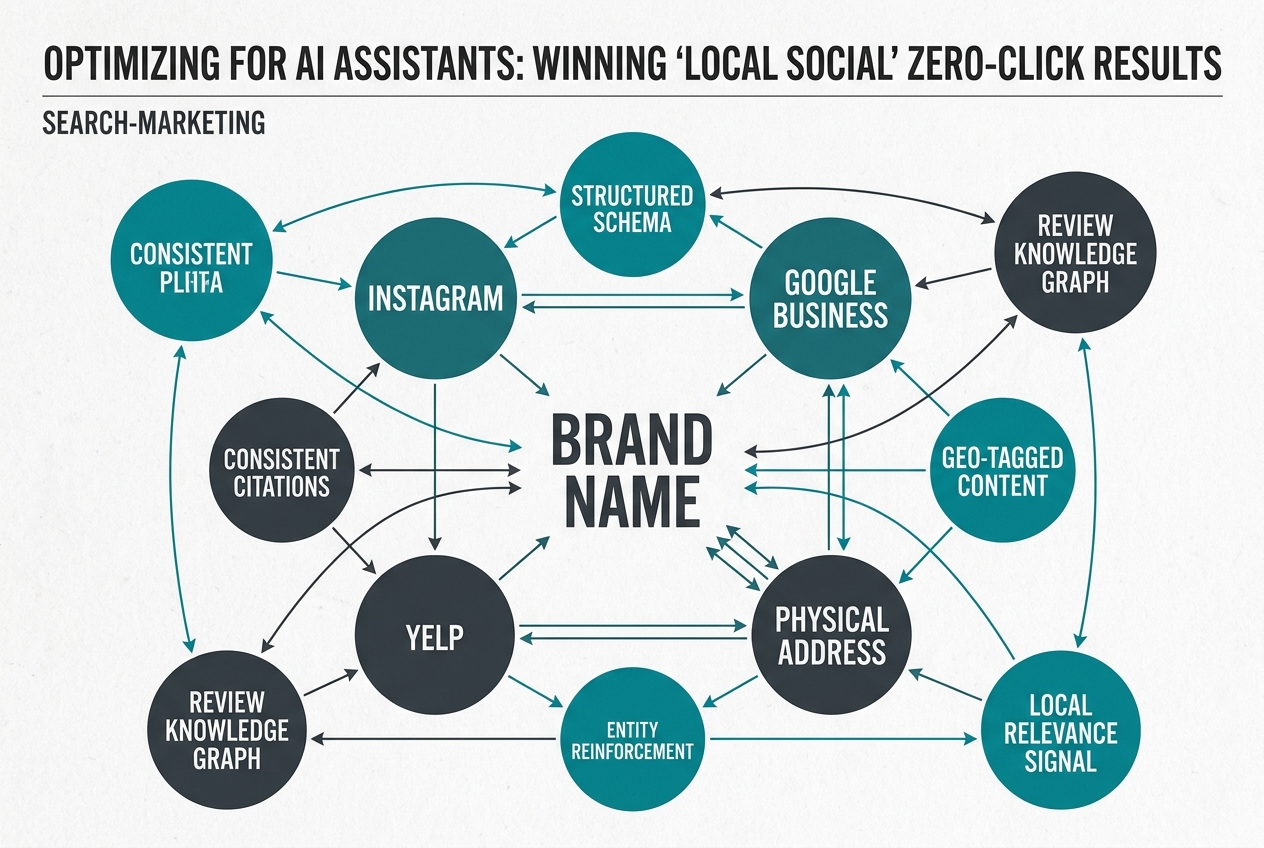
For local businesses, the "Knowledge Graph" is your most important asset. This is the invisible web of connections between your brand name, your physical coordinates, and the services you provide. If Google’s Knowledge Graph has conflicting information about your operating hours or service categories, Gemini will hedge its bets and recommend a competitor with cleaner data.
What to do:
- Use a tool like the Google Knowledge Graph Search API or a third-party aggregator like Yext or Moz Local to see your current 'Entity' status.
- Identify discrepancies in NAP (Name, Address, Phone) across the 'Big Three': Google, Apple Maps, and Bing.
- Search for your brand in ChatGPT and Gemini specifically asking: "What is [Brand Name] known for in [City]?" Note which sources they cite in the footnotes.
Why it matters: AI models are risk-averse. They cite sources that have high agreement across multiple platforms. If your Instagram says you are a 'Wellness Retreat' but your Yelp says 'Day Spa,' the AI may struggle to categorize you for specific niche queries, like the satirical wellness campaigns recently launched by JCPenney to differentiate from off-price retail.
Common pitfall: Focusing only on your website. AI assistants frequently bypass websites entirely if they can find sufficient structured data on social platforms or directory aggregators.
Step 2: Optimize Instagram Location Tags for 'Visual Search' Retrieval
Instagram is no longer just a photo-sharing app; it is a massive, geo-tagged database that AI models use to understand 'vibe' and 'popularity.' When Gemini processes a local query, it looks for social proof that a location is active.
Instagram's location pages are high-authority signals. When users tag your physical location, they are creating a distributed network of backlinks that confirm your entity's relevance. You need to treat your Instagram Location Page as a secondary homepage optimized for AI crawlers.
What to do:
- Encourage User-Generated Content (UGC) with Location Tags: Create 'grammable' moments that specifically incentivize the use of your location tag.
- Keyword-Rich Captions: Don't just post emojis. Use specific, descriptive language in your captions. Instead of "Lunch time!" use "Best organic kale salad and quiet booths for business meetings in Austin."
- Alt-Text Strategy: Manually edit the alt-text of every Instagram post to include your primary keywords and city. AI vision models (like GPT-4o) process these images to understand the context of a location.
Why it matters: AI assistants are increasingly multimodal. They don't just read text; they 'see' the images associated with a location. If your location tag is flooded with high-quality images of people working on laptops, the AI will confidently recommend you for the query "best cafes to work from."
Common pitfall: Using generic tags like #coffee or #latte. These offer no local signal. Always prioritize the specific city and neighborhood tags to anchor your content geographically.
Step 3: Weaponize Google Business Profile (GBP) Updates
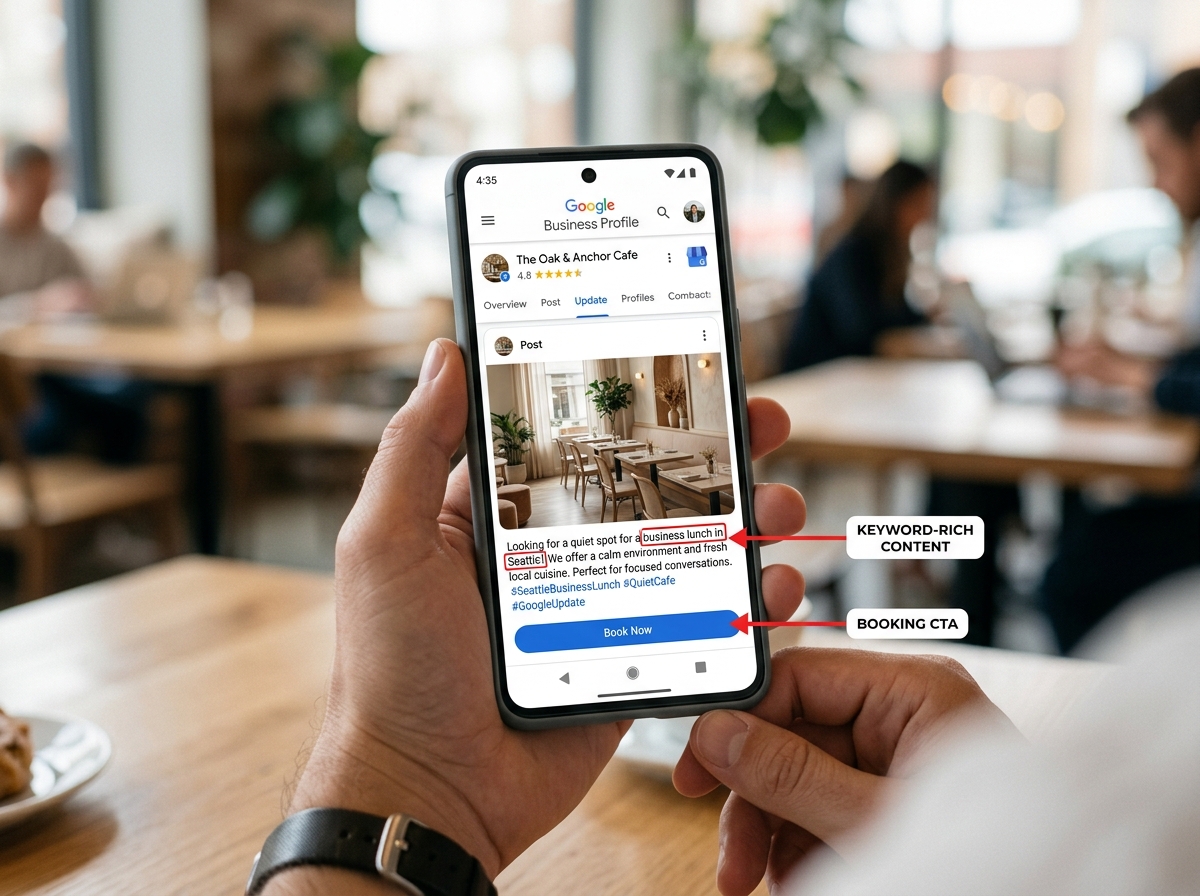
Your Google Business Profile is the single most influential factor for Gemini's local results. However, most marketers stop at filling out the basic info. To win the zero-click result, you must use the 'Updates' (formerly Posts) feature as a micro-blogging platform.
Gemini uses these updates to answer specific, long-tail questions. If a user asks, "Does any place nearby have a gluten-free Friday special?" and you posted an update about your gluten-free Friday menu two days ago, you are almost guaranteed the citation.
What to do:
- Post 3x Weekly: Use the 'Update' feature to highlight specific services, products, or events.
- Use Natural Language: Write your updates in the way people speak. Use phrases like "If you're looking for..." or "Many of our customers ask about..."
- Q&A Optimization: Don't wait for customers to ask questions. Seed your own Q&A section with the exact queries you want to rank for in AI search.
Why it matters: According to Search Engine Land's analysis of retrieval stacks, recency is a massive weight in the 'cache' layer of AI search. A GBP update from 48 hours ago is more 'retrievable' for a trending query than a static website page from six months ago.
Common pitfall: Treating GBP updates like traditional ads. AI doesn't care about "10% OFF NOW!" as much as it cares about "We now offer outdoor seating for large groups in our North End location."
Step 4: Align LinkedIn Content with 'Professional Entity' Signals
LinkedIn is often overlooked in local social, but for B2B or professional services, it is a goldmine for AI training data. As noted in recent discussions about LinkedIn's algorithm, the platform rewards 'polished business speak.' While some call this 'AI slop,' for an LLM, this structured, predictable language is easy to parse and categorize.
If you want to be the 'Top-rated Marketing Agency in Seattle' according to ChatGPT, your LinkedIn company page and your employees' profiles need to reinforce that specific entity association.
What to do:
- Standardize Employee Headlines: Ensure key staff members have the city and the specific service offering in their headlines (e.g., "Senior Strategist at [Agency] | Seattle Digital Marketing").
- Publish Thought Leadership via Articles: LinkedIn Articles are indexed heavily. Use them to define your niche. A 1,500-word piece on "The Future of Retail in Downtown Seattle" anchors your brand to that geography and topic.
- Engagement as a Proxy for Authority: High engagement on LinkedIn posts signals to AI crawlers that your brand is an authority in its space, increasing the likelihood of being cited in 'Best of' queries.
Why it matters: AI models use LinkedIn to verify the legitimacy of a business. A strong, active LinkedIn presence acts as a trust signal that can push you above a competitor who only has a basic website.
Common pitfall: Being too casual. While 'authentic' content works for humans, LLMs currently have an easier time categorizing structured, professional language. Balance the two.
Step 5: Master the 'Review Response' as a Metadata Source
Reviews are the lifeblood of local social, but the responses to those reviews are an untapped SEO opportunity for AI. When you respond to a review, you are adding fresh, relevant text to your entity's profile.
Instead of "Thanks for the review!" you should be writing, "We're so glad you enjoyed the [Specific Dish] at our [Neighborhood] location. We strive to be the best [Category] in [City]."
What to do:
- Keyword Injection: Naturally weave your primary and secondary keywords into your responses.
- Address Specific Features: If a reviewer mentions your 'fast Wi-Fi,' confirm it in the response. This reinforces the signal for AI assistants looking for 'places with fast Wi-Fi.'
- Consistency Across Platforms: Respond to reviews on Yelp, Google, and Facebook using a consistent tone and keyword set.
Why it matters: AI assistants synthesize reviews to provide summaries. If 50 reviews mention 'great atmosphere' and your responses reinforce 'great atmosphere for remote work,' the AI summary will likely read: "Known for a great atmosphere conducive to remote work."
Common pitfall: Using automated, identical responses for every review. AI can easily identify and discount repetitive 'canned' text. Each response must be unique enough to count as a new signal.
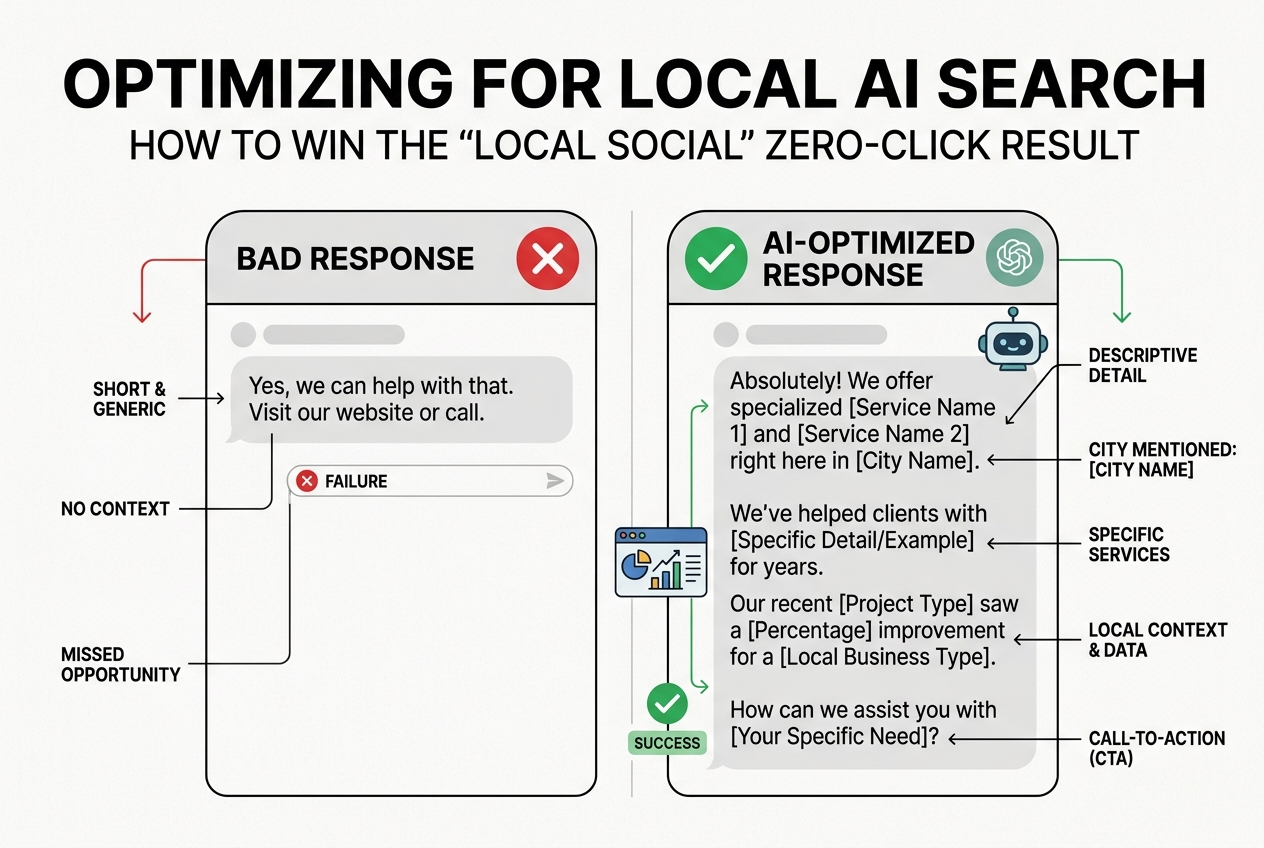
Step 6: Verification — How to know if you're winning
Winning in the zero-click landscape requires a new set of KPIs. You can no longer rely on Google Search Console clicks alone. You need to verify your 'Share of Model' (SoM).
The Verification Checklist:
- Incognito AI Testing: Use a fresh session in Gemini, ChatGPT, and Perplexity. Ask: "Recommend a [Category] in [City]." Do you appear in the top 3? Are you the first citation?
- Citation Audit: When you are recommended, click the footnotes. Are they pointing to your Instagram, your GBP, or your website? Ideally, you want a mix of all three to show 'Entity Breadth.'
- Brand Sentiment Analysis: Ask the AI: "What are the pros and cons of [Your Brand]?" If the 'pros' align with the keywords you've been seeding in your review responses and Instagram captions, your optimization is working.
- Local Pack Presence: While not strictly AI search, your performance in the traditional Google 'Local Pack' remains a leading indicator. If you're dropping there, you'll likely drop in Gemini's recommendations soon after.
Next Steps: 3 Related Tactics to Try Next
Once you have mastered the basics of local social optimization for AI, consider these advanced tactics to further solidify your dominance:
- Hyper-Local Paid Placements: Explore 'Search' placements within email and other non-traditional environments. As discussed by Jon Kagan in Search Engine Journal, Demand Gen and Audience Ads can deliver high-intent traffic that reinforces your brand's relevance in specific geographic clusters paid search email tactics.
- Video Transcript Optimization: AI models are increasingly 'listening' to video content. Ensure your Reels and TikToks have accurate, keyword-rich captions and transcripts. If you mention your city and service in the first 3 seconds of the audio, AI transcription services will pick that up as a local signal.
- Collaborative Entity Building: Partner with other local businesses for 'cross-tagging' campaigns. When a local coffee shop and a local bookstore tag each other in a post about a 'Perfect Saturday in [Neighborhood],' they are creating a mutual reinforcement of their local entity status that AI assistants can easily map.
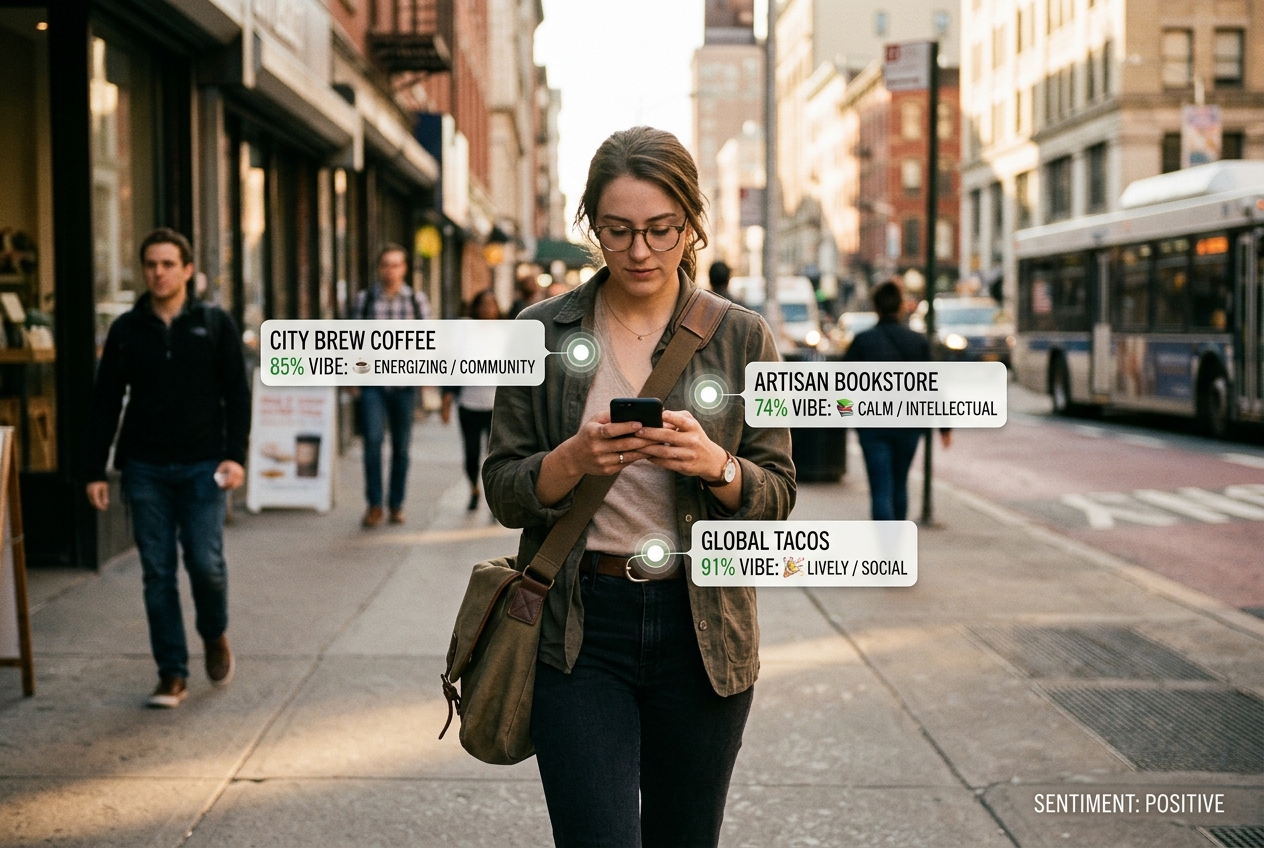
By treating every social post, review response, and profile update as a data point for an AI's training set, you move beyond the limitations of traditional SEO. You aren't just trying to rank; you're trying to become the definitive answer. In a world where the AI makes the choice for the user, being the definitive answer is the only way to survive.
FAQ