

On August 17, 2026, Google Ads will officially deprecate the 'target overperformance' cushion within its Smart Bidding algorithms. This structural shift forces tCPA and tROAS strategies to align strictly with stated numerical targets, removing the historical tendency for the system to deliver conversions below cost-per-acquisition caps during periods of high inventory liquidity.
Why it matters: For performance marketers, this isn't just a technical tweak; it's a potential margin killer. If your current campaigns rely on Google 'beating' your target to maintain overall account profitability, you are about to see a sharp rise in actual CPAs. You must audit your bid thresholds now to prevent the algorithm from spending into inefficient placements that were previously avoided by the overperformance buffer.
TL;DR
- The Change: Google is removing the internal 'safety margin' that often delivered results better than your tCPA/tROAS targets.
- The Risk: Accounts with 'loose' targets (set higher than the actual desired cost) will see spend accelerate and efficiency drop.
- The Fix: Tighten targets to reflect your true break-even point and review historical 'Actual vs. Target' gaps immediately.
The death of the 'Overperformance Buffer'
For years, seasoned media buyers have noticed a quirk in Google’s machine learning: if you set a tCPA of $50, the system often delivered at $42. This gap—the overperformance buffer—allowed for a margin of error in creative testing and landing page fluctuations. Google’s upcoming update effectively closes this gap. The algorithm is being recalibrated to treat your target as a literal instruction rather than a ceiling to stay well under.
This shift coincides with a broader trend in the AI landscape where systems are moving toward literal interpretation of advertiser intent. We see similar shifts in how AI agents are being empowered. For instance, according to Search Engine Journal's reporting on Cloudflare's recent moves Cloudflare AI agent wallets, the infrastructure for AI to make literal financial decisions is maturing. In the Google Ads context, this means the 'agent'—the bidding algorithm—will now spend every penny of your target if it believes it can find a conversion, regardless of whether it could have found a cheaper one yesterday.
If your account has historically seen an actual CPA that is 15-20% lower than your target, don't view that as a success of your bidding strategy. View it as a warning. On August 18, that 20% gap will likely vanish as the system expands its reach to capture more expensive auctions that still technically fall under your $50 limit.
Step 1: The 'Actual vs. Target' Variance Audit
Your first move is a deep dive into the last 90 days of performance data. You aren't looking for high-level success; you're looking for the delta between your targets and your reality. Open your Google Ads UI and create a custom report comparing 'Avg. Target CPA' against 'Cost / conv.' across all Search, Display, and Performance Max campaigns.
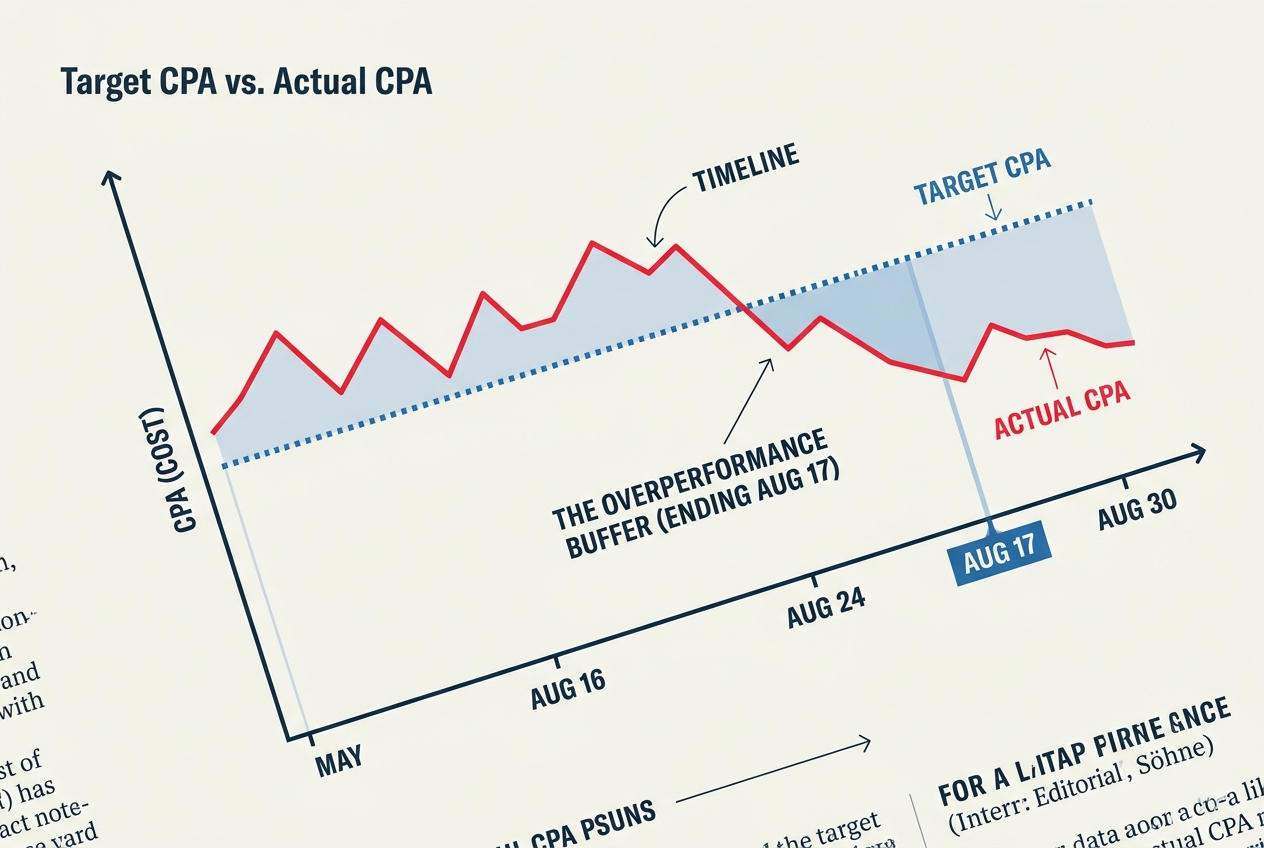
If your actual CPA is significantly lower than your target, you are at the highest risk. Why? Because the algorithm has been 'holding back.' Once the update rolls out, the system will perceive this gap as 'unused permission' to bid more aggressively in competitive auctions.
Consider the advice from MarTech regarding data fluctuations: "Not every change in a marketing metric deserves a response." However, this specific structural change is an exception. This isn't a temporary market fluctuation; it's a change in the physics of the auction. If you don't tighten your targets to match your actual desired CPA, the system will do exactly what you told it to do: spend up to your limit.
Step 2: Recalibrating tROAS for High-Value Segments
For e-commerce brands, the tROAS (Target Return on Ad Spend) changes are even more sensitive. Many brands set a 'conservative' tROAS of 400% while actually achieving 550%. This was a common tactic to ensure the algorithm stayed within high-intent audiences.
Post-August 17, a 400% target will be treated as an invitation to find lower-quality traffic that barely clears the 4:1 hurdle. You must recalibrate these targets to reflect the 550% reality if you want to maintain your current bottom-line margins.
This is particularly vital as Google integrates more 'community signals' into its AI. Recent data from Search Engine Land Community signals in AI suggests that UGC and community platforms are now the largest third-party sources for AI training and intent mapping. As Google's bidding engine incorporates these signals to find 'new' buyers, it may venture into experimental placements. Without a tight tROAS cap, your budget might be diverted into these newer, less-proven 'community-driven' placements that have a higher cost-per-click.
Step 3: Performance Max and the 'Spend Acceleration' Trap
Performance Max (PMax) will be the most volatile campaign type during this transition. Because PMax has the widest reach—spanning Search, YouTube, Gmail, and Discovery—it has the most 'room' to spend into if the bidding constraints are loosened.
We recommend a two-week 'cooling period' starting August 17. During this time, avoid making major creative or structural changes to your PMax campaigns. You need a clean environment to observe how the bidding update affects your reach.
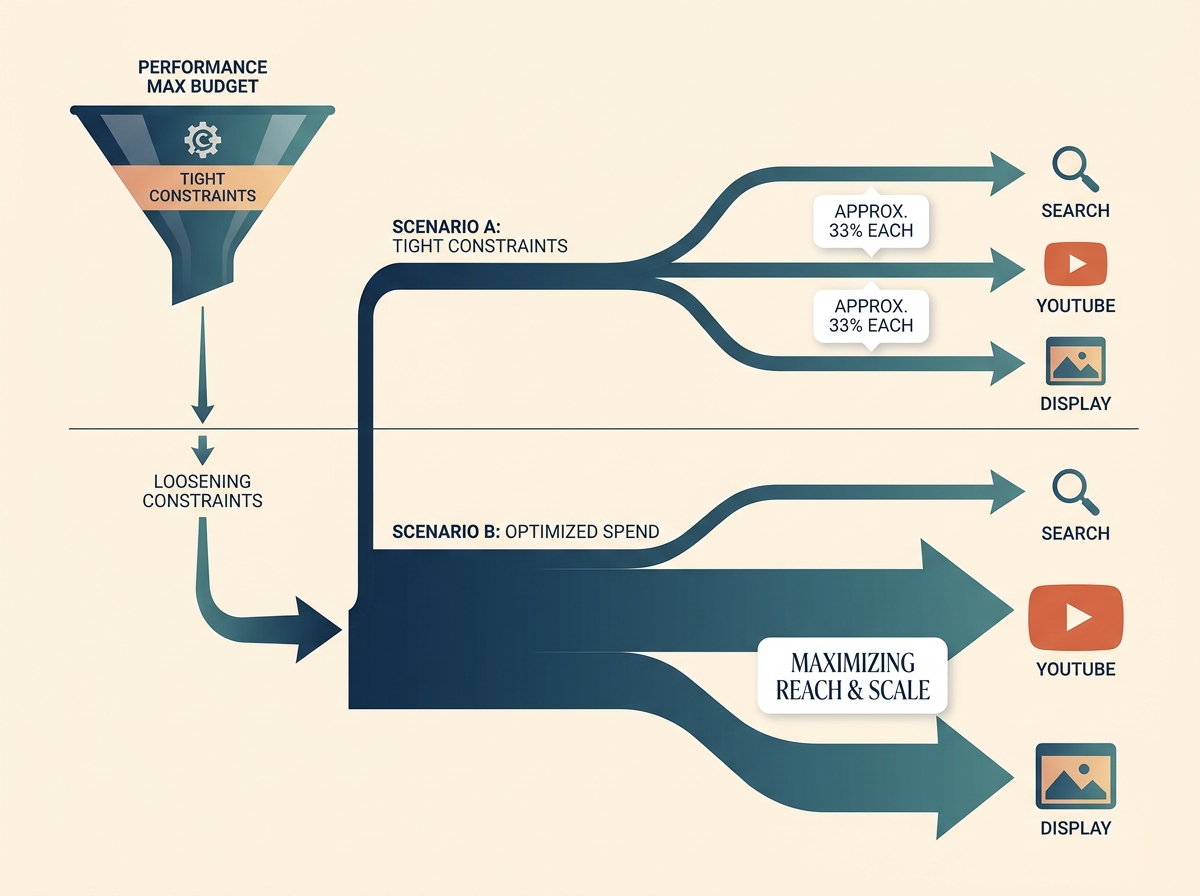
Watch your 'Impression Share' metrics. If you see a sudden spike in Impression Share alongside a rising CPA, the algorithm is successfully buying more volume, but at a higher price point. If that volume doesn't convert at a higher rate, your blended ROAS will tank.
The Human Element: Training for the AI Era
While we focus on the technical settings, the broader industry is preparing for a world where AI management is the primary skill set. Meta’s recent partnership with NABTU to invest in skilled trades for the AI era Meta NABTU partnership highlights a macro shift: the infrastructure of AI is being built by humans who understand the systems. For marketers, 'building the infrastructure' means setting the right guardrails.
Don't let the 'Smart' in Smart Bidding fool you into passivity. The smartest thing a marketer can do right now is realize that the algorithm is a tool that follows instructions literally. If your instructions are sloppy, your results will be expensive.
Immediate Action Plan for August 17
To ensure your account doesn't bleed budget in the third week of August, follow this checklist:
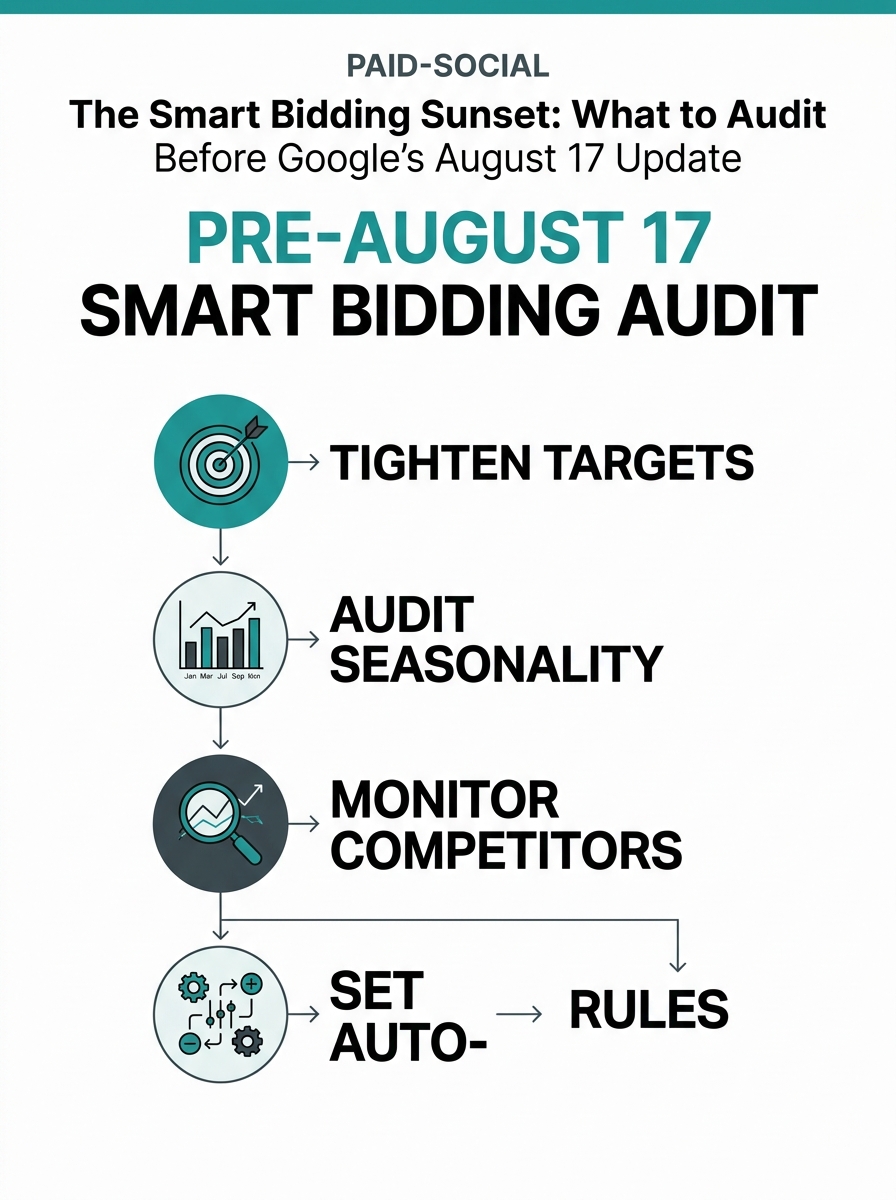
- Tighten Targets: If your Actual CPA is >10% below Target, lower the Target CPA by 5-7% immediately. Do this in small increments to avoid triggering a 'Learning Phase' reset.
- Audit Seasonal Adjustments: If you have any active Seasonality Adjustments, remove them before August 17. You don't want two different algorithmic shifts competing for control of your bids.
- Monitor ChatGPT Ad Placements: With OpenAI now allowing health and finance ads in ChatGPT OpenAI health finance ads, the competitive landscape for search-style intent is shifting. Google may respond by trying to 'capture' more intent within its own ecosystem—often at a premium price.
- Set Automated Rules: Create a rule that notifies you if daily CPA exceeds your 7-day average by more than 20%. This acts as a manual 'circuit breaker' while the new bidding logic settles.
Google's move toward literal target adherence is a sign of a maturing ad ecosystem. It removes the 'training wheels' that protected inefficient accounts. For the proactive marketer, this is an opportunity to out-optimize competitors who are asleep at the wheel. For everyone else, it’s a looming tax on account management negligence. Audit today, or pay the price on August 18.
FAQ