
By the end of 2025, the 'Dead Internet Theory' graduated from a niche conspiracy to a line item in your marketing budget. When bots outnumber humans across the open web, your reach metrics aren't just inflated—they're fictional. For the brand marketing lead, this isn't an existential crisis; it's a procurement one. If you are still using creator contract templates from 2023, you are likely paying a 30% to 50% 'bot tax' on every campaign.
Why it matters: In 2026, the delta between 'impressions' and 'human views' has widened to a cavernous gap. Relying on platform-reported vanity metrics without legally binding verification clauses exposes your brand to massive waste and potential compliance risks. You need to shift from paying for visibility to paying for verified human interaction.
Key takeaways
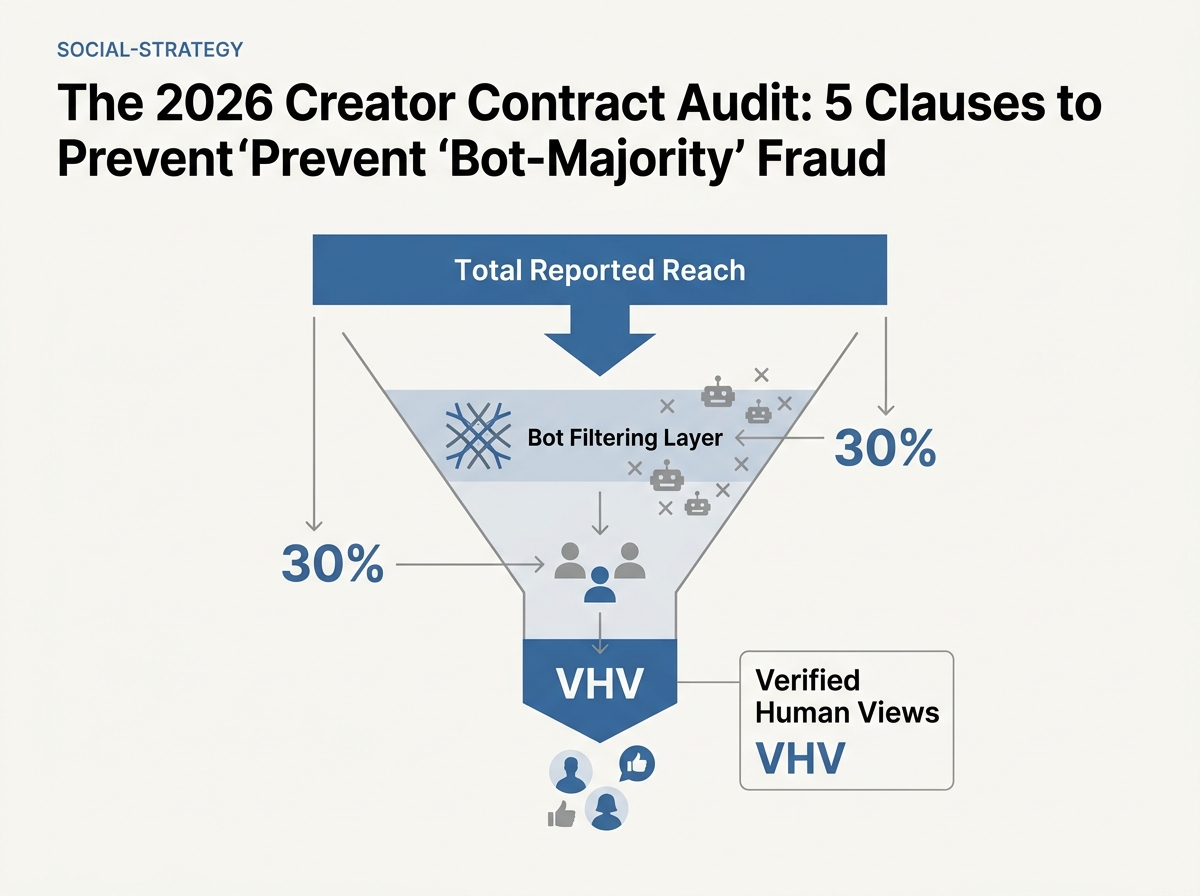
- Kill the CPM for Reach: Stop paying for impressions. Transition to 'Verified Human View' (VHV) or conversion-based payment milestones.
- First-Party Data Access: Mandate direct access to creator-side platform analytics through tools like Sprout or Brandwatch to bypass curated screenshots.
- The Synthetic Media Clause: Explicitly define and ban un-disclosed AI-generated personas or engagement pods in your legal terms.
- Whitelisting & Dark Posts: Demand access to the creator's ad manager for 'dark posting' to ensure your paid spend is optimized against your own CRM data, not the creator's potentially bot-heavy organic audience.
The death of the vanity metric and the rise of bot-majority fraud
We've reached the tipping point. According to recent industry benchmarks, nearly 47% of all internet traffic is now automated, with 'bad bots'—those designed to scrape, mimic human behavior, and inflate metrics—accounting for the majority of that growth. For influencer marketing, this means the old guard of 'reach' and 'engagement rate' is compromised. A creator with 2 million followers might only be reaching 400,000 humans; the rest is a feedback loop of automated scripts and AI agents.
How Meta's new Reels ranking changes paid budget pacing
This isn't just about 'fake followers' in the 2018 sense. Today's bot-majority fraud is sophisticated. AI agents can now mimic human dwell time, leave contextually relevant comments, and even trigger 'add to cart' events without a single human finger touching a screen. To combat this, your 2026 creator contract audit must prioritize human verification over platform-reported signals. You aren't just hiring a creator; you're buying a bridge to a specific human community. If that bridge leads to a server farm, the contract must provide a clawback mechanism.
Clause 1: The Verified Human View (VHV) threshold
Traditional contracts pay based on 'delivered posts.' Modern contracts must pay based on 'Verified Human Views.' This clause shifts the burden of proof onto the creator (or their agency) to provide data from third-party verification partners like DoubleVerify or Integral Ad Science (IAS) that filter out non-human traffic.
How to draft the VHV clause
You should specify that final payment is contingent upon a 'Humanity Score' of at least 85%. If the post-campaign audit shows that more than 15% of the engagement originated from known bot networks or suspicious data centers, the fee is prorated. This isn't about punishing the creator for the platform's flaws; it's about aligning the incentive toward building high-quality, human-centric audiences rather than chasing viral spikes that attract automated scrapers.
Clause 2: Mandatory first-party analytics integration
Screenshots are the enemy of truth. In 2026, any creator worth their fee should be comfortable granting 'read-only' access to their professional dashboard via an API. Whether you use Hootsuite, Sprinklr, or a specialized creator management platform, the contract must mandate this integration 48 hours before the campaign starts and 30 days after it ends.
Why first-party data is non-negotiable
Platforms like Google Ads are already moving toward more automated, 'Smart Bidding' environments (as seen in the recent August 17 updates to Target CPA and ROAS [S5]). In this landscape, your creator data must be as clean as your search data. If you feed bot-inflated creator metrics into your attribution model, you'll misallocate millions in spend. By pulling data directly from the API, you can see 'Reach by City,' 'Follower Growth Spikes,' and 'Completion Rates'—metrics that are far harder to spoof than a static screenshot of a 'Likes' count.
Clause 3: The 'Synthetic Persona' disclosure and ban
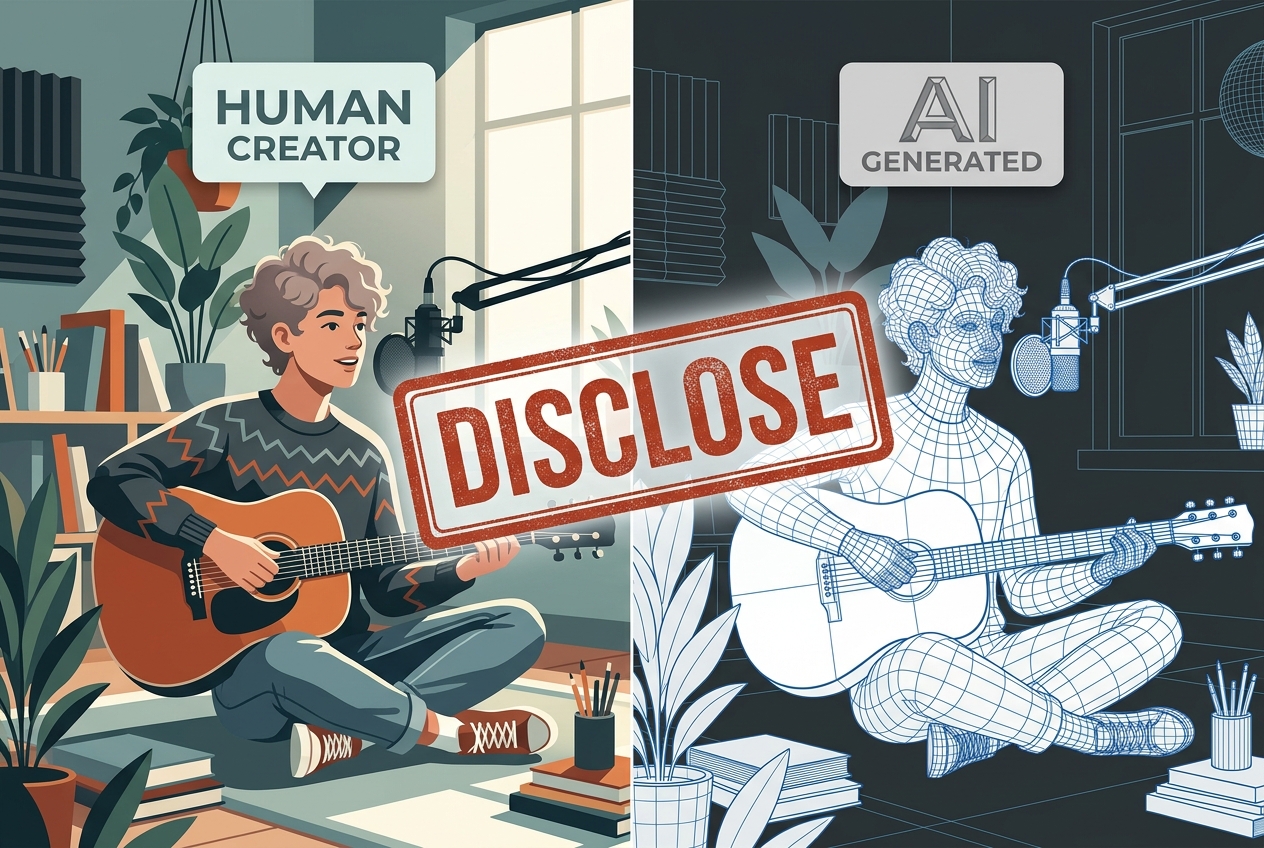
With the rise of fully AI-generated influencers, you must define what a 'human creator' is in your legal documents. We've seen cases where agencies sub-lease a creator's likeness to an AI firm, which then produces 10x the content using synthetic voices and faces. Unless you are specifically hiring a virtual influencer, your contract should include a 'Human-in-the-Loop' requirement.
The Clause Language: "Creator warrants that all content produced under this Agreement shall be performed by the specific individual(s) named herein. The use of generative AI to simulate the Creator's likeness, voice, or persona without express written consent is a material breach of contract."
This protects you from 'ghost-creators'—AI models that look like the person you hired but lack the genuine community trust you're actually paying for. It also prevents 'engagement pods' where AI agents are used to artificially boost the 'sentiment' of the comments section to meet contractual KPIs.
Clause 4: Attribution and the 'Link-in-Bio' bypass
Direct attribution is the only antidote to bot fraud. If a creator can't drive a measurable action, their 'reach' is irrelevant. However, the 'link-in-bio' is increasingly a graveyard for attribution. In 2026, your contracts should mandate the use of unique, trackable landing pages or 'Shopify Collective' integrations that allow for real-time sales tracking.
Moving beyond the UTM
UTMs are easily stripped by privacy-focused browsers and AI search agents. Instead, use 'Attribution Parity' clauses. This requires the creator to use platform-native shopping tools (like TikTok Shop or Instagram Checkout) alongside your own tracking. This gives you two data points to triangulate. If TikTok says the creator sold 500 units but your warehouse only saw 50, you have a bot-driven 'add-to-cart' bot problem that needs addressing before the next payout.
[INTERNAL: Measurement and attribution challenges in the post-cookie era -> attribution-revival-2026]
Clause 5: The 'Dark Posting' and whitelisting mandate
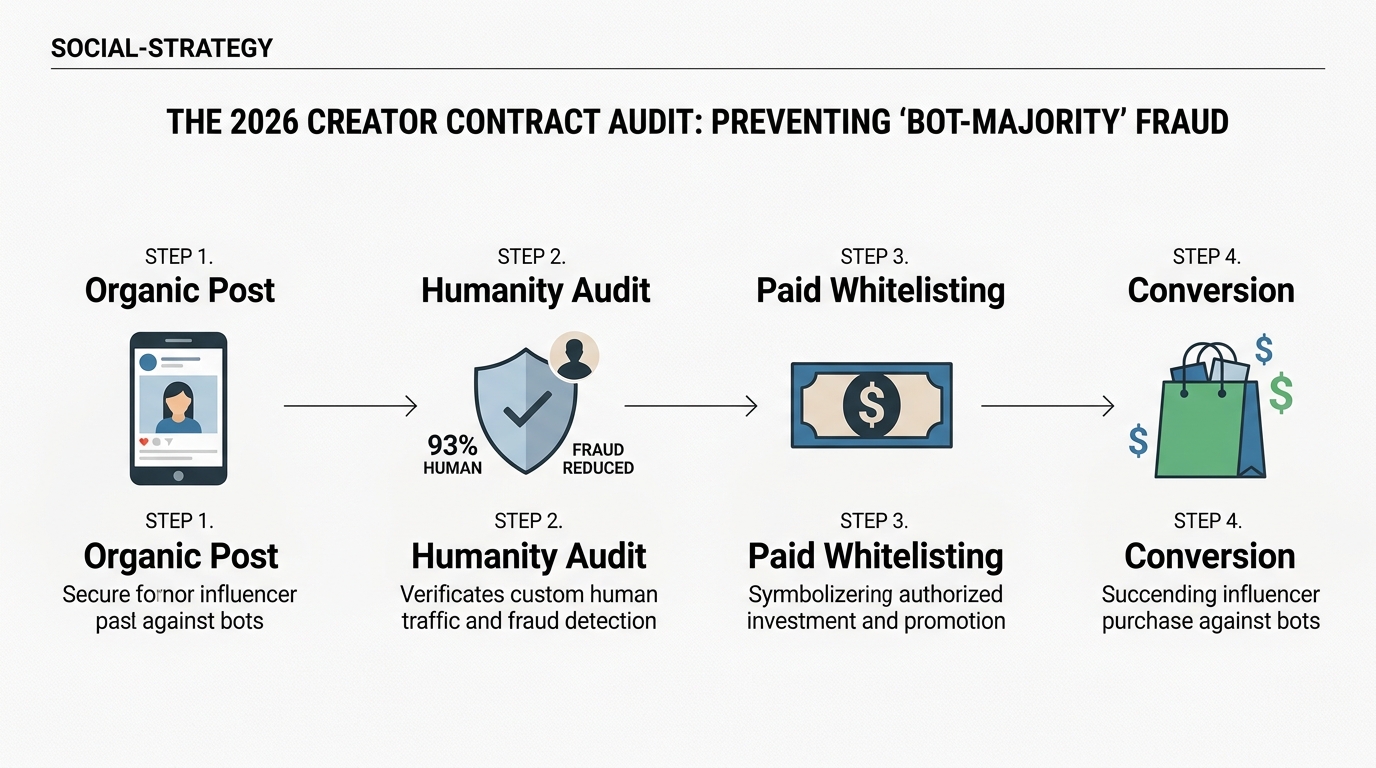
Organic reach is a lottery; paid amplification is a strategy. Your 2026 creator contract templates must include 'Whitelisting' (or 'Partnership Ads') rights as a standard, not an add-on. This allows you to take the creator's best-performing human-verified content and push it behind the scenes to a targeted audience of your known customers.
The workflow for 2026 whitelisting
- Identify: Use the first-party data access (Clause 2) to find the post with the highest 'Human Completion Rate.'
- Amplify: Use the creator's handle to run a 'Dark Post' (an ad that doesn't appear on their main profile) targeted at your CRM's 'Lookalike' audience.
- Audit: Compare the performance of the paid amplification against the organic 'bot-majority' feed. Usually, the paid version will have a higher conversion rate because you are filtering for humans.
Troubleshooting the 'Bot-Majority' pushback
Creators may push back on these clauses, fearing that platform algorithms are out of their control. You should frame these terms as a partnership. Offer 'Humanity Bonuses'—extra payments if the campaign achieves a 95%+ human verification score. This turns the creator into an ally in the fight against fraud.
If a creator refuses API access, it is a massive red flag. In an era where Google is expanding Search campaigns for events and attractions [S3], and AI search is challenging traditional SEO outcomes [S4], data transparency is the only currency that matters. You shouldn't be afraid to walk away from a creator who operates in a 'black box.'
Advanced variants: The 'Outcome-Only' contract
For high-ticket brands or those with long sales cycles, consider the 'Outcome-Only' model. In this setup, the base fee is minimal, but the performance bonuses are uncapped. This inherently solves the bot problem because bots don't buy $500 skincare routines or book $2,000 travel packages. By aligning the contract with the bottom line, you render the 'bot-majority' problem irrelevant to your ROI.
As we look toward the 2027 planning cycle, the brands that win won't be the ones with the loudest creators—they'll be the ones with the cleanest data. Start your audit today by stripping out 'impressions' and replacing them with 'verified human actions.' Your CFO will thank you.
How to apply this tomorrow
- Audit your current template: Search for the word 'Impressions.' If it's a primary KPI, delete it.
- Update your 'Definitions' section: Add a clear definition for 'Non-Human Traffic' (NHT) and 'Synthetic Media.'
- Vet your tech stack: Ensure your social listening or creator management tool (like Brandwatch or CreatorIQ) has an active API connection for the platforms you use most.
- Brief your legal team: Explain that 'Reach' is no longer a reliable metric and that 'Verified Human View' is the new industry standard for 2026.
[INTERNAL: Creator-economy economics and brand-deal pricing benchmarks -> creator-pricing-2026]
FAQ