
Reporting on social media performance after the fact is a post-mortem, not a strategy. By the time your monthly report shows a 15% dip in sentiment, the damage to your brand equity is already done. In 2026, the competitive advantage belongs to the strategists who treat social data as a leading indicator for product development and market demand rather than a trailing metric for PR success.
You’ve likely read the platform updates regarding AI-driven sentiment. You know that AI social listening in 2026 is more automated than ever. But automation without a framework is just faster noise. To move from retrospective reporting to predictive intelligence, you need a workflow that bridges the gap between Sprout Social’s operational efficiency and Brandwatch’s deep-tissue consumer research.
Why it matters: Brands that fail to integrate social intelligence into their product and R&D cycles are seeing a 22% higher failure rate in new product launches compared to those using predictive listening, per 2025 industry benchmarks. This tutorial outlines the exact framework for building a predictive engine that anticipates shifts before they reach the mainstream.
Key takeaways
- The Hybrid Stack: Use Sprout Social for real-time operational signals and Brandwatch for long-tail cluster analysis.
- Predictive Clustering: Identify 'emergent themes' by monitoring the rate of change in niche communities before they hit high-volume keywords.
- Cross-Functional Integration: Move social data out of the marketing silo and into the 'Integrated Search Brief' to align SEO, PPC, and Product teams.
- GEO Optimization: Leverage new tools like Adobe Brand Visibility to ensure your brand remains visible in generative search results.
The Architecture of Predictive Social Intelligence
Predictive social listening isn't about guessing the future; it's about identifying the early high-velocity signals that indicate a shift in the status quo. In the 2026 landscape, this requires a tiered approach to data. Most social teams spend 90% of their time in the 'Engagement' tier—likes, shares, and direct mentions. Predictive intelligence lives in the 'Anomalous Signal' tier.
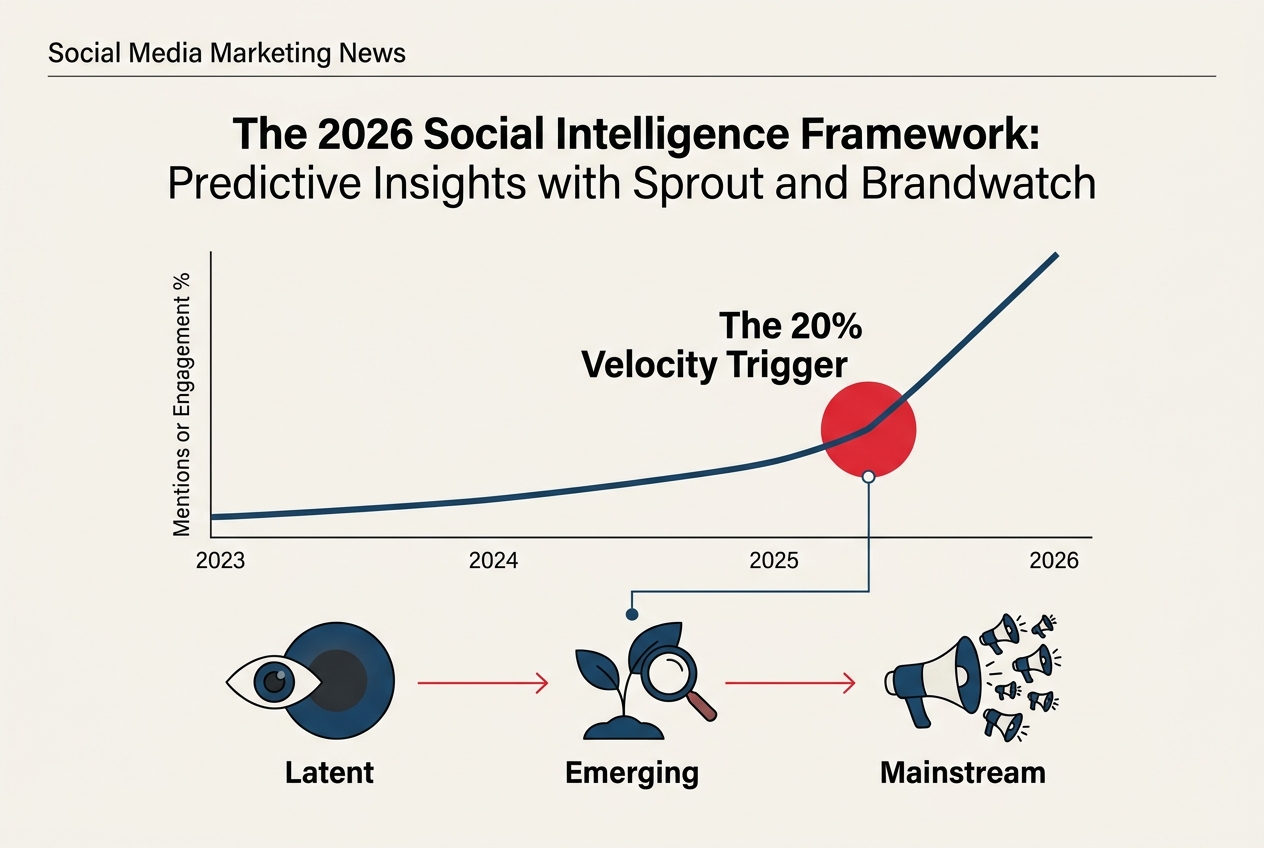
We categorize these signals into three buckets: Latent, Emerging, and Mainstream.
- Latent Signals: These exist in niche subreddits, specialized Discord servers, or closed creator communities. The volume is low, but the passion is high.
- Emerging Signals: This is where the 'volume velocity' spikes. You see a 300% week-over-week increase in a specific keyword phrase, even if the total mentions are only in the hundreds.
- Mainstream Signals: By the time a topic hits the TikTok Creative Center's trending list, the arbitrage opportunity is gone.
To build this framework, you must first audit your current stack. Sprout Social remains the gold standard for operational listening—handling the 'now' of your brand's direct ecosystem. However, for predictive work, you need the historical depth and broad-web scraping capabilities of Brandwatch.
Per Hootsuite's June 2026 report on AI social listening, tools are now capable of 'emotion-mapping' beyond simple positive/negative binary. You aren't just looking for 'unhappy' customers; you're looking for 'frustrated with [Specific Feature]' customers whose sentiment is shifting from 'frustrated' to 'searching for alternatives.'
Step 1: Configuring Sprout Social for Operational Early Warning
Sprout Social’s Listening tool is your 'smoke detector.' It’s where you monitor the health of your existing categories. To make it predictive, you must move beyond your brand name and competitors.
You should be building 'Category Health' queries. If you are in the CPG space, don't just listen for 'oat milk.' Listen for 'dairy alternatives' + 'digestion' + 'bloating.'
The Velocity Alert Setup
In Sprout, navigate to the Listening tab and create a new Topic. Use the 'Advanced' builder to include proximity operators. For example: "sustainability" NEAR/5 "packaging".
Once the topic is live, set up Spike Alerts. Most managers set these too high. You want to be notified when a topic exceeds its baseline by 20% over a 24-hour period. This is your first indicator that a latent signal is moving into the emerging phase.
Sentiment Volatility Monitoring
Look at the 'Sentiment' tab not for the average score, but for the volatility index. A stable 70% positive sentiment is less interesting than a sentiment score that swings from 80% to 50% and back to 70% within a week. That volatility suggests a polarized conversation or an unresolved consumer pain point that your product team can solve.
Step 2: Deep-Tissue Analysis with Brandwatch Consumer Research
While Sprout tells you that something is happening, Brandwatch tells you why and who is starting it. Brandwatch’s ability to ingest data from 100 million+ sources, including blogs and forums, is critical for identifying the 'Patient Zero' of a trend.
Topic Clustering and AI Summaries
Use Brandwatch’s 'Topic Analysis' to visualize the conversation. In 2026, the AI-driven clustering automatically groups mentions into 'intent buckets.'
For a skincare brand, Brandwatch might show a cluster of conversations around 'barrier repair' that is distinct from 'acne treatment.' If the 'barrier repair' cluster is growing 40% faster than the rest of the category, that is a predictive signal for your Q3 content and product strategy.
The 'Innovator' Segment Filter
One of the most underused features in Brandwatch is the ability to filter by 'Author Influence' or 'Bio Keywords.' To find predictive insights, create a segment of 'Innovators'—users who have keywords like 'Founder,' 'Researcher,' 'Early Adopter,' or 'Analyst' in their bios.
When this specific segment starts talking about a new ingredient or a shift in the economy, the mainstream usually follows 3-6 months later. This gives your brand the lead time needed for building a strong brand voice that resonates with the coming shift.
Step 3: Integrating Social Intelligence into the Product Lifecycle
This is where most frameworks fail. The data stays in a PDF that the Product Manager never opens. To fix this, you must adopt the 'Integrated Search Brief' model.
As noted by Search Engine Journal in June 2026, aligning SEO, PPC, and Content is the only way to survive the AI search era. We take this further: your social intelligence must inform the 'Product Brief.'
The Social-to-Product Feedback Loop
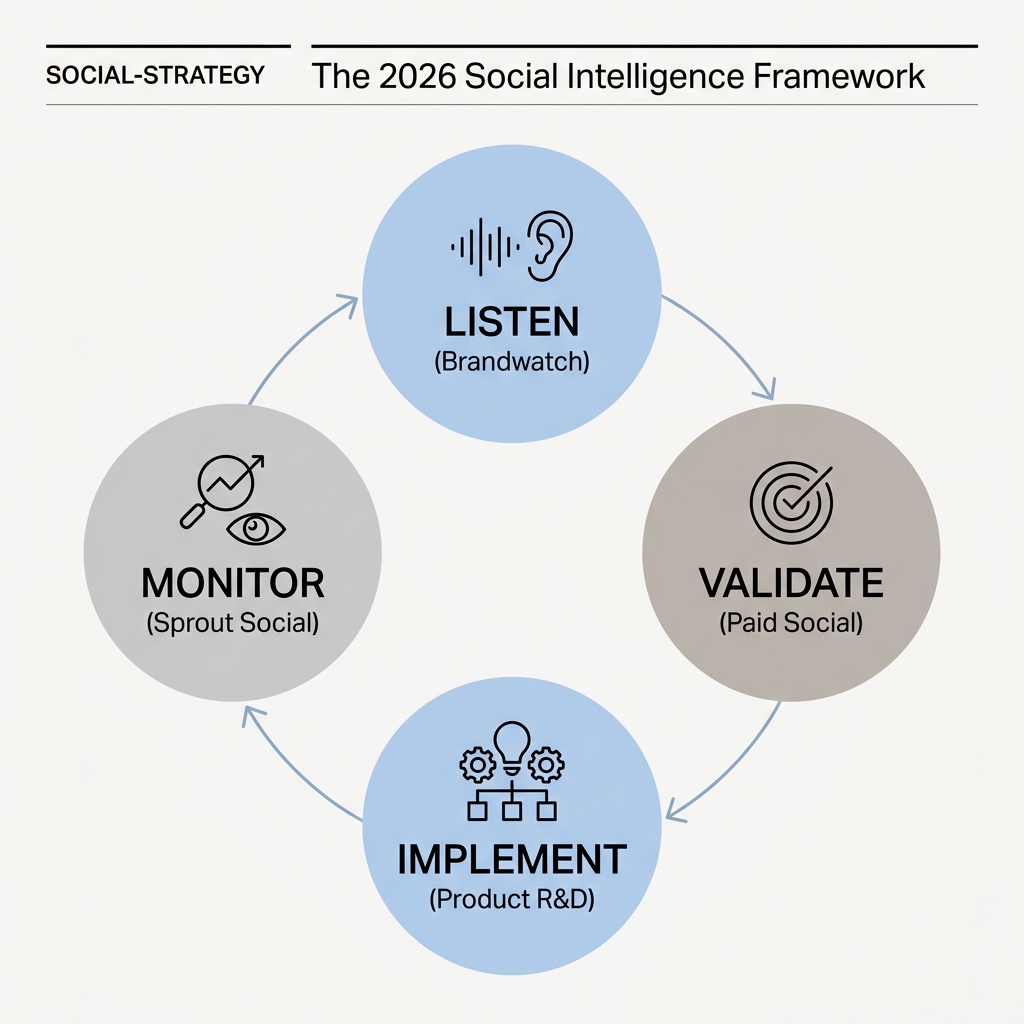
- Monthly Intelligence Sync: The Social Lead meets with the Product/R&D lead.
- The 'Unmet Need' Report: Instead of showing top-performing posts, show the top 5 'unmet needs' identified through Brandwatch clusters.
- Validation via Paid Social: Use Sprout’s ad integration to run 'smoke tests.' If Brandwatch suggests a trend toward 'minimalist packaging,' run two versions of a social ad—one highlighting the product, one highlighting the new packaging concept. Use the CTR as a hard data point to validate the social listening theory.
Step 4: Optimizing for Generative Engine Optimization (GEO)
In 2026, social intelligence isn't just about what people say to each other; it's about what AI tells them about you. Adobe’s recent launch of 'Brand Visibility' (integrating Semrush data) allows enterprises to see how they are being cited in LLM responses.
Your social listening data should feed your GEO strategy. If Brandwatch shows that consumers are increasingly asking about your product's 'ethical sourcing,' and your current AI search footprint doesn't mention it, you have a visibility gap.
Use your social insights to update your website’s schema and high-authority content. This ensures that when an AI agent (like those mentioned in the Adobe CX Enterprise update) recommends a brand in your category, yours is at the top of the list because the 'Social Proof'—the aggregate of consumer sentiment—is aligned with the AI's training data.
Troubleshooting and Common Pitfalls
Predictive listening is prone to 'False Positives.' A viral tweet from a meme account can look like a trend in the data, but it has no staying power.
- The 'Meme' Filter: Always check the 'Spread' vs. 'Depth' of a signal. High spread (shares) with low depth (unique comments/discussions) usually indicates a fleeting meme. High depth with moderate spread indicates a real cultural shift.
- Data Silos: If your Sprout data isn't being compared against your Brandwatch data, you're only seeing half the picture. Use an API connector or a tool like Google Data Studio to overlay Sprout's engagement spikes with Brandwatch's sentiment clusters.
- Ignoring the 'Silent Majority': Social listening over-indexes on the loudest 1% of users. Balance your findings with first-party data (CSAT scores, email surveys) to ensure the 'predictive' trend isn't just a vocal minority.
Advanced Variant: The 'Pre-Trend' Content Engine
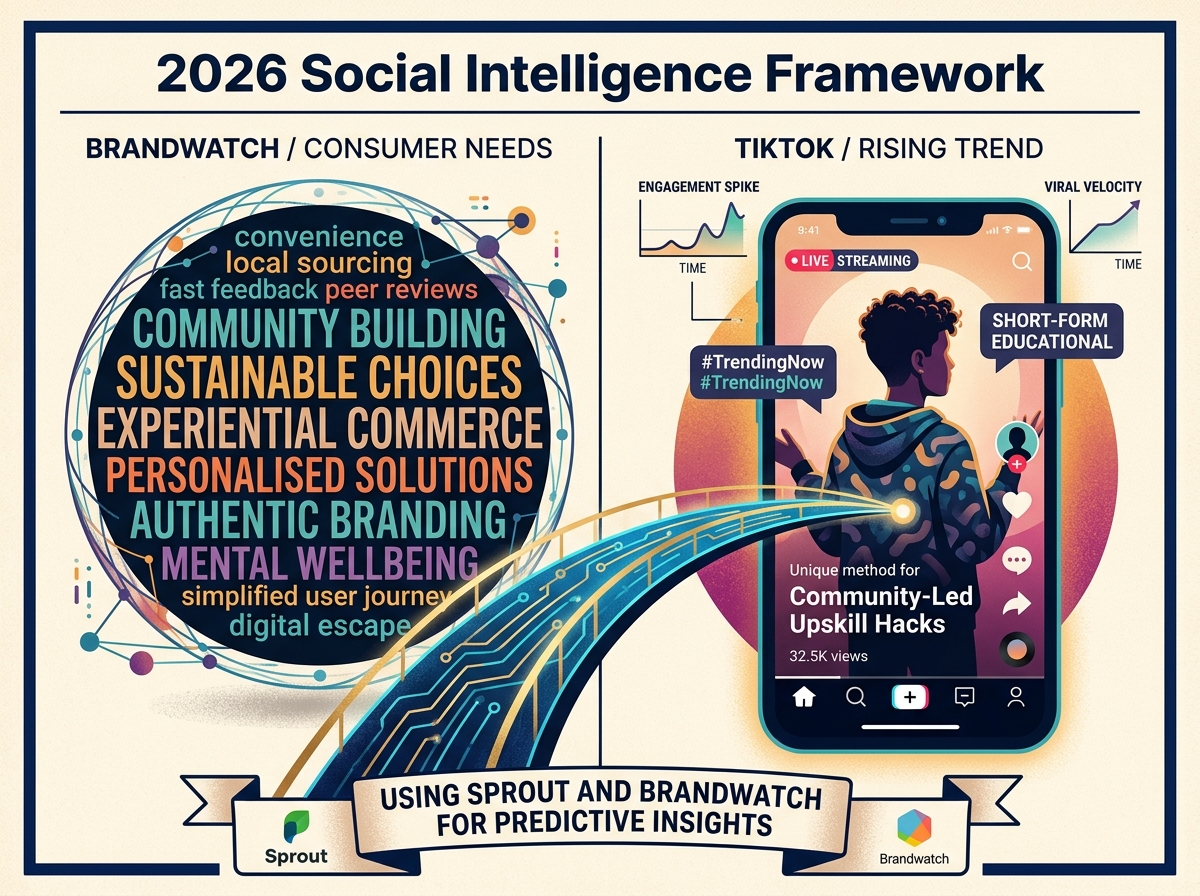
Once your framework is solid, you can move into 'Pre-Trend' content creation. This involves using TikTok marketing tools (as explored in [S3]) to identify rising audio and visual styles that correlate with your Brandwatch clusters.
If Brandwatch identifies a trend toward 'Financial Nihilism' among Gen Z, and TikTok shows a rising audio trend of 'low-fi office vlogs,' you combine them. You create content that addresses the sentiment using the trending format before your competitors have even identified the sentiment shift.
This is the pinnacle of the 2026 Social Intelligence Framework: you aren't just watching the market; you are anticipating its next move and meeting it there with surgical precision.
How to Implement This Tomorrow
You don't need a 10-person data science team to start.
- Define your 'Edge' Sources: In Brandwatch, create a custom source group of the top 50 niche forums and 100 key influencers in your industry.
- Set Sprout Alerts for 'Adjacent Categories': If you sell coffee, set alerts for 'sleep hygiene' and 'morning routines.'
- Schedule the First Cross-Functional Meeting: Bring one 'Emerging' signal to your Product or SEO lead and ask: "If this becomes a mainstream trend in six months, are we ready?"
By shifting your perspective from 'What did they say?' to 'What will they want next?', you transform the social media department from a cost center into a primary driver of business growth.
FAQ