
If you are still finalizing your July content calendar in mid-June, you aren't planning for success; you're planning for obsolescence. The traditional social media calendar—a static spreadsheet of pre-approved posts—has become a liability in a landscape defined by rapid-fire trend cycles and AI-driven discovery.
By the time your 'National Donut Day' post goes live, the cultural conversation has already moved through three cycles of a TikTok sound and a new search-intent cluster. To survive in 2026, brands must transition to a signal-based content strategy. This approach replaces the 'set it and forget it' mentality with a dynamic framework that prioritizes real-time social intelligence over rigid scheduling.
This guide will show you how to build a responsive system that identifies high-value signals and empowers your team to override the calendar when it matters most. You will learn to integrate tools like Sprout Social, Sprinklr, and TikTok’s latest attribution suites to turn raw data into high-performing creative.
TL;DR
- Shift from Static to Dynamic: Move from 30-day fixed plans to a 70/30 split (70% evergreen, 30% signal-reactive).
- Leverage Search Intent: Use TikTok's new Search Hubs to identify what users are actually looking for before creating content.
- Automate Intelligence: Set up 'Signal Triggers' in your listening tools to alert you when a topic reaches a critical mass.
- Measure Real Impact: Move beyond likes to the TikTok Attribution Portfolio, which tracks how reactive content drives actual sales.
Step 1: Audit Your Current Latency and Define Signal Triggers
Before you can change how you plan, you must understand why you're slow. Most brand teams suffer from 'approval rot'—a process where a single tweet requires five layers of sign-off. In a signal-based world, latency is the enemy of ROI.
Start by identifying your 'Signal Triggers.' These are specific data points that, when met, give your social team the immediate authority to pivot away from the pre-planned calendar. These aren't just 'trends'; they are business-relevant spikes. For example, a 20% increase in brand mentions within a 4-hour window or a specific keyword appearing in the 'Rising' column of TikTok’s Search Hubs.
According to Kantar’s 2026 Most Valuable Brands list, Google has reclaimed the top spot largely due to its integration of AI-driven search utility. Your social strategy must mirror this utility. If people are searching for 'how to use [Product] with [New Trend],' and your calendar says to post a generic 'Happy Monday' graphic, you are failing the utility test.
What to do: Map out your current approval workflow. Identify every person who touches a post. Then, create a 'Fast-Track' lane for signal-based content where only one senior stakeholder provides a 'kill' or 'go' decision within 30 minutes of a trigger event.
Why it matters: Speed is the only way to capture the 'Branded Buzz' that TikTok is now formalizing with its new search-to-creator connection tools. If you wait 48 hours, the search volume has peaked and you're paying more for less visibility.
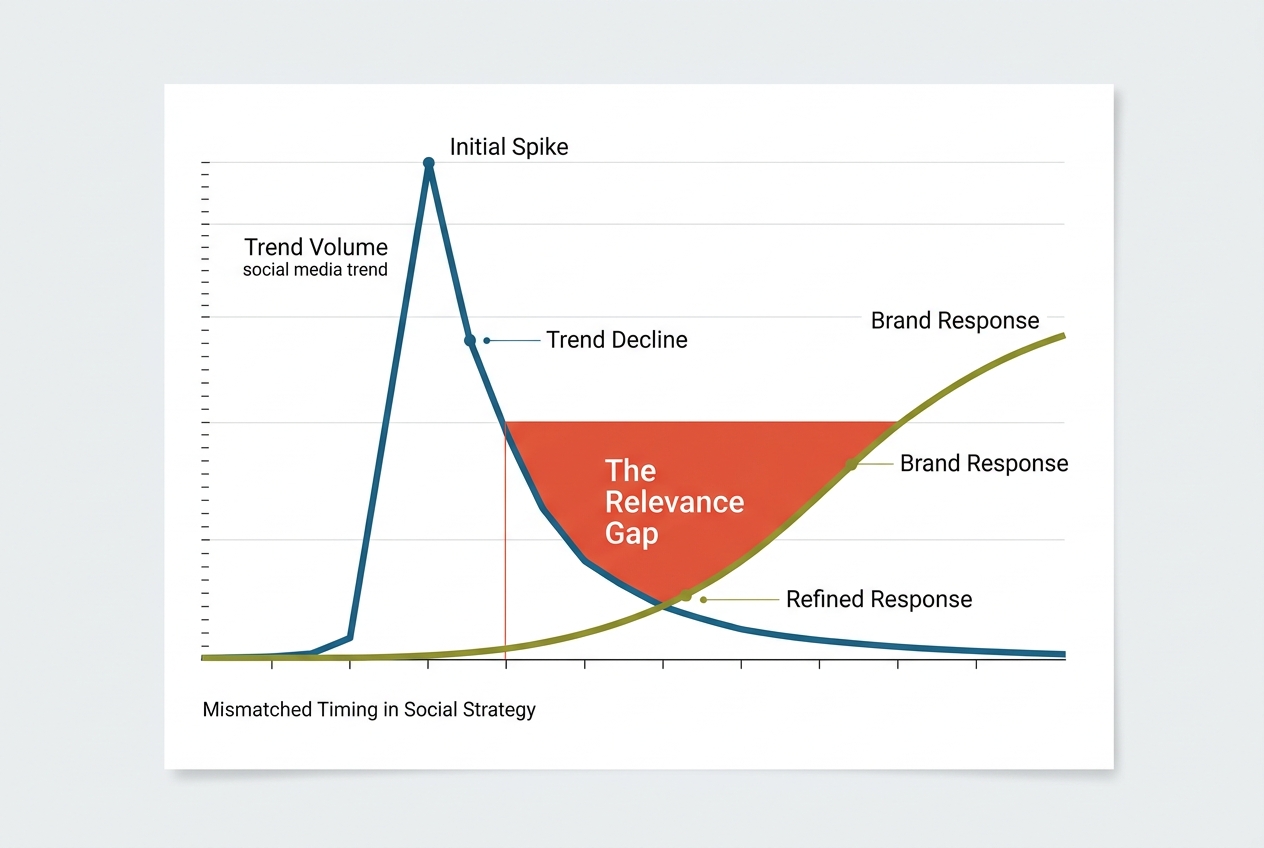
Common pitfall: Defining signals too broadly. 'When something goes viral' is not a trigger. 'When our core competitor is mentioned alongside [Keyword] more than 500 times in an hour' is a trigger. Be clinical.
Step 2: Configure Your Intelligence Stack for Real-Time Detection
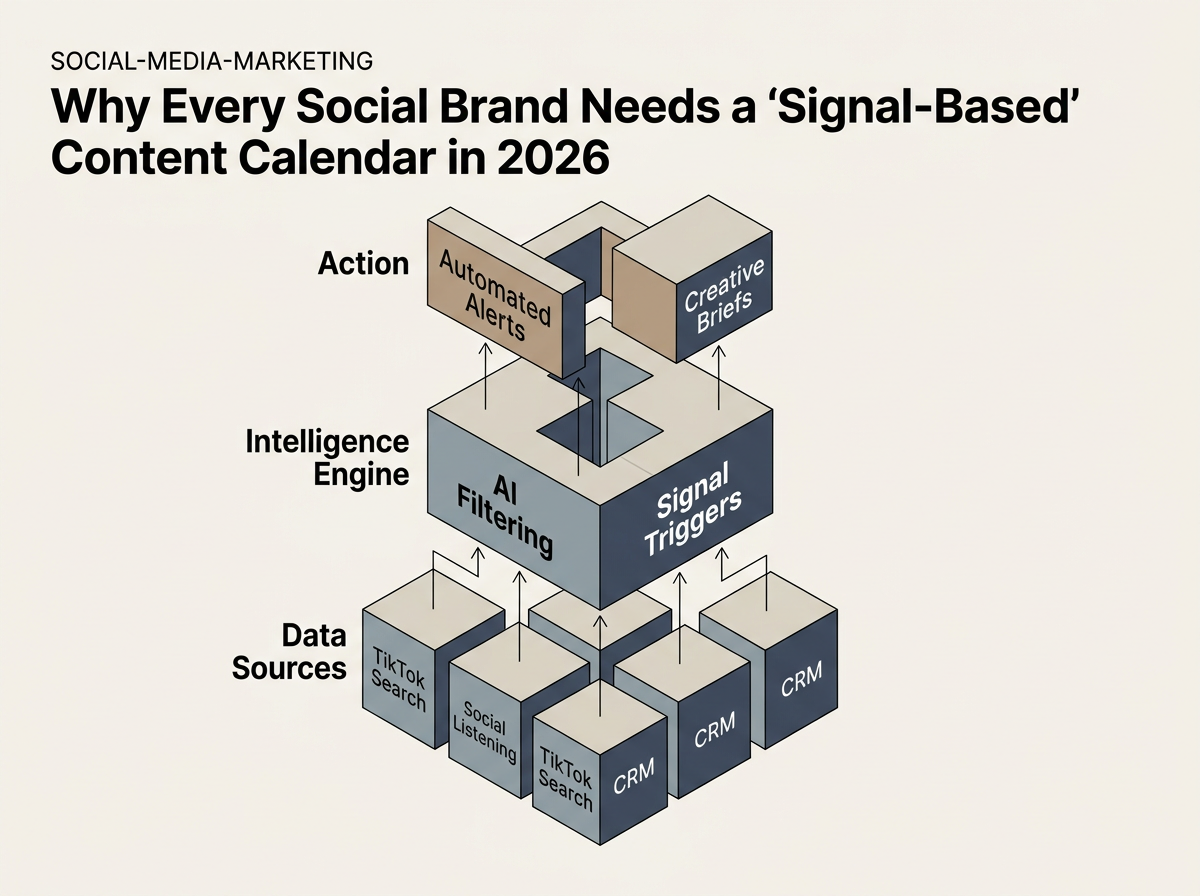
Your social media calendar shouldn't live in Google Sheets; it should live inside a social intelligence platform. Tools like Sprout Social and Sprinklr have evolved from simple scheduling buckets into sophisticated 'listening engines.'
In 2026, you need to configure these tools to look for 'Search Intent' rather than just 'Engagement.' With the release of TikTok's Search Hubs in May 2026, we now have a direct line into what users are typing into the search bar. This is a massive shift. Previously, we guessed what people liked based on what they watched. Now, we know what they want because they are asking for it.
What to do: Set up 'Topic Clusters' in your listening tool. If you are a beauty brand, don't just track #skincare. Track 'skin barrier repair' + 'under $20' + 'dermatologist recommended.' When the volume for a specific cluster spikes, your intelligence tool should automatically flag this as a content opportunity.
Why it matters: TikTok's new 'TopReach' ad product allows brands to buy the top two ad spots simultaneously. To make this spend efficient, the creative needs to be hyper-relevant to the current conversation. You can't use a video filmed three months ago for a TopReach buy if the conversation has shifted to a new specific pain point.
Common pitfall: Relying on global trends. Just because 'Cottagecore' is trending globally doesn't mean it matters to your SaaS brand. Filter your intelligence by your specific audience segments to avoid chasing 'empty' reach.
Step 3: Implement the 70/30 'Flex' Calendar Structure
The biggest mistake marketers make is trying to be 100% reactive. That leads to burnout and a fragmented brand voice. Instead, adopt a 70/30 split.
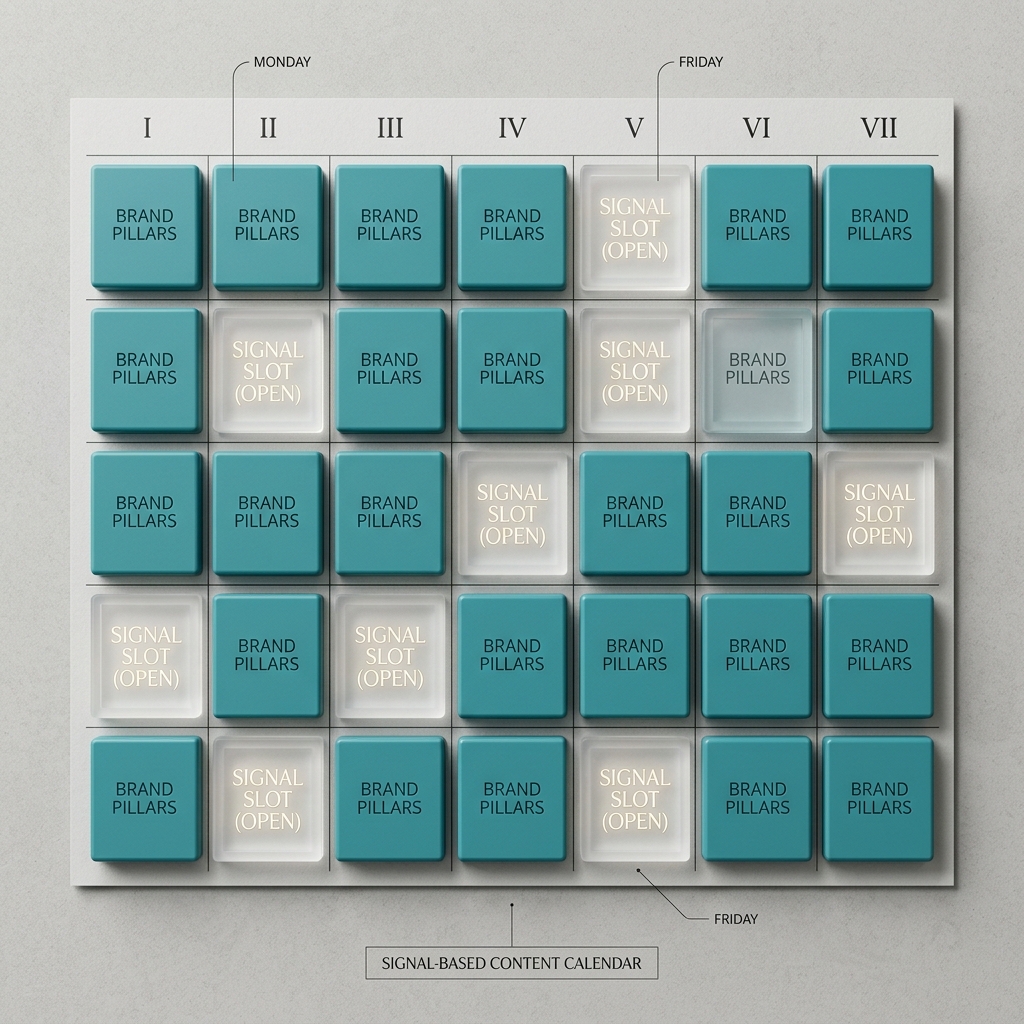
70% of your calendar remains 'Core Content'—the high-production, brand-building pillars that can be planned weeks in advance. The remaining 30% is 'Signal Slots.' These are empty blocks in your scheduling tool (like Hootsuite or Later) reserved specifically for reactive content triggered by your intelligence stack.
What to do: In your project management tool (Asana, Monday.com, etc.), create 3-5 'Placeholder' tasks per week. These tasks have pre-assigned creative templates and a pre-approved 'Fast-Track' team. When a signal is detected, the team fills the placeholder. If no signal meets the threshold by 2
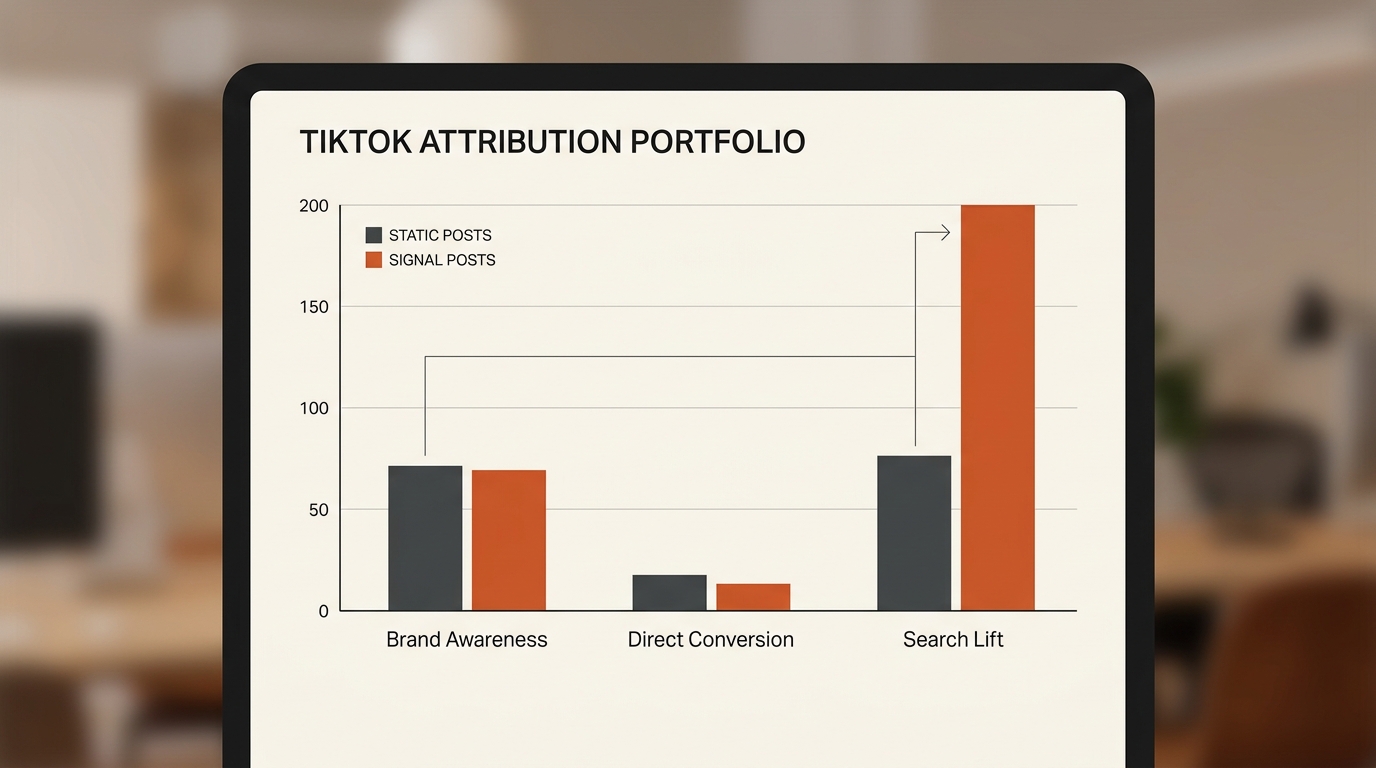
PM, the slot is either left empty or filled with a 'back-up' evergreen post.Why it matters: This structure allows for the 'Attribution Portfolio' tracking that TikTok introduced in May 2026. By having dedicated slots for reactive content, you can specifically measure how these 'signal' posts influence the customer journey compared to your standard evergreen content. Early data suggests reactive content often serves as the 'middle-funnel' bridge that turns awareness into search intent.
Common pitfall: Treating the 30% as 'low quality.' Reactive doesn't mean 'sloppy.' It means 'timely.' You still need high-quality audio and clear brand markers, even if the turnaround is four hours.
Step 4: Use AI to Bridge the Creative Gap
The bottleneck in signal-based marketing is usually creative production. You found the signal, you have the slot, but you don't have the video. This is where the new generation of AI tools comes in.
As reported by PopRant in May 2026, TikTok’s new AI Ads tool is already showing signs of being able to generate high-fidelity variations of creator content at scale. While it won't replace human strategy, it is the perfect engine for signal-based response. You can take an existing high-performing asset and use AI to 're-skin' the hook or the captions to match the trending signal you just identified.
What to do: Create a 'Modular Creative Library.' Instead of finished videos, store hooks, transitions, and calls-to-action as separate assets. When a signal hits—say, a specific question about your product's sustainability—you can use an AI video editor to stitch a relevant 'Sustainability Hook' onto a high-performing product demo.
Why it matters: This allows you to maintain the 'Branded Buzz' without needing a film crew on standby 24/7. It’s about being 'directionally perfect' and 'temporally exact.'
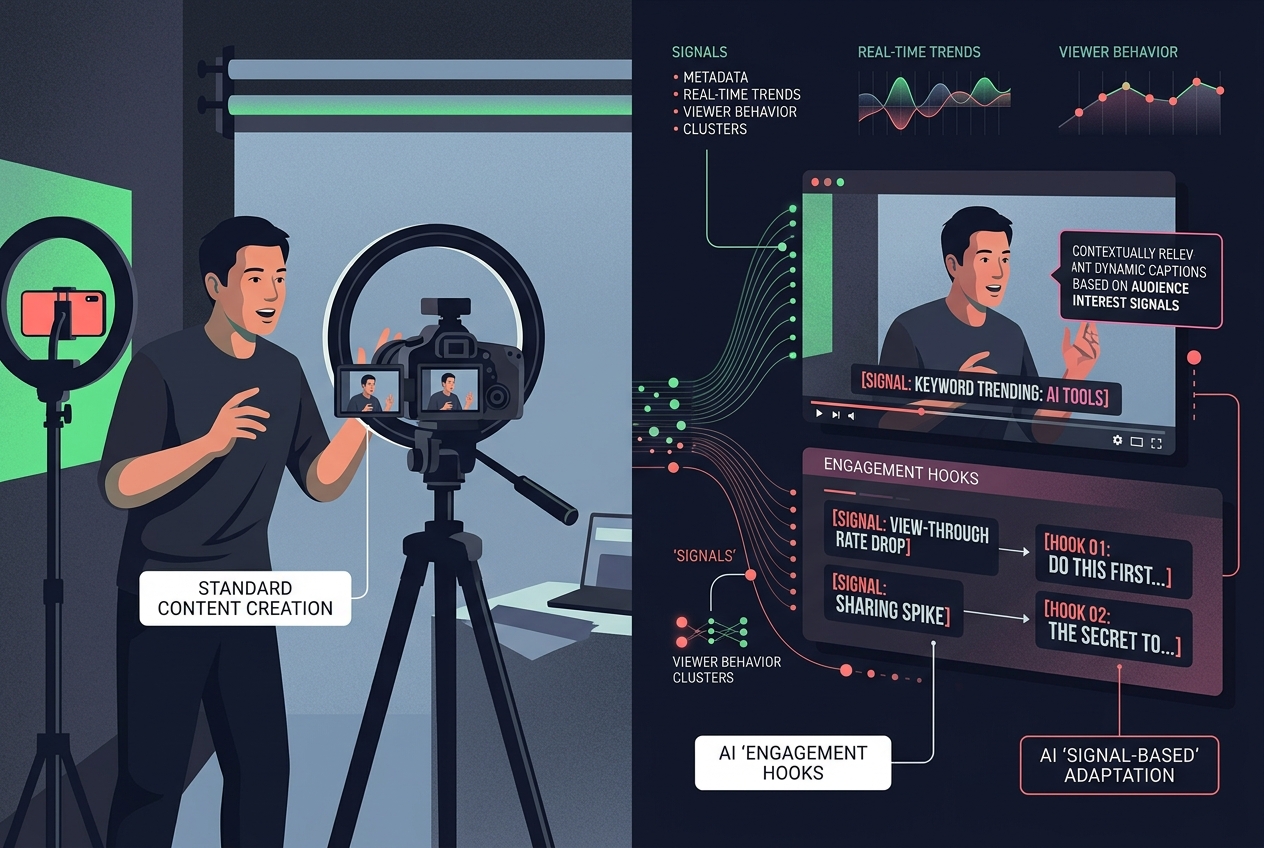
Common pitfall: Over-relying on AI-generated faces. Consumers in 2026 are increasingly sensitive to 'uncanny valley' content. Use AI for editing, captioning, and background manipulation, but keep the human element (your creators or employees) at the center of the frame.
Step 5: Validate via the TikTok Attribution Portfolio
How do you know this extra effort is working? In the past, we relied on 'Last-Click' attribution, which consistently undervalued social media's role in the discovery phase. TikTok’s new Attribution Portfolio, launched in mid-2026, aims to end this debate by providing a holistic view of the 'Signal-to-Sale' pipeline.
What to do: Tag your signal-based posts with a specific metadata tag in your CRM or social tool. After 30 days, run a report through the TikTok Attribution Portfolio to compare the 'Conversion Lift' of signal-based posts versus your 70% core content. Look specifically at 'Search Following View'—a metric that tracks how many people searched for your brand after seeing a reactive post.
Why it matters: Signal-based content is designed to meet search intent. If your data shows a spike in branded search immediately following a signal-based post, you have proven the ROI of your real-time strategy. This is the data you need to justify the 'Fast-Track' approval process to your C-suite.
Common pitfall: Measuring only immediate sales. Signal-based content often acts as a 'trust builder' that pays off three weeks later. Ensure your attribution window is set to at least 28 days to capture the full impact.
Three Related Tactics to Try Next
Once you have mastered the signal-based calendar, you can further optimize your presence with these advanced maneuvers:
- Creator-Led Signal Response: Instead of your brand account responding to a signal, ship the 'Signal Brief' to a whitelisted creator who can produce a 'Stitch' or 'Duet' within two hours. This adds third-party credibility to your real-time response.
- Automated Boost Rules: Set up rules in your ad manager (Meta or TikTok) to automatically put $500 behind any organic post that achieves a 2x higher-than-average 'Save' rate in its first hour. This ensures your best reactive content gets the reach it deserves before the signal fades.
- Search-First Scripting: Use the keywords found in TikTok's Search Hubs as the literal first three seconds of your video scripts. If the signal is 'how to fix a patchy beard,' your video must start with those exact words to satisfy the algorithm's SEO requirements.
Moving to a signal-based strategy is uncomfortable. It requires giving up the illusion of control that a 30-day calendar provides. But in an era where Google and TikTok are merging search and social into a single, AI-driven experience, 'planned relevance' is an oxymoron. Your calendar should be a map, not a script. Follow the signals, and the ROI will follow.
FAQ