

If you are asking "How much search volume does this keyword have?" you are already asking the wrong question. In 2024 and 2025, search volume was a proxy for potential traffic. In the current era of Large Language Models (LLMs) and Generative Search Experiences (GSE), that proxy is broken. If an AI can summarize your answer in a three-sentence paragraph, the search volume for that query is effectively zero for your brand's bottom line. The user got what they needed; they aren't clicking your link.
Why it matters: Marketers must shift from chasing raw volume to optimizing for "Click-Worthiness." This is the delta between a user who wants a quick fact (captured by AI) and a user who needs a deep-dive, a tool, or a transaction (captured by you). If you don't make this shift, your reporting will show high visibility but plummeting referral traffic.
Key takeaways
- Zero-click is the new baseline: Queries with high volume but low complexity are now entirely consumed by AI overviews.
- Complexity equals conversion: Click-worthiness lives in the "messy middle" where users need nuance, expert opinion, or interactive elements that an LLM cannot replicate.
- New Referral Strings: Tools like Perplexity, ChatGPT, and Claude are creating new attribution challenges that mimic the "oldest mistakes" in conversion optimization by obfuscating the true source of intent.
The Death of the Informational Query
For two decades, SEO was a game of volume. You found a high-volume keyword like "how to bake sourdough" and you wrote a 2,000-word post hoping to capture a fraction of those 50,000 monthly searches. Today, Google's AI Overview or a quick prompt to Perplexity gives the user the exact ratios and timing without them ever leaving the search interface. The volume is still there, but the click-worthiness is gone.
Think of search volume like the foot traffic outside a store. In the old days, everyone walking by had to come inside to see the price of a shirt. Now, the price is projected on the window in giant neon letters. People are still walking by (search volume), but they don't need to come inside (click) to get the information. Your job is no longer just to get them to the window; it's to offer something so compelling that the window display isn't enough.
This shift is causing a massive re-evaluation of content libraries. We've seen a trend where informational content—the kind that used to be the "top of funnel" darling—is seeing a 40-60% drop in click-through rates (CTR) even when rankings remain stable. If your strategy is still built on high-volume, low-intent keywords, you are effectively subsidizing the training data for the LLMs that are stealing your traffic.
Defining Click-Worthiness: The New Mental Model
Click-worthiness isn't a single metric you'll find in Semrush or Ahrefs yet. It is a qualitative assessment of whether a user's intent requires a destination. To understand this, we have to look at the "Complexity Gap."
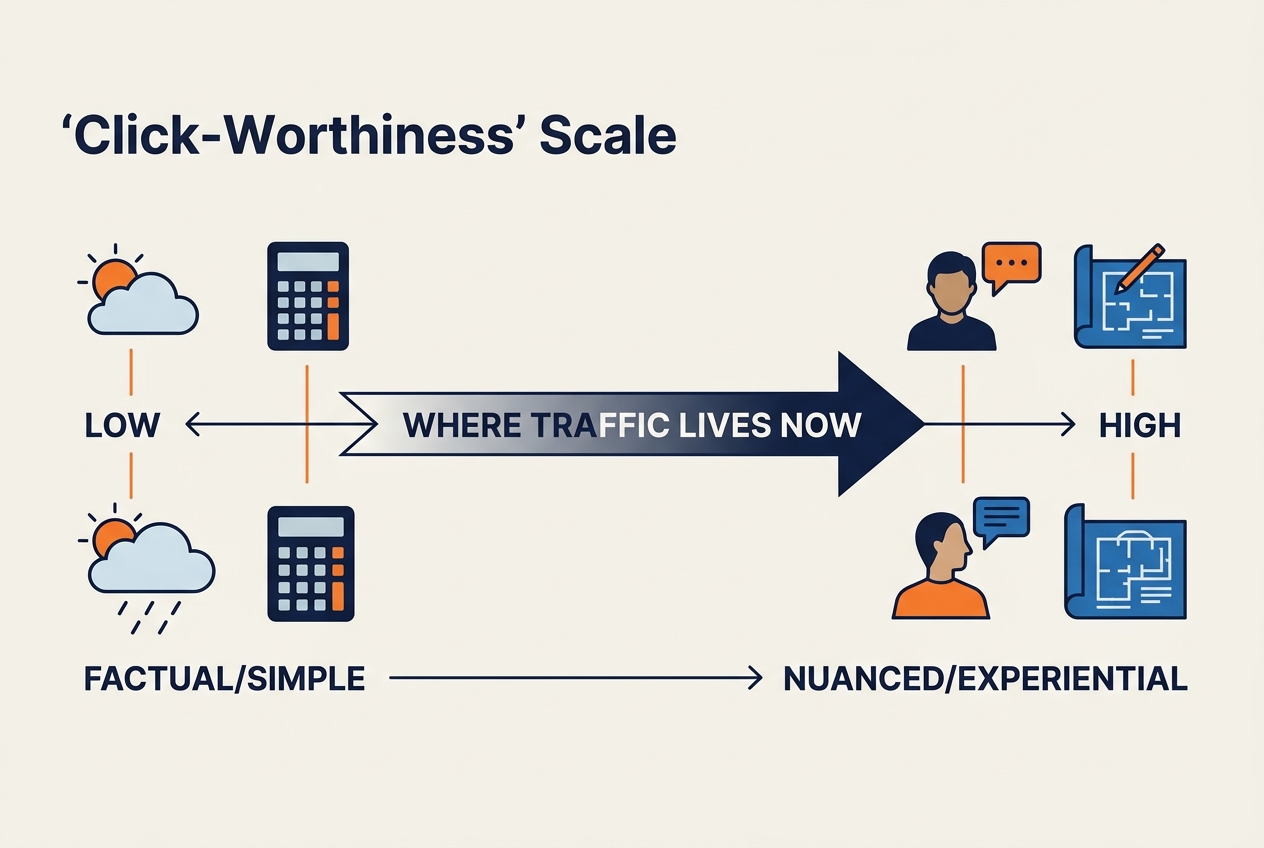
An AI is excellent at synthesis but poor at lived experience. If a user asks "What are the symptoms of a cold?", the AI wins. If a user asks "How did it feel to run my first marathon with asthma?", the user wants a human voice. They want the blog post. They want the video. That is click-worthy.
We categorize click-worthiness into three distinct buckets:
- Utility-Driven: The user needs a calculator, a template, or a downloadable asset. AI can describe a budget, but it can't be your living Excel sheet.
- Perspective-Driven: The user needs an opinion from a trusted source. This is why we've seen "Spider-Man: Brand New Day" break box office records by leaning into social-first marketing rather than traditional TV buys (per Adweek's August 2026 reporting). The audience wanted the vibe and the community consensus, not just the showtimes.
- Transaction-Driven: The user is ready to buy. While AI can recommend products, the actual checkout happens on your turf.
The AI Referral Trap: Recreating Old Mistakes
As Slobodan Manic recently noted in Search Engine Journal, AI referrals are currently recreating the "oldest mistake" in conversion optimization: focusing on the last touch without understanding the influence. When a user asks ChatGPT for a product recommendation and then clicks a link to your site, that traffic often shows up as "Direct" or with a generic referral string that doesn't capture the nuance of the prompt that led them there.
This is a measurement crisis. If you can't see the intent behind the AI referral, you can't optimize for it. We are seeing a return to the "dark social" era where attribution is more of an art than a science. To combat this, brand marketing leads are shifting budgets toward "LLM Visibility"—ensuring their brand is the one the AI cites—rather than just trying to rank #1 in a traditional SERP.
Furthermore, the leadership at the major players is shifting. With Google losing veterans like Jeff Dean to the more AI-centric DeepMind wing under Demis Hassabis, the priority has moved permanently away from "sending traffic to the web" and toward "answering the user's question." If the architects of search are no longer incentivized to provide clicks, marketers cannot rely on search volume as a growth metric.
How to Measure Intent in the LLM Era
If search volume is out, what is in? We suggest a three-pillar approach to measurement that prioritizes intent over eyeballs.
1. The Friction-to-Value Ratio
Measure how much effort a user has to put in to get the value. If an AI can provide 100% of the value with zero friction, your click-worthiness is zero. If your content provides 500% more value (through proprietary data, interactive tools, or exclusive video) but requires a click (friction), you have a viable strategy. Track the CTR of your high-ranking pages specifically against AI-summarized queries to find your "safe zones."
2. Share of Model (SoM)
Instead of Share of Voice (SoV) in search, start measuring Share of Model. Use tools like BrightEdge Generative Parser or manual prompting across GPT-4o, Claude 3.5, and Gemini to see how often your brand is cited in response to category-level prompts. If you have high SoM but low site traffic, your content is too "summarizable." You need to gate the "how-to" or the "why" behind a click-worthy hook.
3. Conversion Depth from AI Sources
Analyze the behavior of users who do come from AI referrers. Based on internal benchmarks from several mid-market agencies, AI-referred traffic often has a higher bounce rate but a higher conversion rate for specific high-intent actions. These users have already been "pre-sold" by the AI's summary. They aren't there to browse; they are there to execute. Optimize your landing pages for these "hot" leads rather than trying to re-educate them.

Strategy Pivot: From Answer-Provider to Experience-Provider
To survive the AI referral era, you must stop being an encyclopedia and start being a destination. This requires a fundamental shift in content production.
How to build a content moat in the age of generative AI
Look at the recent success of traditional media outlets like CBS and ABC news. Despite the digital onslaught, they've maintained or even grown their 25-54 demo ratings (per TVNewser's July 2026 data). Why? Because they provide a curated, human-led experience that people trust more than a sterile AI summary. They aren't just giving facts; they are giving context and personality.
For social media managers and creators, this means doubling down on "Proof of Human." AI can't go to a trade show, it can't unbox a physical product with genuine emotion, and it can't provide a first-hand account of a corporate turnaround. Martin Sorrell’s S4 Capital, for instance, is currently navigating a complex turnaround (per Adweek). An AI can summarize his earnings report, but it cannot capture the strategic intuition or the market sentiment that drives a 26% stock pop. That nuance is what your audience is willing to click for.
What This Means for Your Strategy Tomorrow
You don't need to delete your informational blog posts, but you do need to stop measuring their success by how many people land on them. Instead, use them as "AI Bait"—content designed to be ingested by LLMs so your brand is the one cited in the summary.
For your traffic-driving strategy, focus on the following:
- Proprietary Data: Conduct original research. AI can't hallucinate your internal Q3 survey results (yet).
- Interactive Tooling: Build the calculators, the graders, and the generators that provide a service, not just a sentence.
- Community and Voice: Lean into the creators who have a distinct point of view. People click for people, not for data points.
As the search landscape continues to fragment, the winners won't be those with the most "volume." They will be those who understand that in a world of infinite answers, the only thing worth a click is a meaningful experience.
Measuring social media ROI in a cookieless world
Stop reporting on search volume to your CMO. Start reporting on Click-Worthiness and Share of Model. That is where the actual revenue is hiding.
FAQ